A Sellafield nuclear disaster would spread across Cumbria – new map shows
|
Sellafield nuclear disaster would spread across Cumbria – new map shows, The Mail, By Staff Reporter 27 Sept 20, THE majority of south Cumbria could be affected if there was a major nuclear incident at Sellafield, a new report has revealed…….
Part of the new strategy means Outline Planning Zone’s must be put in place. These are areas outside of the immediate vacinity which could be affected by a disaster. A report from Steve Healey, the chief fire officer for Cumbria, revealed the affected area covers a 50-kilometre circular zone from an epicentre at Sellafield. The area includes as far south as Walney, east as Bowness and north almost to the Scottish border. Cumbria County Council has accepted the report at a meeting of the cabinet, which was chaired by Cllr Stewart Young….. This new concept of an Outlying Planning Zone is new. The zone is determined by kilometres from the centre of the Sellafield site. It takes you way beyond the boundaries of Copeland, showing that other areas of Cumbria would also be affected by a serious incident. “It includes BAE and the docks at Barrow. So, the implications of an accident are so significant for the whole county. It is a responsibility that sits then with Cumbria County Council as well as Barrow, Copeland and Allerdale. This is an important piece of work.” The new regulations allow for a transitional period of 12 months and all changes required to have been made by this May. The authority was on track to meet the deadlines until resources were diverted to respond to Covid-19. A plan has been agreed with the Office for Nuclear Regulation allowing the council to prepare the plans before November 21 this year. The report said Sellafield’s OPZ was the largest in the United Kingdom and whilst only outline planning is required there is a substantial amount of work being undertaken to identify vulnerable premises and infrastructure in the zone. ……… https://www.nwemail.co.uk/news/18752191.sellafield-nuclear-disaster-spread-across-cumbria—new-map-shows/ |
|
Satellite imagery shows North Korea’s Yongbyon Nuclear Center is drying off after breaching of overflow dam
 North Korea’s Yongbyon Nuclear Center: Drying Off, 38 NORTH BY: PETER MAKOWSKY, FRANK PABIAN, JACK LIU AND JENNY TOWN, SEPTEMBER 25, 2020 EXCELLENT SATELLITE IMAGERY
Commercial satellite imagery of the Yongbyon Nuclear Scientific Research Center from September 21 reveals minimal damage to the buildings throughout the complex, but notable damage along the river. Moreover, the breaching of the overflow dam, which regulates the water level of the river adjacent to the reactor area, raises a more serious concern about the ability to maintain a steady reservoir of water for the reactors when they may be operating in the future.
Additionally, substantial grain drying activities are observed throughout the complex and nearby town. While this is a common occurrence during the harvest season, the scale of what is taking place is well beyond what has been observed in previous years.
Reactor Area
There are no observable indications that the 5 MWe reactor is operating or that the Experimental Light Water Reactor (ELWR) has been started. Some vehicles are present around the 5 MWe reactor area, but this has become fairly common over the past year.
The typhoons, which recently impacted North Korea’s west coast, have once again shown the vulnerability of the reactors to seasonal flooding. This is despite the numerous measures taken to protect the site, including dredging along the riverbank to build up the embankments.
The eastern end of the reservoir dam has been breached, resulting in a dramatically lower water level behind the dam, a sharp contrast with the previously reported flooding. The reduced water level has left the two pumphouses servicing the reactors “high and dry,” with the water level above the dam down significantly and the intake cisterns exposed.
The inability to maintain a stable reservoir level, regardless of weather conditions, poses a potential problem for continuous reactor operations if the 5 MWe reactor is restarted or the ELWR is brought online.
Uranium Enrichment Plant (UEP)
At the Uranium Enrichment Plant, what appeared to be work on the cooling units in July to repair, replace or remove old units seems to have been suspended as post-typhoon clean up and repairs and harvest-related activities are currently underway.
Construction and clean-up on the nearby causeway and bridge continues. It appears that sections of the two man-made islands and channels that were damaged from previous flooding are undergoing repairs……. https://www.38north.org/2020/09/yongbyon092520/
Trump might abandon NEW START arms treaty, U.S. allies fear
 U.S. Allies Worry Trump Administration Might Let Key Nuclear Treaty With Russia Die
Internal documents acknowledge concern among allies about the expiration of the Obama-era New START accord, but U.S. negotiators are still playing hardball. Foreign Policy, BY JACK DETSCH, ROBBIE GRAMER SEPTEMBER 24, 2020, S. ALLIES ARE CONCERNED ABOUT THE REPERCUSSIONS OF THE LOOMING EXPIRATION OF THE OBAMA-ERA NEW START ARMS CONTROL TREATY BETWEEN THE UNITED STATES AND RUSSIA, ACCORDING TO AN INTERNAL ADMINISTRATION REPORT OBTAINED BY FOREIGN POLICY. MEANWHILE, FORMER OFFICIALS AND ARMS CONTROL EXPERTS WORRY THE ADMINISTRATION MAY BE SEEKING TO SLOW-WALK THE ACCORD TO DEATH BY MAKING IMPOSSIBLE DEMANDS OF RUSSIA JUST MONTHS BEFORE THE TREATY IS SLATED TO END.
The Trump administration faces a tight deadline to renew the 2010 New START Treaty, which slaps limits on the number of strategic launchers, such as intercontinental and submarine-launched ballistic missiles and heavy bombers that both nations can deploy. Unless both sides reach an agreement on an extension, it will end in February 2021, leaving no meaningful treaty to stave off the threat of an arms race. Top U.S. arms negotiator Marshall Billingslea appears to have temporarily set aside one condition already broadly dismissed as a nonstarter—adding China to the bilateral accord.
Still, he has insisted Beijing will have to be part of any agreement that would replace New START. “The next treaty will have to be multilateral, it will have to include China, and the framework that we are articulating together as two great powers, us and the Russians, will be the framework going forward that China will be expected to join,” Billingslea told reporters in a briefing last month.
In the meantime, U.S. officials have added other conditions: predicating a short-term extension of New START on expanded restrictions on Russia’s growing arsenal of tactical nuclear weapons.
So far, Russia hasn’t shown any inclination to go along with such preconditions for negotiating an extension of the treaty. As the clock winds down, U.S. allies in Europe and arms control experts fear New START might not be renewed.
In an internal State Department report for Congress, the Trump administration acknowledged that the United States’ closest allies are hoping to constrain Russia’s and China’s weapons programs. But the report also notes that allies are growing unnerved by the prospect of talks falling apart as Washington is distracted by a contested presidential election. ……..
Though Billingslea has tried to push the Russians to accept more weapons inspections, there is concern among experts that the United States would also lose vital intelligence into Russian nuclear modernization if the deal lapses. ……. https://foreignpolicy.com/2020/09/24/trump-putin-russia-new-start-nuclear-arms-control-u-s-allies-worry-trump-administration-might-let-key-nuclear-treaty-with-russia-die/
French taxpayers don’t want to pay for Sizewell nuclear station, neither do British.
 France’s EDF demands clarity on British nuclear power plans Times John Collingridge 27 Sept 20, French energy giant EDF is set for a showdown with the Treasury over state funding for nuclear power stations as Britain’s atomic future faces a make-or-break moment.Jean-Bernard Lévy, chairman and chief executive of Électricité de France, will speak to chancellor Rishi Sunak via video link on Wednesday to demand clarity over Britain’s plans for funding nuclear power.
The industry was left reeling this month when Japan’s Hitachi quit its Horizon project to build a £20bn plant on Anglesey.
That shock retreat, after years of prevarication by Westminster over state support for nuclear power and turmoil in the Japanese nuclear industry, left only EDF and China General Nuclear with plans for atomic power stations in the UK.
EDF and China are building the delayed and over-budget £22.5bn Hinkley Point C power station in Somerset, but Paris has balked at
the prospect of French taxpayers funding the next nuclear project in Britain.
Instead, EDF, which is 84% owned by the French state, wants British taxpayers to underwrite a new plant at Sizewell in Suffolk. A
proposed new financial structure, the regulated asset base, would levy a tax on UK household energy bills to help pay for the project.
Other options include the British government taking a stake — although that has worried the Treasury, which is anxious about adding to its debt mountain.
EDF declined to comment. With most of Britain’s ageing reactors due to close by the end of the decade, Sunak and Boris Johnson face the dilemma of whether to fund more big nuclear plants, or rely on wind, solar, gas, small reactors and imported power to keep the lights on.
The American government has warned Hitachi against selling the Anglesey site to China, and is understood to be considering bankrolling US companies to take it over. Westinghouse, which makes the AP1000 nuclear plant, and NuScale Power,
which is developing small, modular reactors, are both believed to be
exploring options for the site. South Korea’s Kepco is also understood to
be interested, as is EDF.
Former UK Energy Minister Sir Ed Davey says new Sizewell nuclear station is too expensive
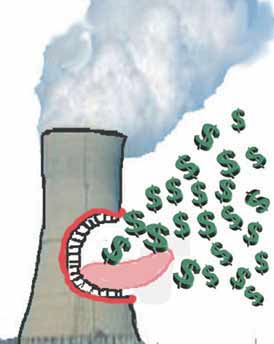 Suffolk’s Sizewell C too expensive, says Sir Ed Davey, BBC, By Vikki Irwin & Chris Bond
28 Sept 20, Former energy secretary Sir Ed Davey has said building a new nuclear power station at Sizewell is “too expensive”.
Suffolk businesses oppose the building of Sizewell nuclear power station
 More than 100 rural Suffolk businesses have written to the Government to
oppose the building of a twin reactor nuclear power station. The letter,
which was addressed to Prime Minister and the Secretary of State for
Business, Energy and Industrial Strategy Alok Sharma amongst others, raised
concerns about the site.
It has attracted signatures from almost 150
individual businesses, farms and landowners in the area. In the letter they
describe the nuclear power station as a “threat” which had been hanging
over their heads for at least eight years. “This would be tolerable if
the Sizewell C project was for the ‘greater good’,” read the letter.
“But we have concluded that it is not necessary to meet the UK’s
commitment to net zero, and would be a slow, risky and expensive waste of
taxpayers’ money that removes opportunities to make use of alternative,
green, deliverable and cost-effective energy solutions. “Meanwhile, many
of our plans are on hold at a time when farming faces the biggest changes
to the policy framework governing our industry in over 50 years.” The
letter also raised concerns about the impact on farm production which
owners say could “render productive land commercially and logistically
unviable”.
https://www.eadt.co.uk/news/sizewell-c-construction-opposed-by-suffolk-businesses-1-685656
As fossil fuel jobs falter, renewables come to the rescue
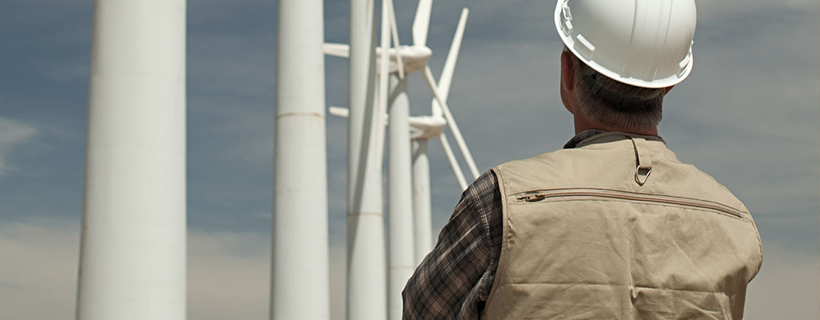 As fossil fuel jobs falter, renewables come to the rescue, BY JEFF BERARDELLI CBS News, SEPTEMBER 25, 2020 In 2011, Don Williams made the long trip from Michigan to North Dakota hoping to capitalize on the Bakken oil boom — to, as he says, “chase oil and make quick cash.” It paid off; for years Williams worked in operations on the oil fields, watching over production and maintaining pump jacks.
To say that Williams worked hard would be an understatement. Putting in 12-hour days, 7 days a week — 84-hour work-weeks were typical. And the work was lucrative. The money flowed as fast as the oil did — until it didn’t. In May, Williams was laid off, along with most of the Bakken workforce, when boom went bust.
But within a week, he made a huge career leap — 300 feet up, to be exact — ascending from the firm grounds of the Bakken Oil Fields to the top of a giant wind turbine to take part in a 12-week training course to become a wind energy technician. In his words, he no longer wanted to “ride the oil waves, the highs and lows,” anymore.
While the jobs are on opposite ends of the energy spectrum — from dirty to clean and from old to new — the mechanical skills Williams gained from his time working in oil helped him navigate the career transition. And lately, many ex-oil workers are taking that same leap in hopes of finding long-term stability — something that is becoming scarcer in fossil fuels.
In the past year, two seismic shocks — a price war between Russia and Saudi Arabia, followed by global pandemic lockdowns — tanked oil demand and prices too, devastating oil and gas production in the Bakken Formation.
From June 2019 through June 2020, U.S. crude oil production fell 38% and natural gas production fell 31%. The unemployment rate in North Dakota rose to 11.3% in June. For the month of August, continued claims of unemployment in North Dakota were nearly 100,000, and about a quarter of those were tied directly to mining, quarrying and oil & gas extraction — the highest unemployment of any sector in the state.
But as luck would have it, fossil fuels aren’t the only energy source North Dakota is rich in. With an average wind speed of 20 mph 300 feet above the ground where the wind turbines churn, North Dakota is prime real estate for wind power. It ranks 10th in wind production in the U.S. with more than 3,000 megawatts (MW) of installed capacity.
Williams says he sees evidence of a renewable revolution right in his backyard, with wind turbines popping up all around his community.
He received his wind technician training at Lake Region State College, a couple hours’ drive east from the Bakken oil fields. To earn a one-year college credit certificate, the cost of the course is about $5,000. Less than a month out of the training program, Williams has already landed a wind technician job at Gemini Energy Services.
Although he says the starting salary does not quite measure up to what the oil fields paid, the trade-off of more time with his family and more stability is well worth it to him. Besides, he’s optimistic about his future financial prospects because he says the industry offers a lot of upward mobility and areas to specialize in…….. https://www.cbsnews.com/news/renewable-energy-jobs-replacing-fossil-fuel-jobs-oil-wind/?fbclid=IwAR1aPeyOQTnh5UlpQKkRvonfkMOxT4cFwLn7uYMO-T1ckd-ldGCkOGlNNeU
Russia’s nuclear-powered ice-breakers lead towards military domination of the Arctic
Russia’s Nuclear-Powered Icebreaker Is a Step Toward Military Domination
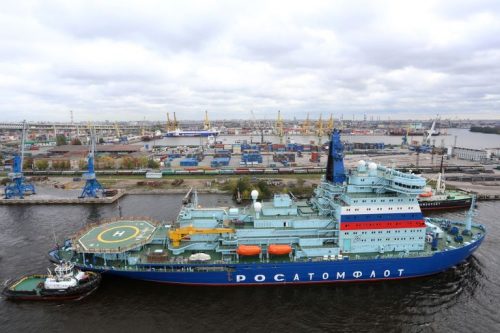
The country is fast becoming an icebreaking superpower. BY KYLE MIZOKAMI, SEP 24, 2020 Russia’s newest icebreaker, the  nuclear-powered Arktika, is headed to its new homeport in St. Petersburg, Russia. The ship, painted in the colors of the Russian state flag, will operate north of the Arctic Circle in anticipation of a year-round shipping route across the icy far north. Arktika is part of Moscow’s emerging policy of exploiting a warming arctic region—and protecting its stake in the region from competitors.
- Russia’s first new nuclear-powered icebreaker in decades, Arktika, is joining the country’s large fleet of icebreaking ships.
- Arktika is capable of smashing through ice that’s nearly 10 feet thick.<
- Millions of Russians live above the Arctic Circle, and warming ocean temperatures could create ice-free shortcuts between Asia and Europe.Russia’s newest icebreaker, the nuclear-powered Arktika, is headed to its new homeport in St. Petersburg, Russia. The ship, painted in the colors of the Russian state flag, will operate north of the Arctic Circle in anticipation of a year-round shipping route across the icy far north. Arktika is part of Moscow’s emerging policy of exploiting a warming arctic region—and protecting its stake in the region from competitors.
<Arktika is the first of a new class of nuclear-powered icebreakers. Construction began at the Baltic Shipyards in St. Petersburg in 2012 with a scheduled launch in 2017, but delays pushed the completion back to 2020. This past February, a short circuit damaged one of the ship’s three 300-ton electric motors, disabling one of the three propellers. Russian authorities ordered the ship to continue, however, and the ship is currently moving on just two propellers.
In 2019, Russian President Vladimir Putin announced the country would ultimately have a fleet of 13 icebreakers, the majority of them nuclear-powered. …………..
Iceabreakers like Arktika could also allow Russia to militarily dominate the Northern Sea Route, smashing a route for Russian warships and transports full of Russian Marines. Warming temperatures will mean other countries, such as Canada and the U.S., will likely move to unlock natural resources previously trapped under sheets of sea ice, and Russia will be in a position to threaten oil, gas, and mineral exploration and exploitation…………. https://www.popularmechanics.com/military/navy-ships/a34128219/russia-nuclear-powered-icebreaker-arktika/
Media avoids covering the Assange extradition – despite it being the media “trial of the century”
 Julian Assange: Press Shows Little Interest in Media ‘Trial of Century’ https://fair.org/home/julian-assange-press-shows-little-interest-in-media-trial-of-century/, ALAN MACLEOD 25 Sept 20,
Labeled the media “trial of the century,” WikiLeaks founder Julian Assange’s extradition hearing is currently taking place in London—although you might not have heard if you’re relying solely on corporate media for news. If extradited, Assange faces 175 years in a Colorado supermax prison, often described as a “black site” on US soil.
The United States government is asking Britain to send the Australian publisher to the US to face charges under the 1917 Espionage Act. He is accused of aiding and encouraging Chelsea Manning to hack a US government computer in order to publish hundreds of thousands of documents detailing American war crimes, particularly in Afghanistan and Iraq. The extradition, widely viewed as politically motivated, has profound consequences for journalists worldwide, as the ruling could effectively criminalize the possession of leaked documents, which are an indispensable part of investigative reporting.
WikiLeaks has entered into partnership with five high-profile outlets around the world: the New York Times, Guardian (UK), Le Monde (France), Der Spiegel (Germany) and El País (Spain). Yet those publications have provided relatively little coverage of the hearing.
Since the hearing began on September 7, the Times, for instance, has published only two bland news articles (9/7/20, 9/16/20)—one of them purely about the technical difficulties in the courtroom—along with a short rehosted AP video (9/7/20). There have been no editorials and no commentary on what the case means for journalism. The Times also appears to be distancing itself from Assange, with neither article noting that it was one of WikiLeaks’ five major partners in leaking information that became known as the CableGate scandal.
The Guardian, whose headquarters are less than two miles from the Old Bailey courthouse where Assange’s hearing is being held, fared slightly better in terms of quantity, publishing eight articles since September 7.However, perhaps the most notable content came from columnist Hadley Freedman (9/9/20).
When asked in an advice article: “We live in a time of so much insecurity. But is there anything we can expect from this increasingly ominous-looking winter with any certainty?” she went on a bizarre tangential rant ridiculing the idea that Assange’s trial could possibly be “politicized,” also crassly brushing off the idea that his young children would never see their father again, and never answering anything like the question she was asked. Holding people to account “for a mess they could have avoided,” she notes, “is not ‘weaponizing’ anything — it is just asking them to do their jobs properly.” She also claimed that believing Assange’s trial was politicized was as ridiculous as thinking antisemitism claims were cynically weaponized against Labour leader Jeremy Corbyn, which, she meant to suggest, was a preposterous idea. This was not an off-the-cuff remark transcribed and published, but a written piece that somehow made it past at least one editor.
Like the Times, the Guardian appeared to be hoping to let people forget the fact it built its worldwide brand off its partnership with WikiLeaks; it was only mentioned in a forthright op-ed by former Brazilian president Lula da Silva (9/21/20), an outlier piece.
The Guardian should be taking a particularly keen role in the affair, seeing that two of its journalists are alleged by WikiLeaks to have recklessly and knowingly disclosed the password to an encrypted file containing a quarter-million unredacted WikiLeaks documents, allowing anyone—including every security agency in the world—to see an unredacted iteration of the leak. In 2018, the Guardian also falsely reported that Trump campaign chief Paul Manafort had conducted a meeting with Assange and unnamed “Russians” at the Ecuadorian embassy (FAIR.org, 12/3/18). And, as former employee Jonathan Cook noted, the newspaper is continually being cited by the prosecution inside the courtroom.
There were only two articles in the English or French versions of Le Monde (9/7/20, 9/18/20) and only one in either of Der Spiegel’s English or German websites (9/7/20), although the German paper did at least acknowledge its own partnership with Assange. There was no coverage of the hearings in El País, in English or Spanish, though there was a piece (9/10/20) about the US government thwarting a Spanish investigation into the CIA spying on Assange at the Ecuadorian embassy in London—accompanied by a photo of a protester against his extradition.
The rest of corporate media showed as little interest in covering a defining moment in press freedom. There was nothing at all from CNN. CBS’s two articles (9/7/20, 9/22/20) were copied and pasted from news agencies AP and AFP, respectively. Meanwhile, the entire sum of MSNBC’s coverage amounted to one unclear sentence in a mini news roundup article (9/18/20).
Virtually every relevant human rights and press freedom organization is sounding the alarm about the incendiary precedent this case sets for the media. The Columbia Journalism Review (4/18/19), Human Rights Watch and the Electronic Frontier Foundation note that the government includes in its indictment regular journalistic procedures, such as protecting sources’ names and using encrypted files—meaning that this “hacking” charge could easily be extended to other journalists. Trevor Timm, founder of the Freedom of the Press Foundation, told the court this week that if the US prosecutes Assange, every journalist who has possessed a secret file can be criminalized. Thus, it essentially gives a carte blanche to those in power to prosecute whomever they want, whenever they want, even foreigners living halfway around the world.
The United Nations has condemned his persecution, with Amnesty International describing the case as a “full-scale assault on the right to freedom of expression.” Virtually every story of national significance includes secret or leaked material; they could all be in jeopardy under this new prosecutorial theory.
President Donald Trump has continually fanned the flames, demonizing the media as the “enemy of the people.” Already 26% of the country (including 43% of Republicans) believe the president should have the power to shut down outlets engaging in “bad behavior.” A successful Assange prosecution could be the legal spark for future anti-journalistic actions.
Yet the case has been met with indifference from the corporate press. Even as their house is burning down, media are insisting it is just the Northern Lights.
Essential points from the 2020 World Nuclear Industry Status Report
Three takeaways from the 2020 World Nuclear Industry Status Report, https://thebulletin.org/2020/09/three-takeaways-from-the-2020-world-nuclear-industry-status-report/
John Krzyzaniak The size of the global nuclear fleet has been stagnant for 30 years, and last year was no different. According to the 2020 World Nuclear Industry Status Report, released Thursday, there were 408 nuclear reactors online across the world as of July 1, 2020—a decline of nine units since the middle of last year and roughly on par with the number of reactors in operation in 1988.
The bulky 361-page industry report was compiled by an international team of independent experts led by Mycle Schneider, a consultant based in Paris. Over the last 15 years, it has become well-known for offering accurate but often sobering assessments of the state of nuclear energy across the globe. Last year, Schneider pointedly asserted that “the world is experiencing an undeclared ‘organic’ nuclear phaseout.”
Although the 2020 report is overflowing with data, several key trends stand out.
First, although the raw number of worldwide reactors is well below its all-time high of 438, their actual combined electricity generation came close to setting a record. As a whole, they generated 2,657 terawatt-hours of electricity in 2019, only three terawatt-hours below the historic peak in 2006. The United States, Russia, and China all hit individual country records for total electricity production from nuclear energy. Nevertheless, nuclear energy’s share of the energy market is in long-term decline, as other forms of energy witness rapid expansion.
Second, China continues to be the main driver of new nuclear energy, but over the long term its intentions are uncertain. The number of new projects there appears to be slowing. Whereas two years ago there were 20 units under construction, today there are only 15. Moreover, China missed its nuclear energy goals for 2020 by a sizeable margin: It planned to have 58 gigawatts of installed nuclear capacity and 30 more gigawatts under construction, but it currently has about 45 gigawatts capacity online and only 14 more under construction.
Third, reactor construction delays and cost overruns continue to plague the nuclear industry and, notably, early indications suggest that small modular reactors may be no exception.
For 63 reactors that came online worldwide between 2010 and 2019, the mean construction time was 10 years. Tennessee’s Watts Bar Unit 2, which took more than 43 years from construction start to grid connection, was the only reactor completed in the United States during that time period. But even in China, where average construction times were among the lowest, delays were widespread, and in many cases the real construction times were double the initial expectations.
While small modular reactors exist mostly on paper, there are many companies hoping to change that, promising units that are safer, cheaper, and faster to build. Last month, the US Nuclear Regulatory Commission approved a small modular reactor design submitted by a company called NuScale Power. Though several hurdles remain, NuScale plans to build its first reactor at the site of the Idaho National Laboratory and supply power to Utah Associated Municipal Power Systems as early as 2029.
But other countries’ recent experiences, detailed in the report, point to the difficulties ahead. Russia brought two small reactors online in 2019, but these took over 12 years to build, and at a cost about six times as much as the original estimates. These are the famed floating reactors of the Akademik-Lomonosov—they’re literally installed on a large ship, and that complication almost certainly contributed to the delays and high costs.
But there are more comparable examples for NuScale. The CAREM-25, a 25-megawatt prototype small modular reactor in Argentina, was supposed to receive its first fuel load in 2017 but is at least three years behind schedule. Similarly, China’s High Temperature Reactor project is running four years behind schedule and, while China originally planned to build 18 more of these smaller reactors, the report suggests its appetite may be sated after just one.
That means if countries want to wean themselves off of fossil fuels and stave off the worst effects of climate change, they may need to look elsewhere. And, the report suggests, they already are. The world added 184 gigawatts of non-hydro renewable capacity in 2019, a stark contrast to the 8-gigawatt decline in nuclear capacity.
Importing of increased amounts of uranium hexafluoride to Russia – illegal and dangerous
 Moscow Times 23rd Sept 2020, A series of toxic radioactive waste shipments to Russia from Germany is likely importing more waste than officially declared, Greenpeace Russia said Tuesday. European enrichment firm Urenco resumed exports of uranium
hexafluoride, a waste product known as “tails,” last year after a 10-year pause initiated by Russia’s state nuclear agency Rosatom due to storage safety concerns. The shipments have sparked outcry from environmental activists, who say importing nuclear waste is illegal and threatens human and environmental safety.
Dirty and devilishly dangerous – the aging Diablo Canyon nuclear station
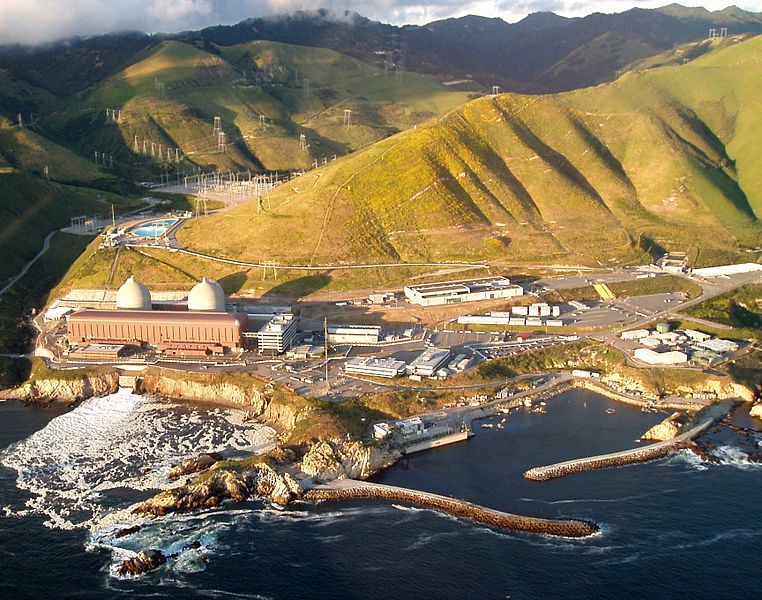
And If You Don’t Know, Now You Know, https://www.independent.com/2020/09/24/all-about-diablo-canyon-nuclear-plant/ David Weisman, 24 Sept 20,
|
Absent annoyances like the Alliance for Nuclear Responsibility (A4NR) and allies, it appears that regulators, elected officials, and the press have their COVID-19 facemasks pulled up over their eyes. With no shortage of crises — pandemics, wildfires, social injustice — plaguing 2020 so far, some long-simmering nuclear shortcuts are slipping under the radar. PG&E, which pled guilty to 84 cases of manslaughter this past spring, has been banking on regulatory inattention to increase profits while ignoring risks to residents and ratepayers from its
|
Latest World Nuclear Industry Status Report shows high levelised cost of nuclear power
|
The latest edition of the World Nuclear Industry Status Report indicates the stagnation of the sector continues. Just 2.4 GW of new nuclear generation capacity came online last year, compared to 98 GW of solar. The world’s operational nuclear power capacity had declined by 2.1%, to 362 GW, at the end of June. https://www.pv-magazine-australia.com/2020/09/25/nuclear-power-is-now-the-most-expensive-form-of-generation-except-for-gas-peaking-plants/ SEPTEMBER 25, 2020 EMILIANO BELLINI From pv magazine Global.
The levelized cost of energy (LCOE) from nuclear power rose from around $117/MWh in 2015 to $155 at the end of last year, according to the latest edition of the World Nuclear Industry Status Report, published annually by French nuclear consultant Mycle Schneider. By contrast, the LCOE from solar power decreased from $65/MWh to approximately $49 and that of wind from $55 to $41. “What is remarkable about these trends, is that the costs of renewables continue to fall due to incremental manufacturing and installation improvements while nuclear, despite over half a century of industrial experience, continues to see costs rising,” stated the report, citing a recent study from financial advisory and asset management firm Lazard. “Nuclear power is now the most expensive form of generation, except for gas peaking plants,” added the study, which did not provide an LCOE for gas peaker generation. The cost difference is having a huge impact in new generation capacity deployment, with just 2.4 GW of new nuclear plants installed last year, compared to 98 GW of solar and 59.2 GW of wind, according to the report. The world’s operational nuclear capacity fell 2.1% to 362 GW by the end of June. “The number of operating reactors in the world has dropped … to 408 as of mid-2020, that is below the level already reached in 1988 and 30 units below the historic peak of 438 in 2002,” the study reported. Six nuclear reactors were grid-connected last year: three in Russia, two in China and one in South Korea. At the same time, five nuclear plants closed last year and three more were shuttered in the first half of this year, with no nuclear facilities added from January to June. An additional eight facilities, which had ceased operations, were decommissioned in 2019. “The ‘big five’ nuclear generating countries – by rank: the United States, France, China, Russia and South Korea – again generated 70% of all nuclear electricity in the world in 2019,” the report stated. “Two countries, the U.S. and France, accounted for 45% of 2019 global nuclear production, that is two percentage points lower than in the previous year, as France’s output shrank by 3.5%.” The report added, the average age of the world’s nuclear reactor fleet has reached 30.7 years, with two-thirds of reactors operating for more than 31 years. The number of reactors under construction rose from 46 to 52 – of which 15, with a total generation capacity of 14 GW, are in China. Most of those projects, however, have suffered years-long delays. Last year, construction started on four plants in China and one each in Russia and the U.K. and work began on a Turkish nuclear plant in the first half of this year. “The ‘big five’ nuclear generating countries – by rank: the United States, France, China, Russia and South Korea – again generated 70% of all nuclear electricity in the world in 2019,” the report stated. “Two countries, the U.S. and France, accounted for 45% of 2019 global nuclear production, that is two percentage points lower than in the previous year, as France’s output shrank by 3.5%.” The report added, the average age of the world’s nuclear reactor fleet has reached 30.7 years, with two-thirds of reactors operating for more than 31 years. The number of reactors under construction rose from 46 to 52 – of which 15, with a total generation capacity of 14 GW, are in China. Most of those projects, however, have suffered years-long delays. Last year, construction started on four plants in China and one each in Russia and the U.K. and work began on a Turkish nuclear plant in the first half of this year. |
|
Canada to splurge $billions on non-existent small nuclear reactors, ineffective and no use against climate change
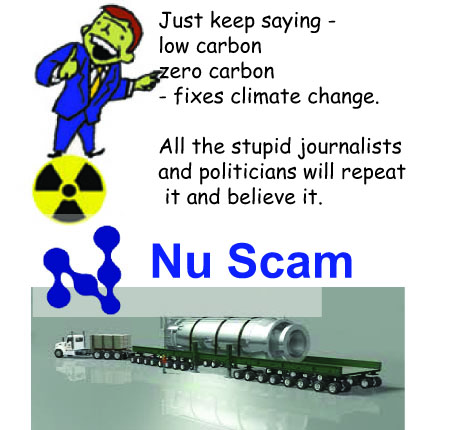 GIBBONS: Nuclear power no solution to climate change https://torontosun.com/opinion/columnists/gibbons-nuclear-power-no-solution-to-climate-change, Author of the article:, Jack Gibbons, Sep 25, 2020 At a time when action on climate change has never been more urgent, the federal Liberals want to throw billions of dollars at non-existent technology that will not make a difference for decades, if ever.
But that’s pretty much the way things have always been when it comes to federal spending on nuclear power: As long as the word “nuclear” is attached, we put common sense aside and fund projects that lead to one dead end after another.
More than $400 million for Advanced CANDU reactors that never got built? You bet. Another $600 million on the infamous Maple medical isotope reactor design, which proved unsafe to operate? No problem.
Now the industry’s latest pitch is Small Modular Reactors (SMRs) and off we go on another wild goose chase with Minister of Natural Resources Seamus O’Regan once again promising billions for technology that is nowhere in sight, let alone use.
Meanwhile, costs for wind and solar have plunged to the point where these energy sources are now outcompeting even natural gas.
Nuclear, for its part, is fading fast. Due to its high costs and safety concerns, nuclear’s share of the world electricity market has cratered in the past two decades. More places are now retiring aging reactors than building them.
The nuclear industry loves to claim they are a critical climate change solution — except on a cost per tonne basis.
Nuclear is like buying a Mercedes to go to the corner store.
Ontario pays as little as two cents a kilowatt hour (kWh) for energy efficient improvements that could displace the need for nuclear while reducing greenhouse gas pollution.
Alberta is now paying around five cents per kWh for solar and four cents for wind.
Ontario Power Generation says it will need to be paid 16.5 cents per kWh for nuclear by 2025.
A whole lot has changed since the bad old days of Ontario’s Green Energy Act.
Yes, the sun doesn’t always shine or the wind blow. Which is why it is fortunate that in Ontario we live beside a giant battery.
Quebec has an enormous water-power reservoir system that Hydro Quebec is keen to integrate with renewable sources for its out-of-province customers.
When we have surplus solar and wind, Quebec stores water. When not, it produces hydro power for export.
We have the connections necessary to make this system work and can expand them at a cost that looks like spare change next to what it costs to rebuild a nuclear reactor or get an SMR prototype built.
The nuclear industry is grasping at straws. Its technology is obsolete, its promises unfulfilled and its costs ever rising.
Betting on nuclear as a climate solution is just sticking our heads in the sand because SMR technology is decades away, extremely expensive, and comes with a nasty pile of security and waste headaches. Yes. Virginia, SMRs still produce lots of highly radioactive waste and we still have no place to put the stuff.
That our government would be this gullible is distressing, especially given the havoc already being wreaked by a changing climate.
We have simple, affordable, reliable and truly clean answers to our climate problem at our fingertips.
Yet our government sits and waits for the nuclear industry to call with some good news. And the phone never rings.
— Jack Gibbons is chairman of the Ontario Clean Air Alliance
Trump Appoints Pair of Climate Science Deniers to National Oceanic and Atmospheric Administration (NOAA While Climate-Fueled Fires and Storms Rage
|
The White House has made a pair of controversial appointments to the National Oceanic and Atmospheric Administration (NOAA), positioning within the climate science agency two individuals who consistently misrepresent and disagree with the scientific consensus on various issues concerning climate change and who have notable ties with conservative think tanks that disseminate climate science denial. As the Washington Post first reported this week, President Trump is naming Ryan Maue to the role of chief scientist at NOAA, a position that will help enforce its scientific integrity process. Maue is a meteorologist who has downplayed the degree and impacts of global warming, particularly ties between extreme weather events and human-caused climate change, and he has a past connection with the Cato Institute. Maue’s appointment follows the White House’s appointment last week of climate science denier David Legates as NOAA’s deputy assistant secretary of commerce for observation and prediction. Legates refutes the well-established scientific understanding that human activity is causing climate breakdown and he is affiliated with the Heartland Institute, which has and continues to traffic in climate denial and disinformation……. These appointments of climate science deniers to NOAA — the agency charged with monitoring changes in the climate system and informing Americans on this science — come at a time when there is rising concern over the Trump administration’s embrace of pseudoscience and apparent attempts to interfere with or attack nonpartisan scientific and public health agencies like NOAA, the Environmental Protection Agency (EPA), the Food and Drug Administration (FDA), and the Centers for Disease Control and Prevention (CDC). A study published in April surveying federal scientists found a perceived loss of scientific integrity under the Trump administration. The new NOAA appointments also arrive as climate-fueled disasters such as unprecedented wildfires and a litany of tropical storms and hurricanes have roiled the nation. It is therefore worth taking a closer look at the backgrounds of these two individuals questioning mainstream climate science………….https://www.desmogblog.com/2020/09/24/trump-noaa-david-legates-ryan-maue-climate-denial?utm_source=DeSmog%20Weekly%20Newsletter |
|
|

1 This Month



Website of the Week
Now until to February 10, 2026 Radioactive waste storage in France: the debate is finally open! How to participate?
-
Archives
- January 2026 (172)
- December 2025 (358)
- November 2025 (359)
- October 2025 (377)
- September 2025 (258)
- August 2025 (319)
- July 2025 (230)
- June 2025 (348)
- May 2025 (261)
- April 2025 (305)
- March 2025 (319)
- February 2025 (234)
-
Categories
- 1
- 1 NUCLEAR ISSUES
- business and costs
- climate change
- culture and arts
- ENERGY
- environment
- health
- history
- indigenous issues
- Legal
- marketing of nuclear
- media
- opposition to nuclear
- PERSONAL STORIES
- politics
- politics international
- Religion and ethics
- safety
- secrets,lies and civil liberties
- spinbuster
- technology
- Uranium
- wastes
- weapons and war
- Women
- 2 WORLD
- ACTION
- AFRICA
- Atrocities
- AUSTRALIA
- Christina's notes
- Christina's themes
- culture and arts
- Events
- Fuk 2022
- Fuk 2023
- Fukushima 2017
- Fukushima 2018
- fukushima 2019
- Fukushima 2020
- Fukushima 2021
- general
- global warming
- Humour (God we need it)
- Nuclear
- RARE EARTHS
- Reference
- resources – print
- Resources -audiovicual
- Weekly Newsletter
- World
- World Nuclear
- YouTube
-
RSS
Entries RSS
Comments RSS
 nuclear-news