Trump might abandon NEW START arms treaty, U.S. allies fear
 U.S. Allies Worry Trump Administration Might Let Key Nuclear Treaty With Russia Die
Internal documents acknowledge concern among allies about the expiration of the Obama-era New START accord, but U.S. negotiators are still playing hardball. Foreign Policy, BY JACK DETSCH, ROBBIE GRAMER SEPTEMBER 24, 2020, S. ALLIES ARE CONCERNED ABOUT THE REPERCUSSIONS OF THE LOOMING EXPIRATION OF THE OBAMA-ERA NEW START ARMS CONTROL TREATY BETWEEN THE UNITED STATES AND RUSSIA, ACCORDING TO AN INTERNAL ADMINISTRATION REPORT OBTAINED BY FOREIGN POLICY. MEANWHILE, FORMER OFFICIALS AND ARMS CONTROL EXPERTS WORRY THE ADMINISTRATION MAY BE SEEKING TO SLOW-WALK THE ACCORD TO DEATH BY MAKING IMPOSSIBLE DEMANDS OF RUSSIA JUST MONTHS BEFORE THE TREATY IS SLATED TO END.
The Trump administration faces a tight deadline to renew the 2010 New START Treaty, which slaps limits on the number of strategic launchers, such as intercontinental and submarine-launched ballistic missiles and heavy bombers that both nations can deploy. Unless both sides reach an agreement on an extension, it will end in February 2021, leaving no meaningful treaty to stave off the threat of an arms race. Top U.S. arms negotiator Marshall Billingslea appears to have temporarily set aside one condition already broadly dismissed as a nonstarter—adding China to the bilateral accord.
Still, he has insisted Beijing will have to be part of any agreement that would replace New START. “The next treaty will have to be multilateral, it will have to include China, and the framework that we are articulating together as two great powers, us and the Russians, will be the framework going forward that China will be expected to join,” Billingslea told reporters in a briefing last month.
In the meantime, U.S. officials have added other conditions: predicating a short-term extension of New START on expanded restrictions on Russia’s growing arsenal of tactical nuclear weapons.
So far, Russia hasn’t shown any inclination to go along with such preconditions for negotiating an extension of the treaty. As the clock winds down, U.S. allies in Europe and arms control experts fear New START might not be renewed.
In an internal State Department report for Congress, the Trump administration acknowledged that the United States’ closest allies are hoping to constrain Russia’s and China’s weapons programs. But the report also notes that allies are growing unnerved by the prospect of talks falling apart as Washington is distracted by a contested presidential election. ……..
Though Billingslea has tried to push the Russians to accept more weapons inspections, there is concern among experts that the United States would also lose vital intelligence into Russian nuclear modernization if the deal lapses. ……. https://foreignpolicy.com/2020/09/24/trump-putin-russia-new-start-nuclear-arms-control-u-s-allies-worry-trump-administration-might-let-key-nuclear-treaty-with-russia-die/
French taxpayers don’t want to pay for Sizewell nuclear station, neither do British.
 France’s EDF demands clarity on British nuclear power plans Times John Collingridge 27 Sept 20, French energy giant EDF is set for a showdown with the Treasury over state funding for nuclear power stations as Britain’s atomic future faces a make-or-break moment.Jean-Bernard Lévy, chairman and chief executive of Électricité de France, will speak to chancellor Rishi Sunak via video link on Wednesday to demand clarity over Britain’s plans for funding nuclear power.
The industry was left reeling this month when Japan’s Hitachi quit its Horizon project to build a £20bn plant on Anglesey.
That shock retreat, after years of prevarication by Westminster over state support for nuclear power and turmoil in the Japanese nuclear industry, left only EDF and China General Nuclear with plans for atomic power stations in the UK.
EDF and China are building the delayed and over-budget £22.5bn Hinkley Point C power station in Somerset, but Paris has balked at
the prospect of French taxpayers funding the next nuclear project in Britain.
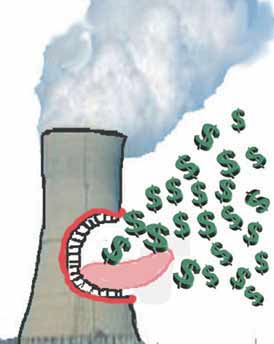
Instead, EDF, which is 84% owned by the French state, wants British taxpayers to underwrite a new plant at Sizewell in Suffolk. A
proposed new financial structure, the regulated asset base, would levy a tax on UK household energy bills to help pay for the project.
Other options include the British government taking a stake — although that has worried the Treasury, which is anxious about adding to its debt mountain.
EDF declined to comment. With most of Britain’s ageing reactors due to close by the end of the decade, Sunak and Boris Johnson face the dilemma of whether to fund more big nuclear plants, or rely on wind, solar, gas, small reactors and imported power to keep the lights on.
The American government has warned Hitachi against selling the Anglesey site to China, and is understood to be considering bankrolling US companies to take it over. Westinghouse, which makes the AP1000 nuclear plant, and NuScale Power,
which is developing small, modular reactors, are both believed to be
exploring options for the site. South Korea’s Kepco is also understood to
be interested, as is EDF.
Former UK Energy Minister Sir Ed Davey says new Sizewell nuclear station is too expensive
 Suffolk’s Sizewell C too expensive, says Sir Ed Davey, BBC, By Vikki Irwin & Chris Bond
28 Sept 20, Former energy secretary Sir Ed Davey has said building a new nuclear power station at Sizewell is “too expensive”.
Suffolk businesses oppose the building of Sizewell nuclear power station
 More than 100 rural Suffolk businesses have written to the Government to
oppose the building of a twin reactor nuclear power station. The letter,
which was addressed to Prime Minister and the Secretary of State for
Business, Energy and Industrial Strategy Alok Sharma amongst others, raised
concerns about the site.
It has attracted signatures from almost 150
individual businesses, farms and landowners in the area. In the letter they
describe the nuclear power station as a “threat” which had been hanging
over their heads for at least eight years. “This would be tolerable if
the Sizewell C project was for the ‘greater good’,” read the letter.
“But we have concluded that it is not necessary to meet the UK’s
commitment to net zero, and would be a slow, risky and expensive waste of
taxpayers’ money that removes opportunities to make use of alternative,
green, deliverable and cost-effective energy solutions. “Meanwhile, many
of our plans are on hold at a time when farming faces the biggest changes
to the policy framework governing our industry in over 50 years.” The
letter also raised concerns about the impact on farm production which
owners say could “render productive land commercially and logistically
unviable”.
https://www.eadt.co.uk/news/sizewell-c-construction-opposed-by-suffolk-businesses-1-685656
As fossil fuel jobs falter, renewables come to the rescue
 As fossil fuel jobs falter, renewables come to the rescue, BY JEFF BERARDELLI CBS News, SEPTEMBER 25, 2020 In 2011, Don Williams made the long trip from Michigan to North Dakota hoping to capitalize on the Bakken oil boom — to, as he says, “chase oil and make quick cash.” It paid off; for years Williams worked in operations on the oil fields, watching over production and maintaining pump jacks.
To say that Williams worked hard would be an understatement. Putting in 12-hour days, 7 days a week — 84-hour work-weeks were typical. And the work was lucrative. The money flowed as fast as the oil did — until it didn’t. In May, Williams was laid off, along with most of the Bakken workforce, when boom went bust.
But within a week, he made a huge career leap — 300 feet up, to be exact — ascending from the firm grounds of the Bakken Oil Fields to the top of a giant wind turbine to take part in a 12-week training course to become a wind energy technician. In his words, he no longer wanted to “ride the oil waves, the highs and lows,” anymore.
While the jobs are on opposite ends of the energy spectrum — from dirty to clean and from old to new — the mechanical skills Williams gained from his time working in oil helped him navigate the career transition. And lately, many ex-oil workers are taking that same leap in hopes of finding long-term stability — something that is becoming scarcer in fossil fuels.
In the past year, two seismic shocks — a price war between Russia and Saudi Arabia, followed by global pandemic lockdowns — tanked oil demand and prices too, devastating oil and gas production in the Bakken Formation.
From June 2019 through June 2020, U.S. crude oil production fell 38% and natural gas production fell 31%. The unemployment rate in North Dakota rose to 11.3% in June. For the month of August, continued claims of unemployment in North Dakota were nearly 100,000, and about a quarter of those were tied directly to mining, quarrying and oil & gas extraction — the highest unemployment of any sector in the state.
But as luck would have it, fossil fuels aren’t the only energy source North Dakota is rich in. With an average wind speed of 20 mph 300 feet above the ground where the wind turbines churn, North Dakota is prime real estate for wind power. It ranks 10th in wind production in the U.S. with more than 3,000 megawatts (MW) of installed capacity.
Williams says he sees evidence of a renewable revolution right in his backyard, with wind turbines popping up all around his community.
He received his wind technician training at Lake Region State College, a couple hours’ drive east from the Bakken oil fields. To earn a one-year college credit certificate, the cost of the course is about $5,000. Less than a month out of the training program, Williams has already landed a wind technician job at Gemini Energy Services.
Although he says the starting salary does not quite measure up to what the oil fields paid, the trade-off of more time with his family and more stability is well worth it to him. Besides, he’s optimistic about his future financial prospects because he says the industry offers a lot of upward mobility and areas to specialize in…….. https://www.cbsnews.com/news/renewable-energy-jobs-replacing-fossil-fuel-jobs-oil-wind/?fbclid=IwAR1aPeyOQTnh5UlpQKkRvonfkMOxT4cFwLn7uYMO-T1ckd-ldGCkOGlNNeU
1 This Month


Tell the Ukrainian Government to Drop Prosecution of Peace Activist Yurii Sheliazhenko

Petition to revoke the licensing of the Near Surface Nuclear Disposal Facility (NSDF) at Chalk River. https://www.ourcommons.ca/petitions/en/Petition/Details?Petition=e-7247


of the week – STOP SMALL MODULAR REACTORS IN CANADA
To see nuclear-related stories in greater depth and intensity – go to https://nuclearinformation.wordpress.com
-
Archives
- March 2026 (204)
- February 2026 (268)
- January 2026 (308)
- December 2025 (358)
- November 2025 (359)
- October 2025 (376)
- September 2025 (258)
- August 2025 (319)
- July 2025 (230)
- June 2025 (348)
- May 2025 (261)
- April 2025 (305)
-
Categories
- 1
- 1 NUCLEAR ISSUES
- business and costs
- climate change
- culture and arts
- ENERGY
- environment
- health
- history
- indigenous issues
- Legal
- marketing of nuclear
- media
- opposition to nuclear
- PERSONAL STORIES
- politics
- politics international
- Religion and ethics
- safety
- secrets,lies and civil liberties
- spinbuster
- technology
- Uranium
- wastes
- weapons and war
- Women
- 2 WORLD
- ACTION
- AFRICA
- Atrocities
- AUSTRALIA
- Christina's notes
- Christina's themes
- culture and arts
- Events
- Fuk 2022
- Fuk 2023
- Fukushima 2017
- Fukushima 2018
- fukushima 2019
- Fukushima 2020
- Fukushima 2021
- general
- global warming
- Humour (God we need it)
- Nuclear
- RARE EARTHS
- Reference
- resources – print
- Resources -audiovicual
- Weekly Newsletter
- World
- World Nuclear
- YouTube
-
RSS
Entries RSS
Comments RSS
 nuclear-news