Iowa’s last nuclear power station to close – 60 years at least to decommission it
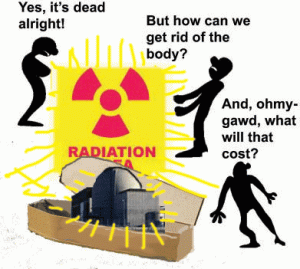 What’s next for Duane Arnold nuclear plant?, THe Gazette, 25 Sep 20, What’s next for Duane Arnold nuclear plant?, THe Gazette, 25 Sep 20,
Derecho damage prompts nuclear plant not to restart, Duane Arnold Energy Center near Palo did not restart after the Aug. 10 derecho caused “extensive” damage to its cooling towers…….. Why is it being decommissioned?
Dean Curtland, plant director, told The Gazette in 2018 Iowa’s changing energy landscape has overshadowed and outpriced Duane Arnold. Closing the facility could save NextEra about $300 million over 21 years, with cost savings coming as early as 2021. That translates to about $42 per residential customer. What impact did the derecho have on its decommissioning? NextEra Energy already was planning on decommissioning Duane Arnold this year. When the derecho caused “extensive” damage to the facility’s cooling towers, NextEra opted against restarting the plant so close to the Oct. 30 decommissioning date. Replacing the cooling towers with fewer than three months until decommissioning was “not feasible,” Robbins said last month. What is happening now that the plant is shut down? The decommissioning process is underway as employees remove nuclear material from the facility “There’s the nuclear fuel that was in the reactor and then nuclear fuel that was in a pool — what is called the spent fuel pool,” Robbins said. “We’ve been moving a lot of the fuel out of that pool and putting it in a storage facility on the site.” How long will the decommissioning process take? The process involves several steps, starting with removing nuclear material from the site. After nuclear material goes into the spent fuel pool, it can go into dry storage. After all the fuel is removed, officials have 60 years to decommission the facility………. Are there any other nuclear power plants in Iowa? Duane Arnold was the last nuclear power plant in the state. The closest nuclear power plant is in Cordova, Ill., about 20 miles northeast of Moline along the Mississippi River. Comments: (319) 398-8394; john.steppe@thegazette.com https://www.thegazette.com/subject/news/business/duane-arnold-energy-center-nuclear-plant-iowa-palo-ia-decommission-20200925 |
|
Recharge’s ”must read” news of the week on the energy transition
 Age of uncertainty, Dutch nuclear bombshell and why its decision-time for Big Oil, Our weekly curation of the must-read news and analysis from the-week-that-was in the global renewable energy industry. https://www.rechargenews.com/transition/age-of-uncertainty-dutch-nuclear-bombshell-and-why-its-decision-time-for-big-oil/2-1-882244 , 25 September 2020 , By Andrew Lee Age of uncertainty, Dutch nuclear bombshell and why its decision-time for Big Oil, Our weekly curation of the must-read news and analysis from the-week-that-was in the global renewable energy industry. https://www.rechargenews.com/transition/age-of-uncertainty-dutch-nuclear-bombshell-and-why-its-decision-time-for-big-oil/2-1-882244 , 25 September 2020 , By Andrew Lee
As Covid-19 continues to dominate political and economic agendas, Recharge carried a sobering reminder of the other emergency facing our world leaders – and some timely insights into how they may respond.
The latest Energy Transition Outlook from Wood Mackenzie puts at $25 trillion over 20 years the cost of investment in carbon-cutting technologies – and follows with the sting in the tail that even that won’t be enough to avoid damaging global warming without drastic measure to replace heavy-emitting industrial plant. Such epic challenges require action from the very top, and there was a cautious welcome for an announcement from China’s leader Xi Jinping that the world’s biggest polluter would aim to be carbon net-neutral by 2060. Although lacking in detail, Xi’s pledge is likely to add further momentum to China’s world-leading renewable energy growth, and Recharge revealed how key power sector players are already planning how the nation can reach a terawatt or more of wind and solar in just five years. Trump v Biden: how the election will impact US renewables policy and the global climate battle Read more
So to that other economic superpower, the US, where Recharge set out just how stark is the contrast between the two contenders in the upcoming Presidential election – Donald Trump, who views the climate emergency as a non-issue, and Joe Biden, who has pledged to rejoin the Paris Agreement withing 24 hours of taking office. Meanwhile, while by no means a superpower (expect possibly in political black comedy and offshore wind), the UK still has plenty to say about the energy transition, especially in its role as notional host of next year’s COP 26. Prime Minister Boris Johnson told a UN roundtable that Britain would make a ‘big bet’ on hydrogen as part of its drive to net-zero, only to be reminded by a leading UK renewables body that his government has yet to come up with a strategy for the key energy transition fuel. Nuclear power, that most controversial piece of the energy transition jigsaw puzzle, was back in the headlines this week in a thoroughly left-field fashion. Recharge reported how the Dutch energy minister is preparing to launch a consultation on the prospect of new nuclear plants in the Netherlands, after perusing a report that claims they can be more cost-effective (contentious) and safer (downright bizarre) than wind or solar projects. Prime Minister Boris Johnson told a UN roundtable that Britain would make a ‘big bet’ on hydrogen as part of its drive to net-zero, only to be reminded by a leading UK renewables body that his government has yet to come up with a strategy for the key energy transition fuel. Nuclear power, that most controversial piece of the energy transition jigsaw puzzle, was back in the headlines this week in a thoroughly left-field fashion. Recharge reported how the Dutch energy minister is preparing to launch a consultation on the prospect of new nuclear plants in the Netherlands, after perusing a report that claims they can be more cost-effective (contentious) and safer (downright bizarre) than wind or solar projects. This was the latest in what is becoming a regular reappearance of nuclear on the energy transition agenda, including recent endorsements of the technology’s potential by the likes of Google and an apparent determination by the French to find a role for its atomic fleet in the future hydrogen economy. Before they do anything they might regret, the Dutch may want to ask the authors of a report that claims nuclear has drained Germany of €1trn ($1.18trn) over its soon-to-end dalliance with the industry. The world’s oil giants are rarely out of the energy transition headlines, and this week it was the turn of Total, the French supermajor, to cause the biggest splash with news that it will buy 6TWh of solar power to supply green electricity to its entire European operation. Elsewhere peer Shell forged a renewable power supply pact with Microsoft, while a less familiar name got in on the act when Recharge revealed how China’s CNOOC has widened its offshore wind footprint and added green hydrogen to its corporate agenda. However, in a reality check for the world’s oil giants, Recharge Editor-in-Chief Darius Snieckus challenged them to rapidly decide that the fate of the planet is more important than any vestiges of their former fossil-led business models, then act – and invest – accordingly. |
|
Indonesia: strong objections to nuclear and “new” fossil fuel technologies being called ”green” energy
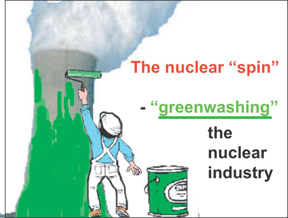 Tug of war: Stakeholders clash over nuclear, fossil fuel addition to green energy bill Norman Harsono, The Jakarta Post Jakarta / Fri, September 25, 2020 Green energy businesses and watchdogs are up in arms over the House of Representatives’ decision to add nuclear and “new” fossil fuel technologies into a landmark green energy bill. Industry players have issued statements and held public hearings with lawmakers over the past two weeks to protest such an addition in the long-awaited New and Renewables Energy (EBT) bill, which promises legal certainty and incentives for listed industries. Nuclear energy, liquefied coal and coal gas – the latter product being pioneered by state-owned coal miner PT Bukit Asam – are all categorized as “new” but not “renewable” in the draft bill, a copy of which was obtained by The Jakarta Post.
Solar and battery ads blocked by Twitter and Facebook move against “political content” — RenewEconomy

Efforts to stamp out ‘fake news’ on social media inadvertently see ads for rooftop solar and clean energy events rejected for being too ‘political’. The post Solar and battery ads blocked by Twitter and Facebook move against “political content” appeared first on RenewEconomy.
Solar and battery ads blocked by Twitter and Facebook move against “political content” — RenewEconomy
1 This Month


Tell the Ukrainian Government to Drop Prosecution of Peace Activist Yurii Sheliazhenko

Petition to revoke the licensing of the Near Surface Nuclear Disposal Facility (NSDF) at Chalk River. https://www.ourcommons.ca/petitions/en/Petition/Details?Petition=e-7247


of the week – STOP SMALL MODULAR REACTORS IN CANADA
To see nuclear-related stories in greater depth and intensity – go to https://nuclearinformation.wordpress.com
-
Archives
- March 2026 (204)
- February 2026 (268)
- January 2026 (308)
- December 2025 (358)
- November 2025 (359)
- October 2025 (376)
- September 2025 (258)
- August 2025 (319)
- July 2025 (230)
- June 2025 (348)
- May 2025 (261)
- April 2025 (305)
-
Categories
- 1
- 1 NUCLEAR ISSUES
- business and costs
- climate change
- culture and arts
- ENERGY
- environment
- health
- history
- indigenous issues
- Legal
- marketing of nuclear
- media
- opposition to nuclear
- PERSONAL STORIES
- politics
- politics international
- Religion and ethics
- safety
- secrets,lies and civil liberties
- spinbuster
- technology
- Uranium
- wastes
- weapons and war
- Women
- 2 WORLD
- ACTION
- AFRICA
- Atrocities
- AUSTRALIA
- Christina's notes
- Christina's themes
- culture and arts
- Events
- Fuk 2022
- Fuk 2023
- Fukushima 2017
- Fukushima 2018
- fukushima 2019
- Fukushima 2020
- Fukushima 2021
- general
- global warming
- Humour (God we need it)
- Nuclear
- RARE EARTHS
- Reference
- resources – print
- Resources -audiovicual
- Weekly Newsletter
- World
- World Nuclear
- YouTube
-
RSS
Entries RSS
Comments RSS
 nuclear-news