In “The Button,” former Defense Secretary William J. Perry and Tom Z. Collina survey the dangers of nuclear escalation.
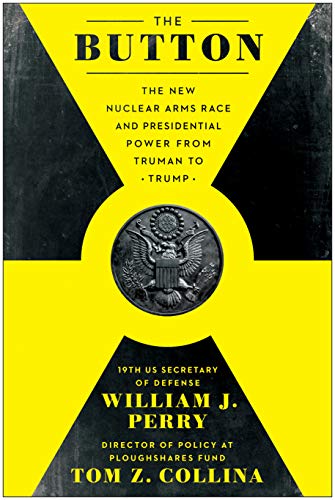 Book Review: The Nuclear Arms Race, Then and Now, Undark, BY MARK WOLVERTON 11 Sept 20, In “The Button,” former Defense Secretary William J. Perry and Tom Z. Collina survey the dangers of nuclear escalation.
IN THE bad old days of the Cold War, both the United States and the USSR maintained thousands of nuclear weapons, ready to be launched at a moment’s notice. Only one person had the authority to unleash America’s nuclear forces: the president of the United States. He could do so at any time, without consulting Congress or the military or anyone else save his own conscience. Although the mechanism for doing so never actually consisted of pushing a button, that became the popular metaphor for setting off doomsday.
|
It was a precarious state of affairs, but there was a certain cold reasoning, or perhaps rationalization, behind it. If the U.S. was attacked, went the argument, there would be no time for careful consideration before nuclear blasts began going off on American soil. Retaliation would have to be immediate. The only way to assure deterrence was to maintain the unquestioned ability for immediate retaliation. So wherever the president went, a military aide followed close behind, carrying the “football,” a special briefcase containing all the secret codes and communication equipment needed to launch World War III at any time. Almost 30 years after the fall of the Soviet Union and the end of the Cold War, little has changed. American and Russian nuclear arsenals, while reduced in numbers due to significant arms control agreements (which have been largely abandoned), still remain on hair-trigger alert, poised to respond to the nonexistent threat of a surprise “bolt from the blue” attack. And the man with the football, the only individual who can order the use of U.S. nuclear weapons, remains the president of the United States: Donald J. Trump. As William J. Perry, former defense secretary in the Clinton administration, and Tom Z. Collina, policy director of the Ploughshares Fund, a nonprofit nuclear disarmament foundation, note in “The Button: The New Nuclear Arms Race and Presidential Power From Truman to Trump,” “the U.S. president can still unilaterally launch a nuclear war in about the same time it takes to order a pizza.” ……….. Casting aside treaties and any logical military necessity, the U.S. and Russia are gearing up for a second nuclear arms race more dangerous than the first, developing new weapons and “modernizing” old ones while extending the potential battlefield into the previously sacrosanct realm of outer space. Yet their rationales remain essentially unchanged from the Cold War, and just as invalid. Rather than a nuclear Pearl Harbor, “The greatest danger of a nuclear exchange during the Cold War came not from a deliberately planned attack, but through bad information, unstable leadership, or false alarms,” Perry and Collina write, chronicling a wide variety of historical examples, some from Perry’s personal experience in the Pentagon. “We have been focused on the wrong threat,” they note, which coupled with the policy of presidential sole authority, makes the U.S. as well as the rest of the world more vulnerable to nuclear catastrophe. “We are preparing for a first strike from Russia that is very unlikely; what is not so unlikely is that we will blunder into a nuclear war. Yet by preparing for the surprise first strike, we actually make the blunder more likely.” And there’s a new wrinkle that didn’t exist during the Cold War: the threat of cyberattacks directed at nuclear weapons command and control systems……….. Perry and Collina depict just such a nightmare scenario in the preface of “The Button,” in which an unnamed U.S. president is interrupted on the golf course by a nuclear attack warning and impulsively orders massive retaliation without waiting for confirmation, only to find out too late that the attack was a false alarm created by a hacking attack on Strategic Command computers. Such a possibility only magnifies the risks of placing nuclear authority in the hands of a single individual who would have only minutes to make the decision to launch. …….. https://undark.org/2020/09/11/book-review-the-button/ |
|
No comments yet.
1 This Month



Tell the Ukrainian Government to Drop Prosecution of Peace Activist Yurii Sheliazhenko

Petition to revoke the licensing of the Near Surface Nuclear Disposal Facility (NSDF) at Chalk River. https://www.ourcommons.ca/petitions/en/Petition/Details?Petition=e-7247


of the week – STOP SMALL MODULAR REACTORS IN CANADA
To see nuclear-related stories in greater depth and intensity – go to https://nuclearinformation.wordpress.com
-
Archives
- March 2026 (222)
- February 2026 (268)
- January 2026 (308)
- December 2025 (358)
- November 2025 (359)
- October 2025 (376)
- September 2025 (258)
- August 2025 (319)
- July 2025 (230)
- June 2025 (348)
- May 2025 (261)
- April 2025 (305)
-
Categories
- 1
- 1 NUCLEAR ISSUES
- business and costs
- climate change
- culture and arts
- ENERGY
- environment
- health
- history
- indigenous issues
- Legal
- marketing of nuclear
- media
- opposition to nuclear
- PERSONAL STORIES
- politics
- politics international
- Religion and ethics
- safety
- secrets,lies and civil liberties
- spinbuster
- technology
- Uranium
- wastes
- weapons and war
- Women
- 2 WORLD
- ACTION
- AFRICA
- Atrocities
- AUSTRALIA
- Christina's notes
- Christina's themes
- culture and arts
- Events
- Fuk 2022
- Fuk 2023
- Fukushima 2017
- Fukushima 2018
- fukushima 2019
- Fukushima 2020
- Fukushima 2021
- general
- global warming
- Humour (God we need it)
- Nuclear
- RARE EARTHS
- Reference
- resources – print
- Resources -audiovicual
- Weekly Newsletter
- World
- World Nuclear
- YouTube
-
RSS
Entries RSS
Comments RSS
 nuclear-news
Leave a comment