A Pakistan threat of nuclear war with India
 Pakistan minister Sheikh Rasheed Ahmed threatens India with nuclear war, Scroll, Ahmed said Pakistan would opt for a nuclear conflict because the Indian Army was far superior in conventional weapons. Scroll In 21 Aug 20 Pakistan minister Sheikh Rasheed Ahmed threatens India with nuclear war, Scroll, Ahmed said Pakistan would opt for a nuclear conflict because the Indian Army was far superior in conventional weapons. Scroll In 21 Aug 20
Pakistan Railway Minister Sheikh Rasheed Ahmed on Thursday threatened India with nuclear war. Speaking to Samaa TV, he said if India attacks Pakistan, it will descend into an “atomic war”. Ahmed said the Pakistan Army was far inferior to India’s in conventional weaponry, and would therefore have to use a nuclear bomb. “This will be a bloody, last and atomic war,” he said. “Our [nuclear] weapon will be very calculated, miniature and perfect, and will target India while protecting the lives of Muslims.” Ahmed claimed that Pakistan now has nuclear weapons that can reach Assam. “Pakistan does not possess enough conventional weapons, so India knows that [in a war], whatever will happen, will happen.” ………. The Pakistani minister’s views are a departure from Prime Minister Imran Khan’s opinion about a war between New Delhi and Islamabad. Khan has stated on two separate occasions that a war between the two nuclear-armed countries would not end well. https://scroll.in/latest/971015/pakistan-minister-sheikh-rasheed-ahmed-threatens-india-with-nuclear-war |
|
See this How the climate crisis is already harming America – photo essay
 How the climate crisis is already harming America – photo essay
The damage rising temperatures bring is been seen around the country, with experts fearing worse is to come, Guardian , by Oliver Milman in New York, with photographs compiled by Gina Lachman 21 Aug 20
Climate change is not an abstract future threat to the United States, but a real danger that is already harming Americans’ lives, with “substantial damages” to follow if rising temperatures are not controlled.
This was the verdict of a major US government report two years ago. The Trump administration’s attitude to climate change was perhaps illustrated in the timing of the report’s release, which was in the news dead zone a day after Thanksgiving.
The report was the fourth National Climate Assessment (NCA), and is seen as the most authoritative official US snapshot of the impacts of climate change being seen already, and the estimate of those in the future.
It is the combined work of 13 federal agencies, and it warns how climate-related threats to Americans’ physical, social and economic wellbeing are rising, and will continue to grow without additional action.
Here we look at the regions of the US where it describes various impacts, with photography from these areas showing people and places in the US where climate change is very real.
If there was a ground zero for the climate crisis in the US, it would probably be located in Alaska. The state, according to the national climate assessment, is “ on the front lines of climate change and is among the fastest warming regions on Earth”.Sign up to the Green Light email to get the planet’s most important stories
Since the early 1980s, Alaska’s sea ice extent in September, when it hits its annual minimum, has decreased by as much as 15% per decade, with sea ice-free summers likely this century. This has upended fishing routines for remote communities that rely upon caught fish for their food.
The thinning ice has seen people and vehicles collapse into the frigid water below, hampering transport routes.Roads and buildings have buckled as the frozen soils underneath melt. Wildfires are also an increasing menace in Alaska, with three out of the top four fire years in terms of acres burned occurring since 2000. The state’s residents are grappling with a rapidly changing environment that is harming their health, their supply of food and livelihoods.
Last year was the hottest year on record in Alaska, 6.2F warmer than the long-term average.
North-east – snowstorms, drought, heatwaves and flooding…………
Northern Great Plains – flash droughts and extreme heat………
Midwest – heavy rains and soil erosion……
South-east – flooding in Louisiana………
Southern Great Plains – Hurricane Harvey……
South-west – drought in the Colorado river basin reduced Lake Mead by more than half since 2000…….
North-west – wildfire increases and associated smoke…..
Hawaii and Pacific islands – coral bleaching….….
Caribbean – hurricanes…. https://www.theguardian.com/us-news/2020/aug/20/climate-crisis-environment-america
Growing national opposition to Holtec plan for ‘temporary’ storage of nuclear wastes near Carlsbad, New Mexico

Nationwide opposition of a nuclear waste storage facility proposed to be built near Carlsbad and Hobbs continued its call for the licensing process for the project to be suspended during the COVID-19 pandemic and that the federal Nuclear Regulatory Commission deny the application altogether.
Holtec International proposed to build the site to store high-level spent nuclear fuel rods transported to southeast New Mexico from generator sites across the county.
Many of the rods are already stored in cooling pools near the generator sites, which supporters of the project said were unsafe as many are located near large bodies of water or densely populated areas.
The concept of Holtec’s consolidated interim storage facility (CISF) was to temporarily store the spent fuel in a remote location while a permanent repository was developed.
Such a facility to permanently store the waste does not exist in the U.S.
The idea faced opposition from New Mexico Gov. Michelle Lujan Grisham and State Land Commissioner Stephanie Garcia Richard along with other state lawmakers.
And during a Thursday public hearing held by the NRC, numerous nuclear watchdog groups from around the country voiced their opposition.
The NRC announced last week it would hold four such online hearings including Thursday’s with others scheduled for Aug. 25, 26 and Sept. 2 to solicit public comments on the Commission’s recently released environmental impact statement (EIS).
The EIS released earlier this year found the project would have minimal environmental impacts during the construction, operation and decommissioning of the facility.
The EIS was required for the first phase of Holtec’s plan for 500 cannisters to be stored, but the NRC also considered the company’s expressed intention to apply for future permits for 19 additional phases for a total of 10,000 cannisters of nuclear waste.
Leona Morgan of the Nuclear Issues Study Group based in Albuquerque said the online hearing process was unjust as many New Mexicans live without adequate internet or phone service to participate in electronic hearings.
While she called for the NRC to reject Holtec’s application, citing safety and environmental risks to the region of the facility and communities along the transportation routes, Morgan also questioned the hearing process itself as it continued during the global pandemic.
Leona Morgan of the Nuclear Issues Study Group based in Albuquerque said the online hearing process was unjust as many New Mexicans live without adequate internet or phone service to participate in electronic hearings.
While she called for the NRC to reject Holtec’s application, citing safety and environmental risks to the region of the facility and communities along the transportation routes, Morgan also questioned the hearing process itself as it continued during the global pandemic.
The Nuclear Issues Study Group, which held a continued presence during the past three public hearings held this year, and NRC’s scoping meetings held in 2018, would boycott the rest of the proceedings, Morgan said.
“There are a large portion of our state that lives without phone or internet service. Our organization is boycotting the rest of these proceedings. It is a sham. There is no reason to rush this process except to line the pockets of shareholders,” she said.
“We see this as a violation of our rights to submit our public comments under the National Environmental Policy Act. And it violates environmental justice. We can’t even verify that the NRC is sitting before us.”
More:Nuclear waste site near Carlsbad opposed by indigenous groups during public hearing
John LaForge, of nuclear watchdog group Nukewatch of Wisconsin also voiced his opposition to the project and ongoing proceedings, pointing to widespread opposition in New Mexico and among Tribal nations.
He demanded public hearings be held in up to 40 states other than New Mexico that could be impacted by the transportation of waste.
“There is no compelling reason at this time for these meetings to be rushed. I opposed this plan due to the governors of New Mexico and of 20 tribal nations,” LaForge said. “With these online meetings, it is apparent to me that the NRC has no interest in the public’s concerns. The people of New Mexico have said no.”
He also criticized the EIS as the NRC noted in the report it would expect no radiation release should there be an accident at the facility.
“In its review, the NRC said it assume in an accident there would be no release of radiation,” LaForge said. “That is alarming and preposterous.”
Petuuche Gilbert of the Acoma Coalition for a Safe Environment based in the Acoma Pueblo near Albuquerque also questioned the EIS as it only considered the environmental impacts of the project for 40 years and only within a 50 mile radius.
“We believe the analysis needs to go beyond the 40 year possibility of storing the waste. We all know the nuclear waste and radioactivity extends beyond that limited timeframe. It really needs to go on for hundreds or thousands of years,” Gilbert said.
“You have the possibility of accidents that could occur along the transportation corridors. The cumulative analysis is limited only to a 50 mile radius. It really needs to be more.”
Adrian Hedden can be reached at 575-628-5516, achedden@currentargus.com or @AdrianHedden on Twitter.
California: 10,849 lightning strikes spark more than 367 fires
|
More than 300,000 acres burned in three days as resource-depleted Calif. battles blazes 10,849 lightning strikes spark more than 367 firesBy Amy Graff, SFGATE, August 19, 2020 In the grips of a rare summer weather pattern marked by blistering heat and violent thunderstorms, California has seen hundreds of wildfires sparked by lightning strikes erupt into monstrous conflagrations that are tearing through a parched landscape and swallowing homes.
Cal Fire spokesperson Jeremy Rahn spoke to the extreme conditions at a Wednesday press briefing and said in the last three days the state experienced a “historic lightning siege” with 10,849 lightning strikes starting more than 367 fires in three days. In all, these fires have burned 300,000 acres, he said. More than 69,000 federal, state and local personnel are battling flames. “Firefighting resources are depleted as new fires continue to ignite,” Rahn said. The state has requested 375 fire engines from other states as well as hand crews as the demand for resources has surpassed availability. Nearly all available private firefighting aircraft in the Western U.S. have been hired and assigned to the incidents. “The size and complexity at which these incidents are burning is challenging all aspects of emergency response,” Rahn said. “It’s important that the community heeds the warnings of law enforcement and remain prepared to evacuate at a moment’s notice.” The greater San Francisco Bay Area is seeing some of the most severe wildfire conditions. Police and firefighters went door-to-door before dawn Wednesday in a frantic scramble to warn residents to evacuate as fire encroached on Vacaville, a city of about 100,000 between San Francisco and Sacramento. At least 50 structures were destroyed, including some homes, and 50 damaged. “This is an incredibly emotional and stressful time for most of us who’ve endured a number of wildfires over the last few years,” said Sonoma County Sheriff Mark Essick.
Ash and smoke filled the air in San Francisco, which is surrounded by wildfires burning in multiple counties to the north, east and south. The LNU Lightning fire is made up of several fires burning in five counties north of San Francisco, including in Vacaville, and had consumed 72 square miles as of Wednesday morning (186 square kilometers)………… In the East San Francisco Bay, a cluster of 20 separate lightning-sparked fires called the SCU Lightning complex was threatening about 1,400 structures in rugged terrain with dense brush. The fires have torched 133 square miles (344 square kilometers). To the south of San Francisco in San Mateo and Santa Cruz counties, about 22,000 people were ordered to evacuate because of a fire burning in dense wooded parkland that threatened communities, Cal Fire spokesman Jonathan Cox said. About 22 fires are part of the complex and most had been burning in relatively remote, dense brush until strong winds overnight Tuesday pushed them into more populated areas, merging some of the fires together. Resources are strapped, he said, given the number of fires burning in California. “We’re in the unfortunate position where firefighters are going to be spending several days out on the fire line,” he said. “It’s grueling, it’s exhausting.” Christopher Godley, Sonoma County’s emergency management director, also conceded that resources are thin. “It’s difficult to second guess what the fire commanders are doing with their aircraft. But it’s not like last year when we saw just a huge wealth of resources flowing into the county,” he said. “It is what it is.” The cluster of wine country fires threatens an area that only last year grappled with another massive blaze that forced 200,000 to flee — a task made more complicated this year because of the pandemic. The Associated Press contributed to this story. https://www.sfgate.com/bayarea/article/California-fires-2020-lightning-total-acreage-15496403.php?utm_campaign=CMS&fbclid=IwAR19z_-L1kTTmmf0btDiMiWwRUk0FaiXAjwGg5Bb5VQ59catMA6cfpZWJkc  |
|
Japan’s Rokkasho nuclear reprocessing plant delayed, for the 25th time!
 Nuclear fuel reprocessing plant completion delayed, NHK News, 21 Aug 20 The operator of a nuclear fuel reprocessing plant in northeastern Japan says it will postpone the scheduled completion of the facility by one year. The plant is the centerpiece of the Japanese government’s nuclear fuel recycling policy.This is the 25th time that Japan Nuclear Fuel Limited has delayed the scheduled completion of the plant. The operator says it now aims to complete construction in the first half of fiscal 2022, which is 25 years behind schedule. Nuclear fuel reprocessing plant completion delayed, NHK News, 21 Aug 20 The operator of a nuclear fuel reprocessing plant in northeastern Japan says it will postpone the scheduled completion of the facility by one year. The plant is the centerpiece of the Japanese government’s nuclear fuel recycling policy.This is the 25th time that Japan Nuclear Fuel Limited has delayed the scheduled completion of the plant. The operator says it now aims to complete construction in the first half of fiscal 2022, which is 25 years behind schedule.
The facility in the village of Rokkasho in Aomori Prefecture, northeastern Japan, is designed to extract plutonium from spent nuclear fuel generated by power plants, for recycling. Masuda Naohiro, the president of Japan Nuclear Fuel Limited, reported the decision to Aomori Governor Mimura Shingo on Friday. Masuda explained that considerable time would be necessary to prepare to ensure safety against tornados, as well as for the assessment of that work……….. The scheduled plant completion has been postponed many times due to various problems and other reasons. Some experts have pointed out technical issues concerning on-site management and maintenance, given the considerable delay in the schedule. The outlook for the use of the extracted plutonium is also unclear. https://www3.nhk.or.jp/nhkworld/en/news/20200821_25/ |
|
As climate extreme weather impacts grow, American nuclear reactors are threatened
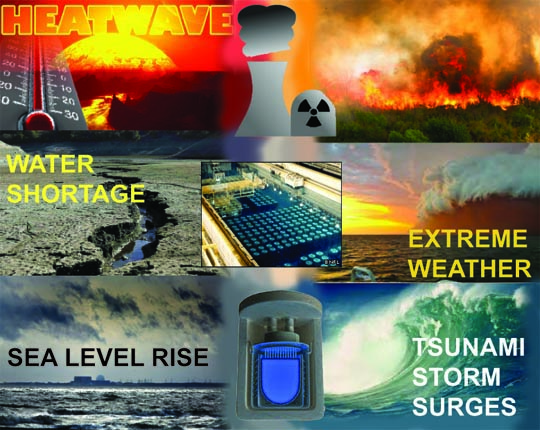 Mounting Climate Impacts Threaten U.S. Nuclear Reactors, Scientific American, Higher temperatures, rising flood risks and increased water stress mean facilities need to take additional resiliency measures, By Avery Ellfeldt, E&E News on August 20, 2020
Soaring temperatures, intensified flood risks and heightened water stress will threaten 57 U.S. nuclear plants over the next 20 years, forcing operators to take additional resiliency measures, according to a new report.
“The consequences of climate change can affect every aspect of nuclear plant operations—from fuel handling and power and steam generation to maintenance, safety systems and waste processing,” said the analysis, which was published yesterday by Moody’s Investors Service.
Analysts used data from Four Twenty Seven, a Moody’s affiliate that provides climate risk intelligence, to examine threats to operating nuclear plants.
“It looks like almost all plants see some kind of climate risk worsening over the next 20 years,” said David Kamran, the report’s author.
The study also underscored that the nuclear sector’s vulnerability to regional climate risks in large part depends on plants’ proximity to water.
Because nuclear generation facilities rely on external water sources for cooling, the vast majority are situated near rivers, lakes and oceans. That exposes them to flooding and storm surges, which can damage critical equipment.
The Four Twenty Seven data show 37 gigawatts of U.S. nuclear capacity is overly exposed to flood risk.That includes plants along the East and Gulf coasts, which are likely to grapple with rising sea levels and intensifying hurricanes in the decades to come. Storm-related rainfall, the reports adds, could “inundate” nuclear facilities and “damage transmission lines or substations, hindering a plant’s ability to deliver power.”
Facilities in the Midwest and South Florida, meanwhile, are more likely to suffer from higher temperatures that have the potential to reduce plants’ ability to generate power. The generation process involves creating steam, which is then cooled and condensed into liquid for reuse.
“If the temperature of incoming water to cool and condense steam is too high, or if the temperature of the discharge water is too high, power plants can be forced to curtail production or shut down temporarily,” the report says.
Facilities in the Rocky Mountain region, near the Colorado River and in California, on the other hand, are projected to face water scarcity, spiking uncertainty about having long-term access to necessary water supplies……. https://www.scientificamerican.com/article/mounting-climate-impacts-threaten-u-s-nuclear-reactors/
Resistance to nuclear waste survey in Hokkaido
SAPPORO – The mayor of Suttsu in Hokkaido, which is considering applying for a survey to host a final disposal site for high-level radioactive waste, said Friday that it might be difficult to make the decision by September as planned.
“It is difficult to make the decision after listening to many voices,” Suttsu Mayor Haruo Kataoka told reporters after meeting with the nine members of the town’s assembly. “It would not be appropriate to rush the decision by our own judgment. Our plan to decide in September might be postponed.”
Kataoka’s remarks came a day after the mayors of three municipalities neighboring Suttsu said Thursday they will urge the town to make a careful decision.
The mayors of the three municipalities unveiled the plan at a meeting with Hokkaido Gov. Naomichi Suzuki.
Of the three, Rankoshi Mayor Hideyuki Kon and Kuromatsunai Mayor Mitsuru Kamada expressed opposition to Suttsu’s move, which involves applying for a literary survey, the first stage of the process for choosing a disposal site.
Kon, Kamada and Shimamaki Mayor Masaru Fujisawa told Suzuki that they will ask Suttsu as early as this month to make a careful decision on the application. ……..
Seven other municipalities, including the town of Niseko, an internationally known ski resort, are planning to oppose the plan, sources said Friday.
Also on Friday, members of the association of fisheries cooperatives made up of nine co-ops around Suttsu, submitted to Kataoka a protest letter expressing strong opposition to the town’s plan.
Referring to the fact that the fisheries industry suffered harmful rumors following the 2011 triple core meltdown at the Fukushima No. 1 power plant, the letter said: “It is utterly unacceptable for those in the fisheries industry. It will have an immeasurable adverse impact not only on the region but also on the fisheries industry as a whole.”
Katsuo Hamano, head of the association, criticized the mayor for making an announcement on the plan even before obtaining the municipal assembly’s approval.
“It goes against the rules of parliamentary democracy,” Hamano told reporters…….
The central government offers up to ¥2 billion in subsidies to any municipality that undergoes the literary survey https://www.japantimes.co.jp/news/2020/08/21/national/hokkaido-suttsu-nuclear-waste-survey-delay/
Court actions over delays in delivering Russia’s giant nuclear icebreaker line
|
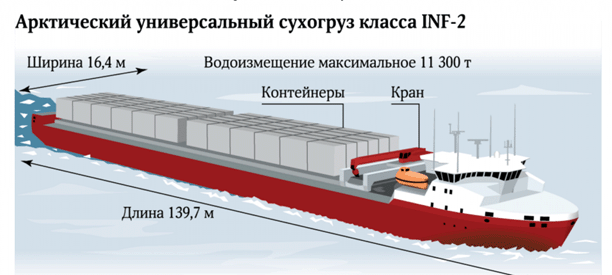
Delays in delivering Russia’s giant nuclear icebreaker line sparks lawsuitsDelays plaguing the launch of the Arktika nuclear icebreaker, billed to be Russia’s largest to date, have prompted a number of lawsuits against the ship’s builder as frustrations mount over a series of technical faults thwarting the vessel’s scheduled release. Bellona , August 21, 2020 by Charles Digges
According to the Barents Observer, which cites industry news portals, Atomflot, Russia’s nuclear icebreaker headquarters, has filed three multi-million dollar lawsuits against the Baltic Shipyard, the St Petersburg-based shipbuilder that has forged most of the country’s icebreaking muscle. Details of the lawsuits are sketchy. But the Barents Observer reports that the suits seek nearly $13.5 million in damages over faulty ship systems and overdue part deliveries, all of which have caused the icebreaker project to overshoot its 2017 deadline. The latest of these mishaps involves a 300-ton electric propulsion engine that failed during the Arktika’s sea trials in February, crippling one of the vessel’s three propeller systems. While the breakdown is not related to the Arktika’s nuclear propulsion system, it was nonetheless an embarrassing setback that will ultimately require the engine to be entirely replaced. Russian media now suggest that the Arktika won’t be repaired before 2021. A new series of upgraded nuclear icebreakers are central component of a Kremlin strategy to keep Arctic sea routes open on a year-round basis. Russia has since Soviet times maintained the world’s largest stable of these vessels. But many have been decommissioned in recent years, and Moscow has embarked on renewing the fleet. The target of this effort is the Northern Sea Route, a 5,600-kilometer sea artery joining Europe to Asia, whose frozen shores are laden with fossil fuels and mineral deposits. To stimulate its development, President Vladimir Putin ordered in 2017 that cargo volumes along the passage reach 80 million tons by the middle of this decade – more than double current volumes. The Arktika, and two other icebreakers in its class – the Ural and the Sibir – are meant to lead the way. Each vessel measures up to 173 meters in length and all are powered by twin RITM-200 nuclear reactors, which deliver a combined 175 megawatts of power – making them the most powerful civilian vessels in the world. Atomflot has filed its suits against the Baltic Shipyard in Moscow’s Arbitration court, the Barents Observer reports. In turn, the shipyard is suing one of its own suppliers – the giant Kirov Plant in St Petersburg, which manufactures heavy machinery. The Arktika’s rollout has face previous delays. In March of 2017, turbines produced by a Ukraine-based manufacturer were held up by military tensions between Moscow and Kiev. https://bellona.org/news/nuclear-issues/2020-08-%EF%BB%BF%EF%BB%BFdelays-in-delivering-russias-giant-nuclear-icebreaker-line-sparks-lawsuits |
|
City of Logan cuts its losses, withdraws from risky NuScam “small” nuclear reactor project
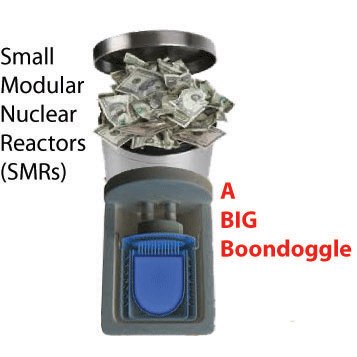 Logan withdraws from risky nuclear power project, Cache Valley
  Daily Charlie Schill August 19, 2020 LOGAN – Members of the Logan City Council voted Tuesday to end the city’s partnership in an increasingly expensive nuclear power project.
As a member of the Utah Associated Municipal Power Systems (UAMPS), Logan City owned a partial interest in a first-of-its-kind nuclear plant proposed to be constructed at the Idaho National Laboratory.
Faced with Sept. 15 deadline to ante up more funding for the risky project, both Mark Montgomery, the city’s light and power director, and Logan Finance Director Richard Anderson recommended that Logan withdraw from the Carbon Free Power Project…….
Montgomery told city council members that Logan had invested about $400,000 in the Small Modular Reactor (SMR) project since 2017. If the city had opted to continue its participation in the project into its initial licensing phase through 2023, the price tag would have been another $654,000.
In early August, the Utah Taxpayers Association urged all Utah cities to reconsider their participation in the SMR project due to its potential for out–of-control costs………
In the original CFPP proposal, the U.S. Department of Energy was to foot the bill for the development of the project’s first module. After pledging up to $1.4 billion for those expenses, federal officials have since backed out of that agreement, leaving UAMPS holding the bag for the project’s first-of-its-kind risks.
Montgomery added that estimated cost of the project have also escalated since 2017, jumping from $3.6 billion to $6.1 billion as of July of this year……… https://www.cachevalleydaily.com/news/archive/2020/08/19/logan-withdraws-from-risky-nuclear-power-project/#.X0BMOOgzbIU
Northern Europe: detecting radiation and where it comes from
|
Radiation detections in northern Europe: what we do and don’t know https://thebulletin.org/2020/08/radiation-detections-in-northern-europe-what-we-do-and-dont-know/# By Cheryl Rofer, August 21, 2020 Alarming events may not be what they initially seem. When an enormous explosion created a mushroom cloud over Beirut on August 4, some people immediately jumped to the wrong conclusion, spreading rumors on social media that a nuclear bomb had gone off. It hadn’t.
Eventually it became clear that the explosion was caused by chemicals stored improperly in warehouses at Beirut’s port. But weapons experts knew from the start that the powerful explosion was not nuclear, because it did not produce a blinding flash of light, or a blast of heat intense enough to set a city on fire. In the hours that followed the explosion, the Comprehensive Test Ban Treaty Organization (CTBTO), which operates a network of monitoring stations around the world, did not detect a telltale spike in atmospheric radiation. That last clue is how experts are able to narrow down the location of nuclear events, from the smallest accidents to major disasters like Chernobyl, and to make educated guesses about what happened. A release of nuclear material spreads its signature on the wind. But that signature is often incomplete or garbled. Nuclear experts are still puzzling over a mysterious event that happened in June, when several monitoring stations in northern Europe detected extremely small quantities of radionuclides in the atmosphere. That event was not a nuclear weapons test, because the CTBTO stations did not detect any seismic activity. So what was it? Experts have scrutinized the radiation signature and narrowed down the possibilities. The finger points to Russia. Radiation alerts. Radioisotope monitoring stations cover most of the globe. The CTBTO runs the biggest network. National radiation safety agencies—for example, in Finland and Sweden—operate other stations. Universities also operate monitoring stations, often in cooperation with the CTBTO or national agencies. Independent monitoring organizations, like the volunteer-driven Safecast, also report radiation measurements. In early June, Norwegian monitoring stations and a CTBTO station detected iodine 131 in far northern Norway. On June 16 and 17, Finland’s Radiation and Nuclear Safety Authority (STUK) detected cobalt 60, ruthenium 103, cesium 134, and cesium 137 in Helsinki. On June 22 and 23, a CTBTO station in Sweden detected ruthenium 103, cesium 134, and cesium 137. Radiation is easy to detect at low levels. The iodine 131 readings were around 1 microbecquerel per cubic meter of air. (A microbecquerel is one atomic disintegration per second in one million cubic meters of air.) But our knowledge of the Chernobyl explosion began with measuring small amounts of radionuclides, so any detection raises an alert. Interpreting the detections. The types of radionuclides detected also provide information. The radionuclides detected in June, except cobalt 60, are produced by nuclear fission. The half-lives of iodine 131 and ruthenium 103 are 8 days and 39 days, respectively, so they must be from recent fission events. These are common fission products from a nuclear reactor. A wider suite of radionuclides would help to pin down what kind of reactor. The iodine 131 detection is ambiguous, though. It is produced by fission, but it is also used fairly commonly to treat hyperthyroidism, in pet cats as well as people. It is easily sent into the air. So it may come from sewage plants or other sources. The fact that it showed up without the other fission products means that its source may be something other than a nuclear accident. Cobalt 60 is not a fission product, but rather an activation product of steel that has been in or very close to a nuclear reactor. It doesn’t usually show up with fission products. It could mean that something was broken in the reactor that released the fission products, or it could be that the Finnish reading was in error. Narrowing down the location. Airborne radionuclides by themselves cannot tell us how or precisely where they were released. The CTBTO tweeted a map indicating the region in northern Europe where the June release may have occurred. This map was probably constructed by tracing the winds during the period just before the radionuclides were detected. A couple of Russian nuclear power plants are located in the area identified, which also covers the location where the United States believes a Russian experimental reactor exploded last summer while it was being raised from the seabed. Last month’s release was probably a minor incident, like a breach in a filter at a nuclear power plant. But Russia has said that there were no incidents at its nuclear power plants. The presence of cobalt 60 and the location have led some to suggest that the release may have been from a new attempt to raise that experimental reactor. It’s not possible, with the limited additional data available so far, to do more than guess the origin of the June radionuclides. The source of a similarly ambiguous release of ruthenium 106 in 2017 took two years to identify. In that case, the release of a single fission product suggested a processing facility, and the wind patterns suggested the Mayak facility in Russia. A detailed study of the stable ruthenium isotopes collected with the ruthenium 106 confirmed those early provisional conclusions. Pinning down the source. Last year’s deadly accident seems to have occurred when a reactor for an experimental nuclear-powered cruise missile was being lifted from the seabed. Again, radionuclide readings from monitoring stations some distance from the source gave early warning to the rest of the world. The amounts and numbers of radionuclides were larger than in the recent release, and reporting on the accident, as people were brought to hospitals, provided more information, including radioisotope detection closer to the site, along with satellite photos and, later, photos of the damaged barge. The radioisotopes indicated that a fission source was involved, although early reports from Russia described an “isotopic source,” a phrase usually reserved for single-isotope heat sources, which would be unsuitable for propulsion. In all three of these cases over the past three years, the radionuclides initially detected by air sampling were ambiguous. Additional information was needed to pin down a source. The best information would come from the country responsible for the release – in all three cases, Russia, which is a signatory to the Convention on Early Notification of a Nuclear Accident. Somebody knows what happened in these cases. We need to hear from them. |
|
UK relations with China at a low point; bad news for nuclear power projects
|
UK nuclear power: The next Huawei? DW, 21 Aug, 20Once a key part of the UK’s energy plans, nuclear power faces rising costs, cheaper renewables and domestic opposition. It also finds itself at the center of a row between London and Beijing that could prove fatal.
London’s relations with China — hailed as entering a “golden era” only four years ago — have deteriorated badly over Hong Kong, hitting a nadir when the UK finally bowed to US pressure to ditch Huawei’s involvement in its new-generation internet (5G) rollout. In late 2019, the US published a list of companies linked to the Chinese military, and after Huawei came the China General Nuclear Power Group (CGN). The state-owned Chinese firm has invested 3.8 billion pounds (€4.1 billion, $4.3 billion) in Britain to date, mainly in the Hinkley Point nuclear plant under construction in Somerset, southwest England, and the Sizewell plant in eastern England. It is also seeking UK regulatory approval to build its own nuclear reactor at Bradwell in Essex, east of London. China warned the UK it would face “consequences if it chooses to be a hostile partner” after London announced its Huawei’s decision. Liu Xiaoming, the Chinese ambassador to the UK, reportedly said China could cut its backing for UK nuclear plants altogether. Years of Chinese involvement in UK nuclear industryCGN’s involvement in the UK nuclear industry began in 2016 when a deal was signed with French state-owned utility Electricite de France (EdF) to collaborate on three reactors totaling 8.7 gigawatts (GW) of power generation, starting with Hinkley Point. The agreement spoke of CGN’s “progressive entry” into the UK’s “resurgent” nuclear ambitions. The UK currently has 15 operational nuclear reactors at seven locations. At its height in 1997, 26% of the country’s power was generated from nuclear, but this has slipped since to 19%. In the Sizewell and Hinkley projects, CGN is providing cash, holding 66% stakes, but with Bradwell it wants to build the reactor itself, using its own technology, and it wants to operate it. Observers say Bradwell is the prize CGN is really seeking: the first Chinese-built nuclear plant outside China. In May, EdF outlined its plans to start work on Sizewell by the end of next year. The project would create 25,000 jobs, it said. But EdF’s continued involvement could be thrown into doubt if no other investor came forward to replace CGN. This is especially troubling given the project is also expected to result in cost overrun. Hinkley Point now costs about 3 billion pounds more than the 20 billion pounds originally planned. Sizewell is also slated to cost 20 billion pounds. “Several projects were planned but only Hinkley Point will likely go ahead,” Jonathan Marshall, Energy and Climate Intelligence Unit (ECIU), told DW. “Bradwell would be a Chinese project, but is now unlikely for political reasons.” Bradwell looks surplus to requirements for the reasons the National Infrastructure Assessment (NIC), a government advisory body, outlined in its most recent long-term assessment: “Given the balance of cost and risk, a renewables-based system looks a safer bet at present than constructing multiple new nuclear power plants,” it read. Financing of nuclear plans unclear“Sizewell is not dependent on CGN investment,” a spokesman from the the Department for Business, Energy and Industrial Strategy (BEIS) said. But not many agree. “Equity funding for nuclear power stations is very difficult for private actors,” Rob Gross, director of the UK Energy Research Centre, told DW. The government’s offer in 2018 to Hitachi to take a third of the equity at the Wylfa nuclear project wasn’t enough to keep the company interested, for example. As Paul Dorfman of University College London’s energy institute and founder of the Nuclear Consulting Group told environmental news platform electrictyinfo.org, it was hard to see who else might invest in Sizewell if the Chinese pull out. “The market won’t touch nuclear with a barge pole. You only see nuclear being built in command-and-control economies, like China and Russia, and a few outliers,” he said. One option would be for the government to take either a majority or minority stake in Sizewell. Another option is a Regulated Asset Base (RAB) model, where consumers are charged a fixed price to cover infrastructure costs. But this would hike energy prices in the long term and make it politically hard to justify. …….https://www.dw.com/en/uk-nuclear-power-the-next-huawei/a-54631808 |
|
Wow! Only the bare 313 years before the Dounreay nuclear power site could be used for anything else!

 uses in 313 years’ time, according to a new report. Dounreay, near Thurso,
was the UK site for the development of fast reactor research from 1955 to
1994. The facility on the north Caithness coast is in the process of being
closed down, demolished and cleaned up. However, the Nuclear
Decommissioning Authority said it would be 2333 before the 148-acre site is
safe for reuse. The date forms part of the authority’s newly-published
draft strategy. Waste is to be removed from the Shaft by 2029, according to
the NDA report.
https://www.bbc.co.uk/news/uk-scotland-highlands-islands-53848766
Independent 20th Aug 2020, In 313 years’ time, 378 years after it first opened in 1955, and 339
years after it ceased operations in 1994, the 178-acre nuclear power
facility site at Dounreay will be safe for other uses, a new report has
stated. Though the site on the north coast of Scotland was only home to
functioning nuclear reactors for 39 years, the clean-up will take roughly
ten times as long, with efforts already underway to clean up hazardous
radioactive material. Part of the demolition process has involved the use
of a remote controlled robot nicknamed the “Reactosaurus”, a 75-tonne
device with radiation-proof cameras, and robotic arms which are able to
reach 12 metres into the reactors where they can operate an array of
size-reduction and handling tools, including diamond wire and disks and
hydraulic shears. One of the areas targeted for waste removal is a highly
contaminated area called the Shaft. In 1977, a catastrophic leak allowed
seawater to flood a 65-metre-deep shaft which was packed full of
radioactive waste as well as more than 2kg or sodium and potassium.
Bikini Atoll – food grown there is radioactive – but, it’s “technically habitable”!

Technically Habitable The background radiation of the island has been found to be at normal levels, and even lower than that of some major US cities. While you could walk around on the island and suffer no real ill effects, living there is an entirely different story because of the aforementioned soil and subsequent food contamination.
Ironically for the islanders of Bikini Atoll, the word ‘bikini’ likely comes from ‘pikinni’ which, in the Marshallese language means ‘coconut place
The Radioactive Coconuts of Bikini Atoll, Beginning in 1946, a series of Atomic bombs were tested on and around the Marshall islands, of which Bikini Atoll is one, as both a means of testing and refining the incredibly destructive power demonstrated at Hiroshima and Nagasaki just a year earlier, as well as making a clear statement of US atomic superiority over the Russians. Medium 21 Aug 20, Danny Kane
For those that don’t know, Bikini Atoll was the US’ test site during the 1940s and 1950s for 23 separate Nuclear bombs.
Beginning in 1946, a series of Atomic bombs were tested on and around the Marshall islands, of which Bikini Atoll is one, as both a means of testing and refining the incredibly destructive power demonstrated at Hiroshima and Nagasaki just a year earlier, as well as making a clear statement of US atomic superiority over the Soviet Union.
The Micronesian inhabitants of Bikini Atoll were approached in 1946 by the US government and asked to re-locate while the tests were being carried out. They would be transported to Rongerik Atoll, which is about 6 times smaller than Bikini Atoll — it also has insufficient food and water supplies and was uninhabited at the time………..
The islanders on Rongerik Atoll were starving, the land their being far less fertile than their native Bikini. They were then moved to Kili Island. It was little improvement for the islanders. Relying on fishing for a large part of their diet, they found Kili, which has no lagoons and rough seas most of the year particularly difficult to survive on.
But on March 1st, 1954, the fate of Bikini Atoll was about to take a destructive turn. Ironically, the bomb that was detonated was one of the few not detonated on the Atoll, instead it was detonated on an artificial island 900m from Namu island. This was the infamous Castle Bravo hydrogen bomb. It exploded that day with the force of 15mt , far more than the 6mt that was expected. It was 750 times more powerful that the Fat Man bomb that levelled Nagasaki. It denoted with 2.5 times the expected yield and remains the largest nuclear bomb ever detonated by the US, equivalent to 15 million tonnes of TNT.
Appropriate precautions hadn’t been taken for such a large detonation, and so nuclear fallout rained down on Bikini Atoll, Rongelap Atoll and Rongerik Atoll. 20,000 people were affected by the Castle Bravo detonation and 15 islands and atolls were contaminated. People showed signs of acute radiation sickness, and, on Rongelap, 2 cm of nuclear ash blanketed the entire island. Children, unaware of the fallouts affects, began playing with the falling ash like snow.
Returning Home
Another 19 atomic bombs would be detonated on and around Bikini Atoll, the last one Juniper on July 22nd, 1954, almost 12 years to the day since the Baker detonation. Now, the fight to return to Bikini Atoll really began. Struggling to survive on Kili Island, the islanders were eager to return home.
In spite of all we’d put it through Bikini Atoll had recovered from its years of abuse at the hands of the US. Having been bounced between various islands and atolls since the testing began, Kili had become their permeant home since 1948, but the islands desperately wanted to return home. It wouldn’t be until 1968 until they got the chance. President Lyndon B Johnson promised that the islanders could return, but an investigation by the Atomic Energy Commission found that the radiation levels in the coconut crab, an essential food source for the islanders, were far above normal and acceptable limits. As such, the islanders were forced to remain on Kili island.
Three families did move back in 1972, followed by others in 1987 despite later advice. Issues continued to plague the islanders though, with a boy who’d been born on Bikini Atoll dying from cancer caused by the radiation. In 1982, those that had returned would be evacuated for a second time when it was found that the top 15 inches of soil contained high concentrations of Caesium 137, which would then make its way into the various plants and fruits the islanders ate — and yes, even the coconuts were affected. This resulted in a high number of stillbirths, miscarriages and genetic abnormalities in the children born from those affected by the atomic tests conducted in and around Bikini Atoll. What’s more men were four times as likely to develop lung cancer on the island, women 60 times more likely develop cervical cancer
Over $150 million has been paid to the Bikini islanders as compensation and to reconstruct homes, facilities and institutions for the islanders, many of whom now live on Kili Island. The call to return to Bikini Atoll is still strong though and many point to the fact that the island is still technically habitable.
Technically Habitable
The background radiation of the island has been found to be at normal levels, and even lower than that of some major US cities. While you could walk around on the island and suffer no real ill effects, living there is an entirely different story because of the aforementioned soil and subsequent food contamination.
One proposed solution, and the one favoured by the islanders themselves, is to scrap the topsoil. The top 15 inches of Caesium 137 contaminated soil would be removed and replaced with potassium rich soil. The plants, preferring the potassium over the caesium, would quickly switch to that. While Caesium 137 would still be present in the earth, it would be absent from the food.
There are unfortunately a number of issues with this. Removing the topsoil would have a devasting effect on the ecology of the island and scientists have argued that it would effectively turn Bikini Atoll into a wasteland. This is to say nothing of the expense and the fact that the scraping of the topsoil would likely have to be repeated on occasion to ensure that Caesium 137 didn’t return to the food supply.
Right now, the islanders live on a majority imported food supply and it’s likely that they could continue to do this on Bikini Atoll. It is hardly a return to normal life on the home island though and if the islanders are forced into the same food import practices they’ve had since the 40s, many argue why return to the island at all. Many islanders seem willing to take the risk of destroying the island if it means that they can return their a potentially grow food once more like their ancestors of old.
And so, it remains to this day. The Bikini islanders have never returned home, instead being forced into limbo. Most live on Kili Island today and there are as many as 2,400 Bikini islanders, with fewer than 40 of them having been alive to witness the fires of nuclear fission all those years ago. A great many of them have never even visited their home island, which in recent years has become a tourist attraction. A great many diving tours are offered, especially of the sunken USS Arkansas and the USS Saratoga aircraft carrier, two of the many ships sunk in the testing, as well as the colossal crater left by Castle Bravo…………..
Ironically for the islanders of Bikini Atoll, the word ‘bikini’ likely comes from ‘pikinni’ which, in the Marshallese language means ‘coconut place’………https://medium.com/@dannykane97/the-radioactive-coconuts-of-bikini-atoll-9bfb568b8b07
Community opposition to South Bruce Nuclear Waste Repository
|
Residents discuss opposition to South Bruce Nuclear Waste Repository, Blackburn News, By Janice MacKayAugust 21, 2020 About 100 South Bruce Residents who oppose an underground repository for used nuclear fuel gathered recently at a fundraiser for the Protect Our Waterways – No Nuclear Waste organization.Residents also had a chance to talk about mobilization efforts against the establishment of the Deep Geological Repository in South Bruce. Ignace is the only other community under consideration for the facility by the Nuclear Waste Management Organization.
Board members of Protect Our Waterways – No Nuclear Waste also spent time updating participants on efforts so far…….. https://blackburnnews.com/midwestern-ontario/midwestern-ontario-news/2020/08/21/residents-gather-discuss-opposition-south-bruce-nuclear-waste-repository/ |
|
Take the money away from nuclear weapons – spend it on Covid-19 relief
Nuclear weapons must go, https://www.goskagit.com/opinion/letters_to_the_editor/letter-nuclear-weapons-must-go/article_668b33b7-76f9-5a31-9c0c-7c85e222aae3.html, By Kathleen Lorence-Flanagan
On the 75th anniversaries of the Hiroshima and Nagasaki nuclear bombings, there were two days of videotaped testimony by hibakusha (survivors), scientists, artists, students, downwinders, mayors, Marshall Islanders, etc. Moving, informative, and inspiring testimony.
The question that kept arising was why do nuclear weapons still exist? It was said that as weapons of global annihilation, “we need to get rid of them before they get rid of us.”
Total global spending on nuclear weapons in 2019 was $73 billion, $35 billion of that by the U.S. alone (CNN).
Could that money not be better spent for COVID economic relief, education, health care, jobs, etc.?
More spending, deregulation of nuclear waste and resumption of nuclear testing are proposed by the current administration.
A positive note: the UN Treaty on the Prohibition of Nuclear Weapons has recently been signed by three more countries, bringing the total to 43.
A total of 50 are needed, at which point nuclear weapons will fall into the same category as biological and chemical weapons. Hopefully seven more nations will step up to the plate.
-
Archives
- February 2026 (228)
- January 2026 (308)
- December 2025 (358)
- November 2025 (359)
- October 2025 (376)
- September 2025 (258)
- August 2025 (319)
- July 2025 (230)
- June 2025 (348)
- May 2025 (261)
- April 2025 (305)
- March 2025 (319)
-
Categories
- 1
- 1 NUCLEAR ISSUES
- business and costs
- climate change
- culture and arts
- ENERGY
- environment
- health
- history
- indigenous issues
- Legal
- marketing of nuclear
- media
- opposition to nuclear
- PERSONAL STORIES
- politics
- politics international
- Religion and ethics
- safety
- secrets,lies and civil liberties
- spinbuster
- technology
- Uranium
- wastes
- weapons and war
- Women
- 2 WORLD
- ACTION
- AFRICA
- Atrocities
- AUSTRALIA
- Christina's notes
- Christina's themes
- culture and arts
- Events
- Fuk 2022
- Fuk 2023
- Fukushima 2017
- Fukushima 2018
- fukushima 2019
- Fukushima 2020
- Fukushima 2021
- general
- global warming
- Humour (God we need it)
- Nuclear
- RARE EARTHS
- Reference
- resources – print
- Resources -audiovicual
- Weekly Newsletter
- World
- World Nuclear
- YouTube
-
RSS
Entries RSS
Comments RSS
 nuclear-news