Minigrids – the clean energy revolution across Africa and Asia

The little-known clean energy revolution https://energy.economictimes.indiatimes.com/news/renewable/the-little-known-clean-energy-revolution/77742430
There are about 5,500 mini-grids in operation across 12 countries in Africa and Asia, according to The State of the Global Mini-grids Market Report 2020 published by the international non-governmental organization Sustainable Energy for All and BloombergNEF, Bloomberg, August 26, 2020,
Over the last decade, the number of people in the world without access to electricity has fallen drastically — from 1.4 billion in 2010 to about 900 million in 2018, according to the United Nations. And yet, if current trends persist, the world won’t be able to meet the UN’s sustainable development goal of universal access to electricity by 2030, with as many as 600 million still lacking basic 21st century services.
It doesn’t have to be so. A new technology has matured and become affordable that could help achieve the laudable goal, and it’s called mini-grids.
As the name suggests, mini-grids are small, isolated versions of larger power grids. They increasingly use solar power as an energy source, with support from batteries or diesel generators. Because the cost of solar power has fallen drastically , mini-grids have become much cheaper than installing long-distance transmission lines from a central electricity grid.
There are about 5,500 mini-grids in operation across 12 countries in Africa and Asia, according to The State of the Global Mini-grids Market Report 2020, published by the international non-governmental organization Sustainable Energy for All and BloombergNEF earlier this year. The report’s authors found that mini-grids could meet the needs of half the people who still need access to electricity in those regions.
As the name suggests, mini-grids are small, isolated versions of larger power grids. They increasingly use solar power as an energy source, with support from batteries or diesel generators. Because the cost of solar power has fallen drastically , mini-grids have become much cheaper than installing long-distance transmission lines from a central electricity grid.
Universal power access will require $128 billion of spending, the report found, but the world is on track to spend only about $63 billion on mini-grids over the next decade. Plugging the gap would cost less than $600 per target household reached.
The need goes beyond money. “Today the mini-grid market is nascent, despite being the least-cost option for electricity access in many areas,” the report concludes. The international Mini-Grids Partnership, which includes the World Bank and other development agencies from rich countries, has approved $2 billion in awards since 2012 but only disbursed 13% of the money, with many projects stuck because of policy uncertainties.
Africa’s most populous country struggles to provide electricity to its 200 million people. Only 55% of the country has access to electricity, and even there, people suffer from power cuts lasting between four and 15 hours every day. As a result, the country spends more than $16 billion annually to power diesel generators.
In 2017, the country passed a law to help mini-grid development, which streamlines the online application process, offers $350 in government subsidies per user once grids with more than 30 users are up and running, and provides for compensation if the main power grid eventually arrives in an area served by a mini-grid. Developers in Nigeria now have simpler processes and clearer guidelines to follow.
The upshot is that mini-grids have become a much more attractive investment. “Now you see a lot of companies flocking to Nigeria,” says Ruchi Soni, program manager at Sustainable Energy for All. “We hear from partners that they would like to replicate Nigeria’s success in their country.”
This offshoot of the clean energy revolution has three benefits: mini-grids can help provide access to electricity to those who lack it and do so in a cleaner and cheaper way. Few things in life are win-win-win.
Welcome to the ‘Pyrocene,’ an Epoch of Runaway Fire
Welcome to the ‘Pyrocene,’ an Epoch of Runaway Fire
Fire scholar Stephen J. Pyne proposes a pyrocentric view of the last 10,000 years — and warns that California’s wildfires herald a very combustible future. Bloomberg City Lab By Laura Bliss, August 27, 2020 It isn’t just California that’s burning. This summer, smoke from massive wildfires in Siberia choked skies as far as Alaska and set new pollution records, in a second consecutive year of unprecedented blazes in the Arctic Circle. Rising temperatures, a loss of precipitation, and parched vegetation are hallmarks of climate change, scientists say, as are the increasingly extreme wildfires that result, from the arid Western U.S. to some of coldest places on Earth.
We have always had what I call “living landscapes,” which are the ones we live in, with growing stuff and dead stuff on the surface. The fires burning in California right now are fires in living landscapes. Then I offer the term “lithic landscape,” which shows a continuity between us burning in one setting and then another. These are the fossil landscapes buried in the past that we’re now burning in the present, with all kinds of strange interactions that we don’t understand.
We can also certainly prevent cities from burning. There is no reason to see them burn like they are. We can shut down the nastier ignition sources like power lines by reinvesting in our grids. We can reimagine how we power our cities: If we had more solar or local power sources, then you would not need [a spread-out electrical grid].
I also think there needs to be a sense of recognition that fire is here to stay, and that we need to work with it in ways that don’t destroy us, or in ways that turn tame fires into feral fires, which is what we have done. Living with fire is an awkward phrase, but it’s true. Unlike Covid-19, there’s no vaccine possible. https://www.bloomberg.com/news/articles/2020-08-27/as-wildfires-rage-the-pyrocene-age-is-upon-us?srnd=citylab
The corrosion of radioactive waste disposal canisters based on in situ tests
 The corrosion of radioactive waste disposal canisters based on in situ tests https://www.sciencedirect.com/science/article/pii/B978012823719900010X, 30 Aug 20,
Abstract
The safe disposal of high-level waste and spent fuel requires the development of disposal canisters with lifetimes of several thousand years. Since iron and copper alloys are the primary canister materials under consideration, corrosion is the main time-dependent degradation mechanism leading to canister failure. In situ corrosion experiments conducted in various underground research laboratories during the past 30–40 years have highlighted the importance of the experimental design, as relatively small differences in design can lead to unexpected phenomena. For example, the importance of confinement in order to decrease microbial activity and achieve low corrosion rates has been shown repeatedly. Furthermore, in situ corrosion experiments have provided insight to repository design and optimization that would not have been possible if the tests were not done in the actual host rock. On the other hand, in order to maximize the usefulness of the obtained results, corrosion-specific experiments with well-defined exposure conditions are needed
Response plan for nuclear emergencies in Castilla-La Mancha
- There is now a response plan for nuclear emergencies in Castilla-La Mancha, the Regional Government in this part of Spain wants to be proactive AUGUST 30, 2020
- TZVETOZAR VINCENT IOLOV Yesterday the official website of the Government of Castilla-La Mancha informed citizens that its representatives had signed an agreement with the Nuclear Safety Council (CSN) of Spain giving the basics for an emergency response plan in the case of nuclear and radiation incidents. This agreement, which has already been published in the autonomous community’s official gazette, will have a validity of four years………… HTTPS://WWW.THEMAYOR.EU/EN/THERE-IS-NOW-A-RESPONSE-PLAN-FOR-NUCLEAR-EMERGENCIES-IN-CASTILLA-LA-MANCHA
Nuclear plant operator appointed as director of schools facilities
 Schools officials have named Christina Renaud, a licensed nuclear plant operator, to take over as director of facilities next month. 30 Aug 20 …….
Trump re-elected would mean unsafe climate for the world, democracy’s end in USA
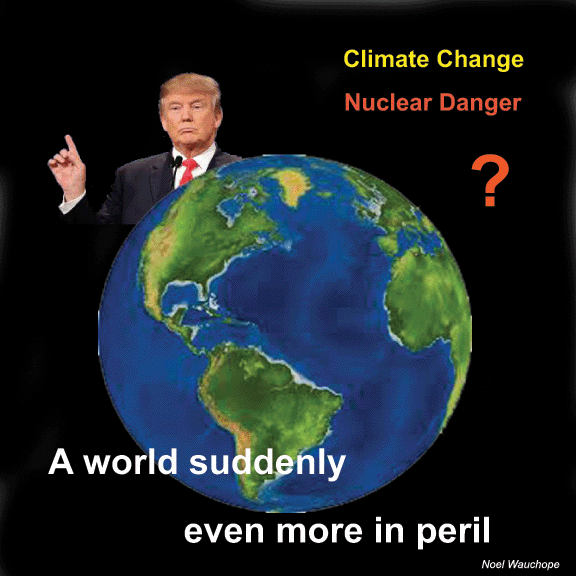
Four more years of Trump would leave democracy, and hope for a safe climate, in tatters
From the perspective of the human species as a whole, the arc of its life on this planet, it may be the most important election ever.
A second Trump term would mean severe and irreversible changes in the climate No joke: It would be disastrous on the scale of millennia. VOX, By David Roberts@drvoxdavid@vox.com Aug 27, 2020, I f Donald Trump is reelected president, the likely result will be irreversible changes to the climate that will degrade the quality of life of every subsequent generation of human beings, with millions of lives harmed or foreshortened. That’s in addition to the hundreds of thousands of lives at present that will be hurt or prematurely end.
This sounds like exaggeration, some of the “alarmism” green types are always accused of. But it is not particularly controversial among those who have followed Trump’s record on energy and climate change……..
………..a Trump victory would make any reasonable definition of “success” on climate change impossible….
More Trump will ensure the continued escalation of global temperatures
We know from the latest IPCC report that the climate target agreed to by nations — no more than a 2° Celsius rise in global average temperatures — is not a “safe” threshold at all. Going from 1.5° to 2° means many more heat waves, wildfires, crop failures, migrations, and premature deaths. We know that every fraction of a degree beyond 2° means more still, along with the increasing risk of tipping points that make further warming unstoppable. Continue reading
Sentencing date for Kings Bay Plowshares moved to October 15 and 16

The six remaining Kings Bay Plowshares defendants have had their sentencing dates moved from September to 
 October 15 and 16. They had requested a continuance because they want to appear in open court in Georgia and the virus situation there is still too out of control to safely allow it.
Steve Kelly has now served almost 29 months in county jails since the action in April, 2018 so has already met the guidelines for his likely sentence. The court may not want to grant him further extensions. (You can send a postcard to Steve to let him know you’re thinking of him. Directions on writing here.)
The other defendants are not sure if they would prefer to seek more continuances or choose virtual appearances for sentencing in solidarity with Steve on those dates in October if it appears unsafe to travel to Georgia at that time. Check the website for updates.
September 9 will be the 40thanniversary of the first plowshares action in King of Prussia, PA. Eight activists, known as the Plowshares Eight, entered the GE plant where nosecones for nuclear missile warheads were manufactured. They hammered on several and poured blood on the nosecones and documents.
There will be a virtual Commemoration of the Plowshares 8 on September 9 at 7 pm ET sponsored by Stop Banking on the Bomb and other Pittsburgh based organizations. Molly Rush, Dean Hammer and John Schuchardt (three of the four living members of the group) will participate in a discussion and reflect on the action which sparked 100 similar acts of disarmament over the years. A summary of the history can be found here: https://kingsbayplowshares7.org/plowshares-history
Email Joyce Rothermel at <rothermeljoyce@gmail.com> to get the Zoom link for Sept 9.
Emile de Antonio’s 1983 film, In the King of Prussia, is about the trial of the Plowshares Eight. The judge is played by Martin Sheen and the defendants are played by themselves. It’s available for viewing on Youtube: https://www.youtube.com/watch?v=kUph8GWFupE
Nuclear colonialism. ICAN says that France must clean up its nucleat test wastelands in Algeria

France must clean up Algerian nuclear test sites: group, https://www.france24.com/en/20200826-france-must- clean-up-algerian-nuclear-test-sites-group 28 Aug 20, France must clean up nuclear test sites in Algeria where radioactive waste remains from testing in the former colony during the 1960s, a Nobel Peace Prize-winning group said Wednesday.
France carried out 17 nuclear explosions in the Algerian part of the Sahara Desert between 1960 and 1966.
Eleven of the tests came after the 1962 Evian Accords ended the six-year war of independence and 132 years of colonial rule.
“France must give the Algerian authorities the full list of where the contaminated toxic waste was buried,” the International Campaign to Abolish Nuclear Weapons (ICAN) said in a new 60-page report.
“The ‘nuclear past’ must no longer remain deeply buried under the sand,” ICAN said, citing the concerned areas as the western Reggane region and a zone close to the In Ekker village.
The campaign group identified contaminated, radioactive elements that have either been buried, or are easily accessible.
“The majority of the waste is in the open air, without any security, and accessible by the population, creating a high level of sanitary and environmental insecurity,” ICAN said.The 2017 Nobel Peace Prize laureate group added that almost nothing has been done to clean the sites, inform the populations and evaluate the risks.
Exposure to radioactive material can cause cancer.
“This case study shows once more an asymmetry of power and an injustice that we find all through nuclear history,” Giorgio Franceschini, director of the Heinrich Boll Foundation which published the report, said in his forward.
“It is not a coincidence that France tested its first nuclear weapon in Algeria, that was still a French colony in 1960,” he added.
France refused to sign up the UN’s 2017 Treaty on the Prohibition of Nuclear Weapons, whereas Algeria signed and is in the process of ratifying the legally binding agreement.
Since Algeria’s independence, Franco-Algerian relations have been tumultuous.
Algerian President Abdelmadjid Tebboune in July called on France to fully apologise for its colonial past.
An apology could “make it possible to cool tensions and create a calmer atmosphere for economic and cultural relations”, especially for the more than six million Algerians who live in France, he said.
“Super Swarm” drones- weaponry as destructive as nuclear weapons

US, China Developing “Super Swarm” Drones With Destruction Power Equivalent To Nuclear Weapons, https://eurasiantimes.com/us-china-developing-super-swarm-drones-with-destruction-power-equivalent-to-nuclear-weapons/ August 28, 2020, EurAsian Times Global Desk
With the US and China leading the development of swarming drone capabilities, they are now looking at not just swarming techniques but also counter swarming tactics. Experts have argued that some drones that are under development are capable of sufficient destructive power to count as Weapons of Mass Destruction.
According to Isaac Kaminer, an engineering professor at the U.S. Naval Postgraduate School who is an expert in the subject of swarming and counter swarming tactics, large-scale adversarial swarms are already an imminent threat. He suggested that stopping a swarm is not simply a matter of driving enough missiles or bullets at it; instead, the swarm has to be outsmarted.
“A swarm with 10,000 or more drones must have extremely high levels of autonomy,” said consultant Zak Kallenborn talking to the Forbes. “No human being could handle the amount of information necessary to make decisions.“
Kaminer defines a ‘Super Swarm’ with large numbers and multiple modes like air, surface, and subsurface threats. The US Navy has already performed offensive swarm operations with its LOCUST drone swarm developed by Raytheon.
According to the developer of LOCUST drone swarm, dozens of small unmanned aircraft systems fly together, filling the sky. Some are collecting information. Some are identifying ground targets. Others might attack the same targets.
“They fly together like a flock of birds, tracking their positions and maintaining their relative positions in the air. Human operators are not needed for every flying drone; instead, they direct the flock as one.”
Currently, the drones are controlled remotely by humans which limits the capabilities both due to the demand for personnel and bandwidth restrictions. Only a few numbers can be used. However, if swarming algorithms are developed it would allow the drones to control itself and hence much larger number can be used increasing its lethality.
It works similar to a swarm of birds or insects. Every member adheres to the same rules to follow cohesion without colliding with each other. This will allow it to work without any central control.
David Hambling, who is also the author of ‘Swarm Troopers: How small drones will conquer the world’, wrote that such a swarm can be defeated by taking advantage of its internal rules – if these can be figured out.
“For example, an entire swarm whose members all have a collision-avoidance rule can be ‘herded’ by a few outsider drones or may be fooled into running into each other. If the members of the swarm are all programmed to attack what they see as the highest-value target in range, then they can all be decoyed into attacking the same dummy.”
The biggest challenge for the US comes from China who is also developing swarming capability as a means of asymmetric warfare, to counterpoise the US advantage in aircraft carriers. Last year, satellite images posted on the Chinese internet displayed a lineup of several drones including the Sharp Sword stealth drone and the Wing Loong Reaper.
Considering the fast pace of development of such technologies it is important to have international laws in place. “The opportunity to develop global norms and treaties around drone swarms and other autonomous weapons is now, “ says Kallenborn. “Collective limits on the number of armed drones in a swarm would reduce the risk to civilians and national security.”
Ohio Attorney General Dave Yost considers legal action over corruption tainted nuclear bailout law
 Ohio Attorney General Considering Legal Action To Stall Nuclear Bailout Rate
  Hikes https://www.wvxu.org/post/ohio-attorney-general-considering-legal-action-stall-nuclear-bailout-rate-hikes#stream/0, By ANDY CHOW August 28, 2020
Ohio Attorney General Dave Yost says he’s considering taking legal action to stall the billion-dollar nuclear power plant bailout as legislators consider a possible repeal to the law that created the subsidies.
The Public Utilities Commission of Ohio have approved the mechanism to be used to increase nearly every ratepayer’s electric bills next year. The increase is part of HB6, a law that creates $150 million in annual subsides to two nuclear power plants.
Yost’s discussion of a possible injunction is the latest action from leaders, advocates and interest groups fighting to repeal HB6, which is said to be the catalyst for a $60 million racketeering scheme.
Michael Hartley with the Coalition to Restore Public Trust says legislators must toss out the law.
“Every single word of it is corrupt, and every single word of it is tainted. That is why, to restore the public trust in Ohio’s government and political system, that’s why the legislature needs to repeal HB6 in its entirety,” Hartley says. “The citizens of Ohio feel duped. They feel that their government duped them on this bill. And therefore, they’re mad, they’re very mad. And they want this repealed.”
Federal investigators say a utility company believed to be FirstEnergy and its subsidiaries funneled millions of dollars to personally and politically benefit former House Speaker Larry Householder (R-Glenford) in exchange for the bailout.
HB6 allowed an increase of $0.85 for everyone’s monthly electric bills. That increase would generate $170 million in annual subsidies, $150 million for nuclear power plants, and $20 million for solar farms.
The bill also created an increase of up to $1.50 a month on electric bills to subsidize two coal plants, Kyger Creek in Gallia County and Clifty Creek in Madison, Indiana.
Several measures in HB6 were priorities for FirstEnergy and its former subsidiary FirstEnergy Solutions, now called Energy Harbor. FirstEnergy CEO Chuck Jones has said he believes the company acted properly in the matter and intends to fully cooperate with investigators.
Water shortage, drought, necessitate shutdown of France’s Chooz Nuclear Plant

 Nuclear reactor in France shut down over drought, Chooz Nuclear Plant on Belgian border turned off after dry summer evaporates water needed to cool reactors, AA, Cindi Cook |25.08.2020 A nuclear power plant in northern France has been temporarily shuttered due to a drought in the area, said the company that runs the plant Tuesday.
The second reactor of the Chooz Nuclear Power Plant, in Ardennes, on the Belgian border, was shut down late Monday night, after the first reactor ceased operations Friday evening.
The actions were taken due to low water levels in the Meuse River, the main artery that runs through the area used to cool the two reactors.
The plant is named after Chooz, the commune where it is located in the Ardennes. The region is on level three of four drought alert levels…….
Water is a crucial ingredient for nuclear plant safety to cool the reactor core. ……
Water restrictions have been imposed this summer in 79 out of the 96 mainland departments in France due to drought conditions. https://www.aa.com.tr/en/europe/nuclear-reactor-in-france-shut-down-over-drought/1952943
A series of safety problems bring EDF’s decision on early shut down of Scotland’s Hunterston nuclear station
Scottish nuclear power station to shut down early after reactor problems
EDF Energy to close Hunterston next year after spending £200m on repairs, Guardian, Severin Carrell and Jillian Ambrose, Fri 28 Aug 2020 Hunterston nuclear power station, one of the UK’s oldest remaining nuclear plants, is to close down next year, earlier than expected, after encountering a series of safety-critical problems in its reactors.
Industry sources told the Guardian that EDF Energy, the state-owned French operator of Hunterston, decided at a board meeting on Thursday afternoon that the plant would stop generating electricity in late 2021, at least two years earlier than planned.
The energy company had hoped to keep generating electricity from the 44-year-old nuclear plant on the Firth of Clyde until 2023, after ploughing more than £200m into repairing the reactor.
Hunterston, which first began generating electricity in 1976, has been offline since 2018 after inspectors discovered 350 microscopic cracks in the reactor’s graphite core.
In October last year the Ferret, an investigative website, reported that at least 58 fragments and pieces of debris had fallen off the graphite blocks as the cracks worsened. It quoted the Office for Nuclear Regulation (ONR) as saying this had created “significant uncertainty” about the risks of debris blocking channels for cooling the reactor and causing fuel cladding to melt.
After a two-year investigation, the ONR said on Thursday that reactor 3 at Hunterston would be allowed to restart as planned, but it would only be allowed to generate electricity for approximately six months.
EDF then plans to apply next spring to extend its life for one final six-month run. EDF said it would begin the process of decommissioning Hunterston no later than the first week of 2022…….
Richard Dixon, the director of Friends of the Earth Scotland, said: “In terms of energy security, clearly there’s no problem. Its reactors haven’t been running and the lights haven’t gone out. What’s more urgent now is to build up renewables and energy efficiency, to make sure the gap left by Hunterston is filled by zero-carbon electricity or energy saving.” ……… https://www.theguardian.com/uk-news/2020/aug/27/hunterston-scottish-nuclear-power-station-to-shut-down-early-after-reactor-problems
Kazakhstan’s moves toward a world free of nuclear weapons
 Leading the way to a world free of nuclear weapons, Today more than ever, the world needs leadership in the field of nuclear non-proliferation and disarmament. Kazakhstan keeps providing this leadership, writes Jonathan Granoff. https://www.euractiv.com/section/central-asia/opinion/leading-the-way-to-a-world-free-of-nuclear-weapons/ 28 Aug 20, Jonathan Granoff is the president of the Global Security Institute.In 1949, the first of over 450 nuclear explosive tests, surprised the residents in towns and villages in the northeast corner of Kazakhstan. The sky lit up with a blinding flash of light followed by an enormous mushroom cloud. In houses books falling from shelves and the crashing of dishes could be heard. They had not been forewarned.
For the next forty years, silently, in the bodies of at least one and half million citizens the consequence of the radioactive fall-out of those hundreds of explosions inflicted numerous diseases such as cancer and horrible birth defects. Not only did the explosions cause cracks in houses and roads.
It caused the crack of tragedy in the hearts of millions. The people of Kazakhstan, because of those nuclear tests in the windswept steppe test site at Semipalatinsk, know all too well the reality of nuclear weapons
Millions of activists worldwide in the late 1980s protested nuclear testing, prominent amongst those protests was the Nevada-Semipalatinsk Movement, bringing together the voices of citizens of the USA and the then Soviet Union.
The protesters in Kazakhstan demonstrated enormous courage for they were still living in a system where political repression posed serious dangers.
But times changed and that became very clear when Kazakhstan’s First President, Nursultan Nazarbayev, came into office. He did not ignore or avoid addressing these dreadful devices and their national and global impact.
He set out to bring his sense of responsibility as a witness to the reality of nuclear weapons into meaningful action, not only for his nation but also for the world.
First and foremost, he supported the brave activists who protested the testing in Kazakhstan and he signed the historic Decree shutting down the Semipalatinsk test site on 29 August 1991.
It should be noted Kazakhstan was then still part of the Soviet Union. In his speeches, Nazarbayev has always emphasized that the closure expressed the will of the people.
This bold gesture helped stimulate a moratorium on testing which has to this day restrained the five permanent members of the Security Council and holders of more than 97% of the world’s nuclear arsenals (the P5) – United States, Russia, China, United Kingdom, and France from further testing.
It also gave momentum to the global movement to create a treaty to end all nuclear testing, the Comprehensive Test Ban Treaty (CTBT). 29 August is now the International Day against Nuclear Tests. It was established on December 2, 2009 at the 64th session of the United Nations General
Soon after the Soviet Union collapsed, Kazakhstan, under the leadership of Nazarbayev, set a precedent in world history by abandoning the world’s 4th largest nuclear arsenal and the status of a de facto nuclear power.
This decision was crucial not only for the formation and further development of Kazakhstan but also had far-reaching global consequences. Kazakhstan had inherited more than 100 stationary-based missiles with about 1,400 nuclear warheads.
In addition, 40 strategic Tu-95 MS bombers with 240 cruise nuclear missiles were deployed in Kazakhstan. Giving up this powerful arsenal gained the nation enormous international good will and recognition, and the moral credibility to demand progress on legal duties of all nuclear weapons states to negotiate the universal elimination of nuclear weapons.
Nazarbayev’s strategic decision was instrumental in stimulating confidence in the maturity of independent Kazakhstan. It remains an action of national pride and international respect.
Kazakhstan also set out to address the nuclear non-proliferation problem. In 2017, under the leadership of Nazarbayev, it created the world’s first bank for low enriched uranium under the auspices of the International Atomic Energy Agency.
This unique mechanism provides countries around the world with the opportunity to develop peaceful nuclear energy without the need to create their own uranium enrichment programs, which represents a proliferation danger.
Kazakhstan has also become an active participant in absolutely all basic international treaties and institutions in the field of non-proliferation of nuclear weapons and a strong contributor to stability in the world.
For example, under Nazarbayev’s leadership, it was a leading contributor in the creation of the Central Asian Nuclear-Weapon-Free Zone (CANWFZ) signed into force by Kyrgyzstan, Tajikistan, Turkmenistan and Uzbekistan on 8 September 2006.
Current President Kassym-Jomart Tokayev is continuing the country’s nuclear non-proliferation and disarmament commitments. The world needs leadership today in this field more than ever.
The Nursultan Nazarbayev Foundation has established the “Nazarbayev Prize for Nuclear Weapon Free World and Global Security”, which is awarded every 2 years on 29 August for outstanding contributions to non-proliferation and disarmament.
It was first presented in 2017 to King of Jordan Abdullah II. In 2019, the laureates were the Executive Secretary of the CTBTO Preparatory Commission, Lassina Zerbo and former IAEA Director-General Yukio Amano (posthumously).
In 2012, Nazarbayev announced the launch of the ATOM Project (Abolish Testing – Our Mission). ATOM is an online petition to world governments to forever abandon nuclear testing and to bring the Comprehensive Nuclear-Test-Ban Treaty into force as soon as possible.
Speaking at the 70th session of the UN General Assembly in September 2015, Kazakhstan’s First President called for making the construction of a world without nuclear weapons the main goal of mankind in the 21st century and the adoption of the UN Universal Declaration on a Nuclear-Weapon-Free World.
In 2016, in his Manifesto: The World, The 21st Century”, Nazarbayev sets forth a comprehensive vision to move toward a world without reliance on militarism and war, but based on a cooperative human-centred approach to security. Now, a recognized official UN document, it contains realistic policy proposals worthy of serious debate today.
The solution of many problems in the field of global security, conflict prevention and resolution, and especially nuclear disarmament depend on the availability of environments and platforms for honest debate and dialogue.
President Nazarbayev thus established the Astana Club – a forum where annually more than 50 world renown politicians and experts discuss current security issues in Eurasia and beyond.
In November 2019, as part of the fifth meeting of the Club, Nazarbayev initiated the creation of an authoritative political platform, the Global Alliance of Leaders for a Nuclear-Free World.
GAL is an alliance of leaders that will allow for an open dialogue with members of the “nuclear club” and make a feasible contribution to strengthening global security.
Kazakhstan, within the framework of the GAL, will act as a neutral dialogue platform for both nuclear and non-nuclear states.
Those who have already supported the project and expressed their readiness to contribute to the implementation of this initiative include former heads of state, heads of international organizations and famous experts: Heinz Fischer (Austrian Federal President 2004-2016), Mohammed El-Baradei, IAEA Director General 1997-2009, Nobel Peace Prize Laureate), Lassina Zerbo (CTBTO Executive Secretary), and others of similar stature.
Nazarbayev, stimulated by perestroika and President Mikhail Gorbachev’s new thinking, developed a vision of a peace loving, open minded, dynamic nation respectful of the rule of law that could be a responsible actor in world affairs.
A bold perspective given the turbulence of these times, it requires diligent and courageous perseverance and a people of enormous dynamism to help advance it, including finding a path to ensuring that the ethnic and religious diversity of their nation can remain harmonious and not lead to conflict as it has been the case so many times in other places. Again, Kazakhstan is providing a good example.
U.S. Air Force pursues ‘dual-use’ conventional nuclear weapons. “conventional nuclear”???
Air Force pursues ‘dual-use’ conventional nuclear weapons This contradiction forms the conceptual basis for the Pentagon’s current nuclear-weapons strategy, Fox News, By Kris Osborn | Warrior Maven 28 Aug 20, It might seem like a paradox: be ready to fight a limited “tactical” nuclear war and maintain an ability to ensure catastrophic annihilation of an enemy with nuclear weapons to keep the peace.
This contradiction forms the conceptual basis for the Pentagon’s current nuclear-weapons strategy, which not only calls for a new generation of intercontinental ballistic missiles (ICBMs), but also directs the development and deployment of several low-yield, tactical nuclear weapons options.
This includes nuclear-armed cruise missiles, submarine-launched nuclear weapons with low-yield warheads, scalable air-launched nuclear missiles and glide bombs………..
Some have raised a concern that developing nuclear and conventional variants of the same weapon might lead an adversary to mistake a conventional attack for a nuclear one, therefore causing major unwanted escalation and starting a nuclear exchange.
Others also maintain that there should not, in any fashion, be room for the concept of a “tactical” or “limited” nuclear war. Any use of nuclear weapons, the thinking goes, should result in the complete and total nuclear destruction of the attacker…….. https://www.foxnews.com/tech/air-force-pursues-dual-use-conventional-nuclear-weapons
EDF’s Hunterston ageing nuclear power station kept going in effort to prolong all EDF’s old reactors
The Ferret 27th Aug 2020, The energy company, EDF, is planning to operate a cracked and ageingnuclear power station at Hunterston in North Ayrshire for another year before closing it down for good. The company is hoping to restart the two 44-year-old reactors at the site for two last six-month periods and then
begin decommissioning them “no later than 7 January 2022”.
being put at risk. They are calling for the plant to be permanently closed down now. The 50-strong group of Nuclear-Free Local Authorities in the UK demanded that both reactors never re-open. “The safest thing to do is to
close Hunterston B and start accelerated decommissioning of its reactors,” said the group’s Scottish convener, Glasgow SNP councillor Feargal Dalton. “We totally disagree with EDF that decommissioning should start in 2022. It should happen now for the sake of public safety.” He added: “The fact it has taken two years and much resource from EDF to provide sufficient information to the ONR to allow a restart to take place is indicative of the level of risk over the structural integrity of these reactors.”
been in such a financial pickle long before the virus hit,” he added.https://theferret.scot/hunterston-cracked-nuclear-reactors-another-year/
-
Archives
- February 2026 (228)
- January 2026 (308)
- December 2025 (358)
- November 2025 (359)
- October 2025 (376)
- September 2025 (258)
- August 2025 (319)
- July 2025 (230)
- June 2025 (348)
- May 2025 (261)
- April 2025 (305)
- March 2025 (319)
-
Categories
- 1
- 1 NUCLEAR ISSUES
- business and costs
- climate change
- culture and arts
- ENERGY
- environment
- health
- history
- indigenous issues
- Legal
- marketing of nuclear
- media
- opposition to nuclear
- PERSONAL STORIES
- politics
- politics international
- Religion and ethics
- safety
- secrets,lies and civil liberties
- spinbuster
- technology
- Uranium
- wastes
- weapons and war
- Women
- 2 WORLD
- ACTION
- AFRICA
- Atrocities
- AUSTRALIA
- Christina's notes
- Christina's themes
- culture and arts
- Events
- Fuk 2022
- Fuk 2023
- Fukushima 2017
- Fukushima 2018
- fukushima 2019
- Fukushima 2020
- Fukushima 2021
- general
- global warming
- Humour (God we need it)
- Nuclear
- RARE EARTHS
- Reference
- resources – print
- Resources -audiovicual
- Weekly Newsletter
- World
- World Nuclear
- YouTube
-
RSS
Entries RSS
Comments RSS
 nuclear-news