Minigrids – the clean energy revolution across Africa and Asia
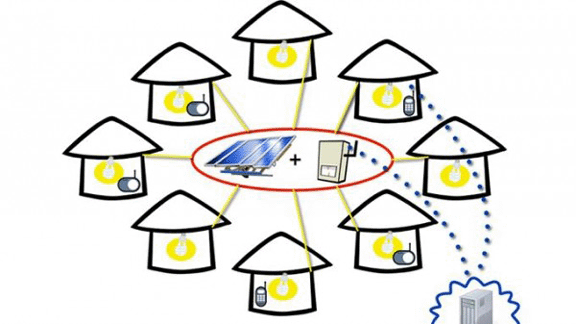
The little-known clean energy revolution https://energy.economictimes.indiatimes.com/news/renewable/the-little-known-clean-energy-revolution/77742430
There are about 5,500 mini-grids in operation across 12 countries in Africa and Asia, according to The State of the Global Mini-grids Market Report 2020 published by the international non-governmental organization Sustainable Energy for All and BloombergNEF, Bloomberg, August 26, 2020,
Over the last decade, the number of people in the world without access to electricity has fallen drastically — from 1.4 billion in 2010 to about 900 million in 2018, according to the United Nations. And yet, if current trends persist, the world won’t be able to meet the UN’s sustainable development goal of universal access to electricity by 2030, with as many as 600 million still lacking basic 21st century services.
It doesn’t have to be so. A new technology has matured and become affordable that could help achieve the laudable goal, and it’s called mini-grids.
As the name suggests, mini-grids are small, isolated versions of larger power grids. They increasingly use solar power as an energy source, with support from batteries or diesel generators. Because the cost of solar power has fallen drastically , mini-grids have become much cheaper than installing long-distance transmission lines from a central electricity grid.
There are about 5,500 mini-grids in operation across 12 countries in Africa and Asia, according to The State of the Global Mini-grids Market Report 2020, published by the international non-governmental organization Sustainable Energy for All and BloombergNEF earlier this year. The report’s authors found that mini-grids could meet the needs of half the people who still need access to electricity in those regions.
As the name suggests, mini-grids are small, isolated versions of larger power grids. They increasingly use solar power as an energy source, with support from batteries or diesel generators. Because the cost of solar power has fallen drastically , mini-grids have become much cheaper than installing long-distance transmission lines from a central electricity grid.
Universal power access will require $128 billion of spending, the report found, but the world is on track to spend only about $63 billion on mini-grids over the next decade. Plugging the gap would cost less than $600 per target household reached.
The need goes beyond money. “Today the mini-grid market is nascent, despite being the least-cost option for electricity access in many areas,” the report concludes. The international Mini-Grids Partnership, which includes the World Bank and other development agencies from rich countries, has approved $2 billion in awards since 2012 but only disbursed 13% of the money, with many projects stuck because of policy uncertainties.
Africa’s most populous country struggles to provide electricity to its 200 million people. Only 55% of the country has access to electricity, and even there, people suffer from power cuts lasting between four and 15 hours every day. As a result, the country spends more than $16 billion annually to power diesel generators.
In 2017, the country passed a law to help mini-grid development, which streamlines the online application process, offers $350 in government subsidies per user once grids with more than 30 users are up and running, and provides for compensation if the main power grid eventually arrives in an area served by a mini-grid. Developers in Nigeria now have simpler processes and clearer guidelines to follow.
The upshot is that mini-grids have become a much more attractive investment. “Now you see a lot of companies flocking to Nigeria,” says Ruchi Soni, program manager at Sustainable Energy for All. “We hear from partners that they would like to replicate Nigeria’s success in their country.”
This offshoot of the clean energy revolution has three benefits: mini-grids can help provide access to electricity to those who lack it and do so in a cleaner and cheaper way. Few things in life are win-win-win.
Welcome to the ‘Pyrocene,’ an Epoch of Runaway Fire
Welcome to the ‘Pyrocene,’ an Epoch of Runaway Fire
Fire scholar Stephen J. Pyne proposes a pyrocentric view of the last 10,000 years — and warns that California’s wildfires herald a very combustible future. Bloomberg City Lab By Laura Bliss, August 27, 2020 It isn’t just California that’s burning. This summer, smoke from massive wildfires in Siberia choked skies as far as Alaska and set new pollution records, in a second consecutive year of unprecedented blazes in the Arctic Circle. Rising temperatures, a loss of precipitation, and parched vegetation are hallmarks of climate change, scientists say, as are the increasingly extreme wildfires that result, from the arid Western U.S. to some of coldest places on Earth.
We have always had what I call “living landscapes,” which are the ones we live in, with growing stuff and dead stuff on the surface. The fires burning in California right now are fires in living landscapes. Then I offer the term “lithic landscape,” which shows a continuity between us burning in one setting and then another. These are the fossil landscapes buried in the past that we’re now burning in the present, with all kinds of strange interactions that we don’t understand.
We can also certainly prevent cities from burning. There is no reason to see them burn like they are. We can shut down the nastier ignition sources like power lines by reinvesting in our grids. We can reimagine how we power our cities: If we had more solar or local power sources, then you would not need [a spread-out electrical grid].
I also think there needs to be a sense of recognition that fire is here to stay, and that we need to work with it in ways that don’t destroy us, or in ways that turn tame fires into feral fires, which is what we have done. Living with fire is an awkward phrase, but it’s true. Unlike Covid-19, there’s no vaccine possible. https://www.bloomberg.com/news/articles/2020-08-27/as-wildfires-rage-the-pyrocene-age-is-upon-us?srnd=citylab
The corrosion of radioactive waste disposal canisters based on in situ tests
 The corrosion of radioactive waste disposal canisters based on in situ tests https://www.sciencedirect.com/science/article/pii/B978012823719900010X, 30 Aug 20,
Abstract
The safe disposal of high-level waste and spent fuel requires the development of disposal canisters with lifetimes of several thousand years. Since iron and copper alloys are the primary canister materials under consideration, corrosion is the main time-dependent degradation mechanism leading to canister failure. In situ corrosion experiments conducted in various underground research laboratories during the past 30–40 years have highlighted the importance of the experimental design, as relatively small differences in design can lead to unexpected phenomena. For example, the importance of confinement in order to decrease microbial activity and achieve low corrosion rates has been shown repeatedly. Furthermore, in situ corrosion experiments have provided insight to repository design and optimization that would not have been possible if the tests were not done in the actual host rock. On the other hand, in order to maximize the usefulness of the obtained results, corrosion-specific experiments with well-defined exposure conditions are needed
Response plan for nuclear emergencies in Castilla-La Mancha
- There is now a response plan for nuclear emergencies in Castilla-La Mancha, the Regional Government in this part of Spain wants to be proactive AUGUST 30, 2020
- TZVETOZAR VINCENT IOLOV Yesterday the official website of the Government of Castilla-La Mancha informed citizens that its representatives had signed an agreement with the Nuclear Safety Council (CSN) of Spain giving the basics for an emergency response plan in the case of nuclear and radiation incidents. This agreement, which has already been published in the autonomous community’s official gazette, will have a validity of four years………… HTTPS://WWW.THEMAYOR.EU/EN/THERE-IS-NOW-A-RESPONSE-PLAN-FOR-NUCLEAR-EMERGENCIES-IN-CASTILLA-LA-MANCHA
Nuclear plant operator appointed as director of schools facilities
 Schools officials have named Christina Renaud, a licensed nuclear plant operator, to take over as director of facilities next month. 30 Aug 20 …….
1 This Month

Petition to revoke the licensing of the Near Surface Nuclear Disposal Facility (NSDF) at Chalk River. https://www.ourcommons.ca/petitions/en/Petition/Details?Petition=e-7247


of the week – STOP SMALL MODULAR REACTORS IN CANADA
To see nuclear-related stories in greater depth and intensity – go to https://nuclearinformation.wordpress.com
-
Archives
- March 2026 (153)
- February 2026 (268)
- January 2026 (308)
- December 2025 (358)
- November 2025 (359)
- October 2025 (376)
- September 2025 (258)
- August 2025 (319)
- July 2025 (230)
- June 2025 (348)
- May 2025 (261)
- April 2025 (305)
-
Categories
- 1
- 1 NUCLEAR ISSUES
- business and costs
- climate change
- culture and arts
- ENERGY
- environment
- health
- history
- indigenous issues
- Legal
- marketing of nuclear
- media
- opposition to nuclear
- PERSONAL STORIES
- politics
- politics international
- Religion and ethics
- safety
- secrets,lies and civil liberties
- spinbuster
- technology
- Uranium
- wastes
- weapons and war
- Women
- 2 WORLD
- ACTION
- AFRICA
- Atrocities
- AUSTRALIA
- Christina's notes
- Christina's themes
- culture and arts
- Events
- Fuk 2022
- Fuk 2023
- Fukushima 2017
- Fukushima 2018
- fukushima 2019
- Fukushima 2020
- Fukushima 2021
- general
- global warming
- Humour (God we need it)
- Nuclear
- RARE EARTHS
- Reference
- resources – print
- Resources -audiovicual
- Weekly Newsletter
- World
- World Nuclear
- YouTube
-
RSS
Entries RSS
Comments RSS
 nuclear-news