Last week in August – nuclear, climate, pandemic news
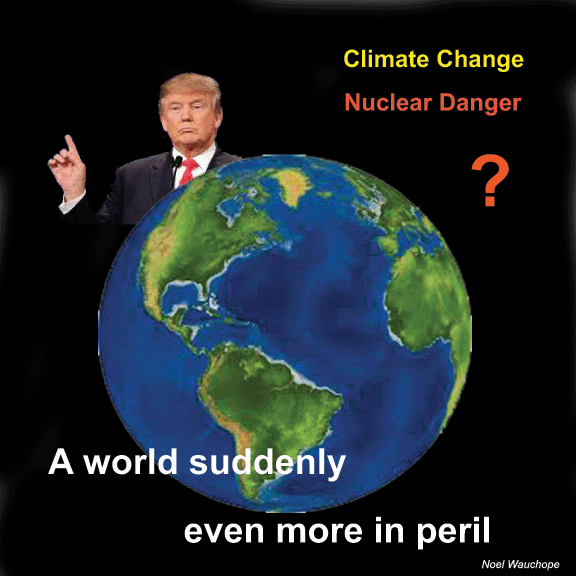
During August, with the 75th anniversary of the Hiroshima and Nagasaki atomic bombings, my websites have focused on nuclear weapons. And so have prominent websites like Beyond Nuclear International. In the wider media world, attention has been on the coronavirus pandemic, with some attention going to the climate crisis, and weather extremes. We know that the pandemic is a global threat to human society. Most people are aware of global heating.
Yet as a subject of concern, nuclear weapons and the risk of nuclear war, seem to be taboo. During this month of commemoration of those horrible nuclear bomb events of 1945, governments of the nuclear-armed nations continue to spend obscene amounts of tax-payers’ money on nuclear weapons. The Women’s International League of Peace and Freedom released its very sobering report on this.— Assuring Destruction Forever: 2020 edition.
The nuclear industry struggles on, fraught as it is with scandals, bribes, corrupt politics and lies. At least from USA, you occasionally get to hear about this: the mind boggles at what it’s like in Russia and China. Of course, the Internet is awash with pro nuclear propaganda – nuclear helping fight coronavirus, nuclear “solving” climate change, nuclear waste giving us new batteries, Bill Gates teaming up with some other nuclear gee-whiz gimmick -providers – all to be done at tax-payer cost, of course.
Some bits of of good news – Some evidence that – People have lasting immunity To COVID-19, even after mild cases. Scientists Uncover Secret In Centuries-Old Mud, Drawing A New Way To Save Polluted Rivers.
Nuclear nations have handled COVID-19 the worst . Global coronavirus update – India’s huge jump in infections, but USA still leads in cases.
Welcome to the ‘Pyrocene,’ an Epoch of Runaway Fire. Major holes in ozone hole treaty must be addressed to avert stronger climate change.
Big oil looks to solve its problems by flooding Africa and Asia with plastic.
“Super Swarm” drones– weaponry as destructive as nuclear weapons.
The corrosion of radioactive waste disposal canisters based on in situ tests .
Analysing the evidence on effects of ionising radiation on wildlife.
Minigrids – the clean energy revolution across Africa and Asia.
ANTARCTICA. Ice melting at a surprisingly fast rate underneath Shirase Glacier Tongue in East Antarctica.
MIDDLE EAST. Expansion of nuclear power in the troubled Middle East – not a good idea.
JAPAN. Evacuation orders for Fukushima radioactive areas to be lifted without decontamination. Strong opposition in Hokkaido to taking on nuclear waste.
EUROPE. Nuclear and gas industries desperate to win EU endorsement AND FUNDING, as clean and green.
USA.
- You can have four more years of Trump, or you can have a habitable planet. But you can’t have both. Trump re-elected would mean unsafe climate for the world, democracy’s end in USA. Not all scientists are objective, especially nuclear scientists running for election. Compromise, compromise: U.S. Democrats almost merging into Republicans.
- If the arms treaty with Russia ends USA will spend even more than the planned $1.2 trillion on nuclear weapons. U.S. Air Force pursues ‘dual-use’ conventional nuclear weapons. “conventional nuclear”?
- Sentencing date for Kings Bay Plowshares activists moved to October 15 and 16.
- The Shoeshone people – theirs the most nuclear bombed territory on Earth.
- Ohio Attorney General Dave Yost considers legal action over corruption tainted nuclear bailout law. Ohio nuclear corruption: Democrats want lawmakers to take action on House Bill 6. Ohio House Democrats will try a “rarely used tool”a discharged petition to repeal nuclear bailout law.– Householder and HB 6: A Nuclear ‘Environmental Nightmare’ Fueled By ‘Corruption‘,
- Exelon demanding Illinois state subsidies for 2 nuclear power stations. Jacksonville Electric Authority (JEA) tried to become part-owner of Plant Vogtle in 2019.
- NuScam’s small nuclear project could fall through – spelling trouble for the whole nuclear industry. Lehi City Council backs out of NuScam ‘small’ nuclear reactor project. Two U.S.cities cut their losses, pullout of dodgy NuScam “small” nuclear reactor project.
- America needs to abandon the idea of Yucca Mountain for nuclear waste dump: both Trump and Biden have. Local opposition to Holtec’s temporary storage for nuclear waste in New Mexico. Army dismantling long dead nuclear power plant at Fort Belvoir.
- Radiation hazard at Dead Horse Bay, Brooklyn.
- Derecho (Extreme wind) Damage Results in Early Retirement of Duane Arnold Nuclear Power Plant.
- Climate science deniers jump on to Far Right with QAnon conspiracy group.
CHINA. The Chinese viewpoint on nuclear deterrence and cyberattacks. Scientists conduct first in situ radiation measurements 21 km in the air over Tibetan Plateau.
UK.
- The Assange extradition hearing – a continued travesty of justice.
- Sizewell nuclear plant to take 20 years to build, emitting 5.7 million tonnes of carbon dioxide. East Suffolk Council dithers over Sizewell C nuclear project, many questions unanswered.
- EDF’s Hunterston ageing nuclear power station kept going in effort to prolong all EDF’s old reactors. Cracks in UK’s Hunterston and other very old nuclear reactors. A series of safety problems bring EDF’s decision on early shut down of Scotland’s Hunterston nuclear station. The closure of Hunterston B will not cause power network outages.
- Frank Barnaby, nuclear weapons scientist and global hero.
FRANCE. Water shortage, drought, necessitate shutdown of France’s Chooz Nuclear Plant.
KAZAKHSTAN. Kazakhstan’s moves toward a world free of nuclear weapons,
CANADA. Canadian Public asked for views on transport of used nuclear fuel.
RUSSIA. Russia releases previously classified film of “Tsar Bomba” the most powerful nuclear bomb blast E\eve.
IRAN. Iran to grant IAEA inspectors access to suspected ex-nuclear sites.
ALGERIA. Nuclear colonialism. ICAN says that France must clean up its nucleat test wastelands in Algeria.
BELARUS. Safety of Belarus nuclear power station in question after IAEA report.
SPAIN. Response plan for nuclear emergencies in Castilla-La Mancha.
PHILIPPINES. Philippines wary of nuclear power: costs to be borne by tax-payer.
AUSTRALIA. Australia entangled in the military-industrial-intelligence-security complex .
75 years on, the plan is still for planet-ending nuclear confrontation
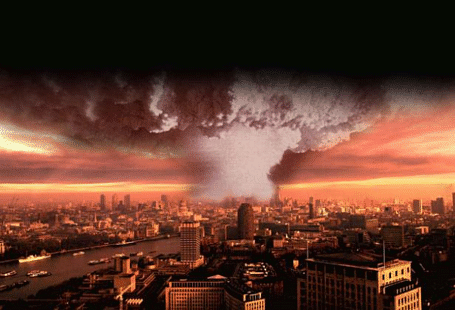
It’s been 75 years Why are we still planning for the ultimate planet-ending act?, By Ray Acheson, on August  30, 2020 by beyondnuclearinternational
Reaching Critical Will, a program of the Women’s International League of Peace and Freedom, has released its new report — Assuring Destruction Forever: 2020 edition. This is its introduction, (edited here for publication timing), a powerful reminder of the lessons humanity has yet to learn, 75 years after the US dropped atomic bombs on the Japanese cities of Hiroshima and Nagasaki.
It’s August 2020. Seventy-five years since a US president sitting in Washington, DC decided to drop two atomic bombs on the people of Japan—one on the city of Hiroshima, the other on Nagasaki. Thus began the nuclear age, marked with the construction of multiple “doomsday machines” programmed for unwinnable wars and global conflagration; astonishing wastes of human and financial resources; bullish, masculinised conflicts among states that deploy violence here and there while dancing around their potential for planet-ending acts; and the relentless peddling of all this as completely, totally, and undeniably rational.
Seventy-five years of apocalyptic potential
But it is not rational. And the continued investment by certain governments in not just the maintenance but also the “modernisation”—the upgrading, updating, and life- extending—of nuclear weapons is absurd, dangerous, and immoral. Fortunately, during the COVID-19 crisis, people are starting to take notice of where all of the money—in many cases, taxpayers’ money—has gone; of why their governments cannot provide basic protective equipment and medical supplies and services during a global pandemic. And even more fortunately, there is something we can do to get rid of the threat of nuclear weapons and release trillions of dollars to deal with real, rather than imagined, crises of security, safety, and stability: we can divest, and we can disarm.
For seventy-five years, the world has lived under the threat of radioactive blast and firestorm, the effects of which are immediately devastating and punishingly intergenerational. For seventy five years, from production to testing and use to storage of radioactive waste, nuclear weapon activities have contaminated land and water—and will continue to do so for thousands of years more. For seventy-five years, a very few governments—nine, at current count—have decided to invest trillions of dollars into these instruments of death and destruction. For seventy-five years, corporations like Lockheed Martin, Boeing, and Bechtel have reaped incredible profits from government contracts for bombs and bombers. Certain academics, politicians, and bureaucrats have risen through the ranks of think tanks or government administrations in positions bankrolled by the nuclear profiteers, spinning theories of “nuclear deterrence” and “strategic stability” to justify this massive, unconscionable investment in technologies of massive violence.
It’s been seventy-five years. Will we reach one hundred if we continue on like this? Can we survive a century with nuclear weapons? Can we survive a century of wasted money and ingenuity; a century of tensions between human beings armed to the death with the capacity to destroy entire cities, countries, the world, in moments; a century of living with this existential threat while another, that of climate change, promises even more damage and uncertainty ahead?
The question of can we, though, is not as relevant as should we. Should we just keep going, the way the nuclear war mongers want? They say we’ll be fine. Better than if we were to disarm, they argue. Eliminating nuclear weapons will “destabilise” international relations, they assert. It will mean another global conflict, invasions and occupations, “dogs and cats living together.”
Preparing for major apocalypse in the midst of a “minor” one
Right now, we are in the midst of a global pandemic for which no governments were sufficiently prepared. We do not have enough basic equipment like ventilators and protection for health care workers. Capitalist economies are tanking as the majority of workers have been ordered to stay at home to prevent the virus from spreading even more rampantly than it has already. Millions of people have lost or will lose their jobs. Hundreds of thousands have and will lose their lives.
But don’t worry: the nuclear-armed states can still launch their nuclear weapons! US Strategic Command has said that the coronavirus has had “no impact” on the ability of the United States to launch its nuclear weapons. “Right now across the command, we are working to make sure that our ICBMs remain on alert and our critical command and control capabilities stay viable,” say those in charge of the US doomsday machine.
While nuclear weapon forces in all nuclear-armed states are likely to be affected by the pandemic and may have to delay or reduce active deployments or other activities they deem necessary for the effectiveness of their “deterrence” doctrines, the fact is that there are still approximately 13,410 nuclear weapons in the world. While this is significantly less than the 70,000+ kicking around in the 1980s, it is still more than enough to destroy our planet many, many times over………….
Even without the detonation of a nuclear bomb, accidentally or on purpose, these weapons are costing lives. The International Campaign to Abolish Nuclear Weapons (ICAN) has calculated annual nuclear weapon spending in three countries and compared it to the costs of meeting immediate health care needs during the coronavirus pandemic. In France, for example, which spends approximately €4.5 billion a year right now on its nuclear weapon programme, the government could redirect those funds to pay for 100,000 hospital beds for intensive care units, 10,000 ventilators, and the salaries of French nurses and 10,000 doctors. In each of the nuclear-armed states, the money spent on nuclear weapons has directly impacted the resources available to deal with the pandemic. ……….
it is not just during the COVID-19 pandemic that we need to be concerned with nuclear weapon maintenance, modernisation, or use. This is a pandemic we live with every day, to the point where it has become completely normal for the vast majority of people in the world. Out of sight, out of mind. Missile tests don’t even make the news. Nuclear weapon tests, such as those most recently by the Democratic People’s Republic of Korea (DPRK), grab the headlines for a moment—but the fact that those most vocally condemning the DPRK’s actions possess far larger nuclear arsenals themselves is virtually never discussed outside of antinuclear activist circles.
We cannot wait until a nuclear weapon is used again before we pay attention and act to end the threat of nuclear war. We don’t have to.
In 2017, the majority of the world’s countries negotiated and adopted the Treaty on the Prohibition of Nuclear Weapons. It outlaws the possession, use, threat of use, and development of nuclear weapons. It closes existing legal gaps in international law, provides for nuclear disarmament, and categorically rejects the idea nuclear weapons provide security or stability.
Among other things, this treaty precludes nuclear weapon modernisation, and bans any assistance—material or otherwise—with such programmes. This follows the letter and spirit of the nuclear Non-Proliferation Treaty (NPT), which obligates nuclear-armed states both to nuclear disarmament and to ceasing the nuclear arms race. None of the nuclear-armed governments are in compliance with either treaty. It is here, on the basis of international law and all of the commitments and actions to which these governments have voluntarily subscribed over the past fifty years, that we can demand an end to nuclear weapons.
It is also on the basis of public health, environmental protection, and of morality and human rights, that we can demand nuclear weapon divestment and disarmament. It is past time to unleash the funds and the forces of human ingenuity to more productive, positive, progressive ends: towards a Green New Deal and a Red Deal. Towards health care, housing, education, food, decarceration and prison abolition, migration, and more. Towards international relations and transnational cooperation based on peace, equity, justice, and solidarity, instead of weapons and war.
Ray Acheson is the Director of Reaching Critical Will, the disarmament program of the Women’s International League for Peace and Freedom. This article forms the introduction to the organizations’ new report — Assuring Destruction Forever. We have elected not to change its British spellings. https://beyondnuclearinternational.org/2020/08/30/its-been-75-years/
Nuclear nations have handled COVID-19 the worst

The most useless of arsenals – Nuclear nations have handled COVID-19 the worst https://beyondnuclearinternational.org/2020/08/30/the-most-useless-of-arsenals/, By Tilman Ruff, August 30, 2020 by beyondnuclearinternational
The Covid-19 pandemic has demonstrated that massive arsenals are useless in a pandemic. The countries that have spent obscene sums on nuclear weapons have failed to provide the most basic of protective equipment against the coronavirus, putting their citizens in danger every day.
New pathogens will continue to evolve, spread and disrupt our world. Indeed as we deplete habitats for other species, wreak climate havoc, and grow food industrially, we can expect new infectious diseases more often.
COVID-19 is just the latest; it will certainly not be the last. Bad enough it is, but far from the worst we could expect.
Exposing vulnerability
COVID-19 has caught even the wealthiest nations unprepared; their massive armaments useless against a small, mindless aggregation of single stranded RNA, a few proteins and a thin lipid envelope about 120 nm across.
Nations investing obscene sums in nuclear weapons that must never be used have been unable to provide the most basic of protective equipment – gowns, gloves, and facemasks for their frontline health professionals putting themselves in danger every day.
The best funded public health organization in the world, the Centers for Disease Control and Prevention of the United States, went from recommending N95 respirators for doctors and nurses at risk to recommending improvised bandanas in the face of severe shortages of the most basic protection costing a fraction of a dollar.
The US government rejected international assistance with test kits and was then left with woefully inadequate numbers of its own faulty kits.
Learning from the pandemic
This coronavirus can teach us a lot if we are willing to learn.
It shows where the real threats to our security lie, for which massive military arsenals and the most powerful WMD are not only useless, but get in the way.
It shows our interconnected vulnerabilities and capacities, that globalized problems respect no borders, are shared and demand cooperative solutions.
It has shown how quickly the exceptional hubris of arrogant leaders serving their own and narrow vested interests can enable great harm to occur; evil measured in monumental failures of leadership, causing tens of thousands of deaths that could readily have been prevented.
It has shown the uselessness of ideological baggage in confronting big challenges.
It has laid bare that respect for truth, evidence and science; and listening to the expert custodians of that evidence, are crucial.
It has demonstrated that changes once deemed unthinkable can be made, and made fast.
It has shown that female leaders are often more sensible and reliable in a crisis, and that we need more of them.
It has shown the great ingenuity, resourcefulness and kindness that people everywhere are capable of.
It has shown that what the science and experts tell us – that new pandemics will occur and that we are woefully prepared to deal with them – will occur if warnings are not heeded.
Choosing to listen
We can prevent some new pandemics from occurring. We can always respond better if we listen to the evidence and prepare well for what can be expected.
If we do not listen to or choose to see the overwhelming evidence of accelerating climate disruption, and quickly and drastically reduce greenhouse gas emissions, catastrophe will bear down on us in our lifetimes and the world our children and grandchildren live in will be much more violent, difficult and impoverished.
If we ignore the reality of what nuclear weapons do, and the growing dangers of their use, then what may be a small risk on any given day, over time will become inevitable.
A final epidemic
This COVID pandemic will abate. However after a nuclear war there will be no re-building, no coming back. It would be the final epidemic. There will not be a health care system in overloaded crisis; there will be no health system and no one able to staff it. We can prepare for a pandemic; for nuclear war there is only prevention.
That is why we have to act now to protect our Earth from rampant heating and the abrupt ice age that would follow the radioactive incineration of nuclear war; as if our lives depended on it, because they do.
We can’t stop all new epidemics. And we don’t yet know if we can eradicate the COVID-19 virus.
But we can and must end nuclear weapons before they end us. The Treaty on the Prohibition of Nuclear Weapons provides the best available path forward. We should heed the lessons of COVID and take that path while we still can.
Tilman Ruff is Associate professor at the Nossal Institute for Global Health, School of Population and Global Health, University of Melbourne, Co-President, International Physicians for the Prevention of Nuclear War (Nobel Peace Prize 1985) and Co-founder of the International Campaign to Abolish Nuclear Weapons (ICAN, Nobel Peace Prize 2017)
This article first appeared on Croakey and is republished with kind permission of the author.
A string of USA nuclear scandals: bribes, corrupt politics and lies, in effort to keep the industry alive

|
Nuclear Industry Politics: Bribes, Corruption and Lies https://www.ewg.org/energy/23289/nuclear-industry-politics-bribes-corruption-and-lies?utm_campaign=EWG+Content&utm_content=1598472836&utm_medium=Social&utm_source=facebook&fbclid=IwAR1paLNGDeZaXdPj0OfluAkJC31n5WWzJdlOTUamCB5IA5The U.S. nuclear industry knows it can’t compete fairly on the open market with safe, clean, cost-effective renewable energy sources like solar, wind and storage batteries, so it’s turning to illegal and unsavory tactics. This year, a string of scandals has exposed how some utilities are willing to use bribes, corrupt politics and lies to keep aging reactors online and planned new plants alive.
|
|
Global coronavirus update – India’s huge jump in infections, but USA still leads in cases
|
Meanwhile, far-right protesters and others have stormed the German parliament building following a protest against the country’s pandemic restrictions. This story will be regularly updated throughout Monday. India records world’s biggest single-day jump in virus casesThe Health Ministry on Sunday local time also reported 948 deaths in the past 24 hours, taking total fatalities to 63,498. India has now reported more than 75,000 infections for four straight days. The surge has raised the country’s total virus tally to over 3.5 million and comes at a time when India is reopening its subway networks and allowing sports and religious events in a limited manner from next month as part of efforts to revive the economy. Even as eight Indian states remain among the worst-hit regions and contribute nearly 73 per cent of the total infections, the virus is now spreading fast in the vast hinterlands, with experts warning that the month of September could be the most challenging. Global cases reach 25 millionThe number of confirmed coronavirus cases globally has topped 25 million, according to a tally kept by Johns Hopkins University. The United States leads the count with 5.9 million cases, followed by Brazil with 3.8 million and India with 3.5 million. The real number of people infected by the virus around the world is believed to be much higher — perhaps 10 times higher in the US, according to the Centres for Disease Control and Prevention — given testing limitations and the many mild cases that have gone unreported or unrecognised. Global deaths from COVID-19 stand at over 842,000, with the US having the highest number with 182,779, followed by Brazil with 120,262 and Mexico with 63,819. Far-right pandemic restriction protesters attempt to storm German parliament Senior German officials have condemned attempts by far-right protesters and others to storm the parliament building following a protest against the country’s pandemic restrictions. Hundreds of people, some waving the flag of the German Reich of 1871-1918 and other far-right banners, breached a security barrier outside the Reichstag late on Saturday local time but were intercepted by police and forcibly removed……… https://www.abc.net.au/news/2020-08-31/coronavirus-update-covid19/12610940 |
|
|

The Shoeshone people – theirs the most nuclear bombed territory on Earth
|
A message from the most bombed nation on earth More than 900 nuclear tests were conducted on Shoshone territory in the US. Residents still live with the consequences https://www.aljazeera.com/indepth/opinion/message-bombed-nation-earth-200809112854257.html by Ian Zabart 30 Aug 20, You never know what is killing you when it is done in secret. I watched my uncle suffer from horrible cancer that ate away at his throat and my grandfather die of an auto-immune disease that is known to be caused by exposure to radiation. They say he had a heart attack, but when your skin falls off, that puts stress on your heart. Many of my cousins have died. Last year, my cousin, who is about 50, had a defibrillator put in his chest. Now his daughter, who is a toddler, has heart problems as well. At around the same time, one of my cousins told me his mom has cancer. And then a week later, he found out he has it, too. A few months ago, an elder here died from a rare form of brain cancer. Every family is affected. We have seen mental and physical retardation, leukaemia, childhood leukaemia, all sorts of cancers. The US military industrial complexI am the Principal Man of the Western Bands of the Shoshone Nation of Indians – the most bombed nation on earth. Our country is approximately 40,000 square miles (25.6 million acres), from just west of Las Vegas, Nevada all the way to the Snake River in Idaho, including a 350-mile (563km) wide strip in the Great Basin. There are approximately 25,000 to 30,000 Shoshone lineal descendants but the United States places the number much lower based on blood quantum (a percentage of ancestry). We have been on this land for at least 10,000 years. Our relationship to the US is based upon the Treaty of Ruby Valley signed in 1863. In the treaty, the Shoshone continued to own the land but we agreed that in exchange for $5,000 a year for 20 years, paid in cattle and other goods, the US could establish military posts on the land, that US mail and telegraph companies could continue to operate telegraph and stage lines on it, that a railway could pass through it, that the US could mine for minerals on it. But shortly before the end of World War II, we started to be overrun by the US military industrial complex, in ways we are only now beginning to understand. Nuclear falloutIn 1951, in violation of the treaty, the US established the Nevada Proving Grounds (what would later become known as the Nevada Test Site and is now known as the Nevada National Security Site) on Shoshone territory and began testing nuclear weapons – without our consent or knowledge. We suspect that Nazi scientists brought to the US as part of Operation Paperclip – to help the US develop nuclear weapons – were involved. On January 27, 1951, the first nuclear test took place on our land, when a one-kilotonne bomb was dropped from a plane flying over the site. Over the next 40 years, it became the premier testing location for American nuclear weapons. Approximately 928 nuclear tests took place on the Shoshone territory – 100 in the atmosphere and more than 800 underground. When the US dropped an atomic bomb on Hiroshima in 1945, 13 kilotonnes of nuclear fallout rained down on the Japanese city. According to a 2009 study in the Nevada Law Journal, between 1951 and 1992, the tests conducted on our land caused 620 kilotonnes of nuclear fallout. I was born in 1964, a year after above-ground testing of nuclear weapons was banned. But the US continued to test weapons of mass destruction under our land almost every three weeks until 1992. The downwindersThe fallout from these tests covered a wide area, but it was Native American communities living downwind from the site who were most exposed – because we consumed contaminated wildlife, drank contaminated milk, lived off contaminated land. For Native American adults, the risk of exposure has been shown to be 15 times greater than for other Americans, for young people that increases to 30 times and for babies in utero to two years of age it can be as much as 50 times greater. When the fallout came down, it killed the delicate flora and fauna, creating these huge vulnerabilities across thousands of square miles of Shoshone territory. The pine trees we use for food and heating were exposed, the plants we use for food and medicine were exposed, the animals we use for food were exposed. We were exposed. As a result, we have watched our people die. Some of the strongest defenders of our land, of our people, just gone. But we have to protect our land and our people. Our identity is the land. Our identity is the pure pristine water coming out of the ground, flowing for millions, tens of millions, hundreds of millions of years. We see that pure water as a medicine. People need that pure water to heal. But what we find is that we have the US brokering for the nuclear industry, brokering for the mining industry, the destruction of our property for profit. We cannot endure any further risk, whether from nuclear weapons testing or coal ash or oil tracking, any radiation source at all. Hammers and nailsWe are beginning to understand what has happened to us. For more than 50 years, we have been suffering from this silent killer and the US government’s culture of secrecy keeps it silent. But we need relief. In every other part of the world where there have been nuclear catastrophes or nuclear testing – such as Kazakhstan, Japan, even Chernobyl – there are health registries to monitor those who have been exposed, even if the numbers are kept artificially low in some places. We do not have that here in the US. We do not have that for Native American downwinders. We need that kind of testing. We need health registries. We need monitoring. We cannot wait any longer for the health disparities we are experiencing to be identified. We are having to fight the US to get it to understand our basic health needs. We have managed to obtain documents that were declassified in the 1990s. But there are almost two million pages. Trying to understand all of that is daunting. We do not have any funding and we do not have the support of the US to get that work done. So we are having to do this ourselves as we suffer through this continuing health crisis. We have managed to obtain documents that were declassified in the 1990s. But there are almost two million pages. Trying to understand all of that is daunting. We do not have any funding and we do not have the support of the US to get that work done. So we are having to do this ourselves as we suffer through this continuing health crisis. |
|
Climate change and its impacts are not just the future: they are now

Everything Is Unprecedented. Welcome To Your Hotter Earth, NPR, REBECCA HERSHER, NATHAN ROTT, LAUREN SOMMER-30 Aug 20,
|
The upshot of climate change is that everyone alive is destined to experience unprecedented disasters. The most powerful hurricanes, the most intense wildfires, the most prolonged heat waves and the most frequent outbreaks of new diseases are all in our future. Records will be broken, again and again. But the predicted destruction is still shocking when it unfolds at the same time. This week, Americans are living through concurrent disasters. In California, more than 200,000 people were under evacuation orders because of wildfires, and millions are breathing smoky air. On the Gulf Coast, people weathered a tropical storm at the beginning of the week. Two days later, about half a million were ordered to evacuate ahead of Hurricane Laura. We’re six months into a global pandemic, and the Earth is on track to have one of its hottest years on record. Climate scientist Camilo Mora of the University of Hawaii says if our collective future were a movie, this week would be the trailer. “There is not a single ending that is good,” he says. “There’s not going to be a happy ending to this movie.” Mora was an author of a study examining all the effects of climate change. The researchers concluded that concurrent disasters will get more and more common as the Earth gets hotter. That means we will live through more weeks like this one — when fires, floods, heat waves and disease outbreaks layer on top of one another. “Keep in mind that all these things are related,” Mora explains. “CO2 is increasing the temperature. As a result, the temperature is accelerating the evaporation of water. The evaporation of water leads to drought that in turn leads to heat waves and wildfires. In places that are humid, that evaporation — the same evaporation — leads to massive precipitation that is then commonly followed by floods.” Disease outbreaks are also more likely. The most recent U.S. National Climate Assessment warns that changing weather patterns make it more likely that insect-borne illnesses will affect the U.S. Climate change is also causing people and animals to move and come in contact with one another in new and dangerous ways. If humans dramatically reduce greenhouse gas emissions immediately, scientists say it will help avoid the most catastrophic global warming scenarios. Worldwide emissions are still rising, and the United States is the planet’s second-largest emitter. Mora says helping people connect the dots between the current disasters and greenhouse gas emissions should be every scientist’s priority. “That’s the million-dollar question,” he says. “How do we speak to people in a way that we get them to appreciate the significance of these problems?” Hurricanes and climate change Climate change is making the air and water hotter, and that means more power for hurricanes. “Whenever you get ocean temperatures that are much above average, you’re asking for trouble,” meteorologist Jeff Masters explains. “And we’ve seen some of the warmest ocean temperatures on record for the Atlantic basin this year.” Hot water is like a battery charger for hurricanes. As a storm moves over hot water, like Hurricane Laura did this week, it captures moisture and energy very quickly. In recent years, scientists have seen evidence that global warming is already making storms more likely to grow large and powerful and more likely to intensify quickly. …….. Scientists have also found that hurricanes are dropping more rain, which means more flooding. Flooding is consistently the most deadly and damaging effect of a hurricane. Studies show many people underestimate the flood risks from hurricanes. Just a few inches of moving water can make it impossible to stay on your feet or control your car. Add all that to the current pandemic, and you get a dangerous situation, especially for people living in the path of the storm. As NPR has reported, safe options for people who evacuate this year could be limited because group shelters might accept fewer people in order to maintain social distancing. ………. “People are becoming more vulnerable as this COVID crisis goes on,” Morris says, as more people get laid off or run out of savings. “We have frankly been failing to serve the most vulnerable, and the people who have been made vulnerable by these cascading catastrophes.” Wildfires and Climate Change The fingerprints of climate change are all over the Western wildfires, too. ………. Fires are burning more frequently and intensely in places where they’ve always occurred, and they’re creeping into places where they were previously rare. …………….. How bad it eventually gets depends on how quickly the world can reduce carbon emissions. But the past weeks should make clear: “Climate change and its impacts are not the future,” says Crystal Kolden, a fire scientist at the University of California, Merced. “They are now.” https://www.npr.org/2020/08/28/905622947/everything-is-unprecedented-welcome-to-your-hotter-earth?utm_campaign=storyshare&utm_source=twitter.com&utm_medium=social |
|
Ohio House Democrats will try a “rarely used tool”a discharged petition to repeal nuclear bailout law
 House Democrats to push nuclear bailout repeal, https://www.tribtoday.com/news/local-news/2020/08/house-democrats-to-push-nuclear-bailout-repeal/, DAVID SKOLNICK, Reporterdskolnick@tribtoday.com 30 Aug 20, WARREN — State Reps. Michael J. O’Brien and Michael Skindell will try to push the Ohio House to vote Tuesday to repeal the controversial House Bill 6 that bailed out two failed nuclear power plants and is at the heart of a federal political corruption case. House Democrats to push nuclear bailout repeal, https://www.tribtoday.com/news/local-news/2020/08/house-democrats-to-push-nuclear-bailout-repeal/, DAVID SKOLNICK, Reporterdskolnick@tribtoday.com 30 Aug 20, WARREN — State Reps. Michael J. O’Brien and Michael Skindell will try to push the Ohio House to vote Tuesday to repeal the controversial House Bill 6 that bailed out two failed nuclear power plants and is at the heart of a federal political corruption case.
O’Brien, D-Warren, said he and Skindell, D-Lakewood, will try a “rarely used tool” — called a discharged petition — to bypass committee hearings on their legislation to repeal HB 6 and bring it to the House floor for a vote. The petition is permitted under House rules if a bill hasn’t been assigned to a committee at least 30 days after it was introduced, he said. This bill was proposed July 29 and hasn’t been given a committee assignment. The effort needs the signatures of at least 50 of the House’s 99 members to get on the floor of the legislative body for a vote. There are 52 Republicans and 37 Democrats in the House. O’Brien said he and Skindell are seeking to get support through electronic signatures, because of the COVID-19 pandemic, by Monday and have a vote taken Tuesday. Tuesday is the first day the House will be in session since the bill was proposed. “There’s hardly any additional debate needed on the issues,” O’Brien said. “Hopefully we’ll receive enough signatures. Republicans have a similar bill. There’s enough collective thought to repeal.” Former House Speaker Larry Householder, R-Glenford, and four associates — including former Ohio Republican Party Chairman Matt Borges — were arrested on federal racketeering charges in a $60 million bribery case related to the taxpayer-funded bailout of two nuclear power plants near Cleveland and Toledo through HB 6. Householder was a driving force behind the rescue, pushing through a plan to subsidize the plants and eliminate renewable energy incentives. The bill provided a $1.3 billion ratepayer bailout of the plants owned by former subsidies of FirstEnergy Corp. last year. The rescue adds a new fee to every electricity bill in the state from 2021 to 2027 for the two plants. Several Republicans — including those who voted for the bill — support a repeal. “It’s widely known that corruption was involved with House Bill 6,” O’Brien said. “When corruption is revealed, we need to act quickly. We feel House Bill 6 should be repealed immediately. We’ve been hearing from constituents on this issue requiring immediate attention.” There’s a similar bill in the Senate co-sponsored by state Sens. Sean O’Brien, D-Bazetta, and Stephanie Kunze, R-Hilliard. Sean O’Brien said he spoke to Senate President Larry Obhof, R-Medina, who plans to refer it to a committee, most likely Energy and Public Utilities, with sponsor testimony occurring this week. Obhof “wants a straight repeal,” O’Brien said. “I think it will go pretty quickly. He said it would be done by election time.” |
Big oil looks to solve its problems by flooding Africa and Asia with plastic
Big Oil Is in Trouble. Its Plan: Flood Africa With Plastic. https://www.nytimes.com/2020/08/30/climate/oil-kenya-africa-plastics-trade.html
Faced with plunging profits and a climate crisis that threatens fossil fuels, the industry is demanding a trade deal that weakens Kenya’s rules on plastics and on imports of American trash. NYT, By Hiroko Tabuchi, Michael Corkery and Carlos Mureithi, Aug. 30, 2020
Confronting a climate crisis that threatens the fossil fuel industry, oil companies are racing to make more plastic. But they face two problems: Many markets are already awash with plastic, and few countries are willing to be dumping grounds for the world’s plastic waste……..
Last year, Kenya was one of many countries around the world that signed on to a global agreement to stop importing plastic waste — a pact strongly opposed by the chemical industry. Emails reviewed by The Times showed industry representatives, many of them former trade officials, working with U.S. negotiators last year to try to stall those rules.
The industry thinks it has found a solution to both problems in Africa.
According to documents reviewed by The New York Times, an industry group representing the world’s largest chemical makers and fossil fuel companies is lobbying to influence United States trade negotiations with Kenya, one of Africa’s biggest economies, to reverse its strict limits on plastics — including a tough plastic-bag ban. It is also pressing for Kenya to continue importing foreign plastic garbage, a practice it has pledged to limit.
Plastics makers are looking well beyond Kenya’s borders. “We anticipate that Kenya could serve in the future as a hub for supplying U.S.-made chemicals and plastics to other markets in Africa through this trade agreement,” Ed Brzytwa, the director of international trade for the American Chemistry Council, wrote in an April 28 letter to the Office of the United States Trade Representative.
The United States and Kenya are in the midst of trade negotiations and the Kenyan president, Uhuru Kenyatta, has made clear he is eager to strike a deal. But the behind-the-scenes lobbying by the petroleum companies has spread concern among environmental groups in Kenya and beyond that have been working to reduce both plastic use and waste.
Kenya, like many countries, has wrestled with the proliferation of plastic. It passed a stringent law against plastic bags in 2017, and last year was one of many nations around the world that signed on to a global agreement to stop importing plastic waste — a pact strongly opposed by the chemical industry.
The chemistry council’s plastics proposals would “inevitably mean more plastic and chemicals in the environment,” said Griffins Ochieng, executive director for the Centre for Environmental Justice and Development, a nonprofit group based in Nairobi that works on the problem of plastic waste in Kenya. “It’s shocking.”
The plastics proposal reflects an oil industry contemplating its inevitable decline as the world fights climate change. Profits are plunging amid the coronavirus pandemic, and the industry is fearful that climate change will force the world to retreat from burning fossil fuels. Producers are scrambling to find new uses for
an oversupply of oil and gas. Wind and solar power are becoming increasingly affordable, and governments are weighing new policies to fight climate change by reducing the burning of fossil fuels.
Pivoting to plastics, the industry has spent more than $200 billion on chemical and manufacturing plants in the United States over the past decade. But the United States already consumes as much as 16 times more plastic than many poor nations, and a backlash against single-use plastics has made it tougher to sell more at home……….
The Kenya proposal “really sets off alarm bells,” said Sharon Treat, a senior lawyer at the nonpartisan Institute for Agriculture and Trade Policy who has worked for more than a decade advising trade talks in both the Trump and Obama administrations. Corporate lobbyists “frequently offer up very specific proposals, which the government then takes up,” she said. ………..
The plastics industry’s proposals could also make it tougher for to regulate plastics in the United States, since a trade deal would apply to both sides.
The records, obtained through Freedom of Information Act requests by Unearthed, a London-based affiliate of the environmental group Greenpeace, paint a picture of close ties between the trade representatives, administration officials and industry representatives. …………..
Kenya isn’t the only country taking measures to curb plastics. A recent report by the United Nations counted 127 countries with policies on the books to regulate or limit use.
In response, the industry has tried to address the plastics issue. The Alliance to End Plastic Waste — formed by oil giants like Exxon Mobil and Chevron, as well as chemical companies like Dow — last year pledged $1.5 billion to fight plastic pollution. That figure, critics point out, is a small fraction of what the industry has invested in plastic infrastructure.
Manufacturers “say they will address plastic waste, but we say plastic itself is the problem,” Mr. Ochieng said. “An exponential growth in plastics production is just not something we can handle.”………….
Despite the industry opposition, last year more than 180 countries agreed to the restrictions. Starting next year, the new rules are expected to greatly reduce the ability of rich nations to send unwanted trash to poorer countries. The United States, which has not yet ratified the Basel Convention, won’t be able send waste to Basel member nations at all……
That setback has re-energized industry to seek deals with individual countries to boost the market for plastics, and find new destinations for plastic waste, analysts say.
In Nairobi, local groups are worried. “My concern is that Kenya will become a dumping ground for plastics,” said Dorothy Otieno of the Centre for Environmental Justice and Development. “And not just for Kenya, but all of Africa.” https://www.nytimes.com/2020/08/30/climate/oil-kenya-africa-plastics-trade.html
The Assange extradition hearing – a continued travesty of justice

 Assange Travesty Continues https://www.craigmurray.org.uk/archives/2020/08/assange-travesty-continues/?fbclid=IwAR2MvHqWNmC2Z7gpPI3I24-XwXRvFGIUFmxoa5LgBm5vJqgDJ3BxSDexU4U
By 7 September it will be six months since I applied to resume my membership of the National Union of Journalists. I STILL have not the slightest idea who objected, or what the grounds were for objection. I have not heard from the NUJ for months. A senior official of an international journalists’ organisation has told us that he inquired, and learnt that the NUJ national executive has considered my application and set up a sub-committee to report. But if so, why is this secret, why have I not been informed, and why am I not allowed to know what the objection is? I find this all very sinister. At this stage it is not paranoid to wonder whose hand is behind this.
The practical effect of this is that without NUJ membership I cannot access a Press card, and avail myself of whatever media arrangements are in place for the Assange hearing (just as I was kept out of most of the Salmond trial). I have now reached the stage where I would like to take legal action against the NUJ, but the finances are beyond me. I am not going to ask you to donate because we are going to need all our resources for the contempt case against me, which the Crown drags out.
I shall be writing next week about my own case and that hearing earlier this week. I would just note now that the “virtual hearing” is entirely unsatisfactory and unfair on defendants. There was at least one occasion when my QC agreed with a suggestion of the judge when I would have instructed them not to had I been, as I should normally have been, seated near them in court and able to instruct.
Unlike our adversaries including the Integrity Initiative, the 77th Brigade, Bellingcat, the Atlantic Council and hundreds of other warmongering propaganda operations, this blog has no source of state, corporate or institutional finance whatsoever. It runs entirely on voluntary subscriptions from its readers – many of whom do not necessarily agree with the every article, but welcome the alternative voice, insider information and debate.
Ohio nuclear corruption: Democrats want lawmakers to take action on House Bill 6
Some lawmakers demand action on nuclear bailout bill amid corruption scandal, The Highland County Press, By Todd DeFeo, The Center Square, 30 Aug 20, https://www.thecentersquare.com/
Democrats want lawmakers to take action on House Bill 6, a ratepayer-funded bailout of nuclear power plants in Ohio, when the state House convenes next week, but one Republican says any replacement must prioritize nuclear energy.
“When corruption is revealed, it is important we as lawmakers act quickly to fix what has been broken,” Reps. Michael J. Skindell, D-Lakewood, and Michael J. O’Brien, D-Warren, said in a letter to members of the House of Representatives. Last month, the lawmakers introduced legislation, House Bill 738, to repeal the bill, but it has not yet been assigned to a committee.
“Our constituents are telling us that this issue requires our immediate attention and action, and every day that passes further erodes the public’s trust in this institution and in each of us,” they added.
The lawmakers want to use a discharge petition, “a seldom-used parliamentary maneuver.” According to House rules, “a bill can be discharged from a committee with the signatures of a majority of members (50) once the bill has sat in committee for 30 days,” they wrote.
HB6 created a new Ohio Clean Air Program to support nuclear energy plants and some solar power facilities. Electricity consumers fund the program, potentially bringing in up to $85 million in the 2021 fiscal year, with a surcharge that runs through 2027.
Lawmakers pushed the measure after Akron-based FirstEnergy Solutions said it planned to close Davis-Besse Nuclear Power Station in Oak Harbor near Toledo and Perry Nuclear Power Plant in Perry. FirstEnergy Solutions filed for bankruptcy in March 2018 and emerged earlier this year as Energy Harbor.
Several high-profile Republicans, including Gov. Mike DeWine, have called for the repeal of the legislation. Senate President Larry Obhof, R-Medina, told The Columbus Dispatch the state Senate would take up a repeal of HB6 when it meets in September.
Climate science deniers jump on to Far Right with QAnon conspiracy group
In May, a second Q-Drop riffed on climate change, with a link to a snarky tweet about science and the Swedish teen climate activist Greta Thunberg by a would-be House Republican who’d lost her primary race in March.
Both of those Q-Drops were picked up by a report commissioned by a coalition of environmental groups and conducted by the research firm Graphika, which found that a group of vocal climate science deniers began using QAnon hashtags in May — and they haven’t stopped since.
“The QAnon movement hasn’t traditionally covered climate change, but in May, when an influential QAnon account tweeted about climate denial, there was a notable and sustained increase of QAnon content shared within the climate denial group,” Michael Khoo, an advisor on disinformation for the environmental group Friends of the Earth, and Melissa Ryan, CEO of CARD Strategies and author of the Ctrl Alt-Right Delete weekly newsletters, wrote in an article published today on Medium.
Asked and Answered
The questions that Q advanced on climate change have been asked and answered — as essentially all of the burning questions on climate science still churning around in climate denial circles have been.
And today, as the impacts of a warming climate are accelerating, it is very clear that we collectively have little time to spare waiting until those who haven’t been keeping up with, or who refuse to acknowledge, the scientific consensus are convinced. The longer the world waits to slash greenhouse gas pollution, the less chance we collectively have to calm the worst impacts of a warming world, according to the world’s top climate experts, and if we don’t, climate change could make all of the calamities we’ve faced in 2020 soon pale in comparison.
Q, however, raised different concerns about climate action.
“Who audits where the money goes?” the December Q-Drop asked, linking to an article about the Green Climate Fund, which provides funding to help developing countries reduce their greenhouse gas emissions to help them meet their Paris Agreement goals.
Nevermind that if you want the audits of the Green Climate Fund alluded to in the Q-Drop, the answer is extraordinarily unmysterious and unglamorous: the audited financial statements are posted online and they’re done by accountants. Nevermind also that the Paris Agreement itself was never fundamentally about the movement of money, but instead involves countries promising to regulate pollution inside their borders — something we’re still continuing to fail to do, both in the United States and worldwide.
And nevermind that the U.S., whose politicians the Q-Drop implies are pocketing money somehow along the way, has nearly walked away from both the Paris Agreement and the Green Climate Fund. That’s despite the glaring fact that the U.S. has been the world’s worst climate polluter since 1750, meaning that this country has played the single largest role in causing the very problem that the global climate pact attempts to (somewhat) address.
To turn Q’s question around, one very basic question Q has never answered is who exactly they are — and to what extent, if any, they’ve sought to monetize the power and influence they’ve been busy amassing. “At this point, who’s behind it is speculation more than anything,” Ryan told DeSmog.
Another key part of the problem — as ever — is that climate science deniers publicly talk a lot more than others. Whereas in years past, mainstream media was faulted for giving climate science deniers a misleading amount of airtime, today, they’re using social media to achieve the same ends. Graphika’s research found that for every social media post by the vocal climate scientists and environmentalists they studied, the vocal climate science deniers they studied posted four times.
“On average, they observed that the Climate Denial group was about four times ‘louder’ (number of tweets relative to the group size) than the Climate Science group,” Khoo and Ryan, both advisors to a coalition of environmental groups that commissioned Graphika’s research, wrote.
Clutching at Q’s Coattails
Not only is QAnon taking up climate denial, but prominent climate deniers have been taking up QAnon.
“The other thing we see is that the right needs QAnon more and more to amplify their messaging,” said Ryan.
Take, for example, Naomi Seibt, a young German YouTuber who has questioned climate science and who has worked with the Heartland Institute, a U.S. think tank and notorious promoter of climate science denial………….
As in Germany, white supremacists in the U.S. have increasingly engaged in racially motivated “mass shooter” armed attacks on unarmed people. And QAnon followers have also begun committing violent acts. “I think it’s also important to remember that the FBI has declared QAnon a domestic terrorism threat,” said Ryan, “and QAnon has inspired kidnappings, it has inspired at least one murder, it has inspired arson, there is a real danger from these folks who are drawn to this and become just embroiled in it.”…………
Social Media Fail
Khoo and Ryan pointed to the ways that social media companies for years failed to conduct the most basic scrutiny of information that they publish online and allowed all sorts of demonstrably false information to be repeated in an endless rumor mill online.
“Facebook has policies that let Trump lie uninterrupted,” they wrote. “And when climate deniers get a simple fact-check on Facebook, members of Congress themselves have sent letters to company executives to complain.”
All of this can, of course, have significant policy consequences in the real world.
“The danger for environmental advocates and for the planet is that QAnon could be the energy that stops a big push for any meaningful climate action,” Khoo told DeSmog. “If a Green New Deal is the next thing, we could see QAnon followers serving as the foot soldiers in that war.”
There’s also the risk that fossil fuel companies and trade organizations might jump on the QAnon bandwagon, inspired by the conspiracy theory’s popularity. Last week, President Trump praised the movement, claiming not to know much about it except that “they like me very much.”
“If QAnon becomes more mainstream,” Ryan said, “I could see a scenario where industry groups that are invested in climate denial and fossil fuels and such will be incentivized to embrace QAnon or rely on those tactics and networks.”
The other risk is that conspiracy theorizing, when mixed with social media, can not only bring in adherents, it can also raise money.
“The new addition to this history of climate capitalism is the capitalism behind the clicks, the monetizing of disinformation that happens on all the platforms,” Khoo and Ryan wrote. “Virality is central to the profit model, as are ads. Whether or not they’re true is secondary, from a business perspective.”
And the reality is that QAnon has been growing, with NBC News reporting earlier this month that Facebook discovered QAnon accounts and pages have attracted over 3 million member and follower accounts.
Last week, Facebook removed nearly 800 QAnon groups and took some steps to restrict QAnon hashtags and other social media. That follows moves by Twitter to take down roughly 7,000 Twitter accounts and designating QAnon as “coordinated harmful activity.”
Some see that as far too little, far too late. “They’ve had three years of almost unfettered access outside of certain platforms to develop and expand,” Brian Friedberg, a senior researcher at the Harvard Shorenstein Center’s Technology and Social Change Project, told MIT Technology Review in July.
As of press time, Facebook and Heartland have not responded to questions from DeSmog. https://www.desmogblog.com/2020/08/27/qanon-conspiracy-naomi-seibt-climate-science-deniers?utm_source=DeSmog%20Weekly%20Newsletter
Canadian Public asked for views on transport of used nuclear fuel
 Public asked for views on transport of used nuclear fuel Owen Sound The Sun Times Scott Dunn 27 Aug 20 The Nuclear Waste Management Organization wants public input on its planning framework concerning shipping about 5.5 million used nuclear fuel bundles by road and possibly rail, to a permanent storage site, possibly in Bruce County.Spent nuclear fuel rods are currently stored above ground at nuclear sites and the aim is to create a long-term storage solution.
The NWMO’s draft transportation planning framework, based partly on public consultations since 2016, is the subject of a detailed online survey. The survey contains background and facts about the plan and about the management and transportation of used nuclear fuel.
There are five sections to comment on: The basic requirements of used nuclear fuel transportation planning, the plan’s objectives and principles, environmental protection, who needs to be involved in decision-making, and how should the modes and routes be decided. The survey can be found at https://ca.surveygizmo.com/s3/50081627/NWMOworkbookSMEN…....South Bruce, the local municipality near the Bruce Power nuclear station on Lake Huron, is one of two locations which remain potential sites for a $23-billion permanent storage facility buried deep underground.
So far, South Bruce has not declared itself a willing host, or even how that conclusion would be arrived at, though an opposition group has called for a community vote and the mayor has suggested that might be the solution.
The other remaining potential site is Ignace area, northwest of Lake Superior.
Approval of the local First Nations people is also required and earlier this year they turned down a separate plan to bury low- and mid-level nuclear waste in a dedicated underground vault at the Bruce nuclear site.
NWMO says it expects to select its preferred location for the used nuclear fuel vault in 2023. Operation of the deep geological repository and transportation of used nuclear fuel is planned to start in the 2040s. Transport of the bundles will take about 40 years.
The used nuclear fuel will be transported by roads and possibly rail, depending on the location of the repository.
“If an all-road approach were taken, this might involve about 620 truck shipments each year, approximately one-to-two shipments per day. If an all-rail approach were taken, this might involve about 60 train shipments each year, approximately one shipment every six days,” says the organization’s Moving Forward Together document, found on the NWMO website……….. https://www.owensoundsuntimes.com/news/local-news/public-asked-for-views-on-transport-of-used-nuclear-fuel
Cracks in UK’s Hunterston and other very old nuclear reactors
 Radio Scotland (From 1:41:33) 29th Aug 2020, Rob Edwards speaking about Hunterston. The lifetime of Hunterston has been extended 3 times. The problem is these very old reactors have developed all
these cracks.
Reactor 3 has an estimated 377 cracks. Reactor 4 has 209.
Those are only estimates based on looking at a part of the core. They have
underestimated the number of cracks that would appear in the past. If you
have too many cracks you get bits of debris breaking off so the graphite
core of these reactors start to crumble and that in some scenarios could
cause the core to overheat.
They are balancing how much money they can make
out of the plants against a leak. Climate change has been used by the
industry to try to make themselves look better. Hunterston has been closed
for most of the last two years.
The closure of Hunterston B will not cause power network outages
|
Insider Media 28th Aug 2020, The closure of Hunterston B will not cause power network outages,
Scotland’s energy minister Paul Wheelhouse has insisted. The nuclear power station is to close by January 2022, according to operator EDF Energy, almost two years earlier than expected. Last year, Scottish Gas owner
Centrica blamed interruption of electricity supply from Hunterston for loss of income. Wheelhouse reiterated the Scottish Government’s position that no new nuclear power stations should be built in Scotland, with energy generated by renewable sources instead. He said that for a two-month period
in 2018, Hunterston B was entirely offline and the Torness nuclear power station in East Lothian was operating at reduced capacity, but it caused no issues for the energy supply. Wheelhouse told the BBC: “Scotland, in the last year for which we got full statistics, exported a net 15.9 terawatt hours of energy – which dwarfs the output of Hunterston.” https://www.insider.co.uk/news/energy-minister-hunterston-closure-not-22593000 |
|
1 This Month

of the week – Shut Down Drone Warfare!


Tell the Ukrainian Government to Drop Prosecution of Peace Activist Yurii Sheliazhenko

Petition to revoke the licensing of the Near Surface Nuclear Disposal Facility (NSDF) at Chalk River. https://www.ourcommons.ca/petitions/en/Petition/Details?Petition=e-7247
To see nuclear-related stories in greater depth and intensity – go to https://nuclearinformation.wordpress.com
-
Archives
- April 2026 (103)
- March 2026 (251)
- February 2026 (268)
- January 2026 (308)
- December 2025 (358)
- November 2025 (359)
- October 2025 (376)
- September 2025 (257)
- August 2025 (319)
- July 2025 (230)
- June 2025 (348)
- May 2025 (261)
-
Categories
- 1
- 1 NUCLEAR ISSUES
- business and costs
- climate change
- culture and arts
- ENERGY
- environment
- health
- history
- indigenous issues
- Legal
- marketing of nuclear
- media
- opposition to nuclear
- PERSONAL STORIES
- politics
- politics international
- Religion and ethics
- safety
- secrets,lies and civil liberties
- spinbuster
- technology
- Uranium
- wastes
- weapons and war
- Women
- 2 WORLD
- ACTION
- AFRICA
- Atrocities
- AUSTRALIA
- Christina's notes
- Christina's themes
- culture and arts
- Events
- Fuk 2022
- Fuk 2023
- Fukushima 2017
- Fukushima 2018
- fukushima 2019
- Fukushima 2020
- Fukushima 2021
- general
- global warming
- Humour (God we need it)
- Nuclear
- RARE EARTHS
- Reference
- resources – print
- Resources -audiovicual
- Weekly Newsletter
- World
- World Nuclear
- YouTube
-
RSS
Entries RSS
Comments RSS
 nuclear-news