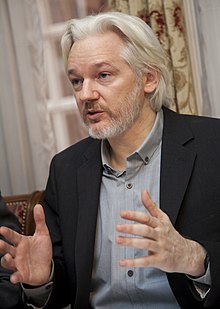
International Lawyers Make Urgent Appeal to British Government- not to extradite Julian Assange
|
ASSANGE EXTRADITION: International Lawyers Make Urgent Appeal to British Government Consortium News August 16, 2020, An array of international lawyers have written to the British prime minister, foreign secretary, secretary of state for justice and home secretary outlining his illegal treatment and demanding Julian Assange’s release. LAWYERS FOR ASSANGE Independent international legal observers of
the proceedings in the case of Julian Assange Open Letter to the UK Prime Minister Mr Boris Johnson, the Lord Chancellor and Secretary of State for Justice Robert Buckland QC, the Secretary of State for Foreign Affairs Dominic Raab and UK Home Secretary Priti Patel.Dear Prime Minister,
Dear Lord Chancellor and Secretary of State for Justice, Dear Secretary of State for Foreign Affairs, Dear Home Secretary, We write to you as legal practitioners and legal academics to express our collective concerns about the violations of Mr. Julian Assange’s fundamental human, civil and political rights and the precedent his persecution is setting. We call on you to act in accordance with national and international law, human rights and the rule of law by bringing an end to the ongoing extradition proceedings and granting Mr. Assange his long overdue freedom – freedom from torture, arbitrary detention and deprivation of liberty, and political persecution. A) ILLEGALITY OF POTENTIAL EXTRADITION TO THE UNITED STATES Extradition of Mr. Assange from the UK to the U.S. would be illegal on the following grounds: 1. Risk of being subjected to an unfair trial in the U.S. Extradition would be unlawful owing to failure to ensure the protection of Mr. Assange’s fundamental trial rights in the U.S. Mr. Assange faces show trial at the infamous “Espionage court” of the Eastern District of Virginia, before which no national security defendant has ever succeeded. Here, he faces secret proceedings before a jury picked from a population in which most of the individuals eligible for jury selection work for, or are connected to, the CIA, NSA, DoD or DoS.[i]Furthermore, Mr. Assange’s legal privilege, a right enshrined in Art. 8 European Convention on Human Rights (ECHR) and long recognised under English common law, was grossly violated through constant and criminal video and audio surveillance at the Ecuadorian embassy carried out by the Spanish security firm, UC Global. This surveillance was, according to witness testimony, ordered by the CIA and has triggered an investigation into the owner of UC Global, David Morales, by Spain’s High Court, the Audiencia Nacional.[ii] The surveillance resulted in all of Mr. Assange’s meetings and conversations being recorded, including those with his lawyers. …………… The UN Model Treaty on Extradition prohibits extradition if the person has not received, or would not receive, the minimum guarantees in criminal proceedings, as enshrined in Art. 14 of the International Covenant on Civil and Political Rights (ICCPR).[v] 2. The political nature of the offence prohibits extradition. The U.S. superseding indictment issued against Mr. Assange on the 24 June 2020 charges him with 18 counts all related solely to the 2010 publications of U.S. government documents. The publications, comprising information about the wars in Iraq and Afghanistan, U.S. diplomatic cables and Guantanamo Bay, revealed evidence of war crimes, corruption and governmental malfeasance.[vi]Charges 1-17 are brought under the Espionage Act 1917, which, in name alone, reveals the political and antiquated nature of the charges…………. several U.S. government officials have at various times ascribed motives “hostile” to the U.S. to Mr. Assange, an Australian citizen.[viii]. The UK-U.S. Extradition Treaty, which provides the very basis of the extradition request, specifically prohibits extradition for political offences in Art. 4(1). ……….. Furthermore, there is broad international consensus that political offences should not be the basis of extradition.[ix] …………. 3. Risk of torture or other cruel, inhuman or degrading treatment or punishment in the U.S. The United Nations Special Rapporteur on Torture and Other Cruel, Inhuman or Degrading Treatment or Punishment (“the UN Rapporteur on Torture”), Professor Nils Melzer, has expressed with certainty that, if extradited to the U.S., Mr. Assange will be exposed to torture or other cruel, inhuman or degrading treatment or punishment. Similar concerns have also been raised by the UN Working Group on Arbitrary Detention, and Amnesty International has recently restated its concerns in relation to the unacceptable risk of mistreatment.[x] The detention conditions, and the draconian punishment of 175 years, in a maximum security prison, which Mr. Assange faces under the U.S. indictment, would constitute torture or other cruel, inhuman or degrading treatment or punishment, according to the current UN Rapporteur on Torture and according to the consistently expressed opinion of his predecessor, as well as of NGOs and legal authorities.[xi]…………….. Under the principle of non-refoulement, it is not permissible to extradite a person to a country in which there are substantial grounds forbelieving that they would be subjected to torture. This principle is enshrined in the 1951 UN Convention Relating to the Status of Refugees, specifically Art. 33(1) from which no derogations are permitted. Also relevant are Art. 3(1) UN Declaration on Territorial Asylum 1967, Art. 3 of the Convention against Torture and Other Cruel, Inhuman or Degrading Treatment or Punishment (CAT), and Art. 2 of the Resolution on Asylum to Persons in Danger of Persecution,………… B) VIOLATIONS OF THE FREEDOM OF THE PRESS AND THE RIGHT TO KNOW Counts 1-17 of the indictment under the Espionage Act violate the right to freedom of expression, the right to freedom of the press and the right to know………………
The UN Rapporteur on Torture has reported, and continues to report, on the treatment of Mr. Assange as part of his United Nations mandate. On 9 and 10 May 2019, Prof. Melzer and two medical experts specialised in examining potential victims of torture and other ill-treatment visited Mr. Assange in Her Majesty’s Prison Belmarsh (“HMP Belmarsh”). The group’s visit and assessment revealed that Mr. Assange showed “all symptoms typical for prolonged exposure to psychological torture, including extreme stress, chronic anxiety and intense psychological trauma.”[xxiv] The UN Rapporteur on Torture concluded “Mr. Assange has been deliberately exposed, for a period of several years, to persistent and progressively severe forms of cruel, inhuman or degrading treatment or punishment, the cumulative effects of which can only be described as psychological torture”………………. We call on the UK government to take immediate action to cease the torture being inflicted upon Mr. Assange, to end his arbitrary and unlawful detention, and to permit his access to independent medical diagnosis and treatment in an appropriate hospital setting. That doctors, their previous concerns having been ignored, should have to call on governments to ‘End torture and medical neglect of Julian Assange’ in The Lancet is extremely worrying.[xxxvii] D) VIOLATIONS OF THE RIGHT TO A FAIR TRIAL We condemn the denial of Mr. Assange’s right to a fair trial before the UK courts. This right has been denied as follows. 1. Judicial Conflicts of Interest Senior District Judge (Magistrates’ Courts) Emma Arbuthnot, who as Chief Magistrate oversees Mr. Assange’s extradition proceedings, has been shown to have financial links to institutions and individuals whose wrongdoings have been exposed by WikiLeaks, the organisation which Mr. Assange founded.[xxxviii] This seemingly clear conflict of interest was, however, not disclosed by the District Judge. District Judge Arbuthnot did not recuse herself and was permitted to make rulings to Mr. Assange’s detriment, despite the perceived lack of judicial impartiality and independence. District Judge (Magistrates’ Courts) Michael Snow has further exhibited bias and unprofessionalism by participating in the defamation of Mr. Assange’s character, labelling the multi-award-winning public interest publisher and Nobel Peace Prize Nominee a “narcissist who cannot get beyond his own selfish interests” in response, ironically, to Mr. Assange’s legal team raising what were patently legitimate concerns regarding bias in the proceedings.[xxxix] 2. Inequality of Arms Mr. Assange has been denied time and facilities to prepare his defence in violation of the principle of equality of arms which is inherent to the presumption of innocence and the rule of law…………… 3. Denial of the defendant’s ability to properly follow proceedings and direct his legal team Mr. Assange and his lawyers have repeatedly informed the Court of his inability to properly follow proceedings, to consult with his lawyers confidentially and to properly instruct them in the presentation of his defence due to his being prevented from sitting with them and being confined to a bulletproof glass box. The arrangement has forced Mr. Assange to resort to waving to get the attention of the judge or the people sitting in the public gallery, in order to alert his lawyers who are seated in the courtroom with their backs to him…………. 4. Refusal to address mistreatment of the defendant Mr. Assange’s lawyers informed the Court that during a single day, on 22 February, prison authorities handcuffed him 11 times, placed him in 5 different cells, strip-searched him twice, and confiscated his privileged legal documents. Overseeing the proceedings, District Judge Vanessa Baraitser explicitly refused to intervene with prison authorities claiming that she has no jurisdiction over his prison conditions…………… We remind the UK government that the right to a fair trial is a cornerstone of democracy and the rule of law. It is a basic human right enshrined in Art. 10 UDHR, Art. 14 ICCPR, Art. 6 ECHR and Art. 6 HRA. These provisions, along with long-standing common law principles, demand a fair and public hearing before an independent and impartial tribunal, the presumption of innocence until proven guilty, the right to be informed promptly and in detail of the nature and cause of the charges, the right to be provided with adequate time and facilities for the preparation of one’s defence, and the right to have the ability to communicate with one’s counsel. For all these reasons we respectfully request that the UK government bring an end to the U.S. extradition proceedings against Mr. Assange and ensure his immediate release from custody. Yours sincerely, Lawyers for Assange ………… (15 collective signatories – international legal organisations) Individual signatories 1555 https://consortiumnews.com/2020/08/16/assange-extradition-international-lawyers-make-urgent-appeal-to-british-government/?fbclid=IwAR0oFpG84PRDIyQ-OOgQmPj3iye_UsgOIro8-VYn2_Z6HQdkrB8ERQvV4KY |
|
Joe Biden will ,be just as pro nuclear as Trump- maybe worse?

|
Nuclear proponent James Conca, writing in that generally pro nuclear publication, Forbes, is jubilant that the Democrats, under Joe Biden , will be staunchly pro nuclear : “The idea that Republican Administrations are pro-nuclear and Democratic ones are anti-nuclear is one of those enduring myths……. nuclear has no real constituency.
……. That said, there has been some recent political and legislative movement on nuclear energy, including passage of the Nuclear Energy Leadership Act, Lifting of the Prohibition on Nuclear Funding, adoption of the Democrat’s America’s Newest Climate Plan that includes nuclear, and DOE’s funding of the Advancing Nuclear Research initiative and the Advanced Reactor Demonstration Project.
The [ Biden] Plan calls for “leveraging the carbon-pollution free energy provided by existing sources like nuclear and hydropower.” The Plan also calls to “Create a Advanced Research Projects Agency on Climate, a new, cross-agency ARPA-C to target affordable, game-changing technologies to help America achieve our 100% clean energy target, including… advanced nuclear reactors …..
Many are questioning how much Biden’s VP choice, Kamala Harris, supports his plan for nuclear. In one of the few insights into her thoughts on the subject, when she was asked d “Do you support the use of nuclear energy?” she answered, “Yes, temporarily while we increase investment into cleaner renewable alternatives.”
Not the most ringing endorsement, but now that she is hooked up with the ticket, it’s likely she will endorse Biden’s plan. The Democratic Party Platform, still in draft form, also calls for a technology-neutral approach, including new and existing nuclear, so again, she is likely to adopt that as well. ….. So expect an up-turn in nuclear energy in a Biden-Harris Administration. https://www.forbes.com/sites/jamesconca/2020/08/17/what-will-a-biden-harris-administration-do-for-nuclear-energy/#1ca07b4a1dd9 |
|
Artificial Intelligence brings a new worry into nuclear weaponry

Artificial intelligence and nuclear weapons: Bringer of hope or harbinger of doom? https://www.europeanleadershipnetwork.org/commentary/bringer-of-hope-or-harbinger-of-doom-artificial-intelligence-and-nuclear-weapons/ Jennifer Spindel |Assistant Professor of Political Science, University of New Hampshire, 17 Aug, 20
In 2017, Russian President Vladimir Putin said whichever country leads in the development of artificial intelligence will be “the ruler of the world.” Artificial intelligence is not unlike electricity: it is a general-purpose enabling technology with multiple applications. Russia hopes to develop an artificial intelligence capable of operations that approximate human brain function. China is working to become the world leader in AI by 2030, and the United States declared in 2019 that it would maintain its world leadership on artificial intelligence. Will the world’s major powers seek to use AI with their nuclear weapons and command and control systems? Pairing nuclear weapons – arguably the previous ruler of the world – with this new technology could give states an even greater edge over potential competitors. But the marriage between nuclear weapons and artificial intelligence carries significant risks, risks that currently outweigh potential benefits. At best, using AI with nuclear weapons systems could increase time efficiencies. At worst, it could undermine the foundations of nuclear deterrence by changing leaders’ incentives to use nuclear weapons.
Opportunities in data analysis and time efficiencies
Artificial intelligence could be a boon for drudgery type tasks such as data analysis. AI could monitor and interpret geospatial or sensor data, and flag changes or anomalies for human review. Applied to the nuclear realm, this use of AI could be used to track reactors, inventories, and nuclear materials movement, among other things. Human experts would thus be free to spend more of their time investigating change, rather than looking at data of the status quo.
Incorporating artificial intelligence into early warning systems could create time efficiencies in nuclear crises. Similar to the boon for data analysis, AI could improve the speed and quality of information processing, giving decision-makers more time to react. Time is the commodity in a nuclear crisis, since nuclear-armed missiles can often reach their target in as little as eight minutes. Widening the window of decision could be key in deescalating a nuclear crisis.
Challenges posed by risks, accidents, and nuclear deterrence
Incorporating artificial intelligence into nuclear systems presents a number of risks. AI systems need data, and lots of it, to learn and to update their world model. Google’s AI brain simulator required 10 million images to teach itself to recognize cats. Data on scenarios involving nuclear weapons are, thankfully, not as bountiful as internet cat videos. However, much of the empirical record on nuclear weapons would teach an AI the wrong lesson. Consider the number of almost-launches and near-accidents that occurred during the Cold War; both U.S. and Soviet early warning systems mistakenly reported nuclear launches. Although simulated data could be used to train an AI, the stakes of getting it wrong in the nuclear realm are much higher than in other domains. It’s also hard to teach an AI to feel the doubts and suspicions that human operators relied on to detect false alarms and to change their minds.
Accidents are also amplified in the nuclear realm. There are already examples of accidents involving automated conventional weapons systems: in March 2003, U.S. Patriot missile batteries shot down a British fighter plane and a U.S. fighter jet while operating in “automated mode,” killing the crews of both planes. Accidents are likely to increase as AI systems become more complex and harder for humans to understand or explain. Accidents like these, which carry high costs, decrease overall trust in automated and AI systems, and will increase fears about what will happen if nuclear weapons systems being to rely on AI.
Beyond accidents and risks, using AI in nuclear weapons systems poses challenges to the foundations of nuclear deterrence. Data collection and analysis conducted by AI systems could enable precision strikes to destroy key command, control, and communication assets for nuclear forces. This would be a significant shift from Cold War nuclear strategy, which avoided this type of counterforce targeting. If states’ can target each other’s nuclear weapons and command infrastructure, then second-strike capabilities will be at risk, ultimately jeopardizing mutually assured destruction. For example, AI could identify a nuclear submarine on patrol in the ocean, or could interfere with nuclear command and control, thus jeopardizing one, or more, legs of the nuclear triad. This creates pressure for leaders to use their nuclear weapons now, rather than risk losing them (or control over them) in the future.
Even if states somehow agree not to use AI for counterforce purposes, the possibility that it could one day be used that way is destabilizing. States need a way to credibly signal how they will – and won’t – use artificial intelligence in their nuclear systems.
The future of AI and nuclear stability
The opportunities and risks posed by the development of artificial intelligence is less about the technology and more about how we decide to make use of it. As the Stockholm International Peace Research Institute noted, “geopolitical tensions, lack of communication and inadequate signalling of intentions” all might matter more than AI technology during a crisis or conflict. Steps to manage and understand the risks and benefits posed by artificial intelligence should include confidence-building measures (CBMs) and stakeholder dialogue.
CBMs are crucial because they reduce mistrust and misunderstanding, and can help actors signal both their resolve and their restraint. As with conventional weapons, transparency about when and how a state plans to use artificial intelligence systems is one type of CBM. Lines of communication, which are particularly useful in crisis environments, are another type that should be explored.
Continued dialogue with stakeholders including governments, corporations, and civil society will be key to developing and spreading norms about the uses of artificial intelligence. Existing workshops and dialogues about the militarization of artificial intelligence, and artificial intelligence and international security show that such dialogues are possible and productive. The international community can consider building on existing cooperative efforts concerning cyberspace, such as the U.N.’s work on norms and behaviour in cyberspace, the Cybersecurity Tech Accords, and Microsoft, Hewlett, and Mastercard’s CyberPeace Institute. This dialogue will help us understand the scope of potential change and should give us incentives to move slowly and to push for greater transparency to reduce misperception and misunderstanding.
USA’s nuclear weapons – not the best way to protect Taiwan
|
Do US Nuclear Weapons Help Protect Taiwan?, Union of Concerned Scientists
GREGORY KULACKI, CHINA PROJECT MANAGER AND SENIOR ANALYST | AUGUST 17, 2020, In an earlier post I explained there is a risk the United States and China could go to war over Taiwan. The United States is prepared to use nuclear weapons to win that war. Some believe that helps protect Taiwan. But does it?
Shall we play a game?At the end of the 1983 movie War Games, a massive US Department of Defense computer plays out every possible nuclear war scenario looking for a way to win. All of them lead to the same dismal end; a global nuclear holocaust. The computer concludes nuclear war is “a strange game” where “the only winning move is not to play.” Six months after the movie was released, US President Ronald Reagan told a joint session of Congress, “A nuclear war cannot be won and should never be fought.” He repeated it many times afterwards, including in a speech at Fudan University in Shanghai. Unfortunately, US war gamers never let go of the idea that a nuclear war can be won, especially if the adversary is China. I can understand why. China has a few hundred nuclear weapons. The United States has thousands. The United States also has what are called tactical, non-strategic or low-yield nuclear weapons that China does not have. Some US officials argue if the United States used these low-yield nuclear weapons it would be difficult for China to retaliate without risking escalation to a full scale nuclear war: a war China would lose because its arsenal is so small. They seem to believe China would be unwilling to take that risk even though China has promised to retaliate if attacked with any type of nuclear weapon. Limited nuclear warThe reason the US war planners think about using nuclear weapons in a Taiwan war is because the United States might lose a conventional fight. They worry China’s conventional forces cannot be stopped without nuclear weapons. This isn’t a new concern. President Eisenhower faced a similar choice during the Taiwan Strait Crisis of the 1950s. …….
Past and prologueToday, the rapid deterioration of US-China relations, disturbing changes in Chinese policy towards Hong Kong and a provocative visit of a US official to Taiwan suggest a new crisis is brewing. As talk of a new Cold War with China increases, a careful look back at the old one may be helpful. ……..
history suggests more nations may be willing to support a US military effort to defend Taiwan if the United States took the option to start a nuclear war off the table. It may seem counterintuitive, but canceling plans to reintroduce US tactical nuclear weapons into Asia and declaring the United States would never use nuclear weapons first, under any circumstances, may be the best way to strengthen Taiwan’s defense. https://allthingsnuclear.org/gkulacki/do-us-nuclear-weapons-help-protect-taiwan
|
|
|
Will Ohio finally be able to use its wind resources, now that the nuclear corruption is being exposed?

|
Will Ohio Finally Inherit Its Wind? https://readersupportednews.org/opinion2/277-75/64623-rsn-will-ohio-finally-inherit-its-wind?fbclid=IwAR0iFghBoz4O6r7yMYGVnrXjyQ27vmsal94R3U6STsPlmM2TWvPOriQ4IiMBy Bob Fitrakis and Harvey Wasserman, Reader Supported News, 17 August 20
 midst an astonishing billion-dollar nuke reactor corruption scandal, one of the world’s richest wind resources—the key to Ohio’s economic and ecological future—is being trashed by a single sentence. midst an astonishing billion-dollar nuke reactor corruption scandal, one of the world’s richest wind resources—the key to Ohio’s economic and ecological future—is being trashed by a single sentence.
According to the American Wind Energy Association, Ohio is being robbed of $4 billion worth of industrial development, thousands of jobs, and a wealth of cheap, emissions-free energy by a single easily-removable clause in the Ohio Code. How? In 2014, without public hearings, pro-fossil/nuke legislators slipped into law a requirement that wind turbines be sited at least 1300 feet from property lines. The previous requirement was 600 feet. There are no meaningful economic, ecological, or health/safety imperatives served by the additional set-back footage. No other state has such a requirement. But by vastly expanding the land required for turbine siting, that single sentence stopped some $4 billion in pre-approved northern Ohio wind farm development. Ohio’s “North Coast” has steady winds blowing over flat fields whose farmers desperately need the fat checks that come with turbine leasing. The region is uniquely crisscrossed with transmission lines feeding nearby urban areas where the power is consumed. Ironically, Ohio is already a leading manufacturing center for the turbine industry being blocked within its own borders. The proposed arrays are set to create thousands of jobs, save hundreds of family farms, and provide decades of reliable, clean electricity at rates far below current subsidized fossil/nuke prices. The employment created by the wind construction projects would far exceed that at the Davis-Besse and Perry reactors. The nuke bailout is now under intense fire. Because House Bill 6 has been tainted by the $60 million in bribes given House Speaker Larry Householder to grease it through the legislature, even pro-nuke governor Mike DeWine wants it rescinded. It comes in the wake of some $9 billion in “stranded cost” bailout money sucked up by Ohio’s nukes starting in 1999. But if HB6 goes away as promised, DeWine and pro-reactor legislators will likely introduce a new, slightly altered bailout. As a popular concession, they might drop the previously included handout for two coal burners or avoid attacking Ohio’s highly successful energy efficiency programs. But the one move that could completely revamp Ohio’s energy future would be to restore its wind setback to levels commonly accepted nearly everywhere else. Opening Ohio’s energy markets to cheap wind power would undercut subsidized, fossil/nuke-inflated electric rates, restore the jobs deleted by shutting the reactors, and spur long-term economic growth as virtually nothing else would. Will Ohio’s safe energy movement grab the opportunity to make all that happen? Bob Fitrakis & Harvey Wasserman have co-authored numerous books on election protection and the environment appearing at www.freepress.org along with Bob’s Fitrakis Files. Harvey’s People’s Spiral of US History awaits Trump’s departure at www.solartopia.org, where his Solartopia! Our Green-Powered Earth also resides. |
|
Nuclear waste should no longer be exempt from environmental laws
 How Bedrock Environmental Law Can Break the Nuclear Waste
  Logjam, https://news.bloomberglaw.com/environment-and-energy/insight-how-bedrock-environmental-law-can-break-the-nuclear-waste-logjam Geoffrey Fettus, NRDC 17 Aug 20
The 30-year battle over nuclear waste disposal at Yucca Mountain in Nevada shows it’s time for the Atomic Energy Act to be amended. Geoffrey Fettus, senior attorney for the Natural Resources Defense Council, says Congress should pass legislation to end the exemption of nuclear waste from hazardous waste and other bedrock environmental laws.
For more than 30 years, Congress and the federal government have tried again and again to shove our nation’s spent nuclear fuel down a hole at Yucca Mountain, Nev. It’s time to use our foundational environmental laws get out of this seemingly impenetrable maze.
Congress should amend the Atomic Energy Act to remove exemptions from environmental laws for radioactive waste, a proposal that got an important boost from the House Select Committee on Climate Crisis as it called for a task force of federal, state, local, and tribal officials to study the implications of this idea.
Earlier this year, President Trump bowed to reality and abandoned efforts to force the radioactive waste on Nevada, the Yucca mirage finally dissipated. What’s clear now is that trying to force Nevada, or Utah, or New Mexico, or Tennessee (or any other state) to take the entirety of the nation’s most toxic nuclear waste won’t work. Continuing down that path will get us nowhere.
Instead of seeing recalcitrant states as the problem, what if we acknowledge the reality that they must be a key part of the solution for nuclear waste?
Feds Have Exclusive Jurisdiction Over Radioactive Materials
Remarkably, our bedrock environmental laws don’t cover nuclear waste, and they should. The Atomic Energy Act started the nuclear industry and was enacted years before our key pollution safeguards were established.
Crucially, and mostly for nuclear weapons reasons, the AEA gave the federal government exclusive jurisdiction over all radioactive materials, including radioactive waste. When Congress enacted our foundational environmental laws decades later, each of them included an exemption that excludes radioactive waste except in limited or marginal ways.
This is the original sin that must be rectified.
To explain this pernicious problem, when Congress considered nuclear waste in its precedent setting 1982 Nuclear Waste Policy Act, it just accepted the AEA’s sole federal authority and nuclear waste’s exclusion from environmental law as the way of the world. Only a few years later, for the sake of political expedience, Congress cut short a well thought out siting process and required the Yucca Mountain repository as the only option.
This was supposed to expedite the process, but not surprisingly, it exploded in controversy and eventually ground to a halt. And now it has finally, truly, died. But nuclear waste remains just as toxic and problematic as ever.
If nuclear waste were covered by environmental laws, i.e., without the current exemptions that limit EPA and state authority, protective federal health and welfare standards can combine with state-level decision-making over where and how the waste could be stored within its borders.
Amending the AEA and removing the provisions that exempt nuclear waste from our hazardous waste and water laws would give us our best chance to garner public acceptance for a process to find safe, technically sound storage sites for toxic nuclear waste—waste that will remain dangerous to human health for hundreds of thousands of years.
Why This Can Work
Consider how things could change if environmental laws could operate as intended.
Under regular environmental law (that covers pollution of air, water, land), the EPA sets strong standards commensurate to the harm of the pollutant. States can then assume the management of that program (or leave it to the EPA) and set additional, stricter standards if they wish.
A state can have strong regulatory authority to set terms for how much waste it might dispose of, how the facility will operate, and the requisite power to enforce those protective standards and protect its citizens—all things it cannot do now for radioactive waste.
To be clear, the standards for high-level radioactive waste will need to be special and extraordinarily protective, and the rulemaking for those standards will be quite a technical ordeal. But, there’s no getting around doing that hard work; Congress tried to take a short cut and it failed.
Once those standards are in place, the EPA and the states can, as in other instances, share the necessary roles of guarding public safety and welfare from radioactive waste. This institutional framework allows for both scientific defensibility of potential sites and, importantly, public acceptance of the process.
The Task Falls to Congress
For far too long many members of Congress and officials in Washington fought any efforts like this as they sought the quick fix of Yucca. Now there’s evidence of change. The ambitious report from the House Select Committee on Climate Crisis included this key recommendation:
Congress should establish a task force comprised of federal, state, local, and tribal officials to study the implications of amending the Atomic Energy Act to remove exemptions from environmental laws for spent fuel and high-level waste, while maintaining federal minimum standards.
Lawmakers should pick up this recommendation, create just such a task force, and move forward with this plan. Will this work? Yes—but it will take both hard work and time.
One thing I can guarantee is that the current approach isn’t working and won’t ever work. No single state is going to willingly accept the entirety of the nation’s nuclear burden without any way to protect their citizens; we have decades of evidence for this proposition. No amount of stomping of feet in the halls of Congress can change that.
Author Information
Geoffrey Fettus is a senior attorney for the Natural Resources Defense Council’s climate and clean energy program in Washington, D.C. He litigates in federal courts and testifies before Congress on the beginning and end of the nuclear fuel cycle. Prior to joining the NRDC, he was a staff attorney at the New Mexico Environmental Law Center and an assistant attorney general in New Mexico’s Office of the Attorney General.
A real setback to UK”s Bradwell nuclear project: Colchester Council voted unanimously to reject the proposal

Blow to Bradwell B nuclear power plant as council unanimously reject plans, Maldon Standard
A motion, put forward by council leader Mark Cory, said: “This council objects to new nuclear at Bradwell due to the local environmental impacts and prefers a focus on renewable energy alternatives.”
During the debate, councillors called for a “united front” approach amongst councillors and north Essex MPs.
he Bradwell B project is a joint operation between CGN and EDF Energy. Its backers claim it will create 900 permanent jobs as well as 9,000 jobs during construction.
If permitted, it would be built alongside the decommissioned Bradwell power station, however, the proposals have generated a wave of opposition.
Campaign group Blackwater Against New Nuclear Group (BANNG) welcomed Colchester Council’s decision after submitting a statement to the council, outlining four reasons for rejecting the proposal.
Chairman Prof Andy Blowers said: “It is unacceptable for such a dangerous power station and long-term highly radioactive waste stores to be located so close to large populations such as Mersea and Colchester which would be completely unprotected in the event of a major release of radioactivity.
“And the site is unsuitable since its precious environment and heritage is irreplaceable and would be severely compromised if not altogether destroyed.”
Peter Banks, of West Mersea Town Council and co-ordinator of BANNG, added: “With my practical, scientific mind, I endorse this policy. With my passionate, environmentally pumping heart, I endorse this policy.
“BANNG is delighted that all councillors, regardless of political persuasion, have endorsed this policy.”….https://www.maldonandburnhamstandard.co.uk/news/18652490.blow-bradwell-b-nuclear-power-plant-council-unanimously-reject-plans/
California grid melts in record heat. Are renewables to blame? — RenewEconomy

The California grid is failing to meet demand in a record heatwave. It is already becoming clear that this is a story of mismanagement, rather than the fault of renewables. The post California grid melts in record heat. Are renewables to blame? appeared first on RenewEconomy.
via California grid melts in record heat. Are renewables to blame? — RenewEconomy
U.S. Senator Harris and Rep Ocasio-Cortez introduce Bill on climate harm
 Reuters 6th Aug 2020, U.S. Senator Kamala Harris and Representative Alexandria Ocasio-Cortez on
Thursday introduced legislation to beef up federal accountability for
pollution in minority communities disproportionately harmed by climate
change. Harris, a leading contender to be Democratic presidential candidate
Joe Biden’s running mate, was running in the Democratic primary last year
when she first floated the Climate Equity Act with Ocasio-Cortez.
Danger in Houthi Smuggling of Thorium to Iran
|
Yemen Official Warns of Blast Worse than Beirut’s over Houthi Smuggling of Thorium to Iran, Asharq Al-Awsat, Sunday, 16 August, 2020 Jeddah – Asma al-Ghabri
The Yemen Coalition of Independent Women held a virtual seminar titled “Iranian intervention: A History of Disorder in The Arab Countries,” which tackled a variety of issues, including the Iran-backed Houthi militias’ smuggling of Thorium from Yemen to Iran. Hodeidah Undersecretary Walid al-Qudaimi warned of the impending danger facing Yemen over the ongoing smuggling of the material. Houthis are actively enriching Thorium extracted from Yemeni mountains and sending it to Iran for arms manufacture. Qudaimi said that a blast worse than the one that took place at Beirut port on August 4, due to the explosion of highly-flammable ammonium nitrate, was in store for Yemen if the smuggling does not stop…… “When we talk about Yemen, the catastrophe is very big and worse than we might expect,” he said, adding that Houthis control the ports of Hodeidah and use them to smuggle weapons and explosive materials of all kinds……. https://english.aawsat.com/home/article/2450796/yemen-official-warns-blast-worse-beirut%E2%80%99s-over-houthi-smuggling-thorium-iran |
|
Unleash the tremendous potential of Ohio wind energy jobs instead of bailing out nuclear plants.
Unleash the tremendous potential of Ohio wind energy jobs instead of bailing out nuclear plants, https://www.cleveland.com/letters/2020/08/unleash-the-tremendous-potential-of-ohio-wind-energy-jobs-instead-of-bailing-out-nuclear-plants.html By Other Voices, David Hughes, Madison 17 Aug 20,
State Rep. Jamie Callender is wrong (”Ohio and Lake County still need the policy of HB 6,” Aug. 12): Ohio electricity ratepayers should not be forced to pay increased rates to keep two failing nuclear plants open. FirstEnergy has a long history of bad management decisions and did not deserve a taxpayer bailout.
Rep. Callender would be smarter to develop a plan to put those nuclear plant workers, and thousands more, to work in the renewable energy sector. He should start by repealing the “wind setback” law. This would unleash enormous growth in wind energy exactly where the nuclear plants are. The bonus would be no more deadly nuclear waste from two uneconomical and unsafe nuclear plants.
August 17 Energy News — geoharvey

Opinion: ¶ “The European Green Deal Offers Massive Opportunities For Green Business” • The European Green Deal is a set of policy initiatives that are all targeted at transforming the 27-country bloc to a climate neutral economy by 2050. One of the pillars of the European Green Deal is to stimulate innovation-based competitiveness. [CleanTechnica] Science […]
1 This Month
Chernobyl: The Lost Tapes – A good documentary on Chernobyl on SBS available On Demand for the next 3 weeks– https://www.sbs.com.au/ondemand/tv-program/chernobyl-the-lost-tapes/2352741955560

of the week–London Campaign for Nuclear Disarmament

Tell the Ukrainian Government to Drop Prosecution of Peace Activist Yurii Sheliazhenko
To see nuclear-related stories in greater depth and intensity – go to https://nuclearinformation.wordpress.com
-
Archives
- April 2026 (126)
- March 2026 (251)
- February 2026 (268)
- January 2026 (308)
- December 2025 (358)
- November 2025 (359)
- October 2025 (376)
- September 2025 (257)
- August 2025 (319)
- July 2025 (230)
- June 2025 (348)
- May 2025 (261)
-
Categories
- 1
- 1 NUCLEAR ISSUES
- business and costs
- climate change
- culture and arts
- ENERGY
- environment
- health
- history
- indigenous issues
- Legal
- marketing of nuclear
- media
- opposition to nuclear
- PERSONAL STORIES
- politics
- politics international
- Religion and ethics
- safety
- secrets,lies and civil liberties
- spinbuster
- technology
- Uranium
- wastes
- weapons and war
- Women
- 2 WORLD
- ACTION
- AFRICA
- Atrocities
- AUSTRALIA
- Christina's notes
- Christina's themes
- culture and arts
- Events
- Fuk 2022
- Fuk 2023
- Fukushima 2017
- Fukushima 2018
- fukushima 2019
- Fukushima 2020
- Fukushima 2021
- general
- global warming
- Humour (God we need it)
- Nuclear
- RARE EARTHS
- Reference
- resources – print
- Resources -audiovicual
- Weekly Newsletter
- World
- World Nuclear
- YouTube
-
RSS
Entries RSS
Comments RSS
 nuclear-news