Vulnerability of nuclear reactors to extreme weather events. Flooding all too close to North Korea’s main nuclear reactor
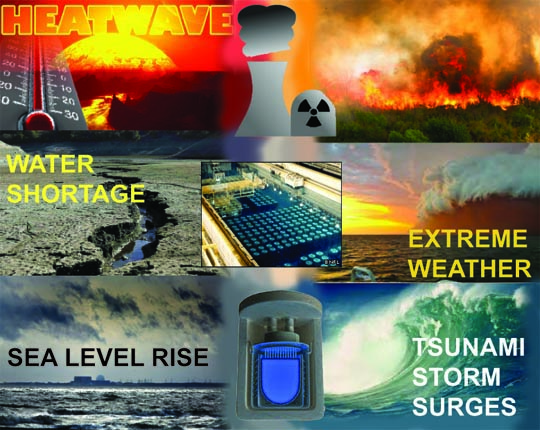 North Korea floods kill 22, approach nuclear reactor — but Kim doesn’t want help, WP, By Simon Denyer August 14, 2020 , TOKYO — Flooding caused by weeks of unusually heavy monsoon rains has killed at least 22 people in North Korea, with four others missing, and even approached the country’s main nuclear reactor, but leader Kim Jong Un says he is too worried about coronavirus to accept outside help.
The International Federation of the Red Cross said the floods have left at least 22 people dead and four missing, citing the Democratic People’s Republic of Korea Red Cross and the country’s State Committee for Emergency and Disaster Management.
The floodwaters approached the Yongbyon nuclear complex last week, reaching the bases of two pump houses designed to cool the country’s main nuclear reactor, according to the 38 North website, citing satellite imagery.
The floodwaters have receded somewhat and pose “no imminent danger,” as the main reactor apparently has not been operating for some time and a nearby experimental light water reactor has yet to come online, said Jenny Town, deputy director of 38 North, part of the Stimson Center.
“But this year, the river level is usually high,” Town added. “If this were to happen when a reactor was running, it could cause problems in the cooling systems that would necessitate the reactors to be shut down.” ………. https://www.washingtonpost.com/world/north-korea-floods-kill-22-approach-nuclear-reactor–but-kim-doesnt-want-help/2020/08/13/f53992a8-ddda-11ea-b4f1-25b762cdbbf4_story.html
A Major Nuclear Arms Treaty Expires Next Year. What Happens Next?
 A Major Nuclear Arms Treaty Expires Next Year. What Happens Next? https://www.wunc.org/post/major-nuclear-arms-treaty-expires-next-year-what-happens-next
 signed an updated strategic arms reduction treaty. Unless that agreement, New START, is renewed before February, the two largest nuclear arsenals will be unconstrained for the first time since the height of the Cold War.
The impending deadline is a reminder that the possibility of nuclear warfare did not end with the Cold War, nor is North Korea the sole threat. In fact, expert Alexandra Bell suggests that domestic nuclear accidents, like the one in Goldsboro, North Carolina in 1961, are also a major threat. The infrastructure is aging, agrees Michaela Dodge, who argues that modernization is essential to the safety and effectiveness of strategic weapons in deterrence policy.
So what is the price tag of those upgrades?
Host Frank Stasio talks with Bell and Dodge about the risks, benefits and costs of maintaining strategic nuclear weaponry as the U.S. approaches the expiration of New START. Bell is the senior policy director for the Center for Arms Control and Non-Proliferation. Dodge is a research scholar at the National Institute for Public Policy.
Malaysia rejects nuclear power, focuses on renewable energy
Khairy says nuclear energy ‘not on the table’ for now, focus on renewable energy sources, Malay Mail, Friday, 14 Aug 2020, BY YISWAREE PALANSAMY KUALA LUMPUR, — Science, Technology and Innovation Minister Khairy Jamaluddin said today that the idea to develop nuclear energy as a power source will be a last option for Malaysia, as there are many other sources of energy in the same category which the country has yet to explore.
The Rembau MP said that his ministry is not considering nuclear energy development for now…..
In February, then Prime Minister Tun Dr Mahathir Mohamad spoke of the inherent need for a more non-polluting renewable energy source for the world, but rejected nuclear energy source, over the fear of the radioactive level in its waste.
Dr Mahathir pointed out that Malaysia does not have enough expertise in science that is needed to manage nuclear power.
He also expressed worry about the long-term effects of radioactive waste.
In July 2018, Yeo announced that the then PH government would not be building nuclear power plants or explore nuclear energy.
In winding up her ministerial reply on the 2020 Budget in Parliament last year, Yeo also announced that the Malaysian Nuclear Power Corporation (MNPC) would be shut down. ……. https://www.malaymail.com/news/malaysia/2020/08/14/khairy-says-nuclear-energy-not-on-the-table-for-now-focus-on-renewable-ener/1894036
Nuclear weapons countries have an obligation to lead in nuclear weapons control – U.N.
 Urgent need’ to stop erosion of nuclear order, major UN disarmament forum hears, UN News, 14 Aug 20
“There is an urgent need to stop the erosion of the nuclear order. All countries possessing nuclear weapons have an obligation to lead”, Director-General of the UN Office at Geneva (UNOG) Tatiana Valovaya, told the Conference on Disarmament, which she also heads.
Impetus moving forward
Ms. Valovaya noted that 2020 was a year of important disarmament milestones, including the 75th anniversary of the Organization’s founding, and of the atomic bombings of Hiroshima and Nagasaki, along with the 50th anniversary of the entry into force of the Nuclear Non-Proliferation Treaty.
She maintained that they should generate momentum to do more to counter the erosion of the disarmament, arms control and non-proliferation architecture, encouraging more constructive work to “negotiate new global legal instruments, including in this Conference”.
She urged participants to “jointly reflect on these issues” and what they mean for the Conference.
Upholding that the body remains an “extraordinary platform for dialogue and confidence-building”, she expressed encouragement over its members’ determination to resume meetings and stood ready, with the Secretariat, to support its work.
Funding shortfall
Speaking as UNOG chief, Ms. Valovaya explained that the Secretariat was facing “a severe liquidity crisis”.
“While we are sparing no effort to identify ways to re-prioritize and make bridge funding available”, she informed that the Office in Geneva “has not received sufficient funding for normal operations through to the year’s end”.
And this comes on top of “unforeseen expenses related to the COVID-19 pandemic”.
She said that her office would soon be briefing Member States in Geneva on the situation, measures and outlook going forward for the rest of the year……. https://news.un.org/en/story/2020/08/1070142
Renewable energy a better choice for Ohio, than nuclear bailout
Robots may be used for clean-up of highly radioactive areas of UK’s Dounreay nuclear complex

and taking apart the most highly radioactive areas of Dounreay. The nuclear
power complex on the Caithness coast near Thurso is being decommissioned.
Dounreay’s operator said they were working with Robotics and Artificial
Intelligence in Nuclear (Rain), a consortium of universities. Led by the
University of Manchester, they are exploring the potential for using robots
in the Fuel Cycle Area (FCA), which has the most contaminated parts of the
site.
most inaccessible”. A group of scientists from Rain carried out trials
earlier this year in the FCA laboratories of a small remotely operated
vehicle equipped with sensors, cameras and a manipulator “arm”.
https://www.bbc.co.uk/news/uk-scotland-highlands-islands-53763880
Torres Strait Islanders claim climate change affects their human rights – Australia govt tries to stifle their claim
Australia asks UN to dismiss Torres Strait Islanders’ claim climate change affects their human rights
Complaint argues Morrison government has failed to take adequate action on emissions or adaptation measures, Guardian, Katharine Murphy Political editor 14 Aug 20 The Morrison government has asked the human rights committee of the United Nations to dismiss a landmark claim by a group of Torres Strait Islanders from low-lying islands off the northern coast of Australia that climate change is having an impact on their human rights, according to lawyers for the complainants.
The complaint, lodged just over 12 months ago, argued the Morrison government had failed to take adequate action to reduce emissions or pursue proper adaptation measures on the islands and, as a consequence, had failed fundamental human rights obligations to Torres Strait Islander people.
But the lead lawyer for the case, Sophie Marjanac, says the Coalition has rejected arguments from the islanders, telling the UN the case should be dismissed “because it concerns future risks, rather than impacts being felt now, and is therefore inadmissible”.
Marjanac said lawyers for the commonwealth had told the committee because Australia is not the main or only contributor to global warming, climate change action is not its legal responsibility under human rights law.
“The government’s lawyers also rejected arguments that climate impacts were being felt today, and that effects constituting a human rights violation are yet to be suffered”.
A spokesman for the attorney general, Christian Porter, said submissions to the human rights committee were not publicly available……
Lawyers for the islanders have alleged that the catastrophic nature of the predicted future impacts of climate change on the Torres Strait Islands, including the total submergence of ancestral homelands, is a sufficiently severe impact as to constitute a violation of the rights to culture, family and life.
The challenges associated with sea level rise in the Torres Strait have been well documented. A report from the Climate Council on the risks associated with coastal flooding notes that Torres Strait Island communities are extremely low-lying and are thus among the most vulnerable in Australia to the impacts of climate change.
The report concludes the shallowness of the strait “exacerbates storm surges and when such surges coincide with very high tides, extreme sea levels result”. It cites sea level data collected by satellite from one location in the Torres Strait between 1993 and 2010 that indicated a rise of 6 mm per annum, “more than twice the global average”,
Although the report notes this was a single dataset, low-lying islands in the Pacific – and Torres Strait islands such as Masig and Boigu – are likely to be at the forefront of forced displacement. Some forecasts have predicted up to 150 million people could be forcibly displaced by climate change by 2040 – larger than the record number of people already forced from their homes globally.
The non-profit group ClientEarth is supporting the complaint. A spokesman for the group said: “It is shameful that Indigenous communities on Australia’s climate frontline are being told that the risk of climate change to their human rights is merely a future hypothetical issue, when scientists are clear these impacts will happen in coming decades”.
“Climate change risk is foreseeable and only preventable through immediate action in the present. States like Australia have legal duties to protect the human rights of their citizens”. https://www.theguardian.com/australia-news/2020/aug/14/australia-asks-un-to-dismiss-torres-strait-islanders-claim-climate-change-affects-their-human-rights
Climate Change Is a Security Threat to the Asia-Pacific
|
Climate Change Is a Security Threat to the Asia-Pacific Climate change is likely to alter the local physical and strategic environment profoundly, and potentially catastrophically. The Diplomat, By Shiloh Fetzek and Dennis McGinn, August 10, 2020 This week the ASEAN Joint Task Force on Humanitarian Assistance and Disaster Relief (HADR) will meet via video conference, with the COVID-19 pandemic escalating just as some countries in the disaster-prone Indo-Asia Pacific enter their cyclone, drought, heatwave, or monsoon seasons. The overlaying of the pandemic with existing complex challenges is a timely reminder that planning for HADR capacities – and regional security – needs to be attuned to the increasing likelihood of multiple, overlapping hazards and converging security risks, especially in a future where climate change alters the context in which other disasters and crises take place. Developing a clearer recognition of how climate change can reshape the strategic environment will be essential for preserving regional security, stability, and prosperity in the face of complicated and interlocking challenges, as we argue in a new report on the Indo-Asia Pacific published by the International Military Council on Climate and Security (IMCCS).
The Indo-Asia Pacific is highly exposed to climate change impacts. Climate change is likely to alter the local physical and strategic environment profoundly, and potentially catastrophically. More frequent or intense extreme weather, sea level rise, and ocean acidification (among other climate impacts) will create a range of threats to the well-being and security of countries in the region, many of which are already threatened by disaster vulnerability and increasingly complex security tensions.
As well as the immediate physical impacts, climate change will increase food and water insecurity, contribute to forced migration and displacement, and challenge disaster response and recovery capabilities …….. https://thediplomat.com/2020/08/climate-change-is-a-security-threat-to-the-asia-pacific/
|
|
$6.6 trillion in annual GDP at risk as Asian climate warms – McKinsey Global Institute
|
McKinsey sees $6.6 trillion in annual GDP at risk as Asian climate warms, https://www.smh.com.au/business/markets/mckinsey-sees-6-6-trillion-in-annual-gdp-at-risk-as-asian-climate-warms-20200813-p55ley.html By Bloomberg News, August 14, 2020 Lethal heatwaves, droughts, floods and typhoons will become more common in Asia-Pacific, which faces more severe potential impacts from climate change than many parts of the world, McKinsey & Co. researchers warn.Asia is particularly at risk because it has such a high number of poor people, who tend to rely more on outdoor work, living in areas most vulnerable to extreme increases in heat and humidity, McKinsey Global Institute said in a new report published on Thursday. By 2050, the loss of that labor could cost the region as much as $US4.7 trillion ($6.6 trillion) a year in GDP, about two-thirds of the global total at risk. The report underscores the economic risks of delaying investments that mitigate or adapt to climate change. The potential for widespread damage is similar to the region’s experience during the current pandemic, according to McKinsey. What we have seen is that countries, cities and people can take resolute actions and if we do take these actions and sustain them, we can cooperate globally and see positive outcomes,” said Oliver Tonby, McKinsey’s Asia chairman, who co-authored the report. The projections are based on a scenario in which the world fails to cut greenhouse gas emissions and Asia warms by 2 degrees Celsius. They show that by 2050, between 500 million and 700 million people living in places like India, Bangladesh and Pakistan could experience heatwaves that exceed the survivability threshold. The loss of outdoor labour during those times could shave off 7 per cent to 13 per cent off GDP in those three countries, resulting in losses of $US2.8 trillion to $US4.7 trillion across the whole of Asia on average per year, according to the report. Extreme precipitation events could rise three- or four-fold by 2050 in parts of Japan, China, South Korea and Indonesia, according to McKinsey. Increased riverine flooding could cause $US1.2 trillion in damage in Asia, about 75 per cent of the global impact. Conversely, as the earth warms, parts of southwestern Australia could spend more than 80 per cent of a decade in drought conditions by 2050 and regions of China could experience droughts 40 per cent to 60 per cent of the time. Climate change will also increase the likelihood of severe typhoon strikes from the Philippines and Vietnam to Northeast Asia. It will also create winners and losers, increasing surface water supply in parts of northern India and China while depleting reservoirs in Australia.
To face the business risks, Tonby said companies need to assess their exposure and take it into consideration when making plans. A significant opportunity lies in infrastructure development in Asia as the region is still rapidly urbanising. |
UK: Nuclear site evacuated after chemical found
|
UK: Nuclear site evacuated after chemical found Bomb disposal squad deployed after chemical found in small amounts at site, AA Karim El-Bar |14.08.2020 LONDONA nuclear power site in Britain has been evacuated and a bomb squad deployed after a chemical was found needing removal, local media reported on Friday.
The chemical is organic peroxide and was found in small amounts on the site, which underwent a controlled evacuation as a precautionary measure. The incident took place at the Magnox Reprocessing Plant, which is part of the Sellafield site. The plant was non-operational and will remain so until the chemical is disposed of. The plant is also segregated from the nuclear section, and as such as the incident was declared a conventional safety risk rather than a nuclear safety risk……….. Sellafield is Europe’s largest nuclear site, with over 200 nuclear facilities and 1,000 buildings covering an area of two square miles. https://www.aa.com.tr/en/europe/uk-nuclear-site-evacuated-after-chemical-found/1942144 |
|
Armenia’s Metsamor nuclear power plant poses threat to region
Armenia poses a threat to regional security not only through its military provocations and policy of occupation but also with its outdated Metsamor nuclear power plant (NPP), which experts consider to be dangerous.
“Armenia’s Metsamor nuclear power plant, which is located in a seismic region, poses a threat to the region,” Azerbaijani Ambassador to International Atomic Energy Agency (IAEA) Galib Israfilov has said in an interview with the weekly edition of the Nuclear Intelligence Weekly of the energy company Energy Intelligence Group.
Israfilov said that the International Atomic Energy Agency (IAEA) does not have mechanisms to address these concerns as Armenia is unwilling to consider these issues.)
……….. despite Metsamor NPP’s risk to the region, Armenia seeks to operate this nuclear plant until 2026. The Armenian government has agreed with Russian nuclear agency Rosatom to keep the plant running beyond its original closing date of 2016.
Experts have long been voicing concerns over Metsamor’s danger to the region.
Antonia Wenisch of the Austrian Institute of Applied Ecology in Vienna has called Metsamor ‘among the most dangerous’ nuclear plants still in operation, saying that a rupture ‘would almost certainly immediately and massively fail the confinement,’ in an article published at National Geographic.
“There is an open reactor building, a core with no water in it, and accident progression with no mitigation at all”.
“It is in the midst of a strong seismic zone that stretches in a broad swath from Turkey to the Arabian Sea near India,” the article said.
Polish politician and Member of the European Parliament Anna Fotyga also raised the questions about the possible threat of the nuclear power plant to the regional security in 2017
Metsamor Nuclear Power Plant in Armenia is the last of its kind outside Russia that still uses an outdated model from the 1960s. The Soviet model of using a pressurised water reactor is often cited as the most dangerous kind of nuclear power plant, as it does not meet the minimum required safety standards. In addition, Metsamor is situated in an active earthquake zone just 30 km from Yerevan, and as such poses a potential threat to the Armenian capital and the whole South Caucasus region,” Fotyga said.
MEP Fotyga noted that smuggling of nuclear and radioactive materials from Armenia was observed, thus Georgia’s security services could prevent a number of such cases such as smuggling of highly enriched uranium.
Metsamor, which was built in 1969 during the USSR and now is the only VVER 440, Model 230, operating outside of Russia, is still functioning.
It should be noted that the Metsamor nuclear plant does not have any containment vessel. Its VVER-440 reactor lacks a shell that would contain radiation in the event of an accident.
he US government has called the NPP “ageing and dangerous, while the EU envoy had called Metsamor “a danger to the entire region”. Armenian expert on energy at the UNDP Ara Marjanyan told “BBC” that “the design of our VVR-type reactors is rather old. For instance, they do not have concrete containment domes to contain possible explosion debris.”
Five years ago, the Members of the EU Parliament Heidi Hautala and Ulrike Lunacek, who served as Vice President of the EUP as well, also questioned the threat and out-of-dated design of the Metsamor NPP in a parliament session and reminded that in 2012, the parliament adopted a resolution recommending the closure of the Metsamor plant before 2016. https://www.azernews.az/aggression/167884.html
1 This Month
10 March A LIVE WEBINAR THE REAL EFFECTS OF NUCLEAR POWER
What the Industry Isn’t Telling Us
1:00 PM Mountain, 2 pm Central, 3 pm Eastern. Live on the Keepers of the Water Facebook page



18 March Webinar @ 1 PM EST: An Assessment of SMR Projects: The Case of Canada
register for the zoom:
https://us02web.zoom.us/webinar/register/WN_o8BIIOUvQ2ONJR1nta65DQ#/registration


of the week – STOP SMALL MODULAR REACTORS IN CANADA
To see nuclear-related stories in greater depth and intensity – go to https://nuclearinformation.wordpress.com
-
Archives
- March 2026 (119)
- February 2026 (268)
- January 2026 (308)
- December 2025 (358)
- November 2025 (359)
- October 2025 (376)
- September 2025 (258)
- August 2025 (319)
- July 2025 (230)
- June 2025 (348)
- May 2025 (261)
- April 2025 (305)
-
Categories
- 1
- 1 NUCLEAR ISSUES
- business and costs
- climate change
- culture and arts
- ENERGY
- environment
- health
- history
- indigenous issues
- Legal
- marketing of nuclear
- media
- opposition to nuclear
- PERSONAL STORIES
- politics
- politics international
- Religion and ethics
- safety
- secrets,lies and civil liberties
- spinbuster
- technology
- Uranium
- wastes
- weapons and war
- Women
- 2 WORLD
- ACTION
- AFRICA
- Atrocities
- AUSTRALIA
- Christina's notes
- Christina's themes
- culture and arts
- Events
- Fuk 2022
- Fuk 2023
- Fukushima 2017
- Fukushima 2018
- fukushima 2019
- Fukushima 2020
- Fukushima 2021
- general
- global warming
- Humour (God we need it)
- Nuclear
- RARE EARTHS
- Reference
- resources – print
- Resources -audiovicual
- Weekly Newsletter
- World
- World Nuclear
- YouTube
-
RSS
Entries RSS
Comments RSS
 nuclear-news