Racism in nuclear bomb testing, bombing of Japanese people, and nuclear waste dumping

Langston Hughes voiced the opinion that until racial injustice on home ground in the United States ceases, “it is going to be very hard for some Americans not to think the easiest way to settle the problems of Asia is simply dropping an atom bomb on colored heads there.”[25] While his statement was made in 1953, near the eighth anniversary of the Hiroshima and Nagasaki bombings, it remains equally relevant today, as we approach the 75th anniversary
Memorial Days: the racial underpinnings of the Hiroshima and Nagasaki bombings , Bulletin of the Atomic Scientists, Elaine Scarry, Elaine Scarry is the author of Thermonuclear Monarchy: Choosing between Democracy and Doom and The Body in Pain: the Making and Unmaking of the World. She is Cabot Profess… By Elaine Scarry, August 3, 2020
This past Memorial Day, a Minneapolis police officer knelt on the throat of an African-American, George Floyd, for 8 minutes and 46 seconds. Seventy-five years ago, an American pilot dropped an atomic bomb on the civilian population of Hiroshima. Worlds apart in time, space, and scale, the two events share three key features. Each was an act of state violence. Each was an act carried out against a defenseless opponent. Each was an act of naked racism. ……….
Self-defense was not an option for any one of the 300,000 civilian inhabitants of the city of Hiroshima, nor for any one of the 250,000 civilians in Nagasaki three days later. We know from John Hersey’s classic Hiroshima that as day dawned on that August morning, the city was full of courageous undertakings meant to increase the town’s collective capacity for self-defense against conventional warfare, such as the clearing of fire lanes by hundreds of young school girls, many of whom would instantly vanish in the 6,000° C temperature of the initial flash, and others of whom, more distant from the center, would retain their lives but lose their faces.[2] The bombing of Hiroshima and Nagasaki initiated an era in which—for the first time on Earth and now continuing for seven and a half decades—humankind collectively and summarily lost the right self-defense. No one on Earth—or almost no one on Earth[3]—has the means to outlive a blast that is four times the heat of the sun or withstand the hurricane winds and raging fires that follow………
Centuries of political philosophers have asked, “What kind of political arrangements will create a noble and generous people?” Surely such arrangements cannot be ones where a handful of men control the means for destroying at will everyone on Earth from whom the means of self-defense have been eliminated……..
When Americans first learned that the people of Hiroshima and Nagasaki had been collectively vaporized in less time than it takes for the heart to beat, many cheered. But not all. Black poet Langston Hughes at once recognized the moral depravity of executing 100,000 people and discerned racism as the phenomenon that had licensed the depravity: “How come we did not try them [atomic bombs] on Germany… . They just did not want to use them on white folks.”[4] Although the building of the weapon was completed only after Germany surrendered on May 7, 1945, Japan had been designated the target on September 18, 1944, and training for the mission had already been initiated in that same month.[5] Black journalist George Schuyler wrote: “The atom bomb puts the Anglo-Saxons definitely on top where they will remain for decades”; the country, in its “racial arrogance,” has “achieved the supreme triumph of being able to slaughter whole cities at a time.”[6]
Still within the first year (and still before John Hersey had begun to awaken Americans to the horrible aversiveness of the injuries), novelist and anthropologist Zora Neale Hurston denounced the US president as a “butcher” and scorned the public’s silent compliance, asking, “Is it that we are so devoted to a ‘good Massa’ that we feel we ought not to even protest such crimes?”[7] Silence—whether practiced by whites or people of color—was, she saw, a cowardly act of moral enslavement to a white supremacist. Continue reading
The nuclear bombing of Hiroshima and Nagasaki did NOT save lives and shorten World War 2

This article disputes the “Stimson narrative”, – the story that the atomic bombing was necessary, and therefore acceptable.
What Europeans believe about Hiroshima and Nagasaki—and why it matters , Bulletin of the Atomic Scientists Benoît Pelopidas Benoît Pelopidas is the founder of the Nuclear Knowledges program at the Center for International Studies at Sciences Po in Paris (formerly chair of excellence in security studies). Kjølv Egeland, Kjølv Egeland is Marie Skłodowska-Curie Postdoctoral Fellow in Security Studies at Sciences Po, focusing on strategic narratives and global nuclear order.
By Benoît Pelopidas, Kjølv Egeland, August 3, 2020 Did the atomic bombings of Hiroshima and Nagasaki shorten the war, and were they necessary to force the Japanese surrender? Many people believe the answer to both questions is yes: In dropping the Bomb, America chose the lesser of two evils.
Although historians have long challenged this narrative as wrong or misleading, a significant number of Europeans still believe it. That is the primary result of a recent survey of European views on nuclear affairs generally and the atomic bombings of Japan specifically. The survey, carried out in October 2019, involved approximately 7,000 respondents aged 18 and upward, carefully selected to ensure representative samples from Belgium, France, Germany, Italy, the Netherlands, Poland, Sweden, Turkey, and the United Kingdom.
The survey also shows that those who believe the bombings were necessary and effective at significantly shortening the war are more likely to harbor skepticism toward nuclear disarmament than those who do not. That being said, European publics remain on the whole staunch in their support for the elimination of nuclear weapons. Even in nuclear-armed France and the United Kingdom, large majorities reject the idea that nuclear weapons could ever be used morally. Although others across the world may hold similar views, to date there has been no broad survey posing these questions in the United States or elsewhere. Future surveys could investigate whether the same pattern exists beyond Europe…………
it does not appear that the US executive spent much time deliberating whether atomic weapons should be used or not. Discussions instead focused on how, when, and where they would be employed. ………….
According to declassified documents, the US military estimated in June 1945 that a full-scale invasion of the Japanese home islands, in the worst-case scenario, could be expected to incur up to 220,000 casualties—quite far from Stimson’s “over a million.” Moreover, of the 220,000 casualties, only 46,000 were projected as fatalities. The number of people killed in Hiroshima and Nagasaki, on the other hand, was probably at least twice as high as the “over a hundred thousand Japanese” reported by Stimson in 1947………
the idea that the US government was faced with only two options in August 1945—full invasion or atomic bombing of Japanese population centers—has little basis in reality. Alternative courses of action, not mutually exclusive, would have included negotiations, a demonstration of the atomic bomb in an uninhabited area, continued strategic bombing short of the use of atomic weapons, continued economic blockade, and waiting for the Soviets to declare war against the Japanese empire.
it is not clear that the atomic bombs were in fact responsible for the Japanese surrender. The Japanese war cabinet had over an extended period of time been divided between a “peace party,” which argued that Japan should seek an end to the war as quickly as possible, and a “war party,” which argued the war should be continued as Japan sought good offices from the Soviet Union to negotiate a peace deal with the United States and Britain. In the view of the acclaimed historian Tsuyoshi Hasegawa, who consulted primary sources in Japanese, it was the Soviet Union’s breach of the Soviet–Japanese Neutrality Pact and attack against Japan on August 9, 1945 that tipped the scale and forced the emperor’s decision to surrender the very next day (the final decision was formalized a few days later, following discussions within the Japanese executive). In the absence of the Soviet invasion, Hasegawa concludes, the two atomic bombs would “most likely not have prompted the Japanese to surrender, so long as they still had hope that Moscow would mediate.”
The historian John Dower concurs: The Soviet entry into war was more important than the atomic bombing in producing Japanese surrender. Once the Soviets intervened, the Japanese appear to have favored surrendering to Washington over allowing Moscow to conquer their country. At the same time, from the perspective of the Japanese government, the atomic bombings provided an opportunity to frame the Japanese military’s shattering defeat as a result not of its own incompetence, but as an outcome of the introduction of a new and revolutionary weapon by the enemy. In Dower’s words, the atomic bombings allowed the Japanese emperor to spin the capitulation as “nothing less than a magnanimous act that might save humanity itself from annihilation by an atrocious adversary.”
In fact, according to the US Air Force’s own review, finalized not long after the end of the war, Japan would likely have surrendered that same autumn even in the absence of atomic bombings or an invasion. Similarly, the Joint Chiefs of Staff expressed skepticism about the use of atomic bombs both before and after the fact.
In summary, many of the central claims on which the official story about Hiroshima and Nagasaki is founded—that the atomic bombings were necessary to end the war, that they ended a conflict that otherwise would have slogged on, and that they saved a large number of American soldiers’ lives—appear to rest on shaky ground. While certain aspects of the story stand up to scrutiny, others have been proven plain wrong, and others remain contested by scholarship. But have people caught up with the historiography?
European views on the atomic bombings of Japan. Asked to note their agreement or disagreement with the statement that “the atomic bombings of Japan in World War II shortened the war significantly,” 23 percent of respondents to the October 2019 survey “strongly” agreed, 29 percent “somewhat” agreed, 31 percent reported no opinion, 9 percent “somewhat” disagreed, and 8 percent “strongly” disagreed. In other words, while 52 percent of respondents expressed support for the idea that the war was significantly shortened by the atomic bombings, only 17 percent pushed back against that idea.
Regarding the question of whether “the atomic bombings of Japan in World War II were necessary to bring Japan to surrender,” the survey results were more balanced. 12 percent of respondents “strongly” agreed, 19 percent “somewhat” agreed, 33 percent reported no opinion, 15 percent “somewhat” disagreed, and 21 percent “strongly” disagreed.
On the statement, “The atomic bombings of Japan in World War II saved American soldiers’ lives,” 14 percent of respondents expressed that they “strongly” agreed, 25 percent that they “somewhat” agreed, 38 percent reported no opinion, 11 percent expressed that they “somewhat” disagreed, and 13 percent expressed that they “strongly” disagreed.
Finally, asked to note their agreement or disagreement with the statement that “the atomic bombings of Japan in World War II killed innocent civilians,” 71 percent of respondents to the 2019 survey “strongly” agreed, 14 percent “somewhat” agreed, 12 percent expressed no opinion, and less than 5 percent “strongly” or “somewhat” disagreed.
The results suggest that the Stimson narrative still holds sway among Europeans, but that support might be weakening over time. On each statement, older respondents were slightly more likely than younger respondents to express agreement with Stimson’s interpretation of the atomic bombings.
Finally, it bears mentioning that British respondents stand out among the nine European populations sampled as the greatest believers in the Stimson narrative. The results unfortunately do not give further insight into the causes of this tendency, but three mutually reinforcing hypotheses are plausible. First, the shared language of the United States and the United Kingdom allows narratives and talking points to travel relatively frictionless across borders. Second, the United Kingdom was directly involved in the building of the atomic bomb through the Manhattan Project and, by extension, partly responsible for the fates of the people of Hiroshima and Nagasaki……..
Attitudes toward nuclear disarmament. European publics have long offered strong support for arms control and the elimination of nuclear weapons. This pattern is further corroborated by the survey data, which show consistent support for nuclear disarmament. ……..
The support for disarmament is robust and consistent: 81 percent of respondents who strongly agreed with the goal of eliminating nuclear weapons within 25 years also offered strong support for an agreement to eliminate nuclear weapons. …….
However, there is clear relationship between degree of faith in the Stimson narrative and support for the abolition of nuclear weapons. Respondents who said the atomic bombings shortened the war significantly, were necessary to bring about the Japanese surrender, or saved American soldiers’ lives were significantly more likely to believe that the abolition of nuclear weapons would “make the world less safe” compared to those who did not express such views. ………..
However, there is clear relationship between degree of faith in the Stimson narrative and support for the abolition of nuclear weapons. Respondents who said the atomic bombings shortened the war significantly, were necessary to bring about the Japanese surrender, or saved American soldiers’ lives were significantly more likely to believe that the abolition of nuclear weapons would “make the world less safe” compared to those who did not express such views. ……….
It is the responsibility of scholars and educators to work against such epistemic vulnerability to expose citizens to the latest advances of knowledge so that they can independently form their political views. https://thebulletin.org/2020/08/what-europeans-believe-about-hiroshima-and-nagasaki-and-why-it-matters/?utm_source=Newsletter&utm_medium=Email&utm_campaign=MondayNewsletter08032020&utm_content=NuclearRisk_WhatEuropeansBelieve_08032020#
Joe Biden’s pro nuclear plan ignores the nuclear waste question
|
Biden’s Clean Energy Plan Will Fix Everything and Nothing https://www.realclearenergy.org/articles/2020/07/31/bidens_clean_energy_plan_will_fix_everything_and_nothing_500581.html. By Oliver McPherson-Smith, July 31, 2020
The year 2020 has been one of upheaval and change, but the American love for the outdoors has remained constant. Unsurprisingly, climate change and protecting the environment are two key issues in this year’s election cycle. To pitch his vision for the future, former vice president Joe Biden has unveiled his revamped plan “to build a modern, sustainable infrastructure and an equitable clean energy future.” However, for a plan that takes aim at greenhouse emissions, the manifesto is filled with an excessive amount of hot air. Flashy spending targets and en vogue nomenclature are an unsustainable alternative to detailed policy.
The 7,000-word plan draws from the Democratic nominee’s initial climate plan, albeit renovated in light of the Coronavirus pandemic and the suggestions of Bernie Sanders and John Kerry. At the cost of $2 trillion, this new and improved version roams from rebuilding infrastructure to restoring wetlands, while constructing 1.5 million energy efficient homes and public housing units en route. It also sets the target of creating millions upon millions of jobs in industries as diverse as auto manufacturing and “climate-smart agriculture.”
The problem with these lofty ambitions is that they are often vague, and sometimes outright misleading. For example, the plan calls for the creation of an ”Environmental and Climate Justice Division” within the Department of Justice (DOJ). The plan doesn’t, however, detail why the lawyers and regulators in the DOJ, Environmental Protection Agency, and Department of Energy are so beyond reform that taxpayers need to hire more bureaucrats. Rather than marshalling a platoon of Erin Brockoviches, this eco-vanity department with no clear rationale risks emulating the seriousness and legal rigor of Greta Thunberg.
Even the clearest promises are short on details. Take the aim to convert “all 500,000 school buses in our country — including diesel — to zero emissions.” In principle, clean school transportation from door to desk is an easy sell for most Americans, but who is going to convert the buses and how much of the $2 trillion budget will be eaten up by it? Detailing the practical implementation of these ambitions would take them from fantasy to fact.
In its most egregious moments, Biden’s Clean Energy plan plays dirty with reality. One of the plan’s ambitious objectives is to make the American power sector “carbon pollution-free” by 2035. To achieve this, the plan carves out a role for greater nuclear power, offering reliable, emissions-free energy for consumers.
But the plan conveniently omits how a Biden administration would manage the nuclear waste created in the process. The former vice president has been a long-time critic of the perpetually beleaguered Yucca Mountain nuclear repository, and some have credited him with axing the project during the Obama administration. So where will the waste be stored? Which community gets to host America’s inaugural “carbon pollution-free” nuclear dumping ground?
In its most egregious moments, Biden’s Clean Energy plan plays dirty with reality. One of the plan’s ambitious objectives is to make the American power sector “carbon pollution-free” by 2035. To achieve this, the plan carves out a role for greater nuclear power, offering reliable, emissions-free energy for consumers. But the plan conveniently omits how a Biden administration would manage the nuclear waste created in the process. The former vice president has been a long-time critic of the perpetually beleaguered Yucca Mountain nuclear repository, and some have credited him with axing the project during the Obama administration. So where will the waste be stored? Which community gets to host America’s inaugural “carbon pollution-free” nuclear dumping ground?
|
|
|
|||||||

Flamanville -the costly bloated shoddy leaky white elephant in France’s nuclear room
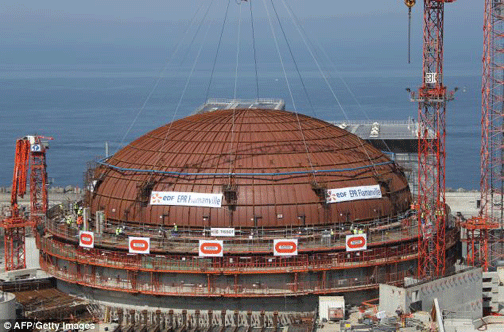
France’s Revolutionary Nuclear Reactor Is a Leaky, Expensive Mess
With a bloated budget, endless delays, and shoddy construction, EPR looks like a big mistake. BY CAROLINE DELBERT, AUG 3, 2020
- A revolutionary French reactor design is 10 years overdue and nearly four times over budget.
- Taking big technology swings requires risk, but this huge miscalculation looks bad.
- The reactor uses less uranium and aims to replace a decommissioned reactor at an existing plant.
France’s new energy minister has called a major French nuclear project “a mess” in public interviews. The European pressurized reactor (EPR) that was commissioned for the Flamanville nuclear power plant, where it joins two existing pressurized water reactors, has been delayed and plagued by problems. The latest extension takes the project timeline from 13 years to 17 at least.
The goal with the EPR design was to continue to kit out the world’s highest-output nuclear plants, with individual reactors that were more powerful and safer. The EPR uses less uranium because its chemical design is more efficient. And it’s not any kind of major technological leap; instead, it’s an iteration on a previous design that’s just a little bit better.
The engineers are so eager to keep iterating that they already have an EPR 2 design in the works. This sounds pretty straightforward … right?
That puts Flamanville 10 years past its original due date. One of the more alarming causes for delay is a break in the “main secondary system penetration welds,” which has contributed to a budget that’s bloated from a planned $3.9 billion to $14.6 billion.
Barbara Pompili was just appointed France’s minister of ecological transition, which is the department that includes energy as well as environmental issues like biodiversity. Pompili is publicly and avowedly anti-nuclear, even for civilian energy. With a new spotlight on her office, she told a French radio station, “We have made a commitment to reduce the share of nuclear power to 50 [percent] by 2035.”
Pompili said the critiques of Flamanville’s overdue EPR reflect broad industry consensus from different reports, not her own anti-nuclear views.
Nuclear waste – how to warn people for 10,000 years
 How to build a nuclear warning for 10,000 years’ time, The nuclear waste buried far beneath the earth will be toxic for thousands of years. How do you build a warning now that can be understood in the far future?, BBC Future, 3 Aug 20
“This place is not a place of honor,” reads the text. “No highly esteemed dead is commemorated here… nothing valued is here. What is here was dangerous and repulsive to us. This message is a warning about danger.”
It sounds like the kind of curse that you half-expect to find at the entrance to an ancient burial mound. But this message is intended to help mark the site of the Waste Isolation Pilot Project (WIPP) that has been built over 2,000 feet (610m) down through stable rocks beneath the desert of New Mexico. The huge complex of tunnels and caverns is designed to contain the US military’s most dangerous nuclear waste.
This waste will remain lethal longer than the 300,000 years Homo sapiens has walked across the surface of the planet. WIPP is currently the only licensed deep geological disposal repository in operation in the world. A similar facility should also open in Finland in the mid-2020s.
When the facility is full sometime in the next 10 to 20 years, the caverns will be collapsed and sealed with concrete and soil. The sprawling complex of buildings that currently mark the site will be erased. In its place will be “our society’s largest conscious attempt to communicate across the abyss of deep time”.
vThe plan calls for huge 25ft (7.6m) tall granite columns marking the four-sq-mile (10 sq km) outer boundary of the entire site. Inside this perimeter, there is an earth berm 33ft (10m) tall and 100ft (30m) wide marking the repository’s actual footprint. Then inside the berm will be another square of granite columns.
At the centre of this monumental “Do Not Enter” sign will be a room containing information about the site. In case the information becomes unreadable, there will be another buried 20ft below, and another buried in the earth barrier itself. Detailed information about the WIPP will be stored in many archives around the world on special paper stamped with the instruction that it must be kept for 10,000 years, the rather arbitrary length of the site’s license.
The plan calls for huge 25ft (7.6m) tall granite columns marking the four-sq-mile (10 sq km) outer boundary of the entire site. Inside this perimeter, there is an earth berm 33ft (10m) tall and 100ft (30m) wide marking the repository’s actual footprint. Then inside the berm will be another square of granite columns.
Welcome to the world of nuclear semiotics. The vast landscape proposed for the WIPP is partly influenced by science fiction. Nuclear physicists, engineers, anthropologists, sci-fi writers, artists and others have come together in the very broad, esoteric field of research into the way that future humans – and anything that comes after us – might be warned of our deadly legacy
Sadly, the idea to cover the site with a forest of massive concrete thorns was not taken up, nor the idea to create a self-perpetuating atomic priesthood who would use legend and ritual to create a sense of fear around the site for generations. Linguist Thomas Sebok first used the phrase “nuclear priesthood” in 1981. ……. https://www.bbc.com/future/article/20200731-how-to-build-a-nuclear-warning-for-10000-years-time
Arms control, the new arms race, and some reasons for optimism

|
“The end of arms control as we know it”
The last agreement limiting America’s and Russia’s nuclear arsenals is months away from expiring. Vox, By Alex Ward@AlexWardVoxalex.ward@vox.com Aug 3, 2020, In December 2019, a secretive group of elite Americans and Russians gathered around a large square table. It was chilly outside, as Dayton, Ohio, can get in the winter, but the mood inside was just as frosty.
The 147th meeting of the Dartmouth Conference, a biannual gathering of citizens from both nations to improve ties between Washington and Moscow, had convened. Former ambassadors and military generals, journalists, business leaders, and other experts came together to discuss the core challenges to the two countries’ delicate relationship, as members had since 1960. In recent years, that has included everything from election interference to the war in Ukraine. But now the prospect of an old danger worried them most, just as it had the group’s quiet supporters President Dwight Eisenhower and Soviet Chairman Nikita Khrushchev decades before: nuclear catastrophe. Proceedings typically start with a lengthy summary of the relationship, touching on security, medical, societal, political, and religious issues up for discussion. This time, the synopsis was unnervingly short. “We went right into the nuclear issue,” said a conference member, speaking on condition of anonymity because they were not authorized to speak openly about the event. “There was a belief we were in serious danger because it’s the end of arms control as we know it.” “It was dramatic and sobering,” the member added. The US and Russia were then barely over a year away from losing the last major arms control agreement between them: New START, short for the Strategic Arms Reduction Treaty. That agreement limits the size of the two countries’ nuclear arsenals, which together account for 93 percent of all nuclear warheads on earth. The deal expires on February 5, 2021, and those sitting around the table feared its demise. The trepidation inspired the group’s four co-chairs to do something the Dartmouth Conference hadn’t done in its 60-year existence: release a statement. “Given the deep concerns we share about the security of our peoples, for the first time in our history we are compelled by the urgency of the situation to issue this public appeal to our governments,” they wrote, calling for the US and Russia to invoke the treaty’s five-year extension. Today, roughly half a year before New START stops, the group’s members continue to stress the consequences. “We’re at a decisive point,” said retired US Army Brig. Gen. Peter Zwack, who was at the December meetings. “The entire arms control regime of the past 50 years is about to pass.” Seventy-five years ago this week, the US dropped atomic bombs on Hiroshima and Nagasaki in Japan, unleashing a weapon of mass destruction on the world. Decades of painstaking diplomacy between the world’s two greatest nuclear powers, the US and Russia, helped keep both nations from unleashing that destructive power on each other ever since. But now the US and Russia are mere months from throwing it all away. New START may soon join other defunct arms control agreements, including one prohibiting ground-based intermediate-range missiles scrapped in 2019 and another allowing overflights of nuclear facilities likely to end this year. One reason for all of this: President Donald Trump wants to put his own stamp on arms control history, one way or another…….. “The president has directed us to think more broadly than the current arms control construct and pursue an agreement that reflects current geopolitical dynamics and includes both Russia and China,” a senior administration official told me on the condition of anonymity. “We’re continuing to evaluate whether New START can be used to achieve that objective.” That evaluation has turned into a delicate process with Russia, with high-level and working-level meetings taking place in Vienna to see if New START can be salvaged. Officials from both countries met again at the end of July in Austria’s capital, while China — which the US wants involved to discuss limiting its nuclear and missile capabilities, even though it isn’t a party to New START — didn’t show up……… If New START ends, then, the general animosity between the US and Russia could lead to a nuclear arms race and prompt China to keep building up its forces — a situation unlike anything we’ve seen since the Cold War. “We’re creating the greater threat of a conflict that could literally destroy each country and perhaps even our planet,” Leon Panetta, the former CIA director and defense secretary, told me. The following account of the looming death of US-Russia arms control is based on conversations with over 20 current and former US officials, lawmakers, and experts on three continents. It traces the story of arms control from its origins to its possible end in the coming years, and what that end could mean for all of us. The long and dangerous road to arms control……………..Trump takes control, and trashes arms controlNuclear war is a threat Donald Trump has often talked about over the years, and he has sometimes seemed genuinely concerned about it…….. When Trump took office on January 20, 2017, three major arms control-related agreements were in force: the INF Treaty, a confidence-building measure known as Open Skies, and New START, the agreement Obama had negotiated just a few years earlier. Yet, rather than continue the progress his predecessors made toward making the world safer from the threat of nuclear war, Trump decided to tear it all down, while pursuing an exit from the Iran nuclear deal and ineffective nuclear diplomacy with North Korea. Of those three US-Russia agreements, one is gone, another is almost gone, and the last, it seems, is on the way out. That’s not all bad, some experts say, as Russia did cheat on some of the agreements and the US showed those actions would have consequences. But most experts I spoke to are concerned that Trump is tearing down an artifice with no new blueprints to make it better, or even rebuild what exists. “The whole arms control regime is under considerable stress,” former Energy Secretary Ernest Moniz, who now leads the Nuclear Threat Initiative, told me. “It’s badly frayed.” Let’s take each deal in turn. The INF Treaty The Intermediate-Range Nuclear Forces (INF) Treaty was signed by President Ronald Reagan and Soviet leader Mikhail Gorbachev in December 1987. It prohibited Washington and Moscow from fielding ground-launched cruise missiles that could fly between 310 and 3,400 miles.Both countries signed the deal as a way to improve relations toward the end of the Cold War. However, the two nations still could — and since have — built up cruise missiles that can be fired from the air or sea……… Ultimately….. “the president made the decision to leave” the deal. That officially happened in August 2019. Open SkiesOriginally an idea by Eisenhower and made a reality in 2002, the Open Skies Treaty allows nations to conduct unarmed flights over another country’s military installations and other areas of concern. Entering into effect 10 years later, it has since helped the 34 North American and European signatories, including the US and Russia, gain confidence that others weren’t developing advanced weapons in secret or planning big attacks…….. In May 2020, Trump decided America would withdraw from the Open Skies Treaty, kicking off a six-month clock before the US could officially leave the deal. …………. New STARTAs a reminder, the New START arms control deal became effective in 2011 during the Obama administration. The treaty’s goal, essentially, is to limit the size of the American and Russian nuclear arsenals, the two largest in the world. To ensure those limits are met and kept, the treaty also allows Washington and Moscow to keep tabs on the other’s nuclear programs through stringent inspections and data sharing, thereby curbing mistrust about each other’s nuclear and military plans. At the time, it was heralded as a major achievement and is still considered such by top lawmakers………… As of mid-July 2020, the two nations had exchanged more than 20,400 total notifications about the state of their arsenals. Rose Gottemoeller, who led the New START negotiations for the US at the State Department, told me all that goes away if Trump decides not to stay in the agreement. “The Russians won’t allow for verifications and inspections without a legal basis,” she said. And without the ability to get deep insight into Russia’s nuclear forces, trust would surely erode. “The exact thing which gives us an excellent understanding of Russian strategic forces is all going to break down,” said Gottemoeller, who in 2019 stepped down as NATO’s deputy secretary. “Unless you have access to verify what’s going on with the warheads on missiles or submarines, you don’t really understand what’s going on.” Putin, Russia’s president, says he sees value in the deal. “Russia is not interested in starting an arms race and deploying missiles where they are not present now,” he told Russian officials in December. “Russia is ready to immediately, as soon as possible, by the end of this year, without any preconditions, extend the START Treaty so that there would be no further double or triple interpretation of our position.” Trump hasn’t taken up Putin on his offer yet, even though those two could extend the agreement for up to five years without anyone else’s input………….. So why get out of a deal that almost everyone says is vital to keeping US-Russia relations stable? The answer is China…….. In July, top US arms control negotiator Marshall Billingslea extended an “open invitation” to Chinese officials to join the US and Russia in Austria for New START talks, even though Beijing has long said it won’t sign on to New START since its arsenal is so much smaller than Washington’s and Moscow’s. …………… The new arms race“Arms control creates an additional layer of insurance between states not getting along well and a possible hot war,” Samuel Charap, who served as a senior adviser to Gottemoeller after New START entered into force, told me. “If you remove the failsafe, you create more risk.” Without the longstanding architecture in place, Washington and Moscow would enter a dangerous arms control hiatus and could see already poor relations spiral out of control. The US and Russia have many nuclear-tipped missiles already pointed at each other, but it would be even worse if both sides try to one-up their adversary by creating more deadly and usable weapons. That, unfortunately, is exactly what’s happening. Welcome to the new arms race. ……………….. A review conference for the treaty was supposed to take place in April but was postponed due to the coronavirus. Whenever it meets, the lack of US-Russia arms control commitment could make it the testiest gathering in decades. Some may seriously push for the NPT to be dissolved. And if that’s the case, what’s to stop nations like Iran, Saudi Arabia, or others from sprinting toward the bomb? Second, the end of an important era in global security fades away with nothing to replace or build on it. “The good old days when arms control was going hand-in-hand with a cooperative security relationship — which basically ties my security to your security — those days are gone, and I don’t see them coming back,” said the University of Hamburg’s Kühn. The only chance of a return to that time, he added, would likely be after Trump, Putin, and Chinese President Xi Jinping leave their offices………………. There are reasons for optimism. Washington and Moscow are having conversations now, including a working-level meeting in July in Vienna. Even though the administration is skeptical of arms control, and Billingslea is not a fan of the concept, Trump’s team at least hasn’t outright rejected negotiations. However unlikely now, the two powers could come to an agreement before New START’s expiration on February 5. If they don’t, a newly elected Joe Biden could quickly reach a deal with Putin before the deadline, though he’d have limited time since his term would start in late January. “The election in November will be a major inflection point for New START specifically,” Moniz, the former energy secretary who helped strike the Iran nuclear deal, told me. “If Biden wins, I can’t imagine that he wouldn’t extend New START.”……… https://www.vox.com/world/21131449/trump-putin-nuclear-usa-russia-arms-control-new-start |
|
Glaciers in New Zealand – extreme melting due to global heating

|
Human-induced climate change is causing ‘extreme’ melting in New Zealand glaciers, The study is only the second to draw a direct link between glacier melt and human-induced climate change. SBS NEWS 4 AUG 20 BY BIWA KWAN New analysis of data and photo records of melting glaciers in New Zealand has found human-induced climate change increased the likelihood of mass ice melt. The new modelling techniques were applied to 10 glaciers in New Zealand to reveal a more detailed picture of what is driving the accelerating rates of ice melt in the region. Lead researcher Lauren Vargo said the analysis compared ice melt under pre-industrial greenhouse gas emissions and current-day emissions to uncover “a quite extreme result”. “Some of the glaciers were at least six times more likely to have experienced that high mass loss because of humans,” said Dr Vargo, who is based at the Victoria University of Wellington. “We’re really confident with that number because that is the low end. The high end is 350 times more likely. “But with the high ice mass loss event we saw [in 2018], it would not have happened at all without humans.” The first study to make a direct link between human-induced climate change and glacier melt focused on glaciers in the Northern Hemisphere where more robust data records exist. The study – published in the journal Science in 2014 – looked at records between 1851 and 2010 using a running mean over 20-year periods. Dr Vargo said the rate of ice melt has resulted in the loss of a quarter of New Zealand’s glaciers since the 1970s. Rapid melt events in 2011 and 2018 prompted the study. …… The study accounted for years like 2013 when some glaciers in New Zealand actually gained mass, but not at a rate to combat the overall decline. ……. HTTPS://WWW.SBS.COM.AU/NEWS/HUMAN-INDUCED-CLIMATE-CHANGE-IS-CAUSING-EXTREME-MELTING-IN-NEW-ZEALAND-GLACIERS |
|
Florida’s nuclear power stations could be at risk in hurricane times
|
Hurricane Isaias projected to strafe eastern side of Florida over the weekend, S and P Global
HIGHLIGHTSUncertainty over where it may make landfall
Utilities and energy companies to keep close eye Houston — In a late July 31 advisory, the National Oceanic and Atmospheric Administration’s National Hurricane Center said heavy rains associated with Hurricane Isaias could begin to affect south and east central Florida late Friday night and the eastern Carolinas by early next week, potentially resulting in isolated flash flooding. NOAA said the Category 1 hurricane was expected to reach the east coast of Florida on Saturday morning. It said that storm surge along the northeastern Florida coast could come late in the weekend, and spread northward along the remainder of the US East Coast through early next week. Florida Power & Light said July 31 it had a restoration workforce of more than 10,000 “ready to respond to Hurricane Isaias amid the global COVID-19 pandemic.” It said it will bring in crews from sister company Gulf Power and has secured more than 2,000 additional restoration personnel from nearly 10 states. “We are committed to restoring service in between bands of severe weather, as long as winds are below 35 MPH,” the company said. FPL owns the two-reactor, 1,600-MW Turkey Point Nuclear Generating Station located two miles east of Homestead, Florida, and about 25 miles south of Miami. According to preliminary mapping of Isaias’ path, the Turkey Point facility may escape the storm’s more severe western rain bands on Saturday. FPL’s 1,880-MW St. Lucie Nuclear facility located further up the Florida coast on Hutchinson Island, may not be so lucky. The center of the storm eye could pass offshore of the St. Lucie facility early on Sunday morning. In a statement, Duke Energy Florida said it believed its customers in central and eastern Florida may experience weather-related outages. …… https://www.spglobal.com/platts/en/market-insights/latest-news/natural-gas/073120-hurricane-isaias-projected-to-strafe-eastern-side-of-florida-over-the-weekend |
|
How the Ohio nuclear bribery scandal developed. And what’s next

 Nuclear bailout in Ohio tied to bribery scandal was years in making Nuclear bailout in Ohio tied to bribery scandal was years in making
Nuclear plants nationwide were warning four years ago that their aging reactors were in need of financial help, because they couldn’t compete with cheaper natural gas-fired plants. The New Indian Express, By PTI 3 Aug 20,
TOLEDO: A $1 billion bailout for Ohio’s two nuclear plants that’s now entangled in a state bribery scandal had little support when the idea came up three years ago. It was all but dead until the spring of last year, when the new leader of the Ohio House stepped up with a last-ditch attempt to give the plants a financial lifeline. But that’s all on shaky ground again after federal authorities accused the powerful Republican Ohio House speaker and four associates of orchestrating a $60 million bribery scheme involving corporate money secretly funneled to them in exchange for passing the bailout. The question for state lawmakers who are under pressure to repeal the bailout is whether they’re willing to face another divisive debate — this time under the shadow of scandal — in order to find a new way to prop up the financially strapped nuclear plants. Here is a look at how the bailout came about and its prospects going forward. DIM OUTLOOK …….. GLIMMER OF HOPE Just months after taking over the GOP-controlled Ohio House, Speaker Larry Householder in early 2019 unveiled a plan to save the nuclear plants and eliminate incentives promoting wind and solar power. It would steer the state in the right direction, he said. …….. BEHIND THE SCENES t was no secret that millions were being spent to persuade lawmakers to support the bill and keep a repeal effort off the statewide ballot last year. But it wasn’t until just two weeks ago that federal authorities said it involved illegal activity that began in 2017. Householder’s strategy, according to a federal complaint, was to pick freshman legislators he’d help elect to sponsor the bill, create a new subcommittee comprised mostly of his supporters who would push the legislation forward, and engage in an expensive media blitz to pressure public officials to back it. Federal prosecutors allege Householder then used “pressure tactics” to get the bill passed, strong-arming his own House members and senators to vote in favor. In exchange, investigators said a dark money group Householder controlled received $60 million from a unidentified company, which the complaint makes clear is FirstEnergy and its affiliates. Householder and his attorney have not commented since his arrest. FirstEnergy’s CEO has said he and the company did not do anything wrong. WHAT’s NEXT? Ohio’s governor is calling on the Legislature to repeal the bailout and replace it, saying he still believes the nuclear plants are an important part of the state’s energy future. Fellow Republican Bob Cupp, a veteran lawmaker from Lima who was chosen this past week to become the new House speaker after lawmakers booted Householder from the job, said one of his first priorities will be to do away with the legislation and start anew. But some lawmakers, including those who voted for the bailout last time around, want nothing to do with it again…….. https://www.newindianexpress.com/world/2020/aug/03/nuclear-bailout-in-ohio-tied-to-bribery-scandal-was-years-in-making-2178602.html |
|
Fire at the Belleville nuclear power plant reveals the disorganization of EDF
  Le Journal de l’Energie 30th July 2020 A fire at the Belleville nuclear power plant reveals the disorganization of Le Journal de l’Energie 30th July 2020 A fire at the Belleville nuclear power plant reveals the disorganization ofEDF. A fire broke out at the Belleville-sur-Loire (Cher) nuclear power plant in April 2020 during a routine maintenance operation carried out by subcontractors, which should not have been left unattended. An incident that was largely avoidable if EDF had followed basic safety rules. An
inspection by the Nuclear Safety Authority (ASN), after the incident, identified “many deviations”. Although the incident did not have an impact on the operation of the plant, it calls into question the safety culture of EDF, the world’s leading nuclear operator. https://journaldelenergie.com/nucleaire/incendie-centrale-nucleaire-belleville-desorganisation-edf/ |
|
Ballooning by $billions – UK’s costs for its nuclear weapons
 The Ferret 2nd Aug 2020 The cost of UK programmes to replace Trident and nuclear submarines on the
Clyde increased by over £1 billion in a year, according to data released
by the Ministry of Defence (MoD).
The construction of new reactor cores,
replacement submarines and major new facilities at the Faslane and Coulport
bases in Argyll are also facing prolonged delays, with growing doubts over
whether some projects can be successfully delivered.
Most of the delays are
unrelated to the coronavirus pandemic. Four major nuclear projects have
been officially rated as “amber” or worse, meaning that they have
“significant issues”. Two have been “rebaselined” by the MoD,
meaning that costs have risen significantly and timescales lengthened.
https://theferret.scot/trident-nuclear-submarine-costs-1bn-delays/
Australia gets anti-China propaganda, funded by USA, in cahoots with Falun Gong

Before becoming Australia’s Defence Minister, Linda Reynolds worked as a project director at Raytheon (weapons manufacturer).
Propaganda Wars: US state department funds anti-China news outlet in Australia https://www.michaelwest.com.au/propaganda-wars-us-state-department-funds-anti-china-news-outlet-in-australia/
by Marcus Reubenstein | Aug 4, 2020 Office bearers of US-backed Chinese language news service Decode China are linked with Falun Gong, the spiritual group that has spent millions backing Donald Trump through fake social media accounts. The same people are on the board of the National Foundation for Australia China Relations, raising scepticism about its ability to repair fractured relationships. Marcus Reubenstein investigates US state funding of anti-China media in Australia and links to global arms dealers via ASPI.
The US State Department is quietly funding a Chinese-language news service in Australia, a move more typically associated with China’s state media propagandists.
And two of the three office bearers of the news service, Decode China, are members of a taxpayer-funded independent board advising the Australian government on engagement with China.
Corporate records show Dr Wai Ling Yeung and Maree Ma became secretary and director, respectively, of Decode China Pty Ltd just eight weeks before Foreign Minister Marise Payne appointed them to the board of the National Foundation for Australia China Relations. The NFACR replaced the Australia China Council (ACC), which was set up by the Fraser government in 1978 and later chaired by former prime minister Gough Whitlam.
The retired Curtin University academic Dr Yeung is a vocal critic of the Chinese government, while Ma is the general manager of the Falun Gong-aligned, largely anti-Chinese government Vision Times newspaper. According to journalist and former Australian Falun Gong practitioner Ben Hurley, Vision Times is part of the apparatus of Falun Gong media in Australia, led by The Epoch Times and New Tang Dynasty Television.
The spiritual group Falun Gong is banned in China and there is substantial evidence that its mainland Chinese followers are harshly persecuted by the Chinese government.
However, former practitioners say it’s a dangerous cult, whose leaders claim to have the power of levitation and tell followers that aliens from other planets are responsible for interracial marriage and mixed-race children.
Falun Gong-aligned media affiliates in the US have been accused of pouring millions of dollars into fake social media accounts and Facebook advertising, since banned, supporting Donald Trump. A recent investigation by the ABC’s Foreign Correspondent and Background Briefing programs revealed Falun Gong-affiliated media in the US have spent more than US$11.5 million in social media advertising to promote Trump.
ASPI lurking in the background Continue reading
The continuing and ever more expensive saga of Britain’s Hinkley Point C nuclear project

Times 3rd Aug 2020, The first thing you notice as you approach Hinkley Point C is the sea of
cranes. There are dozens of them, jutting into the Somerset sky from the
site where EDF, of France, and CGN, the Chinese state nuclear group, are
building Britain’s first new nuclear plant in a generation. One stands
out: a 250 metre-tall yellow beast known as “Big Carl”. It is the
world’s largest crane and is central to the companies’ battle to
deliver the project successfully.
£18 billion, the plant was slated to generate its first power before the
end of 2025. Four years on, the budget has risen to between £21.5 billion
and £22.5 billion and EDF says that there is a risk that first power may
be delayed until 2027, adding £700 million in costs; thanks to disruption
from Covid-19, that risk is now “high”.
another big risk, with EDF warning last week that productivity at the site
and in supply chain factories were still being affected. The company said
that it had done what it could to minimise delays, from bringing in extra
buses to transport workers to sending contractors to France to bring back
parts from a factory laid low by the pandemic. EDF believes that it can
catch up on Covid-19 delays by the end of next year, so long as operations
and its supply chain are back to normal by the end of 2020. How confident
was Mr Crooks that the plant would start up in 2025 as planned?
“There’s a long way to go yet. It is a big, complex project.”
https://www.thetimes.co.uk/article/no-let-up-in-heavy-lifting-at-hinkley-point-plant-3s02wmscp
The longlasting impact of Fukushima nuclear disaster, and nuclear activities world-wide
emeritus at the University of Chicago, published one of the best overviews
any of us at Fairewinds has read about the impact of the meltdowns at the
Fukushima Dai-ichi atomic power reactors upon the people and culture of
Japan.
Focus, the article entitled – This Will Still Be True Tomorrow:
“Fukushima Ain’t Got the Time for Olympic Games”: Two Texts on
Nuclear Disaster and Pandemic is a must-read worldwide. Atomic power plants
and nuclear power waste dumps are located all over the world.
in the burden of nuclear test labs, uranium mining, and the manufacturing
of atomic power fuel and nuclear weapons, the ecological weight of the
radioactive legacy we all live with is overwhelming.
Fukushima Dai-ichi, Dr. Field has written a well-researched and documented
analysis of what is happening today to its victims.
(TEPCO), the owner of the Fukushima Dai-ichi reactors, and the government
of Japan have forged ahead with decisions that have compromised the health,
livelihood, and futures of victims and their families and their subsequent
children – for generations.
nuclear power and the international military/industrial complex, has failed
miserably in its commitment to its citizens and severely impacted the
health and welfare of generations to come with its contaminated land, air,
water, and food.
https://www.fairewinds.org/demystify/fukushima-aint-got-time-for-olympic-games?s=09
Nuclear radiation – potential danger in East Ukraine
Coal mines and the metallurgical plants associated with them are the backbone of the economy in the self-proclaimed republics of Donetsk and Luhansk in eastern Ukraine, where the conflict between the central government and the Russian-backed separatists rages on. Closing them deprives the local population of their livelihoods and threatens these and the neighboring regions in Ukraine with ecological disaster.
Pumps cut off
In 2017, the “Donetsk People’s Republic” (“DPR”) developed a plan, according to which only 17 of the profitable mines in the region were kept in operation.
But reality decided to throw a wrench in the works, primarily because Russia did not invest in the Donetsk industry.
The mines were closed by a simple method: the pumps that pump out the water were turned off. The equipment was cut and handed over for scrap.
And it will inevitably affect the situation on the territory controlled by Ukraine – the mines on Ukrainian territory and the Donbass mines form a single water pumping system.
No radioactive contamination…yet
Of particular concern is the Yunkom mine, which in 1979 carried out an experimental nuclear explosion with a yield of 0.3 kilotons.
After the explosion, a glassy capsule with liquid radioactive waste was formed at a depth of 903 meters. It was flooded just after the pumps were turned off in April 2018.
None of the experts really know how the radioactive capsule will react with water, when it will naturally collapse, or where its contents will end up. Neither the authorities of the self-proclaimed republics nor the government of Ukraine are monitoring the radioactive contamination. Nor are they in the Rostov region, where the waters of the Seversky Donets River flow……… https://jam-news.net/ukraine-conflict-miness-ecology/
1 This Month

of the week – Shut Down Drone Warfare!


Tell the Ukrainian Government to Drop Prosecution of Peace Activist Yurii Sheliazhenko

Petition to revoke the licensing of the Near Surface Nuclear Disposal Facility (NSDF) at Chalk River. https://www.ourcommons.ca/petitions/en/Petition/Details?Petition=e-7247
To see nuclear-related stories in greater depth and intensity – go to https://nuclearinformation.wordpress.com
-
Archives
- April 2026 (114)
- March 2026 (251)
- February 2026 (268)
- January 2026 (308)
- December 2025 (358)
- November 2025 (359)
- October 2025 (376)
- September 2025 (257)
- August 2025 (319)
- July 2025 (230)
- June 2025 (348)
- May 2025 (261)
-
Categories
- 1
- 1 NUCLEAR ISSUES
- business and costs
- climate change
- culture and arts
- ENERGY
- environment
- health
- history
- indigenous issues
- Legal
- marketing of nuclear
- media
- opposition to nuclear
- PERSONAL STORIES
- politics
- politics international
- Religion and ethics
- safety
- secrets,lies and civil liberties
- spinbuster
- technology
- Uranium
- wastes
- weapons and war
- Women
- 2 WORLD
- ACTION
- AFRICA
- Atrocities
- AUSTRALIA
- Christina's notes
- Christina's themes
- culture and arts
- Events
- Fuk 2022
- Fuk 2023
- Fukushima 2017
- Fukushima 2018
- fukushima 2019
- Fukushima 2020
- Fukushima 2021
- general
- global warming
- Humour (God we need it)
- Nuclear
- RARE EARTHS
- Reference
- resources – print
- Resources -audiovicual
- Weekly Newsletter
- World
- World Nuclear
- YouTube
-
RSS
Entries RSS
Comments RSS
 nuclear-news