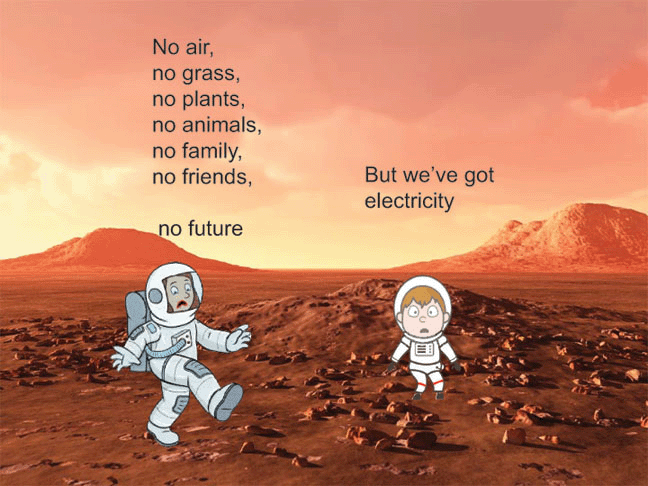
The U.S. Department of Energy put out the formal request to build what it calls a fission surface power system that could allow humans to live for long periods in harsh space environments.
The Idaho National Laboratory, a nuclear research facility in eastern Idaho, the Energy Department and NASA will evaluate the ideas for developing the reactor.
The lab has been leading the way in the U.S. on advanced reactors, some of them micro reactors and others that can operate without water for cooling. Water-cooled nuclear reactors are the vast majority of reactors on Earth.
“Small nuclear reactors can provide the power capability necessary for space exploration missions of interest to the Federal government,” the Energy Department wrote in the notice published Friday.
The Energy Department, NASA and Battelle Energy Alliance, the U.S. contractor that manages the Idaho National Laboratory, plan to hold a government-industry webcast technical meeting in August concerning expectations for the program.
The plan has two phases. The first is developing a reactor design. The second is building a test reactor, a second reactor be sent to the moon, and developing a flight system and lander that can transport the reactor to the moon. The goal is to have a reactor, flight system and lander ready to go by the end of 2026.
The reactor must be able to generate an uninterrupted electricity output of at least 10 kilowatts. The average U.S. residential home, according to the U.S. Energy Information Administration, uses about 11,000 kilowatt-hours per year. The Energy Department said it would likely take multiple linked reactors to meet power needs on the moon or Mars.
In addition, the reactor cannot weigh more than 7,700 pounds (3,500 kilograms), be able to operate in space, operate mostly autonomously, and run for at least 10 years.
“This may drive or start an international space race to build and deploy new types of reactors requiring highly enriched uranium.”
– Edwin Lyman, director of Nuclear Power Safety at the Union of Concerned Scientists
The Energy Department said the reactor is intended to support exploration in the south polar region of the moon. The agency said a specific region on the Martian surface for exploration has not yet been identified.
Edwin Lyman, director of Nuclear Power Safety at the Union of Concerned Scientists, a nonprofit, said his organization is concerned the parameters of the design and timeline make the most likely reactors those that use highly enriched uranium, which can be made into weapons. Nations have generally been attempting to reduce the amount of enriched uranium being produced for that reason.
“This may drive or start an international space race to build and deploy new types of reactors requiring highly enriched uranium,” he said.
Earlier this week, the United Arab Emirates launched an orbiter to Mars and China launched an orbiter, lander and rover. The U.S. has already landed rovers on the red planet and is planning to send another next week.
Officials say operating a nuclear reactor on the moon would be a first step to building a modified version to operate in the different conditions found on Mars.
“Idaho National Laboratory has a central role in emphasizing the United States’ global leadership in nuclear innovation, with the anticipated demonstration of advanced reactors on the INL site,” John Wagner, associate laboratory director of INL’s Nuclear Science & Technology Directorate, said in a statement. “The prospect of deploying an advanced reactor to the lunar surface is as exciting as it is challenging.”
The National 26th July 2020, SCOTLAND could see the end of nuclear weapons on the Clyde within three
years of a Yes vote under radical new plans be put to the SNP annual
conference. A resolution is to be submitted to the event this October
setting out the time frame for the first time.
Robot to use brush to retrieve melted fuel at Fukushima plant, Asahi Shimbun, By KEITARO FUKUCHI/ Staff Writer, July 27, 2020 FUKUSHIMA--A robotic arm under development in Britain will use a brush and vacuum vessel on its end to collect melted fuel in a step toward retrieving debris at the crippled Fukushima No. 1 nuclear power plant.
Details of the device, which will start collecting debris inside the No. 2 reactor on a trial basis next year, were announced on July 2.
The government and plant operator Tokyo Electric Power Co. plan to retrieve melted fuel at the No. 2 reactor ahead of two other reactors because radiation levels are relatively low……..
Training is expected to reduce the time required for workers to put debris into the transfer vessel near the fuel.
EDF Denies Rising Chinese Influence at U.K. Nuclear Site, Bloomberg, By Corinne Gretler, July 26, 2020,
Chinese partner’s role bigger than disclosed, Telegraph said
EDF said allegations are ‘untrue,’ CGN’s role not increasing
Electricite de France SA denied a media report that China General Nuclear Power Corp.’s role at a U.K. nuclear site is increasing, underlining the growing tensions about China’s involvement in critical infrastructure.
The company understated the number of Chinese personnel on site and leaned heavily on CGN’s expertise in planning and construction, the Sunday Telegraph reported, citing company documents and unidentified sources. The newspaper also said Chinese engineers proposed a way to lift a concrete dome onto the reactor at Hinkley Point C that would’ve involved dangling the heavy structure above workers, before it was deemed too dangerous…………
But communities downwind from the first atomic test in the New Mexico desert on July 16, 1945, are still holding out for compensation for health effects that they say have been ongoing for generations due to fallout from the historic blast.
So far, their pleas for Congress to extend and expand a federal radiation compensation program have gone unanswered. The program currently covers workers who became sick as a result of the radiation hazards of their jobs and those who lived downwind of the Nevada Test Site.
Those excluded from the program include residents downwind of the Trinity Site in New Mexico, additional downwinders in Nevada, veterans who cleaned up radioactive waste in the Marshall Islands and others.
Tina Cordova, a cancer survivor and co-founder of the Tularosa Basin Downwinders Consortium, said the excuse always has been that the federal government doesn’t have enough money to take care of those affected.
She said the need is even greater now since the coronavirus is disproportionately affecting those with underlying health conditions and downwinders fall into the category because of their compromised health
“When you talk about enhancing plutonium pit production and defense spending in the trillions, you can’t tell us there’s not enough money to do this,” she told The Associated Press. “You can’t expect us to accept that any longer and that adds insult to injury. It’s as if we count for nothing.”
U.S. Rep. Ben Ray Lujan, the New Mexico Democrat who advocated for the apology, continues to push for amendments to the radiation compensation program. His office recently convened a meeting among downwinders, uranium miners, tribal members, other advocates and staff in House Speaker Nancy Pelosi’s office.
“The congressman believes that the need for medical and monetary compensation has never been more urgent,” said Monica Garcia, a spokeswoman for the congressman.
The discussions come as the New START treaty between the U.S. and Russia nears expiration in 2021. Russia has offered to extend the nuclear arms control agreement while the Trump administration has pushed for a new pact that would also include China.
While the U.S. House has adopted language that would prohibit spending to conduct or make preparations for any live nuclear weapons tests, a group of senators has included $10 million for such an effort in that chamber’s version of the bill.
The Union of Concerned Scientists, nuclear watchdogs and environmentalists all are pushing for the funding to be eliminated. They sent letters this week in opposition and plan to lobby lawmakers.
“A U.S. resumption of nuclear testing would set off an unpredictable and destabilizing international chain reaction that would undermine U.S. security,” reads one letter.
Kevin Davis with the Union of Concerned Scientists’ global security program said resuming live testing would be unnecessary because the U.S. has been able to do sub-critical experiments and use its super computers along with data from past testing to run simulations on the nation’s nuclear stockpile.
The last full-scale underground test was done Sept. 23, 1992, by scientists with Los Alamos National Laboratory at the Nevada Test Site northwest of Las Vegas. Less than two weeks later, then President George H.W. Bush signed legislation mandating a moratorium on U.S. underground nuclear testing.
Democrat Rep. Ben McAdams of Utah is among those leading the effort to ban spending for testing. He said thousands of residents in his state are still dealing with trauma and illness as a result of previous testing.
Dozens of groups also signed on to a letter sent to congressional leaders in May advocating for the expansion of the radiation compensation program.
“We can’t continue to allow the government to walk away from their responsibility,” Cordova said.
While the nuclear macho men plan more nuclear, and nuclear weapons in space, it seems that it takes a woman, Alice Gorman, to investigate the radioactive pollution on Earth and in space, due to these activities
In July 1945, a test conducted in the deserts of New Mexico officially propelled humanity into the nuclear era. Only weeks after the Trinity Test, two atomic bombs were dropped on the Japanese cities of Hiroshima and Nagasaki.
In the following decades, while no other nuclear device was detonated in an act of war, military tests and studies continued.
Seventy-five years later, space archaeologists are wondering how to warn humanity of the future that the sites where these experiments were carried out are still dangerous, Alice Gorman, associate professor at Flinders University in Adelaide, Australia, told The Jerusalem Post.
“The type of plutonium used in the Trinity Test, plutonium-239, has a half-life of 24,000 years, meaning that after this time, only half of it will have decayed into a safe, non-radioactive element. How do we communicate to people living then that the site is dangerous?”
Gorman said the issue presents two challenging elements: What materials can survive such a long time, and what form of language can be used to deliver the actual message?
“As for the first difficulty, we know that stones and pottery last a very long time,” she said. “But the second point raises a big archaeological question related to symbolic communication. If we look at rock art from 20,000 years ago, we can see that there are pictures of animals, but we do not know what those pictures mean. Therefore, it is possible that our current symbols to mark radioactive sites, the yellow [and] black sign, will be interpreted as an invitation to explore the area, rather than to keep away from it.”
The issue is especially important for archaeologists of the future because in some cases, while the danger would be very limited or
not even relevant on the surface, the nuclear waste and its radiation are deeper in the ground, and conducting a dig would be
especially risky. For example, such is the case of Maralinga, a remote area in southern Australia where the UK conducted several
nuclear tests.
Some nuclear tests were conducted in outer space, and nuclear fuel was employed as propellant for rockets.
If the UN Outer Space Treaty of 1967 prohibited nuclear weapons in space, the issue of its weaponization remains very relevant.“Recently, Russia tested an anti-satellite weapon, reawakening the debate,” Gorman told the Post.
She began to work in space archaeology following years of work focused on stone-tool analysis and the aboriginal use of bottle glass after European settlement.
Space archaeology deals with the same issues of regular archaeology, understanding material culture, human behavior and the interaction with the surrounding environment, Gorman said.
“However, we are looking at the post-Second World War period, when the very same rockets that had been developed as missiles started to send spacecraft into orbit,” she said. “We are interested in all of what is on earth, like rocket launch sites or tracking antennas and reception development, as well as town or residential areas where people who worked on these projects live, but also satellites, space junk and all the places on other planets where humans have sent spacecrafts.”
“We are asking the same questions other archaeologists are, but we have the limitations that we cannot visit many of the sites in person, and instead, we have to rely on records or images,” she added.
Gorman was drawn to space archaeology by the idea of exploring space junk, those many objects that cannot even be seen in the sky circling the Earth. Currently, she is working on the archaeology of the International Space Station.
The recent attempt by Israel to land a robotic unit on the moon with the Beresheet mission represents a very interesting development for space archaeologists, Gorman said.
“For many decades, the only material cultures present on the moon were the American and the Soviet one,” she said. “As new countries have started to reach the moon, this has changed, bringing more diversity to the field.”
Does Iran Really Want to Build Nuclear Weapons at Any Cost? Maybe Not
In the past it took nations three to 10 years to build nuclear bombs, yet 30 years since re-launching its nuclear program, Iran hasn’t assembled a bomb. It aspires to be on the threshold, Haaretz,Yossi Melman 26 Jul 20
July 13 marked the fifth anniversary of the nuclear accord between Iran and the major powers, which remains in effect until 2025. At about the same time, Iran experienced explosions and fires at missile sites, power stations, industrial plants and, most significantly, at the uranium enrichment plant in Natanz.
The blasts at several of the Natanz buildings were very powerful, badly damaging the advanced centrifuges. The sabotage has been attributed to a secret operation by Israeli intelligence, perhaps in tandem with American intelligence. Various reports say the damage to the centrifuges will delay their development and set back Iran’s nuclear program by about a year.
If the Mossad and Israeli Military Intelligence are responsible for the explosion as well as for other acts of sabotage and fires that may have originated in operations by underground organizations working with them, it is definitely an accomplishment for Israel. But it is a tactical, not a strategic, accomplishment.
Israel and the United States have been waging a covert and overt rearguard battle to disrupt and delay Iran’s nuclear program for decades. The toolbox used in this war, according to different reports, has included blowing up facilities and equipment, assassinating scientists, cyberwarfare, diplomacy, and sanctions that are badly hurting the Iranian economy. Yet despite all the difficulties in its path, Iran has not really been deterred and has continued to pursue its nuclear program, adjusting its pace to the circumstances.
Yet perhaps it’s time to change the concept that Iran aspires to assemble nuclear weapons at all costs. A glance at the history of nuclear weapons manufacture shows that all 11 countries that wished to build bombs did so within three to 10 years. These include the five major powers; Israel (according to foreign reports); India; Pakistan; and North Korea. Two countries, South Africa and Ukraine, voluntarily dismantled their nuclear weapons. It’s hard to work out why Iran, which has extensive scientific knowhow, which surreptitiously obtained nuclear technology and whose scientists and universities are high level, has not been able to build a bomb in 30 years.
Maybe it’s time to infer that Iran could have assembled nuclear bombs long ago, but is not doing so – for reasons it is keeping to itself.
A year and a half after the 1979 Islamic Revolution that brought Ayatollah Ruhollah Khomeini to power, Iraq invaded Iran. For the next eight years, Iran’s leaders were focused on this bloody war that caused a million casualties on both sides, and saw Iraq use chemical weapons against Iranian troops. Developing a nuclear bomb was not at the top of their agenda then. Some reports in Iran, which have not been solidly corroborated, say that Khomeini himself was reluctant to develop nuclear weapons, because he felt it would be counter to Islamic law, which calls to avoid harming innocents. ……
In 2015, under pressure from the economic sanctions and under threat by Israel to bomb its nuclear sites, Iran signed the nuclear accord with the five major powers and Germany. The accord, which Prime Minister Benjamin Netanyahu vehemently opposed, is in force for 10 years. It imposed drastic restrictions on Iran’s nuclear sites, technology and materials, and Iran upheld them.
Since President Donald Trump withdrew the United States from the accord in May 2018 (the other signatories all still adhere to it) and forcefully renewed the sanctions, Iran has made some measured counter-moves, such as resuming development of advanced centrifuges. These are disturbing violations, but Iran has not withdrawn from the accord and is not “breaking through” and rushing to a bomb.
While the international and economic pressure, as well as the covert campaign, against Iran should continue, we must also acknowledge that Iran wants to become a nuclear threshold state, and for now is still extremely mixed over whether to build a nuclear bomb. ,……..
And this Iranian uncertainty translates into a policy of walking on the brink: Staying a few months to a year away from building a nuclear bomb, but not actually assembling it.
Russian navy to get hypersonic nuclear weapons: Putin, Aljazeera, 26 July 20, The combination of speed and altitude of hypersonic missiles makes them difficult to track and intercept. Russian President Vladimir Putin has said the Russian navy will be armed with hypersonic nuclear weapons and underwater nuclear drones.
The weapons, some of which have yet to be deployed, include the Poseidon underwater nuclear drone, designed to be carried by submarines, and the Tsirkon (Zircon) hypersonic cruise missile, which can be deployed on surface ships.
The combination of speed, manoeuvrability, and altitude of hypersonic missiles, capable of travelling at more than five times the speed of sound, makes them difficult to track and intercept.
It’s been a bit of a Watergate week for nuclear power, with individuals in two states arrested for criminally defrauding the public to keep nuclear power alive. In Ohio, it was public officials, backed by nuclear company money, who illegally orchestrated a massive subsidy. In South Carolina, it was the arrest of an energy company official who has pled guilty to a $9 billion nuclear fraud. This week, we feature the Ohio story. Next week, it will be South Carolina’s turn.
If you were going to pull someone out of central casting to play a thuggish villain, you would choose Larry Householder. But he wouldn’t need any acting skills.
On July 21, Householder, along with four others, was arrested for his alleged involvement in what amounts to the biggest criminal racketeering conspiracy in Ohio history. Somehow it’s not a surprise that it revolved around pots of money to keep two aging and unaffordable nuclear power plants open.
While Householder may physically embody everyone’s idea of a gangster, it’s not his official profession. He is — and presumably that will soon be a “was” — the Speaker of the Ohio House of Representatives.
The scheme is laid bare in an 81-page criminal complaint. It was busted open by a year-long, detailed and covert investigation by the US Attorney’s office and the FBI, and involves the flow of $61 million of dark money directed toward activities that would ensure the passage of legislation in Ohio guaranteeing the bailout of the Davis-Besse and Perry nuclear reactors to the tune of $1.5 billion. The subsidy is being funded via a surcharge on electricity customers.
The bill, known as HB6, also slashed mandates for wind and solar energy and eliminated energy efficiency requirements. It was, as David Roberts described it on Vox just after the bill passed in July 2019, “the worst piece of legislation in the 21st century” and “the most counterproductive and corrupt piece of state energy legislation I can recall in all my time covering this stuff.”
FirstEnergy Solutions, the then owner of the plants, had threatened their closure if the subsidy was not forthcoming.
That ultimatum set in motion a breathtaking sequence of criminal activities beginning in 2018, with the $61 million slush fund first used to bankroll political elections, then to ensure sufficient votes for the July 2019 passage of HB 6, and finally the sometimes violent suppression of citizen efforts to overturn it.
Millions of dollars went into the campaign war chests of 21 political candidates, in order to stack the House with friendly votes for the subsequent nuclear bailout bill. (Only one ended up voting against it.) The money also shored up Householder’s successful bid to regain the House Speakership.
The money also went into the personal pockets of the co-conspirators, although the exact amounts and their purposes are still being investigated. As events unfold we may also learn whether votes in favor of HB6 were “bought” by Householder.
As the story is far from over, more arrests will almost certainly follow. And more news on this will continue to break. By necessity, this can only be a glimpse of the story so far.
The crimes with which Householder and four political advisors and lobbyists have been charged constitute “a shameful betrayal of public trust,” said FBI special agent, Chris Hoffman during a July 21 press conference announcing the arrests and indictment.
It was also, “likely the largest bribery money-laundering scheme ever perpetrated against the people of the state of Ohio,” said US Attorney for the Southern District of Ohio, David DeVillers at the same press conference, whose department led the investigation alongside the FBI.
But whose money was it?
The racketeering scheme that the justice department uncovered found a money trail of $61 million flowing from what they are required to call “Company A” in the indictment, into a 501(c)(4) fund named Generation Now. Generation Now has also been charged with racketeering conspiracy.
“Company A” is FirstEnergy, whose subsidiary, FirstEnergy Solutions (FES) was the then owner of the crumbling and uneconomical Davis-Besse and Perry reactors. (They are now owned by yet another spin-off, Energy Harbor).
Although FirstEnergy has been served with subpoenas, so far no one there has been named in the indictment. And while the company clearly handed out the $61 million, DeVillers said of the web of conspirators that “this enterprise went looking for someone to bribe them”.
Meanwhile, the money trail that led from FirstEnergy to Larry Householder’s pocket and others’ was deftly concealed. As DeVillers described it, the entire scheme was “created completely and utterly to hide where there donor came from and [who it] was.”
Generation Now, as a 501(c)(4), was not obliged to declare the source of its funding. If it had been, said DeVillers at the press conference, the criminal enterprise it operated could never have happened. Despite its name, DeVillers said, “make no mistake, this is Larry Householder’s 501(c)(4).”
And a Republican-led operation. Generation Now’s treasurer is D. Eric Lycan, a Lexington, KY attorney with ties to the Kentucky House Republican Leadership Caucus. In addition to the ad buys Generation Now made for FirstEnergy, it also made them for an entity called Strategic Media Placement, run by GOP operative, Rex Elass. As DeVillers told the media as he pointed to a rather simple flow chart displayed at the press conference, “the real one would have covered this whole wall.”
FBI special agent Hoffman lumped Householder and his cronies in with FBI usual suspects like “gangs, child sex trafficking and Chinese spies,” but said that “public corruption is actually the top criminal priority for the FBI.”
But it should not be the priority for the US Attorney’s office. DeVillers, a Republican and Trump appointee, could not suppress his anger as he told reporters that his district is already struggling with limited resources and “a massive overdose epidemic where you’ve got people dying of overdoses of fentanyl, people stacked up like cord wood at a coroner’s office, we’ve got violent crime sky-rocketing, we’ve got two Franklin County sheriff’s deputies shot this morning.”
And yet, he continued, “we have to take our resources away from those real victim cases and investigate and prosecute some politicians who just won’t do their damn job.”
Chinese spies were in fact part of the Generation Now misinformation campaign, a scare tactic used to derail efforts by a coalition called Ohioans Against Corporate Bailouts (OACB), which launched a petition drive to repeal HB6.
A FirstEnergy/Householder front group ran scaremongering “yellow peril” ads to deter people from signing a petition that would have reversed the nuclear bailout bill, HB6
As petitioners took to the streets, attempting to gather enough signatures to get a repeal of HB6 onto a November ballot, a smear campaign suggested that, among other things, the petition gatherers were in the payroll of Chinese government operatives who were “quietly invading our American electric grid” and that if you signed the HB6 repeal petition, the Chinese government would be capturing “your name, your address, your signature”. National security would be at risk.
Most ludicrously, the Chinese scare ad, put together by Ohioans for Energy Security (in reality a front group funded by Generation Now) suggested China, and by definition the ballot petitioners, were “taking Ohio money,” which is precisely what the Householder racket was doing.
It worked. OACB eventually ran out of time and petition gatherers, with some having been bought off with a portion of the $61 million. In October 2019, OACB withdrew the initiative, which is when HB6 effectively became law. And it still is.
That’s the worst part of the news. Householder and others may pay a fine, or even see jail time, but the people of Ohio remain in danger. Davis-Besse and Perry are two of the most seriously degraded reactors in the country and should have been shut down long ago.
If Davis-Besse suffered a serious meltdown, there could be “1,400 peak early fatalities, 73,000 peak early injuries, 10,000 peak cancer deaths, and $84 billion in property damage,” according to Beyond Nuclear’s Kevin Kamps, citing a 1982 study by the Nuclear Regulatory Commission. With populations having soared since then, today’s figures would be far higher, he pointed out.
Likewise, the Perry plant’s numbers would be well above the 5,500 acute radiation deaths, 180,000 radiation injuries, 14,000 latent cancer fatalities, and $102 billion in property damage, cited in the 1982 study, should that reactor suffer a major accident.
The $1.5 billion subsidy, says Toledo public interest attorney, Terry Lodge, “didn’t go to ensure safe nuclear plant operations for the next five years, but instead was paid to investors as dividends once the FirstEnergy bailout was over.”
However, it looks unlikely that HB6 will be undone, despite the criminal machinations behind its passage. While Howard Learner, executive director of the Chicago-based Environmental Law & Policy Center, told the Toledo Blade that the Ohio bailout “should not remain in effect if obtained through bribery or other means”, it would have to be nullified by the legislature itself, an action for which there seems little political inclination.
One reason for that reluctance could be yet one more sinister discovery. Prior to the vote on HB6, a Trump operative, Bob Paduchik had pressured “at least five members of the Ohio House of Representatives,” to vote ‘yes’ on HR6, according to Politico. “The message is that if we have these plants shut down we can’t get Trump reelected,” one senior legislative source told Politico.
As DeVillers said: “We’re not done with this case.”
How bankrupt US nuclear financing schemes are going to be used to fund nuclear power in the UK to fund nuclear power. https://100percentrenewableuk.org/blogby David Toke 24 July, 20 As different types of corrupt pro-nuclear handouts in the USA unravel the British Government is expected to support bringing in a legalised version of bankrupt US nuclear financing practices to fund Sizewell C nuclear power plant.
The US nuclear power industry is in danger of implosion as corrupt practices used to maintain its old power plant and pay for new plant are the subject of prosecutions. In Ohio the Speaker of the House of Representatives has been arrested on account of charges that he was bribed to ensure that nuclear power and coal plant in Ohio were given bailouts whilst policies supporting renewable energy and energy efficiency were cut back.
Meanwhile in South Carolina the Securities and Exchange Committee has charged executives of the State’s monopoly utility with fraud after the abandonment of two of the only four nuclear reactors whose construction has been started in the USA this century. According to the Wall Street Journal: ‘The defendants claimed the project was on track even though they knew it was significantly delayed and wouldn’t be completed on time by Jan. 1, 2021, to qualify for $1.4 billion of federal tax credits, the securities regulator alleged’. In the process the electricity consumers were charges billions of dollars for the power plant which were not built through a similar cost recovery process that is proposed for the UK.
Over to Florida, and while nobody has been charged with any offences there is great controversy over the way the dominant state utility has charged the electricity consumer for a nuclear power plant that was never built. In this case they never even got as far as breaking ground, but the consumers had to pay out $871 million as well as lots more money for other bungled projects relating to nuclear energy. Florida, like other US states has simultaneously erected huge barriers stopping homeowners (in the so-called ‘Sunshine State’) from putting solar panels on their roofs.
According to the New York Times: ‘Florida is one of eight states that prohibit the sale of solar electricity directly to consumers unless the provider is a utility. There is also a state rule, enforced by the utilities, requiring expensive insurance policies for big solar arrays on houses’.
Meanwhile in Georgia, the third state to use the cost recovery method for financing nuclear plant, the only two nuclear power plant being built in the USA (Vogtle III and IV) are hopelessly delayed with massive cost overruns, again, yes you’ve guessed it, with costs paid by electricity consumers.
Of course all of these real or abandoned nuclear plant were financed under the so-called Regulated Asset Base (RAB) model that is being slated to pay for Sizewell C in the UK. This is hailed as a much cheaper way to pay for nuclear power compared with the way that Hinkley C is financed. Cheaper, for the developer (in this case EDF), certainly, but for the electricity consumer it’s a disaster! The consumer, as the US experience clearly illustrates, starts paying and continues paying for a nuclear power plant long before it is generating any energy, and there is no guarantee even that it will ever generate anything! But the consumer still pays, no matter what the constructions cost overruns turn out to be! And invariably, with nuclear power plant, there are very large cost overruns.
Added to this of course the bias in favour of new nuclear as opposed to new renewable energy schemes is also assured. The contracts nuclear power are being given assure them that they will get paid the premium price for energy generated even if wholesale electricity prices are negative whereas windfarms and solar farms will get nothing in such circumstances. See our report on this. Of course there’s nothing illegal in this because mountains of impenetrable contractual and accountancy paperwork make it so. It is just written by the the people who have the energy establishment’s interests at heart.
Ohio House Republicans introduce legislation to repeal controversial bailout of nuclear power plants, Cleveland 19 News, Jim Nelson | July 23, 2020 COLUMBUS, Ohio (WOIO) – A pair of republican members of the Ohio House of Representatives are introducing a bill to repeal House Bill 6, the controversial bailout of the state’s nuclear power plants now at the center of a bombshell corruption scandal.
“Not only because it was bad policy from the start, but because we need to reassure Ohioans that their representatives, be they democrat or republican, are truly working in their interest,” said Rep. Laura Lanese (R-Grove City).
She, along with Rep. Mark Romanchuk (R-Ontario), will co-sponsor the bill.
Federal investigators say the passage of the controversial legislation was helped by a phony social welfare organization, orchestrated by House Speaker Larry Householder.
They say $61 million was funneled through the organization to Householder and his associates, who in turn helped elect 21 members of the Ohio House of Representatives.
Nearly all of them voted in favor of the bailout.
“House Bill 6 was bad policy from the start,” Lanese said. “From the beginning to the middle through the end, this legislation has been tainted.”
Neither Lanese nor Romanchuk supported the bill.
Romanchuk was not at the Thursday news conference held in Columbus, where Lanese stressed the importance of coming up with a new energy solution.
“Many of my house colleagues are not against nuclear energy. We are part of the ‘all of the above’ policy. This is not about kicking out nuclear energy or destroying jobs,” she said. “I would like to see [that] we include a lot of the clean energy portfolio pieces that were part of the last general assembly’s legislation. Those were taken out in this piece.”
“We did have a lot of support for energy efficiency and renewable energy,” she pointed out……..
While Householder is the only elected official implicated in the criminal complaint, released on Tuesday by the U.S. Attorneys Office, there is speculation that others could be more deeply involved. …….
How atomic bomb survivors have transformed our understanding of radiation’s impacts, Science. By Dennis Normile, Jul. 23, 2020 , HIROSHIMA—Kunihiko Iida wants the world to know that the atomic bombs the United States dropped on Hiroshima and Nagasaki 75 years ago next month are still claiming lives and causing suffering.Iida was 3 years old in August 1945. His father had died in battle; he was living with his mother and her parents in a house 900 meters from Hiroshima’s hypocenter, the spot right beneath the detonation. The blast crumpled the house. The family fled the city, but Iida’s mother and older sister soon died from their injuries, a fact the little boy didn’t grasp. “Until I entered elementary school, I thought they were living and that we would meet someday,” he says.
His injuries left him bedridden for years, and he has suffered debilitating illnesses ever since. Childhood anemia caused him to collapse at school. He’s had ulcers and asthma, underwent two surgeries to remove brain tumors, and now has thyroid growths. “There has never been a break in these illnesses,” he says.
Yet Iida has survived. Thousands of others died prematurely over the years because of radiation-induced cancer, a tally that is still growing. Collectively, they have left an important legacy. Most of what is known today about the long-term health effects of radiation has come out of research with those survivors. The work, now run by the Radiation Effects Research Foundation (RERF), is making “major contributions to our understanding of radiation effects,” even today, says Richard Wakeford, a radiation epidemiologist at the University of Manchester. RERF studies also underpin the limits that countries have set for occupational and medical exposure to radiation.
Iida has participated in the studies since the late 1950s, because, he says, “They are trying to accurately grasp the misery of the atomic bomb,” something he hopes will promote peace. People don’t understand the unique impacts of nuclear weapons, Iida says. He and other participants “have helped the entire world,” says Ohtsura Niwa, chairman of RERF.
The survivors’ ranks are now rapidly thinning. About 70% of the original 120,000 participants enrolled in RERF’s Life Span Study (LSS) have died; most of those remaining are in their 80s and 90s. “We have an ethical obligation” to follow the cohort through the last surviving member, Niwa says—but at the same time, “We have to expand our mission.”
RERF researchers believe they can continue to gather epidemiological findings from existing life and health histories of the LSS participants, but they are also starting entirely new studies, for example of the molecular mechanisms by which radiation exposure leads to cancer. And biological samples from 30,000 study participants collected over 7 decades await genomic analysis………
One of Atomic Bomb Casualty Commission (ABCC) ‘s most immediate concerns was the possible impact of radiation on survivors’ children. It was clear that the bombings affected children already conceived in August 1945, resulting in an increased number of babies born with a small head size. And fruit fly studies showing that irradiation of adults causes heritable genetic changes and birth defects in offspring suggested there might be longer term effects………..
“Leukemia is a very rare disease, but clinicians became aware that it was appearing a lot among the survivors,” says Kotaro Ozasa, an RERF epidemiologist. ABCC showed the disease was especially prevalent among those closest to the hypocenter. Previous studies among people exposed to radiation in a medical context had hinted at the link, Wakeford says, but “the findings from Japan provided convincing evidence.”……..
How radiation exposure affected health
Studies in Hiroshima [shown on map below on original ] and Nagasaki conducted over the past 75 years have yielded important insights into the health effects of radiation. Researchers went to great lengths to determine survivors’ exposure, which depended partly on their distance from the hypocenter of the bombings………..
Year after year, the researchers have tracked the incidence of more than a dozen different types of cancers in the survivors, along with mortality. “Radiation risk is very complex,” says RERF epidemiologist Alina Brenner. It depends on sex and age at exposure and can be influenced by genetic susceptibility and lifestyle factors such as smoking. And risks “change over time as a population ages,” she says. But the sheer size and duration of the LSS, along with its detailed data on exposure, age, and sex, allowed researchers to draw many conclusions as the decades passed.
Dose was clearly very important. Among those who were within about 900 meters of the hypocenter and received more than 2 grays of radiation, 124 have died of cancer. (That dose is about 1000 times the average annual radiation dose from natural, medical, and occupational sources combined.) In its latest LSS update, RERF scientists conclude—based on comparisons of cancer deaths between the exposed group and unexposed controls—that radiation was responsible for 70 of those deaths (see graphic, above). Scientists call this number, 56.5%, the attributable fraction. The numbers of deaths are low because few who were close to ground zero survived the blast, explains Dale Preston, a biostatistician at Hirosoft International who previously worked at RERF. But among these people, “Most of the cancers are due to the radiation,” Preston says
At 1 gray of exposure, the dose roughly 1100 meters from the hypocenter, the attributable fraction is 34.8%, and it decreases linearly for lower doses. Women suffered more radiation-associated cancers than men, largely because of cases of breast cancer. Both men and women exposed at a younger age were more at risk as they aged: “It’s thought that actively dividing cells are more susceptible to radiation effects, so younger people are more sensitive,” Ozasa says. Radiation most increased the risk of leukemia among survivors, followed by cancer of the stomach, lung, liver, and breast. There was little impact on cancers of the rectum, prostate, and kidney. Exposure also heightened the risk of heart failure and stroke, asthma, bronchitis, and gastrointestinal conditions, but less so; for those with a 2-gray exposure, 16% of noncancer deaths were deemed attributable to radiation………..
New data are still coming in. In papers published in 2018 and 2019, for example, RERF scientists reported that women exposed to bomb radiation at the age of menarche, the first occurrence of menstruation, were at a higher risk of developing breast or uterine cancer later in life than those exposed before or after puberty. The proliferation of breast and uterine tissue during puberty provides “a lot of potential for DNA damage induced by radiation,” Brenner says.
The breast cancer study also gives a glimpse of RERF’s future agenda. The first analysis did not try to distinguish among the several major breast cancer subtypes, which vary in their biological mechanisms and prognoses, Brenner says. RERF is now analyzing cancerous tissue collected from patients to determine whether any of those subtypes occur more frequently in radiation victims. If so, that could provide hints about just how radiation damages tissue and raises cancer risk.
SAMPLES ARE ONE RESOURCE RERF has in abundance. During detailed biennial health examinations of more than 23,000 of the survivors (including some exposed in utero), researchers have collected and preserved blood and urine samples, some dating back to the late 1950s. RERF has also amassed frozen cell lines from parents and children in 500 families in which at least one parent was exposed to radiation, plus an equal number of control families.
DNA in those samples—which so far has not been sequenced—could provide a check on the early data about the health of survivors’ offspring. Despite the reassuring findings about birth defects, some researchers worry radiation may have caused mutations in testes and ovaries that children born years later might have inherited. Researchers plan to compare the number and types of mutations found in the families to see whether any are more common in children of radiation-exposed parents, Ullrich says. https://www.sciencemag.org/news/2020/07/how-atomic-bomb-survivors-have-transformed-our-understanding-radiation-s-impacts





 nuclear-news