Mysterious case of mass drone incursions over America’s most powerful nuclear power plant
The Night A Drone Swarm Descended On Palo Verde Nuclear Power Plant, The Drive, BY TYLER ROGOWAY AND JOSEPH TREVITHICK JULY 29, 2020
The mysterious case of mass drone incursions over America’s most powerful nuclear power plant that only resulted in more questions and no changes.
While the news has been filled with claims that strange unidentified craft with unexplainable capabilities are appearing over highly sensitive U.S. installations and assets as of late, a much less glamorous, more numerous, and arguably far more pressing threat has continued to metastasize in alarming ways—that posed by lower-end and even off-the-shelf drones. Less than a year ago and just days after the stunning drone attacks on Saudi Arabia’s most critical energy production infrastructure deep in the heart of that highly defended country, a bizarre and largely undisclosed incident involving a swarm of drones occurred on successive September evenings in 2019. The location? America’s most powerful nuclear plant, the Palo Verde Nuclear Generation Station situated roughly two dozen miles west to Phoenix, near Tonopah, Arizona.
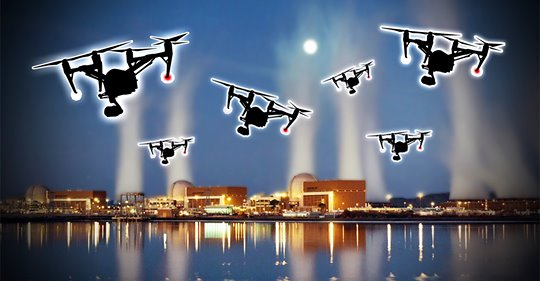
In a trove of documents and internal correspondences related to the event, officials from the Nuclear Regulatory Commission (NRC) described the incident as a “drone-a-palooza” and said that it highlighted concerns about the potential for a future “adversarial attack” involving small unmanned aircraft and the need for defenses against them. Even so, the helplessness and even cavalier attitude toward the drone incident as it was unfolding by those that are tasked with securing one of America’s largest and most sensitive nuclear facilities serves as an alarming and glaring example of how neglected and misunderstood this issue is.
What you are about to read is an unprecedented look inside a type of event that is less isolated in nature than many would care to believe.
A Rapidly Accelerating Threat
Troubling incidents of protracted activity by swarms of drones, including a series of very strange incidents in Colorado and neighboring states last year that the mainstream media was quick to blow off without any real evidence to prompt such a dismissal, are occurring over and near some of America’s most critical infrastructure. These events are occurring as lower-end and lower-performance unmanned aircraft systems (UAS) have become weaponized to increasingly remarkable degree in recent years. Even those built-in sheds in the middle of warzones have been employed with not only deadly, but also a highly disruptive effects. As we mentioned a moment ago, drones have even inflicted major damage to one of the world’s richest and most heavily defended country’s cash cow—oil production. They have also been used in an attempt to assassinate a country’s ruler. And yes, the potential for them to be used for similar purposes exists right here in the United States, as well. ………
Douglas D. Johnson, a volunteer researcher affiliated with the Scientific Coalition for UAP Studies (SCU), was able to obtain a large number of internal documents regarding the September drone incidents at Palo Verde from the NRC via the Freedom of Information Act (FOIA) and kindly shared them with The War Zone. It is important to note that these documents primarily reflect the NRC’s perspective rather than that of any other U.S. government agencies at the federal, state, or local levels. The Arizona Public Service Company, which operates the Palo Verde Generating Station, is also a private entity not directly subject to the FOIA.
Johnson did also submit a FOIA request for relevant documents to the Department of Homeland Security’s (DHS) Cybersecurity and Infrastructure Security Agency (CISA). DHS said it found 32 pages of documents related to the incident from CISA, but declined to release them, citing exemptions related to law enforcement activities. Another 17 pages of relevant records are still undergoing a review by the Transportation Security Administration (TSA).
This particular story starts on Sept. 29, 2019. Shortly before 11:00 PM local time at the Palo Verde Nuclear Generating Station, Daphne Rodriguez, an Acting Security Section Chief at the plant, called the duty officer at NRC’s Headquarters Operations Center (HOC). Rodriguez reported that a number of drones were flying over and around a restricted area near the nuclear power plant’s Unit 3, which houses one of its three pressurized water reactors……..
the list of instances in where HOOs or HEROs were supposed to immediately notify ILTAB included, but were not necessarily limited to the following:
- Ongoing security events. (basis for the drone calls since they were loitering in the OCA [owner controlled area])
- Verbal/telephone/e-mail threats.
- Bomb threats.
- Threats to site employees.
- Fence jumpers/intrusions.
- Security barrier penetrations.
- Discovery of weapons or explosives.
- Event involving law enforcement response/investigation on the owner-controlled area (OCA) or watercraft exclusion areas.
- Event involving FBI investigation.
- Security-related media attention at any level.
- Sabotage/Tampering.
Inconclusive Investigation
It’s not entirely clear what drove the decision at the time by the Palo Verde staff to set up systems to detect rather than knock down the drones. It’s possible that the detections systems were the only ones readily available or that this was the established protocol for security at the plant at the time.
It’s unclear if whoever was flying the drones was still violating FAA regulations, which ban unmanned aircraft from flying lower than 400 feet over “designated national security sensitive facilities,” which includes nuclear power plants, even if they weren’t technically breaking any laws. Arizona also has its own state law prohibiting drones from flying under 500 feet over any critical infrastructure, including power plants.
What we do know is that by Oct. 3, with assistance from the FBI and the Department of Energy, officials at Palo Verde had begun the process of rectifying that situation and getting the airspace over the plant designated as restricted through the FAA.
None of the authorities involved in subsequent investigations into the two drone incursions over Palo Verde were able to determine the operators of the drones or their intent. ILTAB followed up with other officials within NRC on Oct. 28 to see if there had been any new developments and had marked the two SID entries “closed unresolved” by Nov. 25.
Not An Isolated Incident
Rules, regulations, and reporting requirements are, of course, just one part of the picture. Joseph Rivers, the NRC Senior Level Advisor on Security who was coordinating with various other individuals around the Palo Verde incidents, highlighted in one Email that none of this would do anything to directly prevent a hostile actor from using drones in a more nefarious way.
The Changes That Never Came
Oh, and if you think this event may have served as something of a wakeup call for the powers that be, you are mistaken. Just a month after it occurred, the NRC made the highly controversial, if not outright dubious decision to formally decline to require owners of U.S. nuclear power and waste storage facilities to be able to defend against drones.
……. Physicist Edwin Lyman, acting director of the Nuclear Safety Project at the Union of Concerned Scientists, a nonprofit organization, stated the following about the decision:
“The NRC’s irresponsible decision ignores the wide spectrum of threats that drones pose to nuclear facilities and is out of step with policies adopted by the Department of Energy and other government agencies… Congress should demand that the NRC require nuclear facility owners to update their security plans to protect against these emerging threats.
…… The NRC seems more interested in keeping the cost of nuclear plant security low than protecting Americans from terrorist sabotage that could cause a reactor meltdown… The agency needs to remember that it works for the public, not the industry it regulates.”
Sadly, it’s unlikely that any action will be taken when it comes to the threat posed by lower-end drones until a catastrophe occurs. We will discuss just how much is at risk and highlight other even more concerning incidents that have all but proven how capable such an asymmetric and inconvenient threat can be in the very near future.
Regardless, the Palo Verde incidents serve as yet another warning of the potential dark side of the drones that fly among us daily.
Contact the authors: Tyler@thedrive.com and Joe@thedrive.com
You can reach Douglas D. Johnson via @ddeanjohnson on Twitter. https://www.thedrive.com/the-war-zone/34800/the-night-a-drone-swarm-descended-on-palo-verde-nuclear-power-plant
No comments yet.
1 This Month
Chernobyl: The Lost Tapes – A good documentary on Chernobyl on SBS available On Demand for the next 3 weeks– https://www.sbs.com.au/ondemand/tv-program/chernobyl-the-lost-tapes/2352741955560

of the week–London Campaign for Nuclear Disarmament

Tell the Ukrainian Government to Drop Prosecution of Peace Activist Yurii Sheliazhenko
To see nuclear-related stories in greater depth and intensity – go to https://nuclearinformation.wordpress.com
-
Archives
- April 2026 (126)
- March 2026 (251)
- February 2026 (268)
- January 2026 (308)
- December 2025 (358)
- November 2025 (359)
- October 2025 (376)
- September 2025 (257)
- August 2025 (319)
- July 2025 (230)
- June 2025 (348)
- May 2025 (261)
-
Categories
- 1
- 1 NUCLEAR ISSUES
- business and costs
- climate change
- culture and arts
- ENERGY
- environment
- health
- history
- indigenous issues
- Legal
- marketing of nuclear
- media
- opposition to nuclear
- PERSONAL STORIES
- politics
- politics international
- Religion and ethics
- safety
- secrets,lies and civil liberties
- spinbuster
- technology
- Uranium
- wastes
- weapons and war
- Women
- 2 WORLD
- ACTION
- AFRICA
- Atrocities
- AUSTRALIA
- Christina's notes
- Christina's themes
- culture and arts
- Events
- Fuk 2022
- Fuk 2023
- Fukushima 2017
- Fukushima 2018
- fukushima 2019
- Fukushima 2020
- Fukushima 2021
- general
- global warming
- Humour (God we need it)
- Nuclear
- RARE EARTHS
- Reference
- resources – print
- Resources -audiovicual
- Weekly Newsletter
- World
- World Nuclear
- YouTube
-
RSS
Entries RSS
Comments RSS
 nuclear-news
Leave a comment