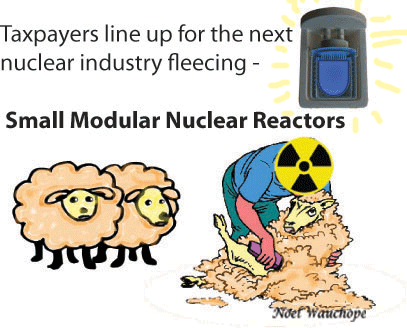
Looks as if 20 municipalities in Utah have been NuScammed for those not so small nuclear reactors
readers may wonder how UAMPS convinced some members to sign an “option” contract, which eventually converts to a “hell-or-high-water” contract, meaning that the buyer has no right, under any circumstances, to abandon the contract once construction, the Achilles heel of nuclear projects, is authorized.
|
|
Over 20 municipalities, primarily located in Utah, have signed a contract with Utah Associated Municipal Power Systems (UAMPS) to purchase entitlement shares for a first-of-a-kind nuclear power plant based on NuScale’s unproven small modular reactor (SMR) design. [and they’re not really small at all]
Ignoring the history of commercial nuclear plant construction, advocates have promoted the SMR project as a cost-effective energy resource without fully addressing the economic, contractual and litigation risks with stakeholders. Between 1953 and 2008, approximately 250 commercial nuclear reactors were ordered in the United States. During this period, ratepayers (and investors) bore the burden for well over $200 billion (in 2009 dollars) in costs for completed and abandoned nuclear plants. For example, one of the largest municipal bond defaults occurred in 1982 when the Washington Public Power Supply System defaulted on $2.25 billion in bonds for two nuclear power plant construction projects. In an effort to reduce their losses, bondholders sued a group of utilities (including several Idaho cities) that entered into contracts to pay for the plants.
Well, what about the UAMPS SMR project, including the $65 dollars per megawatt-hour (price cost of electricity) sales pitch? During a 2018 Los Alamos County Council meeting, held to consider approval of the UAMPS power sales contract, a council member asked a UAMPS lawyer, “There’s been mention of a target of $65 a megawatt-hour. How did we come up with that number?” Another council member, probing into the terms of the contract, expressed additional concern. The councilor stated, “I feel like we’re being sold a bill of goods with $65 a megawatt-hour.” With that said, readers may wonder how UAMPS convinced some members to sign an “option” contract, which eventually converts to a “hell-or-high-water” contract, meaning that the buyer has no right, under any circumstances, to abandon the contract once construction, the Achilles heel of nuclear projects, is authorized. Having a similar concern, especially given the history of nuclear plant construction, a sincere effort was made to address project risks with the UAMPS SMR project chair, including sharing concerns about transparency and proposing possible ways to minimize risks to ratepayers, including contract modifications such as price guarantees and redefining the construction period. Unfortunately, my questions and concerns fell on deaf ears. |
|


No comments yet.
1 This Month
Chernobyl: The Lost Tapes – A good documentary on Chernobyl on SBS available On Demand for the next 3 weeks– https://www.sbs.com.au/ondemand/tv-program/chernobyl-the-lost-tapes/2352741955560

of the week–London Campaign for Nuclear Disarmament

Tell the Ukrainian Government to Drop Prosecution of Peace Activist Yurii Sheliazhenko
To see nuclear-related stories in greater depth and intensity – go to https://nuclearinformation.wordpress.com
-
Archives
- April 2026 (126)
- March 2026 (251)
- February 2026 (268)
- January 2026 (308)
- December 2025 (358)
- November 2025 (359)
- October 2025 (376)
- September 2025 (257)
- August 2025 (319)
- July 2025 (230)
- June 2025 (348)
- May 2025 (261)
-
Categories
- 1
- 1 NUCLEAR ISSUES
- business and costs
- climate change
- culture and arts
- ENERGY
- environment
- health
- history
- indigenous issues
- Legal
- marketing of nuclear
- media
- opposition to nuclear
- PERSONAL STORIES
- politics
- politics international
- Religion and ethics
- safety
- secrets,lies and civil liberties
- spinbuster
- technology
- Uranium
- wastes
- weapons and war
- Women
- 2 WORLD
- ACTION
- AFRICA
- Atrocities
- AUSTRALIA
- Christina's notes
- Christina's themes
- culture and arts
- Events
- Fuk 2022
- Fuk 2023
- Fukushima 2017
- Fukushima 2018
- fukushima 2019
- Fukushima 2020
- Fukushima 2021
- general
- global warming
- Humour (God we need it)
- Nuclear
- RARE EARTHS
- Reference
- resources – print
- Resources -audiovicual
- Weekly Newsletter
- World
- World Nuclear
- YouTube
-
RSS
Entries RSS
Comments RSS
 nuclear-news
Leave a comment