New research: global temperature increase will surpass 2.6 degrees Celsius: the role of clouds
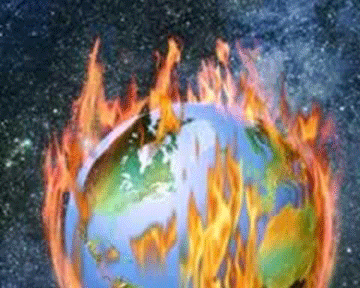 Groundbreaking study: Earth will warm 4.9 to 7 degrees F, E and E News, Chelsea Harvey, E&E News reporter Thursday, July 23, 2020 Research released yesterday suggests that a global temperature increase will surpass 2.6 degrees Celsius. Clouds can influence how much warming Earth experiences from greenhouse gases. NASA How much warming will greenhouse gas emissions cause in the coming years? It’s one of the most fundamental questions about climate change — and also one of the trickiest to answer.Now, a major study claims to have narrowed down the range of possible estimates. Groundbreaking study: Earth will warm 4.9 to 7 degrees F, E and E News, Chelsea Harvey, E&E News reporter Thursday, July 23, 2020 Research released yesterday suggests that a global temperature increase will surpass 2.6 degrees Celsius. Clouds can influence how much warming Earth experiences from greenhouse gases. NASA How much warming will greenhouse gas emissions cause in the coming years? It’s one of the most fundamental questions about climate change — and also one of the trickiest to answer.Now, a major study claims to have narrowed down the range of possible estimates.
It presents both good and bad news. The worst-case climate scenarios may be somewhat less likely than previous studies suggested. But the best-case climate scenarios — those assuming the least amount of warming — are almost certainly not going to happen. It’s “the most important climate science paper that’s come out in several years,” according to climate scientist Andrew Dessler of Texas A&M University, who was not involved with the study. The effort also illuminates some of the challenges of a decadeslong scientific quest to predict the strength of future climate change. At the heart of the new study is a concept known as “climate sensitivity” — how sensitive the Earth is to greenhouse gas emissions and how much it’s likely to warm in response. In studies, scientists often focus on the amount of warming that might be expected if carbon dioxide concentrations doubled their preindustrial levels. It’s a hypothetical scenario, but one that’s not impossible. Prior to the industrial era — around 150 years ago — global CO2 concentrations hovered around 280 parts per million in the atmosphere. Doubling that amount would put the total at 560 ppm. Today, CO2 levels have climbed above 400 ppm. The metric has existed for decades now. In 1979, a groundbreaking report led by Massachusetts Institute of Technology scientist Jule Charney — dubbed the “Charney Report” — suggested the planet’s climate sensitivity probably fell within a range of 1.5 to 4.5 degrees Celsius for a doubling of CO2. In the years since, that range hasn’t changed much. Most studies have found that the amount of warming to be expected after a doubling of CO2 probably falls within those boundaries……… The new report devotes a large chunk of its analysis exclusively to clouds. It examines the growing body of science on how different types of clouds respond to climate change, and how changes in these clouds may affect future climate change. The mounting evidence suggests that clouds are unlikely to mitigate climate change on a global scale, the report concludes. On the contrary, they’re more likely to make it worse. With a new, more confident sensitivity estimate in hand, the report begs the question: What does this mean for future climate policy? On the one hand, the study strikes a blow to a favorite argument used by climate deniers: The uncertainty about climate sensitivity suggests future warming might not actually be that severe. The new report strongly suggests that the best-case sensitivity scenarios — those at the lower end of the old ranges — are probably not in the cards. Still, the revised range doesn’t change much when it comes to the international climate goals outlined by the Paris Agreement. Nations worldwide are striving to keep global temperatures within 2 C of their preindustrial levels. To reach that target, world leaders would have to ensure global CO2 concentrations never double at all. “It’s not clear to me how much we would gain from further decreases in the uncertainty” of this metric, Dessler said. “What this has done, in my opinion, is it’s really moved the game away from these questions about the physics of the climate system into questions about how are humans going to react to climate change.” https://www.eenews.net/stories/1063611707 |
|
No comments yet.
1 This Month

of the week – Shut Down Drone Warfare!


Tell the Ukrainian Government to Drop Prosecution of Peace Activist Yurii Sheliazhenko

Petition to revoke the licensing of the Near Surface Nuclear Disposal Facility (NSDF) at Chalk River. https://www.ourcommons.ca/petitions/en/Petition/Details?Petition=e-7247
To see nuclear-related stories in greater depth and intensity – go to https://nuclearinformation.wordpress.com
-
Archives
- April 2026 (103)
- March 2026 (251)
- February 2026 (268)
- January 2026 (308)
- December 2025 (358)
- November 2025 (359)
- October 2025 (376)
- September 2025 (257)
- August 2025 (319)
- July 2025 (230)
- June 2025 (348)
- May 2025 (261)
-
Categories
- 1
- 1 NUCLEAR ISSUES
- business and costs
- climate change
- culture and arts
- ENERGY
- environment
- health
- history
- indigenous issues
- Legal
- marketing of nuclear
- media
- opposition to nuclear
- PERSONAL STORIES
- politics
- politics international
- Religion and ethics
- safety
- secrets,lies and civil liberties
- spinbuster
- technology
- Uranium
- wastes
- weapons and war
- Women
- 2 WORLD
- ACTION
- AFRICA
- Atrocities
- AUSTRALIA
- Christina's notes
- Christina's themes
- culture and arts
- Events
- Fuk 2022
- Fuk 2023
- Fukushima 2017
- Fukushima 2018
- fukushima 2019
- Fukushima 2020
- Fukushima 2021
- general
- global warming
- Humour (God we need it)
- Nuclear
- RARE EARTHS
- Reference
- resources – print
- Resources -audiovicual
- Weekly Newsletter
- World
- World Nuclear
- YouTube
-
RSS
Entries RSS
Comments RSS
 nuclear-news
Leave a comment