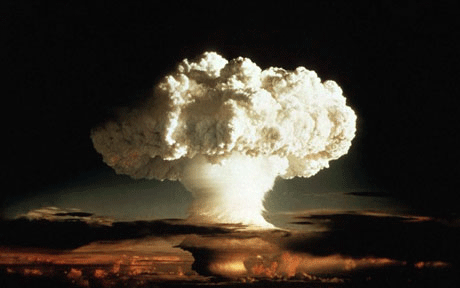
Nuclear bomb testing – the cruellest legacy of environmental injustice and racism
|
Nuclear testing legacy is ‘cruellest’ environmental injustice, warns rights expert,
https://news.un.org/en/story/2020/07/1068481 16 July 2020
Human RightsThe dangerous legacy of nuclear weapons testing continues to affect many communities, a leading rights expert said on Thursday, on the 75th anniversary of testing in the United States, that heralded the nuclear age.
In an appeal to governments worldwide to get rid of weapons of mass destruction, UN Special Rapporteur on toxics, Baskut Tuncak, said that the Trinity tests in New Mexico on 16 July 1945, were the prelude to “two horrific explosions suffered by (the) innocent people of Japan”, during the Second World War.
They were also followed by the detonation of hundreds of nuclear bombs over vulnerable communities in the Pacific, and the disposal of radioactive waste on lands and territories of indigenous peoples. Paradise lostThis had created a legacy of nuclear testing that “is one of the cruellest examples of environmental injustice witnessed” in “what should be a peaceful island paradise”, said Mr Tuncak, who reports to the Human Rights Council in Geneva. From 1946-58, 67 nuclear bombs were detonated on the Marshall Islands, he said, the equivalent of more than 1.5 “Hiroshima-sized explosions every day for 12 years”. Communities “have suffered unimaginably” from radioactive contamination and this continues today “with a legacy of contamination, illness and anguish”, the expert insisted.
Twin environmental disasters made matters worse, he added, referring to climate change-induced sea level rise and nuclear waste concentrated in a radioactive “tomb”. 200 tests in 30 yearsSimilarly, in French Polynesia, over 200 nuclear tests were conducted over a 30-year period from 1966 to 1996, subjecting inhabitants to associated health and environmental damage, the Special Rapporteur said. From Greenland to the indigenous territories of the United States, he warned that people continued to suffer from the nuclear testing era. Waste not“In recent decades, numerous Native American tribes received funding to store unwanted nuclear waste on their lands,” he said. “Those of Point Hope, Alaska, became recipients of radioactive soil and higher cancer rates that are believed to have been the foreseeable result. And the people of Greenland discovered radioactive waste left by the US military, unbeknownst to them as the ice continues to melt in the Arctic.” This discriminatory approach should be addressed by all States as part of the discussion on “systemic racism” and nuclear disarmament, Mr. Tuncak insisted. “Unaddressed, the dangers of radioactive contamination will persist for centuries, and so too will the harmful legacy of racism that surrounds this tragic chapter of humanity,” he added. |
|
Rolls Royce Small Modular Nuclear Reactors: not small, not modular, not cheap, and not going to happen

100% Renewables 16th July 2020, The Government has just announced a £40 million research programme into so-called advanced modular reactor technology that is highly unlikely ever to see any practical use. That is because the so-called small modular reactors (SMRs) are much too expensive for civilian use.
In an important sense it is nonsense to talk about research to develop SMRs as a ‘new’ technology simply because they already exist. They power military submarines and also US aircraft carriers. Their design is simply a smaller
version of the Pressurised Water Reactor (PWR) design that dominates the world nuclear power industry. Indeed PWRs began as small projects housed in submarines which were then developed up in scale so that they could produce electricity more cheaply.
At 450 MW for their proposed plant, the plant is not far off the same order of magnitude as conventional plant – for
example the AGR series that currently generates the bulk of British nuclear plant has units of around 600-660 MW. In fact, as Tom Burke points out, they are close to the size of Britain’s first generation of reactors, the ‘Magnox’ reactors.
Neither is the plant proposed by Rolls Royce modular in the sense that such plant can be rolled off a production line. What Rolls Royce claims is that some parts can be produced in a ‘modular’ fashion. This is not the same as producing whole units off a production line, and in fact the developers of the nuclear plant Vogtle in the USA also claim to produce parts in a ‘modular ‘fashion (although this plant is now hopelessly behind schedule with very large cost overruns).
Peace cranes flyimg in Vermont , in support of U.N. Treaty on the Prohibition of Nuclear Weapons
 Peace cranes on Church Street aim to abolish nukes, https://www.wcax.com/2020/07/17/peace-cranes-hanging-on-church-street-to-abolish-nuclear-weapons/ WCAX News Team Jul. 17, 2020 BURLINGTON, Vt. (WCAX) – Cranes are a symbol of peace in many cultures, and 1,000 origami peace cranes from Japan are now displayed in front of Burlington City Hall in observance of next month’s 75th anniversary of the atomic bombings of Hiroshima and Nagasaki in World War II.The story behind the peace cranes is of a little girl, Sadako Sasaki, who developed cancer from atomic radiation because of the Hiroshima bombing. Sasaki started getting sick around age 11.
Robin Lloyd, an activist for abolishing nuclear weapons, believes Sasaki’s story will not only reach the hearts of Vermonters but also teaches an important lesson.
“The cranes date from a little girl who got leukemia from the Hiroshima bombing,” Lloyd said. “Then her health started to fail and her friends said, ‘If you can fold 1,000 cranes, then your wish will come true.‘”
Sasaki died before she reached 1,000 cranes, but her story lives on. Organizers at Thursday’s event in Burlington say they want to use the peace cranes to gain support for the abolition of nuclear weapons.
Joseph Gainza, a longtime Vermont peace activist, says that Vermont has supported nuclear weapons abolition in the past.
”The House of Representatives overwhelmingly — and the Vermont Senate unanimously — voted on a resolution calling on the United States to enter into the nuclear weapons abolition treaty,” Gainza said.
Today, the Treaty on the Prohibition of Nuclear Weapons continues to gain support, according to Maho Takahashi, an activist in Burlington. ”With that treaty, once 50 countries ratify it, it will enter into force,” Gainza said.
The peace cranes will be flying for the next week. Each crane has a lesson that visitors are encouraged to take and learn from.
California Coastal Commission unanimously approves storage plan at San Onofre Nuclear Generating Station
California Coastal Commission unanimously approves storage plan at San Onofre Nuclear Generating Station CBS8, 17 Jul 20, The Commission voted 10-0 to approve the program to allow storage of spent nuclear fuel on-site. SAN DIEGO COUNTY, Calif. — The California Coastal Commission voted 10-0 in a special meeting today to approve an inspection and maintenance program allowing Southern California Edison to store spent nuclear fuel in a storage site at the San Onofre Nuclear Generating Station.
The program outlines actions SCE will take to inspect the canisters that contain spent nuclear fuel, as well as how potential issues with the canisters will be remedied.
Robotic devices will be used to inspect the canisters and site conditions will be simulated on a test canister, which will be observed for potential degradation. Two spent fuel storage canisters will be inspected every five years starting in 2024, and the test canister will be inspected every two to three years.
Canister flaws will be repaired by the application of a nickel-based metallic spray, and the presence of flaws may result in increased canister inspection frequency and an increase in the number of canisters inspected.
The inspection and maintenance program was also reviewed by the engineering consulting firm LPI, which provided recommendations that included the increase in canister inspections should flaws arise.
Nearly 3.6 million pounds of spent nuclear fuel are stored at the plant, which stopped producing electricity in 2012.
Concerns remain over the plant’s proximity to the ocean and the potential for the site to be affected by rising sea levels, tsunami inundation, seismic hazards.
By 2035, the commission may look to relocate the canisters to another site, although no such location is available, according to a commission report. ……. https://www.cbs8.com/article/news/local/san-onfre-nuclear-power-plant-storage-approval/509-b0c102a6-86b7-45c3-a5d7-b5013cfc19c4
Nuclear waste is piling up in California: leadership is needed
Gov. Gavin Newsom and leaders from the Legislature must demand action on nuclear waste and fill gaps in oversight. By Bart Ziegler, CalMatters, 17 Jul 20,
Bart Ziegler is president of the Samuel Lawrence Foundation, a nonprofit based in Del Mar, bart@samuellawrencefoundation.org.
From San Onofre to Humboldt Bay, nuclear waste is piling up in California.
This most-toxic waste – tons and tons of it – is deadly for 200,000 years. Stranded next to a rising ocean at aging and decommissioned plants, the waste has no permanent home.
California is overdue in showing leadership.
Just as California has broken ranks with the federal government on regulating greenhouse gas emissions, Gov. Gavin Newsom and leaders from the Legislature must demand action on nuclear waste and fill gaps in oversight.
With federal regulators all but cornering nuclear policy, the industry all too often is left to regulate itself. Meanwhile, private contractors slop at ratepayer-funded decommissioning troughs while running loose with safety.
Enough is enough, California!
In north San Diego County, conditions at the shuttered San Onofre Nuclear Generating Station scream for state intervention, as Rep. Mike Levin, a Democrat from San Juan Capistrano, concluded in a task force report issued recently.
First, some background.
Decommissioning started this year at the San Onofre plant, which quit making electricity in 2012. The plant’s majority owner, Southern California Edison, has opened its $4 billion decommissioning purse to Holtec International as lead contractor in charge of transferring 3.6 million pounds of spent nuclear fuel from cooling pools to a storage system of Holtec’s design.
That’s where things get dicey.
Edison’s contractors are cramming the spent fuel assemblies into thin-walled, steel canisters. Workers hoist the canisters from wet storage with a behemoth, track-driven gantry crane and crawl them to a concrete, dry-storage vault. That’s where the 73 canisters will stay. Indefinitely.
Public hand-wringing intensified after a near-accident in 2018 involving a fully-loaded canister and the release of reports showing the canisters are prone to gouging during transfer. That can lead to corrosion and failure, especially in a marine environment. To make matters worse, the canisters cannot be repaired, monitored, inspected or transported once entombed in the vault.
What can California do? For starters, leaders can immediately improve oversight of nuclear waste storage.
Nuclear plant owners admit to not having developed procedures to replace fully-loaded canisters. That’s why, as part of decommissioning California’s coastal nuclear plants at San Onofre, Diablo Canyon and Humboldt Bay, the state Coastal Commission must demand the construction of handling facilities – known as “hot cells” – where canisters can be repaired or replaced.
State lawmakers should order construction of a hot cell at the decommissioned Rancho Seco Nuclear Generating Station, just 40 miles south of their offices in Sacramento.
In San Diego County, near the border with Orange County, 8.2 million people live within 50 miles of the old San Onofre plant. On July 16, the California Coastal Commission is set to act on a staff recommendation to approve Edison’s application to dismantle the plant’s cooling pools. That approval would be disastrous. For now at least, the spent fuel cooling pools provide our last option for dealing with a damaged canister.
Coastal Commissioners are appointed by the same Legislature that should prepare for a crisis instead of responding to one. You don’t wait for a fire to create a fire department. Preparation is cheaper and faster than responding to a crisis. Tragically, the COVID-19 pandemic has shown that preparation is not always our strongest suit.
As recommended in the Report of the San Onofre Nuclear Generating Station Task Force, a state model would improve agency coordination on waste storage permit applications and increase engagement with federal agencies to advance solutions for containing and handling deadly nuclear waste. The solutions should be tied to strict, economic enforcement.
Coastal commissioners, lawmakers, regulators and anyone else with a stake in California – that’s nearly 40 million of us – should read the report and demand action on nuclear waste.
Purpose of US International Development Finance Corporation perverted in the interests of the nuclear industry
|
Trump’s new foreign investment agency: Itching to build on nuclear quicksand. Bulletin of the Atomic Scientists, By Victor Gilinsky, Henry Sokolski, July 17, 2020 In 2018 a Republican Congress, with strong Democratic support, created the US International Development Finance Corporation to “provide the developing world with financially sound alternatives to unsustainable and irresponsible state-directed initiatives.” That’s government-speak for competing with China’s Belt and Road initiative. It didn’t take very long, however, for the new agency to fall in line with an irresponsible state-directed initiative of its own—the Trump administration’s all-out effort to encourage nuclear exports.
In June, the agency, whose own rules prohibit financing nuclear exports, proposed to fling the doors open to such financing, without limiting its scope to the agency’s mission to help the economies of the lower income countries with modest, environmentally sensible projects. There is no hint on what sorts of conditions would apply on funding nuclear reactors. Would the country have to have a system of safety regulation? Would it have to meet security requirements? Would it have to allow international inspections? It isn’t even clear whether the agency’s support would be limited to US reactor exports, and therefore subject to the requirements of the Atomic Energy Act’s Section 123 or whether they could also cover equipment purchases from other suppliers. Such details determine whether a federal bureaucracy is constrained to act responsibly, or whether it is free to cater to the latest whims of the White House. To justify its proposed action, the agency relies on the administration’s ritual talking points—that nuclear exports will “offer an alternative to the financing of authoritarian regimes while advancing US nonproliferation safeguards and supporting US nuclear competitiveness.” These pearls are straight out of the administration’s April 2020 interagency report “Restoring America’s Competitive Nuclear Energy Advantage.” So are the agency’s assurances that advanced “small modular reactors” and “microreactors” will have significantly lower costs than existing nuclear power plants and “could help deliver a zero-emission, reliable, and secure power source to developing countries, promoting economic growth and affordable energy access in underserved communities.” This is all pie in the sky: None of these plants have been built, and their characteristics and economics are speculative. But if the proposed change is restricted to small reactors or microreactors, the nuclear industry’s influential registered lobby, the Nuclear Energy Institute, hasn’t heard about it. The Institute’s president crowed her unqualified approval: “The US International Development Finance Corporation’s proposed policy change to lift its legacy prohibition on nuclear energy projects supports the development of clean, reliable energy worldwide, helps countries reach their energy development goals, buttresses US national security, and can help level the playing field for US firms.” Nor does her response suggest any awareness that the agency’s financing of nuclear projects will be limited to countries in the lower portion of the economic scale……, This whole affair is the latest expression of the administration’s organizing principle for nuclear energy policy—finding ways to loosen rules and to create subsidies to propel nuclear exports. This is supposed to energize the much-diminished domestic nuclear manufacturing sector. Since the whole policy doesn’t make any economic sense, the ultimate argument is based on the dogma: Come what may, we have to head off sales by our adversaries China and Russia……. The agency does have on its books good environmental, social, and economic criteria for evaluating projects. But will they be applied as intended?,………..https://thebulletin.org/2020/07/trumps-new-foreign-investment-agency-itching-to-build-on-nuclear-quicksand/# |
|
Slow progress of Michigan bill opposing high-level nuclear waste dump
Michigan bill opposing high-level nuclear waste dump languishes in Senate committee Iosco County News Herald, By Jim Bloch For MediaNews Group,Jul 16, 2020
-
- The Michigan House of Representative passed a concurrent resolution on Feb. 5 opposing the proposed high-level nuclear waste dump near the shores of Lake Huron in the municipality of South Bruce, Ontario, Canada.
The resolution was sponsored by Gary Howell, the republican representative of the 82nd District, which comprises Lapeer County.
It urges “the United States Congress to take every legal action possible to prevent the construction of any underground high-level nuclear waste repository in the Great Lakes basin,” and urges “the Canadian government to prohibit a high-level nuclear waste repository anywhere in the Great Lakes basin.”
One of the cosponsors of the resolution was Gary Eisen, the St. Clair Township Republican who represents the 81st District, which swoops around the southern half of St. Clair County and includes Marysville, St. Clair, Marine City and Algonac, as well as surrounding townships.
“It’s sitting in the Senate now in Dan Lauwers’s committee,” Eisen said in June, noting that the onset of the COVID-19 pandemic put the brakes on a lot of the legislature’s work. “Everything’s ten times harder now.”
The resolution is in the Committee on Energy and Technology, which Lauwers chairs. His 25th Senate District includes St. Clair County………..
“Placing a deep geological repository near the Great Lakes is a high-risk venture with the potential of causing irreparable harm to millions of lives,” said the resolution. “Underground waste repositories have leaked in the past, costing billions of dollars to repair. Germany, for instance, is spending billions of dollars to dig up low- and intermediate-level radioactive waste that was stored in a salt mine due to leakage and other environmental concerns. In 2014, chemical reactions in a steel barrel full of radioactive waste caused an explosion and fire at a low- and intermediate-level underground waste site in Carlsbad, New Mexico causing a cloud of radioactivity to be released at the surface. Not only did this put the health and safety of the public at risk, it cost taxpayers $2 billion to clean up and repair. As demonstrated, low- and intermediate-level facilities have failed, and this high-level nuclear proposal provides no guarantee, whatsoever, to keep radioactive waste from our environment.”
If the Michigan Senate approves the resolution, it will be sent to Prime Minister of Canada, the Minister of Environment and Climate Change, the Minister of Foreign Affairs, the Premier of Ontario, the Canadian Nuclear Safety Commission, the Canadian Environmental Assessment Agency, the Speaker of the U.S. House, the President of the U.S. Senate, the members of the Michigan congressional delegation, and the U.S. Nuclear Regulatory Commission.
On Jan. 17, Michigan’s U.S. Sens. Debbie Stabenow and Gary Peters, along with Congressman Dan Kildee and Congressman John Moolenaar, introduced a bipartisan resolution opposing Canada’s placement of a permanent nuclear waste storage in South Bruce.
If the Michigan Senate approves the resolution, it will be sent to Prime Minister of Canada, the Minister of Environment and Climate Change, the Minister of Foreign Affairs, the Premier of Ontario, the Canadian Nuclear Safety Commission, the Canadian Environmental Assessment Agency, the Speaker of the U.S. House, the President of the U.S. Senate, the members of the Michigan congressional delegation, and the U.S. Nuclear Regulatory Commission.
On Jan. 17, Michigan’s U.S. Sens. Debbie Stabenow and Gary Peters, along with Congressman Dan Kildee and Congressman John Moolenaar, introduced a bipartisan resolution opposing Canada’s placement of a permanent nuclear waste storage in South Bruce. http://www.iosconews.com/news/state/article_c5a6ae58-996b-5665-b599-cfa8fde7c6ae.html
State of Texas allows reduction in price of importing nuclear waste
State allows reduction in price of importing nuclear waste to Texas https://news4sanantonio.com/news/trouble-shooters/state-allows-drastic-reduction-in-price-of-importing-nuclear-waste-to-texas by APRIL MOLINA, Friday, July 17th 2020 SAN ANTONIO — The state has agreed to allow a private company in West Texas to drop the price charged for incoming nuclear waste.
Waste Control Services (WCS) has been disposing of the nation’s low level nuclear waste in Andrews County at a cost of $100 dollars per cubic foot for Class A waste and $1000 dollars per cubic foot for Class B and C waste.
There is an additional surcharge of 40 cents per unit of radioactivity, but The Texas Commission on Environmental Quality recently approved the request by WCS to drop the price to 5 cents per unit.
A spokesman for WCS explained the market is dynamic so when the price drops, they need to be able to continue to compete.
Public Citizen Texas Office Director, Adrian Shelley worries that by allowing WCS to import nuclear waste at a fraction of the cost, it could result in massive liability for the state.
“If WCS collects less money to import waste in Texas, then there will be less money available should an accident occur and ultimately we’re concerned Texas taxpayers will be on the hook should an accident occur,” Shelley said.
The company doesn’t expect less revenue, rather they anticipate more income as a result of the price drop.
WCS reports Andrews County gets 5% of their revenue and the state gets 25%.
WCS has also been working to get approval for years to temporarily store the nation’s high level nuclear waste that would include spent nuclear fuel rods.
Because of the pandemic, nuclear power plants haveto have safety checks done by remote means
Pandemic drives plant operators to employ remote checks, WNN, 17 July 2020 Nuclear power plant operators are carrying out remote quality and safety related assessments of systems, structures and components (SSCs) to overcome physical distancing and mobility restrictions during the global COVID-19 pandemic, participants in a recent International Atomic Energy Agency (IAEA) webinar said. SSCs must be regularly monitored, replaced and have their quality verified.
1 This Month
Chernobyl: The Lost Tapes – A good documentary on Chernobyl on SBS available On Demand for the next 3 weeks– https://www.sbs.com.au/ondemand/tv-program/chernobyl-the-lost-tapes/2352741955560

of the week–London Campaign for Nuclear Disarmament

Tell the Ukrainian Government to Drop Prosecution of Peace Activist Yurii Sheliazhenko
To see nuclear-related stories in greater depth and intensity – go to https://nuclearinformation.wordpress.com
-
Archives
- April 2026 (152)
- March 2026 (251)
- February 2026 (268)
- January 2026 (308)
- December 2025 (358)
- November 2025 (359)
- October 2025 (376)
- September 2025 (257)
- August 2025 (319)
- July 2025 (230)
- June 2025 (348)
- May 2025 (261)
-
Categories
- 1
- 1 NUCLEAR ISSUES
- business and costs
- climate change
- culture and arts
- ENERGY
- environment
- health
- history
- indigenous issues
- Legal
- marketing of nuclear
- media
- opposition to nuclear
- PERSONAL STORIES
- politics
- politics international
- Religion and ethics
- safety
- secrets,lies and civil liberties
- spinbuster
- technology
- Uranium
- wastes
- weapons and war
- Women
- 2 WORLD
- ACTION
- AFRICA
- Atrocities
- AUSTRALIA
- Christina's notes
- Christina's themes
- culture and arts
- Events
- Fuk 2022
- Fuk 2023
- Fukushima 2017
- Fukushima 2018
- fukushima 2019
- Fukushima 2020
- Fukushima 2021
- general
- global warming
- Humour (God we need it)
- Nuclear
- RARE EARTHS
- Reference
- resources – print
- Resources -audiovicual
- Weekly Newsletter
- World
- World Nuclear
- YouTube
-
RSS
Entries RSS
Comments RSS
 nuclear-news