Thisweek’s climate and nuclear news

Can’t keep up with the Covid-19 news. Crazy world? Disney reopens Florida theme parks as state smashes US record for new coronavirus cases. Big global problems now more obviously intertwining – From Covid-19 to climate: what’s next after the global oil and gas industry crash?
Extreme weather, exacerbated by global heating just keeps on happening. The new normal for Northern Siberia – thawing permafrost,forests on fire. Millions in southern China face floods caused by heavy rains. Floods and landslides lash Nepal, scores dead. Deadly Flooding in Japan. Record heat possible from California to Florida on Sunday.
While the world is preoccupied with Covid-19, and with national responses, and economic effects, climate change should not be forgotten, as it moves on inexorably. Climate change’s big problem – there’s no quick fix. Climate change is seriously hitting women, right now.
July 16 will be the 75 years’ anniversary of the first nuclear bomb detonation. Why do we hear so little about this other sword of Damocles hanging over our collective heads. ? Globally taxpayers $billions go to nuclear weapons, with the ever increasing risk of nuclear war and nuclear winter, resulting from accident, human error, misunderstanding, or “limited” or unlimited nuclear attack.
A bit of (qualified) good news. – Why New Zealand decided to go for full elimination of the coronavirus. Coronavirus: No new cases of COVID-19 in managed isolation in New Zealand. Covid-19 coronavirus: Ashley Bloomfield’s warning as NZ records lowest testing day since March.
Paul Ehrlich warns that overpopulation and overconsumption are driving us over the edge .
Warning of serious brain disorders in people with mild coronavirus symptoms.
American-Israeli strategy developing for clandestine not-quite-war strikes on Iran?
Lower-latitude oceans drive complex changes in the Arctic Ocean. Faith in Climate Action — The Church’s Response to Hothouse Earth. Facebook allows climate denial propaganda, and restricts climate scientists.
Radiation-related health hazards to uranium miners.
INDIA. 90 Coronavirus cases among India’s nuclear workers, most at Rooppur Nuclear Power Plant.
IRAN. Explosion at Iran’s nuclear facility probably caused by Israel. Iran says world ‘must respond’ to Israel after blast at nuclear site.
UKRAINE. In 2020, a new radiological danger in Chernobyl.
USA.
- Democrats split on Trump plan to use development funds for nuclear projects. Senators urge US Development Finance Corp not to fund ‘risky’ overseas nuclear projects. U.S. Rep. Ben McAdams announces opposition to nuclear testing, hopes to extend compensation for downwinders.
- Mega-rich Americans prepare for nuclear war, with luxury bunkers.
- New research shows serious health effects from Three Mile Island nuclear accident. Problems and dangers face the dismantlement of damaged Three Mile Island nuclear reactor.
- The massive task of transporting a massive dead nuclear reactor. Dangerous nuclear waste casks should stay off roads and rails.
- $192.5 million legal settlement over failed SC nuclear project. South Carolina nuclear worker dies of Covid-19.
- “The Hanford Plaintiffs: Voices from the Fight for Atomic Justice”- Book Review. New Book: Doom With A View: Historical and Cultural Contexts of the Rocky Flats Nuclear Weapons Plant.
EUROPE. EU lawmakers ban nuclear from green transition fund, leave loophole for gas. Rapid coal phase-out could drive European green recovery: Bloomberg.
FRANCE. The umpteenth financial slide of the Flamanville EPR. France’s state auditor questions the wisdom of EDF’s Hinkley Point nuclear project in UK. Court reveals that EDF deceived UK about the true financial risks of Hinkley Point nuclear project.
JAPAN. Rally opposes proposal for Fukushima wastewater . Movement in Japan to suspend Olympic Games. Fukushima’s Olympic makeover: Will the ‘cursed’ area be safe from radioactivity in time for Games? Nine years on, Fukushima’s mental health fallout lingers. Fukushima nuclear waste decision also a human rights issue.
UK. UK Ministers losing enthusiasm for small nuclear reactors developed with China. Britain’s nuclear future in trouble, aging reactors, and not enough money without China’s help. The connections between nuclear weapons and nuclear power.
MARSHALL ISLANDS. Anniversary of nuclear bomb test on Mururoa Atoll.
SPAIN. Reducing radioactive waste in processes to dismantle nuclear facilities.
RUSSIA. Evacuation of a tiny Russian village, – in preparation for a nuclear missile test?
AUSTRALIA. Australia a big world player in producing greenhouse gas emissions. Australia now the biggest exporter of global heating– the Saudi Arabia of coal and gas.
The connections between nuclear weapons and nuclear power in the UK
 How much do you know about the connections between nuclear weapons and nuclear power? https://mariannewildart.wordpress.com/2020/07/13/how-much-do-you-know-about-the-connections-between-nuclear-weapons-and-nuclear-power/ JULY 13, 2020 BY MARIANNEWILDART Why is the UK government so addicted to nuclear? How much do you know about the connections between nuclear weapons and nuclear power? https://mariannewildart.wordpress.com/2020/07/13/how-much-do-you-know-about-the-connections-between-nuclear-weapons-and-nuclear-power/ JULY 13, 2020 BY MARIANNEWILDART Why is the UK government so addicted to nuclear?Nuclear weapons and nuclear power share several common features. In fact, the UK’s first nuclear power stations were built primarily to provide fissile material for nuclear weapons during the Cold War. The development of both the nuclear weapons and nuclear power industries is mutually beneficial. And now it appears that the government is using the Hinkley Point C nuclear power station to subsidise Trident, Britain’s nuclear weapons system. As part of a Parliamentary investigation into the Hinkley project, it emerged that without the billions of pounds earmarked for building this new power station in Somerset, Trident would be ‘unsupportable’. Professor Andy Stirling and Dr Phil Johnstone argued that the nuclear power station will ‘maintain a large-scale national base of nuclear-specific skills’ essential for maintaining Britain’s military nuclear capability. Join CND for an online discussion with Professor Stirling and Dr Johnstone about these connections.
|
|
Democrats split on Trump plan to use development funds for nuclear projects
Democrats split on Trump plan to use development funds for nuclear projects, The Hill, BY REBECCA BEITSCH – 07/13/20 Democratic lawmakers are split over a Trump administration proposal that would allow international development funds to be used for overseas nuclear projects.
The U.S. International Development Finance Corp. (DFC), a fledgling government fund with an aim to alleviate poverty, has proposed lifting the longtime ban it inherited from its predecessor that bars funding for any nuclear projects.
Proponents say nixing the ban, originally conceived to limit the risks of nuclear proliferation, will allow the U.S. to help provide nuclear power to countries that will need more energy to grow their economies.
But opponents of removing the prohibition see a number of issues arising if the ban is lifted, including how to handle spent nuclear fuel, the potential for money to be funneled away from poorer nations and the challenge of dealing with risky and expensive projects.
“International nuclear power projects described by DFC are not a cost-competitive form of zero-carbon energy, remain unproven, will divert funds from higher-priority low-income countries, and are not supported by other development banks,” Sens. Ed Markey (D-Mass.) and Bernie Sanders (I-Vt.) wrote in a letter to the DFC on Friday.
“DFC financing of overseas nuclear reactors may offshore the physical risks associated [with] nuclear power, but they would keep U.S. taxpayers on the hook for the steep financial ones,” the senators added. ………
Sen. Sheldon Whitehouse (D-R.I.) and Rep. Conor Lamb (D-Pa.) along with seven other Democratic lawmakers, called the ban “outdated because of advances in nuclear technology.”…….
Lifting the DFC’s prohibition against financing nuclear power would likely direct more funding toward wealthier countries, instead of to the countries that the DFC was created to help,” Markey and Sanders wrote in their letter, pointing to Eastern Europe and the Middle East……… The DFC should not be dedicating its limited financing to unproven technologies that present both safety and security risks. Pushing experimental research and development is not part of the DFC’s mandate.”…… https://thehill.com/policy/energy-environment/507052-democrats-split-on-trump-plan-to-use-development-funds-for-nuclear
Problems and dangers face the dismantlement of damaged Three Mile Island nuclear reactor
“The smell was a combination of rotting eggs, diesel fuel and a smoldering fire pit,” he said.
The plant’s Unit 2 reactor had partially melted down about 4 a.m. March 28, 1979, and as Mohr remembers it, locals panicked, fearing for their safety. Some fled, others hid inside.
“I can remember this like it was yesterday,” said Mohr, who has been a longtime township supervisor. “There was definitely an air of uncertainty. People were confused.”
Four decades later, confusion and concern have returned near the now-inactive power plant as officials at Utah-based EnergySolutions plan to dismantle the historic reactor.
It’s a plan that has state environmental officials and local nuclear watchdogs ringing proverbial alarm bells, pointing to concerns that money set aside for the decommissioning could run out before the work is finished.
That’s in addition to fears about the potential for indefinite radioactive contamination on the island, which sits just upstream from Lancaster County on the Susquehanna River.
Old concerns resurface
To Arthur Morris, Lancaster city’s mayor from 1980 to 1990, some of those worries are familiar. They existed in the years after the 1979 accident, when Morris sat on a state advisory board that focused on radioactive decontamination of Unit 2.
Back then — and now — the Susquehanna River served as the primary source for several downstream Lancaster County drinking water systems, including in Lancaster city.
As mayor, Morris said one of his priorities on the panel was to make sure radiation wasn’t carried downstream and piped through Lancaster residents’ faucets — a priority that led to regular testing near the plant that persists today.
Last week, Morris said he isn’t surprised that some of those old concerns have resurfaced with Unit 2 coming back under scrutiny.
“Those things don’t go away until the island is cleaned up,” Morris said.
‘Worst-case scenario’
However, it’s a cleanup plan that has nuclear watchdog Eric Epstein speaking out on signs of pending danger.
“It’s the worst-case scenario,” said Epstein, a leader of the Harrisburg-based group Three Mile Island Alert.
Last fall, Unit 2’s owners at Ohio-based FirstEnergy Corp. announced that they planned to transfer all related licenses and assets to TMI-2 Solutions LLC, an EnergySolutions subsidiary.
The transfer would mean that EnergySolutions also would take over the responsibility of eventually dismantling the Unit 2 reactor.
And that eventuality had already been planned for by the time the proposed transfer was announced in October. Then, EnergySolutions revealed plans to contract decommissioning work out to New Jersey-based construction company Jingoli, which has had past success with nuclear projects in the United States and Canada.
Despite a track record, state Department of Environmental Protection officials warned that planning for and beginning decommissioning work too early could put the island and surrounding areas at risk.
After all, DEP Secretary Patrick McDonnell noted, Unit 2 is the site of the worst commercial nuclear accident in United States history — an accident that released radioactive gases and grossly contaminated the reactor and its surrounding buildings.
“Because of this, we understand there are very high radiation areas within TMI Unit 2 that present a grave risk to personnel that enter,” a letter signed by McDonnell reads.
That high radiation has prevented all but minor exploration of the Unit 2 area, meaning the radiological conditions inside large portions of the plant remain a mystery, according to the letter.
“I firmly believe TMI Unit 2 is the most radiologically contaminated facility in our nation outside of the Department of Energy’s weapons complex,” it reads.
Postponing the cleanup for “several decades” could allow for a decrease in radioactive potency, possibly lessening the chance of further environmental contamination, McDonnell wrote.
All of that is in addition to raising questions about how radioactive waste will be disposed, transported and stored. That includes concerns about whether any of that waste will be stored on the island — a site that Epstein believes could remain indefinitely radioactive.
Both McDonnell’s writings and Epstein’s concerns were submitted this spring to officials at the U.S. Nuclear Regulatory Commission, which must approve the FirstEnergy-to-EnergySolutions transfer request.
Commission officials have been reviewing the request since November, and similar reviews have been completed in a year or less, according to spokeswoman Diane Screnci.
Financial concerns
But it’s not only environmental issues that will be weighed as part of that review, with Epstein and state officials also raising serious financial concerns.
Specifically, they’ve drawn attention to a largely ratepayer-funded $901 million trust set aside to cover the cost of decommissioning, which has been estimated at upward of $1.2 billion.
Further complicating the issue, according to McDonnell’s letter, is the fact that trust fund dollars are tied to the stock market, which has seen large fluctuations due to the ongoing COVID-19 pandemic.
“Given the obvious uncertainties and complexities associated with cleaning up the remains … the demonstration of adequate funding to complete the decommissioning of TMI-2 and restoration of the site, is a significant concern of the department and the citizens of Pennsylvania,” McDonnell wrote.
Beyond sharing McDonnell’s letters, DEP officials said they could not further discuss the proposed decommissioning, citing litigation. Nondisclosure agreements stipulated by EnergySolutions also prevent DEP and Epstein from sharing some details.
EnergySolutions spokespeople did not respond to multiple requests for comment, though they indicated they are aware of concerns about their work.
Jennifer Young, a FirstEnergy spokeswoman, said company officials have faith the job will be completed on budget despite the existing disparity between the trust fund and estimated cost.
Cost estimates show there are sufficient funds given the project schedule for decommissioning,” she said. “Keep in mind that those funds will continue to accumulate value throughout the decommissioning process, which takes place over many years. Not all the money will be required or spent at one time.”
Epstein said it’s important to point out that the Unit 2 trust is full of ratepayer money, which will be under the full control of EnergySolutions’s TMI-2 Solutions LLC, a private company, with little public scrutiny.
Right company for the job
Despite those concerns, Young said FirstEnergy officials believe EnergySolutions is the right company to dismantle Unit 2. In fact, EnergySolutions decommissioning proposal was selected over offers from two other companies, she said. The unsolicited EnergySolutions proposal was made in 2018, Young said.
By Nuclear Regulatory Commission decree, the plant must be decommissioned within 60 years of halting operation, and Three Mile Island’s functioning Unit 1 was taken offline by its owner, Exelon, in 2019.
“We were faced with a decision to decommission the unit now or wait to start in the 2030s,” Young said.
“Waiting would not guarantee there would be companies available to start the dismantlement in time to comply with the 60-year requirement due to the large number of nuclear plant licenses that will expire in the 2030s,” he said.
Still, Epstein said he’d like a Nuclear Regulatory Commission decision on the transfer to remain delayed until his and DEP’s concerns can be worked through.
Like a big gravestone
Back in Conoy Township, Mohr said his full faith is in the commission to make the right decision — an opinion steeped in the immediate aftermath of the 1979 partial meltdown.
It was a commission official, Harold Denton, who shared the first details with locals, offering assurances that everything would be alright, he said.
“When he was done speaking, it was like the world calmed down,” Mohr said of the commission official. “He put it into a perspective that even we understood.”
For decades since, the plant has meant local jobs and local money, but since the 2019 shutdown, much of that has fallen by the wayside, he said. And it’s mostly for that reason that Mohr said he’s indifferent to the island’s fate.
“It’s almost to the point now that it was never there. If we drive north, we see it,” he said. “It reminds me of the biggest gravestone that I ever saw.”
The new normal for Northern Siberia – thawing permafrost,forests on fire
The Moscow Times reports economic losses from thawing permafrost alone is expected to cost Russia’s economy up to $2.3 billion US per year. Last year’s fires likely cost rural communities in the region almost $250 million US. In March, Russia announced 29 measures it would be taking to try to deal with climate change over its vast landmass but critics complained the efforts have been more focused on exploiting natural resources in the Arctic than mitigating the impacts of a warming climate.
“They are actively going after every mineral and oil and gas deposit that they can,”
As permafrost thaws under intense heat, Russia’s Siberia burns — again, https://www.cbc.ca/news/world/siberia-burning-climate-change-russia-1.5645428
Russia’s northern landscape is being transformed by heat and fire, Chris Brown · CBC News : Jul 12, Right around now, University of British Columbia climatologist and tundra researcher Greg Henry would usually be up at Alexandra Fiord on the central-east coast of Canada’s Ellesmere Island experiencing the Arctic’s warming climate up close.
Instead, the pandemic has kept his research team grounded in Vancouver — and his focus has shifted to observing the dramatic events unfolding across the Arctic ocean in northern Siberia.
“It’s remarkable — it’s scary,” said Henry of the incredible run of high temperatures in Russia’s far north that have been breaking records for the past month.
This week, a European Union climate monitoring project reported temperatures in June were up to 10 degrees higher than usual in some parts of Russia’s Arctic, with an overall rise of five degrees.
The heat and dry tundra conditions have also triggered vast forest fires. Currently, 1.77 million hectares of land are burning with expectations that the total fire area could eventually surpass the 17 million hectares that burned in 2019.
Equally striking is where the fires are burning.
“Now we are seeing these fires within 15 kilometres of the Arctic Ocean,” said Henry. “Usually there’s not much fuel to burn there, because it’s kept cold by the ocean so you don’t get ignition of fires that far north.”
This year though, he said the heat has dried the ground out enough to change the dynamics.
“It’s a harbinger of what we are in for because the Arctic has been warming at twice the rate of the rest of the planet.”
Environmental disaster Continue reading
75 years after the first nuclear bomb explosion, why aren’t we all worried about nuclear war?
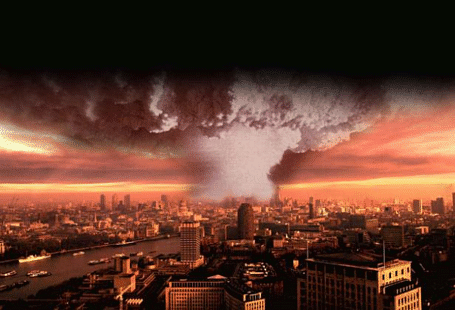
Renewed nuclear danger https://independenttribune.com/news/local/column-renewed-nuclear-danger/article_d71499e9-187c-53c0-8b37-6b9b8f06e2f0.html, By Gerry Dionne, 12 July 20
- July 16 of this year marks the 75th anniversary of the first nuclear bomb detonation. I don’t foresee any dancing in the street to mark the occasion. In fact, I imagine your nightly newscast will ignore it entirely. Oh, we’ll probably hear something about Hiroshima three weeks later. That first use of the weapon in malice has more historic significance. The two bombs dropped on Japan resulted in 214,000 deaths by the end of 1945.
Frankly, I’m mystified that we hear so little about the threat of nuclear war today considering how consequential such an event would be. It’s a danger far more clear and present than an errant asteroid, or an eruption of the Yellowstone Caldera. Currently, we’re all agog about the novel coronavirus. We’ve lived with a nuclear Sword of Damocles hanging over our collective head for 75 years now, and we tend to think we experienced real danger of thermonuclear war for a period of only 13 days back in 1962. We survived that physically unscathed; that’s probably it for one lifetime, right?
The post-World War II arms race has seen 2,056 nuclear test detonations by at least eight nations; more than half of that total (1,030) were American. The United States has not conducted a nuclear test since 1992, when a bipartisan congressional majority mandated a nine-month testing moratorium. In 1996, the United States was the first to sign the Comprehensive Test Ban Treaty, which verifiably prohibits all nuclear test explosions of any yield. Today, the CTBT has 184 signatories and almost universal support. But it hasn’t formally entered into force due to the failure of the United States, China, Egypt, Iran and Israel to ratify the agreement; and by India, Pakistan and North Korea, which have neither signed nor ratified the measure.
This leaves the door to renewed testing open. According to a May 22 article in The Washington Post, senior national security officials discussed the option of a demonstration of nuclear air detonation at a May 15 interagency meeting. A senior official told the Post that a “rapid test” by the United States could prove useful from a negotiating standpoint as the Trump administration tries to pressure Russia and China to engage in talks on a new arms-control agreement.
The push to restart nuclear weapons testing is happening at a time when tensions between the United States and Russia have stepped up provocative moves in airborne “show of force” demonstrations that can turn hazardous when combat aircraft come nail-bitingly close to each other. The danger expands exponentially when the aircraft involved are nuclear-capable, and when the operations are staged in militarily sensitive areas, such as a first-time U.S. B-1B bomber flight May 21 over the Sea of Okhotsk; or a May 29 flight by two B-1B bombers across Ukrainian-controlled airspace for the first time, coming close to Russian-controlled airspace over Crimea.
Not wanting to be left out of the merriment, Russia conducted a March 12 flight of two nuclear-capable Tu-160 “Blackjack” bombers over Atlantic waters near Scotland, Ireland and France from its base on the Kola Peninsula in Russia’s far north, prompting France and the United Kingdom to scramble interceptor aircraft. In conducting these operations, U.S. and Russian military leaders appear to be delivering two messages to their counterparts. First, despite any perceived reductions in military readiness caused by the coronavirus pandemic, they are fully prepared to conduct all-out combat operations against the other. Second, any such engagements could include a nuclear component at an early stage of the fighting.
Although receiving precious little media attention in the U.S. and international press, these maneuvers represent a dangerous escalation of U.S.-Russian military interactions and could set the stage for a dangerous incident involving armed combat between aircraft of the opposing sides. This by itself could precipitate a major crisis and possible escalation. Just as worrisome are the strategic implications of these operations, suggesting a commitment to the early use of nuclear weapons in future major-power engagements.
The U.S. Air Force Global Strike Command has long since supplanted the Strategic Air Command in its function as our nuclear war delivery system. Its commander, Gen. Timothy Ray, has said, “We have the capability and capacity to provide long-range fires anywhere, anytime, and can bring overwhelming firepower, even during the pandemic.” It really doesn’t matter whether those words reassure or horrify you; the eventual outcome of merely holding weapons of nearly limitless lethality is written in stone.
Sources: Arms Control Association Newsletter, July/August 2020; The Washington Post, May 22, 2020; and JanesDefenseWeekly.com, July 5, 2020.
American-Israeli strategy developing for clandestine not-quite-war strikes on Iran?
 Long-Planned and Bigger Than Thought: Strike on Iran’s Nuclear Program Long-Planned and Bigger Than Thought: Strike on Iran’s Nuclear Program
Some officials say that a joint American-Israeli strategy is evolving — some might argue regressing — to a series of short-of-war clandestine strikes. NYT, By David E. Sanger, Eric Schmitt and Ronen Bergman, 12 July 20 As Iran’s center for advanced nuclear centrifuges lies in charred ruins after an explosion, apparently engineered by Israel, the long-simmering conflict between the United States and Tehran appears to be escalating into a potentially dangerous phase likely to play out during the American presidential election campaign.
New satellite photographs over the stricken facility at Natanz show far more extensive damage than was clear last week. Two intelligence officials, updated with the damage assessment for the Natanz site recently compiled by the United States and Israel, said it could take the Iranians up to two years to return their nuclear program to the place it was just before the explosion. An authoritative public study estimates it will be a year or more until Iran’s centrifuge production capacity recovers.
Another major explosion hit the country early Friday morning, lighting up the sky in a wealthy area of Tehran. It was still unexplained — but appeared to come from the direction of a missile base. If it proves to have been another attack, it will further shake the Iranians by demonstrating, yet again, that even their best-guarded nuclear and missile facilities have been infiltrated.
Although Iran has said little of substance about the explosions, Western officials anticipate some type of retaliation, perhaps against American or allied forces in Iraq, perhaps a renewal of cyberattacks. In the past, those have been directed against American financial institutions, a major Las Vegas casino and a dam in the New York suburbs or, more recently, the water supply system in Israel, which its government considers “critical infrastructure.”
Officials familiar with the explosion at Natanz compared its complexity to the sophisticated Stuxnet cyberattack on Iranian nuclear facilities a decade ago, which had been planned for more than a year. In the case of last week’s episode, the primary theory is that an explosive device was planted in the heavily-guarded facility, perhaps near a gas line. But some experts have also floated the possibility that a cyberattack was used to trigger the gas supply.
Some officials said that a joint American-Israeli strategy was evolving — some might argue regressing — to a series of short-of-war clandestine strikes, aimed at taking out the most prominent generals of the Islamic Revolutionary Guards Corps and setting back Iran’s nuclear facilities…….. https://www.nytimes.com/2020/07/10/world/middleeast/iran-nuclear-trump.html
|
|
|
Lower-latitude oceans drive complex changes in the Arctic Ocean,
The University of Alaska Fairbanks and Finnish Meteorological Institute led the international effort, which included researchers from six countries. The first of several related papers was published this month in Frontiers in Marine Science.
Climate change is most pronounced in the Arctic. The Arctic Ocean, which covers less than 3% of the Earth’s surface, appears to be quite sensitive to abnormal conditions in lower-latitude oceans.
“With this in mind, the goal of our research was to illustrate the part of Arctic climate change driven by anomalous [different from the norm] influxes of oceanic water from the Atlantic Ocean and the Pacific Ocean, a process which we refer to as borealization,” said lead author Igor Polyakov, an oceanographer at UAF’s International Arctic Research Center and FMI.
Although the Arctic is often viewed as a single system that is impacted by climate change uniformly, the research stressed that the Arctic’s Amerasian Basin (influenced by Pacific waters) and its Eurasian Basin (influenced by Atlantic waters) tend to differ in their responses to climate change.
Since the first temperature and salinity measurements taken in the late 1800s, scientists have known that cold and relatively fresh water, which is lighter than salty water, floats at the surface of the Arctic Ocean. This fresh layer blocks the warmth of the deeper water from melting sea ice.
In the Eurasian Basin, that is changing. Abnormal influx of warm, salty Atlantic water destabilizes the water column, making it more susceptible to mixing. The cool, fresh protective upper ocean layer is weakening and the ice is becoming vulnerable to heat from deeper in the ocean. As mixing and sea ice decay continues, the process accelerates. The ocean becomes more biologically productive as deeper, nutrient-rich water reaches the surface.
By contrast, increased influx of warm, relatively fresh Pacific water and local processes like sea ice melt and accumulation of river water make the separation between the surface and deep layers more pronounced on the Amerasian side of the Arctic. As the pool of fresh water grows, it limits mixing and the movement of nutrients to the surface, potentially making the region less biologically productive.
The study also explores how these physical changes impact other components of the Arctic system, including chemical composition and biological communities.
Retreating sea ice allows more light to penetrate into the ocean. Changes in circulation patterns and water column structure control availability of nutrients. In some regions, organisms at the base of the food web are becoming more productive. Many marine organisms from sub-Arctic latitudes are moving north, in some cases replacing the local Arctic species.
“In many respects, the Arctic Ocean now looks like a new ocean,” said Polyakov.
These differences change our ability to predict weather, currents and the behavior of sea ice. There are major implications for Arctic residents, fisheries, tourism and navigation.
This study focused on rather large-scale changes in the Arctic Ocean, and its findings do not necessarily represent conditions in nearshore waters where people live and hunt.
The study stressed the importance of future scientific monitoring to understand how this new realm affects links between the ocean, ice and atmosphere.
###
Co-authors of the paper include Matthew Alkire, Bodil Bluhm, Kristina Brown, Eddy Carmack, Melissa Chierici, Seth Danielson, Ingrid Ellingsen, Elizaveta Ershova, Katarina Gårdfeldt, Randi Ingvaldsen, Andrey V. Pnyushkov, Dag Slagstad and Paul Wassmann.
France’s state auditor questions the wisdom of EDF’s Hinkley Point nuclear project in UK

Telegraph 11th July 2020, Doubts cast on EDF’s ability to build power stations on time and budget.
French auditor questions wisdom of state-owned utility’s involvement in building the new Hinkley Point C power station in Somerset.
France’s state auditor has questioned the ability of the company building Britain’s next nuclear power plant to construct new reactors within “acceptable” costs and timeframes. State-owned EDF has already said that its Flamanville nuclear plant in Normandy will now cost €12.4bn due to the expense of fixing 66 faulty welds. On top of that, the project will cost another €6.7bn, according to France’s Court of Accounts in a new report.
EDF has also said the plant’s start date will be delayed until the end of 2022. Flamanville was originally due to cost €3.3bn and start operations in 2012.
Presenting the damning 148-page report this week, Court of Accounts chief Pierre Moscovici said: “There is still uncertainty on the ability of the French nuclear industry, despite its current strong efforts, to build new nuclear reactors within a time frame and costs that remain acceptable.”
The criticism follows a £3bn surge in costs at the Hinkley Point C reactor EDF is building in Somerset. The bill for the project will now be £22.5bn – £2.9bn more than previously forecast – with overruns paid for by EDF. The energy giant has faced lags at its other projects, including Finland’s Olkiluoto 3 nuclear reactor, which is running more than
a decade behind schedule.
In its report, the state auditor questioned the wisdom of involvement in Hinkley Point C, saying its construction was
“weighing heavily” on the financial situation of EDF, whose net debt hit €41bn at the end of last year.
Rally opposes proposal for Fukushima wastewater
|
Rally opposes proposal for Fukushima wastewater https://www3.nhk.or.jp/nhkworld/en/news/20200713_04/ 13 July 20, Dozens of young people in Japan’s Fukushima Prefecture have rallied against a government panel’s proposal on how to dispose of radioactive wastewater stored at the crippled Daiichi nuclear power plant.About 50 people, including fisheries workers, marched through Koriyama City on Sunday. The demonstration was organized by a group of Fukushima residents in their 20s and 30s, who said detrimental rumors about the prefecture may circulate if the wastewater is disposed of improperly. Group representative Sato Taiga said a survey shows that most respondents do not know about the issue. He added that he hopes the group’s activities will raise awareness among people, including the younger generation. Water used to cool molten nuclear fuel from the 2011 accident at the plant has most of the radioactive materials removed before being stored in tanks. But the treated water still contains tritium and some other radioactive substances. The amount stored has reached some 1.2 million tons. The plant’s operator, Tokyo Electric Power Company, expects to reach capacity around the summer of 2022. In February, a government panel compiled a report that says a realistic solution is releasing the wastewater into the sea or air after diluting it in compliance with environmental and other standards. The government is in the process of hearing opinions from local governments and relevant organizations before making its final decision on how to dispose of the treated water. |
|
UK Ministers losing enthusiasm for small nuclear reactors developed with China
DBD, a Cheshire-based engineering firm, was working with China’s Institute of Nuclear and New Energy Technology to build a fleet of gas-cooled small reactors, and had hoped to win government funds. However, ministers have awarded £10m each to three rival projects — including an experimental plan for a fusion reactor. A version of the DBD reactor has already been built in China. DBD declined to comment……. (subscribers only) https://www.thetimes.co.uk/article/ministers-cool-on-chinese-nuclear-reactors-k2m8j76qf
Senators urge US Development Finance Corp not to fund ‘risky’ overseas nuclear projects
 US senators urge agency not to allow funding of ‘risky’ nuclear projects, S and P Global Platts, Author Joniel Cha , Editor Keiron Greenhalgh 12 July 20
HIGHLIGHTS
DFC proposes to reverse prior policy
Lawmakers say nuclear not cost competitive
- Washington — Senators Edward Markey, Democrat-Massachusetts, and Bernie Sanders, Independent-Vermont, in a July 10 letter jointly urged US Development Finance Corp., not to “waste American tax dollars on risky international nuclear projects.”
DFC proposed June 10 to revise its policy so that the federal agency could provide financing for nuclear power projects, beginning a 30-day public comment period ending July 10.
The agency was created in 2019 through the consolidation of Overseas Private Investment Corp. and the US Agency for International Development’s Development Credit Authority.
OPIC and USAID both had bans in place prohibiting them from supporting nuclear reactor projects.
The senators said international nuclear power projects “are not a cost-competitive form of zero-carbon energy, remain unproven, will divert funds from higher-priority low-income countries, and are not supported by other development banks.” ……..
- The senators said: “DFC should not be dedicating its limited financing to unproven technologies that present both safety and security risks. Pushing experimental research and development is not part of the DFC’s mandate.”
DFC has a total investment limit of $60 billion……..
The senators requested a response from DFC by July 31.
The American Nuclear Society and advocacy group Clear Path, along with 40 other organizations and individuals, submitted comment letters to DFC July 2 and 9, respectively, supporting the removal of the ban.
DFC did not respond to requests for comment July 9.https://www.spglobal.com/platts/en/market-insights/latest-news/electric-power/071020-us-senators-urge-agency-not-to-allow-funding-of-risky-nuclear-projects
Movement in Japan to suspend Olympic Games
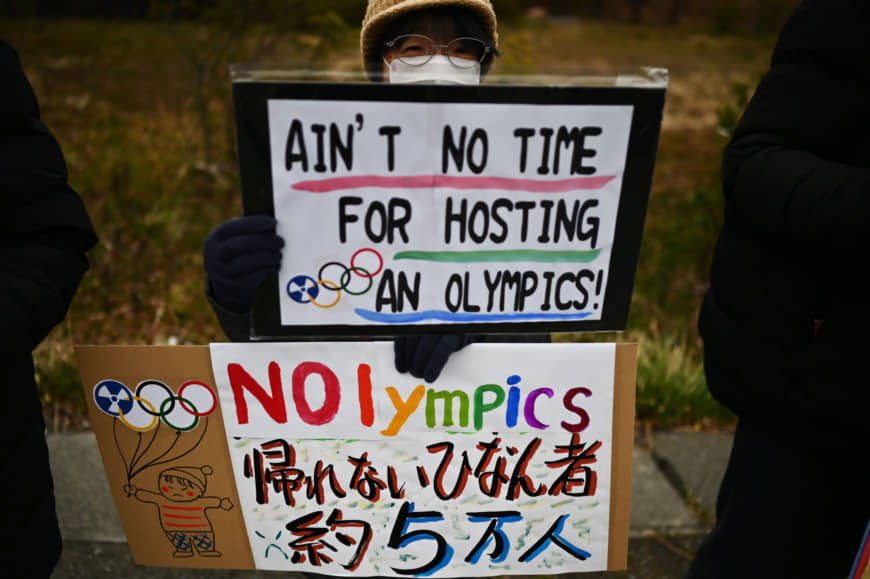
(FILES) This file photo taken on February 29, 2020 shows a protester holding placards during a demonstration against the Olympics, Prime Minister Shinzo Abe and nuclear energy, near the “J-Village” which will host the start of the Olympic torch relay in Naraha, Fukushima prefecture. – The Olympic torch relay that begins in Japan this month will start from Fukushima, emphasising what the government dubs the “Recovery Olympics”, but not everyone in the region will be cheering. (Photo by CHARLY TRIBALLEAU / AFP) / TO GO WITH nuclear-Fukushima-Oly-2020-JPN-Japan,FOCUS by Karyn NISHIMURA
Increasing voices in Japan for the cancellation of the Tokyo Olympics https://wordpress.com/read/feeds/2663585/posts/2804625668
On 7th June Mr Yukio Hatoyama, former Prime Minister of Japan, addressed me a message, expressing his views on the Tokyo Olympics : ”I always thought that instead of spending money on the Tokyo Olympics, the state should use these funds for the decontamination of the affected areas and to compensate the Fukushima nuclear disaster victims.“
He has expressed deep sympathy for the athletes placed in unbearable uncertainties preparing for the postponed Olympics. He urges that the sooner the decision the better for the athletes, since we all know that the Corona pandemic will oblige the Tokyo Olympic Games to be cancelled.
This message has given rise to reactions both in Japan and abroad.As an example,I am sharing with you a mail sent to me by a Japanese living in Germany.
In addition to the Covid-19 crisis, Japan is being cruelly assailed by natural disasters, unprecedented rainfalls and subsequent floods and landslides among others.
Japan faces a national crisis.
With warmest and highest regards,
Mitsuhei Murata
(Former Japanese Ambassador to Switzerland)
——– Forwarded Message ——–Dear Dr Alex Dear Dr Jörg Schmid;
cc: Mr Mitsuhei Murata, Mr Etsuji Watanabe
Recently I have acquired interesting information from Mr Mitsuhei Murata, former Japanese Ambassador to Switzerland, and Mr Etsuji Watanabe, a member of the ACSIR (Association for Citizens and Scientists Concerned about Internal Radiation Exposures), who are two of the leading lights in the anti-nuclear movements in Japan, that there is increasing support within the Japanese society for the complete cancellation, rather than postponement of the Tokyo Olympic Games.
On 7th June Mr Yukio Hatoyama, former Prime Minister of Japan, wrote to Mr Mitsuhei Murata, expressing his views on the Tokyo Olympics : ”I always thought that instead of spending money on the Tokyo Olympics, the state should use these funds for the decontamination of the affected areas and to compensate the Fukushima nuclear disaster victims.“
Subsequently Mr Murata wrote to Mr Thomas Bach, President of the IOC in order to convey this important message :
Dear President Thomas Bach,
Please allow me to inform you of a message a sent to me yesterday from former Japanese Prime Minister Yukio Hatoyama.
He has expressed deep sympathy for the athletes placed in unbearable uncertainties preparing for the postponed Olympics. He urges that the sooner the decision the better for the athletes, since we all know that the Corona pandemic will oblige the Tokyo Olympic Games to be cancelled.
In a press interview article published in January 2016,he made public his plea to consecrate maximum efforts to bringing Fukushima under control.
He has proven himself to be far-sighted. His vision for the future is in conformity with the dawning new world.
With highest and warmest regards,
Mitsuhei Murata
(Former Japanese Ambassador to Switzerland)
Mr Etsuji Watanabe told me that an overwhelming number of anti-nuclear activists are calling for the immediate cancellation of the Olympics. There will be demonstrations on 24th July, on which the 2020 Tokyo Olympic games were to commence, in Kyoto, Osaka and Tokyo. They will be demanding to stop the Olympic Games.
Best regards,
Rie
Book: Doom With A View: Historical and Cultural Contexts of the Rocky Flats Nuclear Weapons Plant.
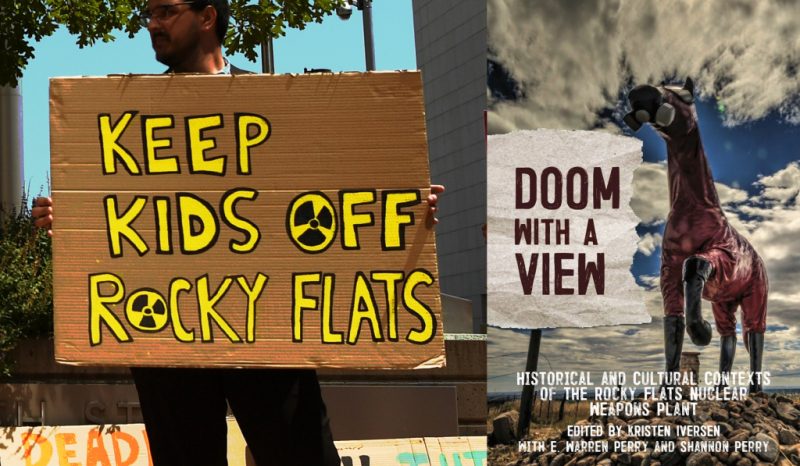
The Grieving Landscape, LONGREADS, Heidi Hutner | Fulcrum Publishing | June 2020 | 16 minutes (4,305 words)
We’re delighted to bring you an excerpt by Heidi Hutner from the anthology Doom With A View: Historical and Cultural Contexts of the Rocky Flats Nuclear Weapons Plant. Edited by Kristen Iverson, with E. Warren Perry and Shannon Perry, the anthology arrives from Fulcrum Publishing in August, 2020.
At thirty-five, I was diagnosed with Hodgkin’s lymphoma. One year before my diagnosis, my mother died from complications after heart surgery. At the time of her death, my mother had cancer — lymphoma. Five years prior to Mom’s death, my father passed away from a brain tumor, a metastasis from the cancer melanoma.
Two years after I had completed my chemotherapy treatment for cancer, I gave birth to Olivia. My miracle baby.
At first, I was ecstatic about the pregnancy. I had always wanted children, and with my cancer, I feared this would never happen. My doctors said I was lucky to give birth to a biological child after chemotherapy (my treatment left me with a 50 percent chance of remaining fertile afterward). But now, a mother-to-be, I was also afraid. How could I protect my child from our family cancer blight?
My desire to protect my daughter from a future cancer diagnosis drove me into a rabbit hole of reading and learning about the reasons for my family’s affliction. I began with Rachel Carson’s Silent Spring and moved forward to more recent literature by Sandra Steingraber, Theo Colburn, and numerous others, including the President’s Cancer Panel Report. I learned that the cancer rates today are off the charts: one in two men and one in three women will get cancer in their lifetimes. Carson predicted this plague in 1963. She warned us of humankind’s “hubris” in carelessly polluting our earth with toxic chemicals and ionizing radiation. The epidemiologist Alice Stewart’s study on the grave danger of X-rays on babies in the womb in the 1950s, sounded the alarm about ionizing radiation as well. Today, our world swirls with pollutants — these carcinogens penetrate mothers’ wombs and breasts. Mother’s milk is a toxic cocktail. Newborns today are born with hundreds of synthetic chemicals in their umbilical cord blood. Synthetic chemicals and ionizing radiation change our makeup, harm our genes, and cause mutagenetic damage. More than 80,000 unregulated pollutants fill our environment.
We are guinea pigs.
Fast forward about eleven years: one summer day, in 2009, on the Upper West Side of Manhattan, at lunch with a close friend (and cousin) of my deceased mother, Phyllis Resnick, I stumbled upon a story about my mom that I had never heard before. The tale Phyllis told would radically change my life. My then-preteen daughter, Olivia, was by my side. She listened rapt with me as we learned of our maternal nuclear legacy.
Phyllis described how in the early 1960s, my mother and she, along with their good friend Thalia Stern Broudy, had been a members of Women Strike for Peace (WSP), an antinuclear group led by Dagmar Wilson and the future congresswoman, Bella Abzug. During the Cold War 1950s and early 60s, the U.S. had detonated one hundred above-ground nuclear test bombs in the Nevada desert and one hundred and six atmospheric test bombs in the South Pacific. The government claimed these test bombs posed no harm and the fallout had not spread, but scientists and medical professionals were concerned. A team of experts in St. Louis, MO, directed by Dr. Louise Reiss, initiated a survey to determine the extent of the impact of the bomb testing. With a chemical makeup similar to calcium, strontium-90, a radioisotope found in fallout, is easily absorbed in teeth and bones. Thousands of baby teeth from across the U.S. were collected between 1958 and 1971 for the St. Louis Baby Tooth Survey. In 1961, preliminary results showed high levels of strontium-90 in baby teeth of children born after 1945 and these levels increased over the time period, as the test-bombing continued. When the mothers of Women Strike for Peace learned the results of the survey, they banded together to stop atmospheric bomb testing. 50,000 WSP members from across the U.S. wrote letters, gathered petitions, lobbied congressional representatives, initiated lawsuits, and protested through marches and street demonstrations. My mother and her cohort of 15,000 WSP members traveled to D.C. to protest, lobby, and meet with their legislators November, 1961. In 1963, the United States, the U.K., and the Soviet Union signed the Partial Nuclear Test Ban Treaty, an agreement to halt atmospheric, under water, and outer space bomb testing. The signing of this treaty has been attributed to the efforts of WSP.
The government claimed these test bombs posed no harm and the fallout had not spread, but scientists and medical professionals were concerned.
After discovering this remarkable story about WSP, I became obsessed with feminist nuclear history. I wondered: Why had I never been told this tale when my mother was alive? What other vital nuclear histories involving women had been buried? So began my journey of exploring women’s antinuclear tales, traveling to nuclear disaster sites, and meeting with members of impacted communities. On this path, I met Kristen Iversen, the author of Full Body Burden, an investigative memoir about growing up next door to Rocky Flats, the former nuclear weapons facility in Arvada, Colorado. Kristen invited me to visit her in Colorado. She would introduce me to experts, scientists, and community members there. I brought my then eighteen-year-old daughter, Olivia, with me. She was about to leave for college. I wanted to share our maternal antinuclear and activist legacy with her before she left home. ………….
Operating from 1952 to 1992, the Rocky Flats nuclear weapons facility was located approximately 15 miles northwest of Denver, a city built by an influx of miners during the gold rush in the nineteenth century. During the years of its operation, the plant constructed more than 70,000 triggers for nuclear bombs. Rocky Flats would be the site of two major secret plutonium fires, blowing radioactive poison into sections of Arvada and Denver in 1957 and 1969. Hundreds of smaller fires also took place, as well as regular leaks, spills, and atmospheric plutonium releases. Plutonium clouds blew over houses, swimming pools, schools, churches, farms, fields, and streams. Rocky Flats is known for powerful Chinook winds — winds that would blow plutonium dust into local neighborhoods. Locals did not know that Rocky Flats was a weapons factory for most of its years of operation. Workers employed there were forbidden to speak of their work and often didn’t comprehend the full extent of the factory’s activities.
By 1989, The FBI and EPA suspected criminal negligence at Rocky Flats, which led to a raid, led by FBI agent Jon Lipsky.
A federal grand jury began an investigation, a settlement was negotiated, the court documents were sealed, and the plant closed. The story of this federal grand jury is fraught and complex, and cover-ups are suspected in the sealing of the documents and lack of full prosecution. The Rocky Flats cleanup was officially completed in 2004; however, numerous scientists, nuclear experts, local citizens, and antinuclear activists argue the cleanup is far from finished. Unknown but large amounts of plutonium and other contaminants remain on the land in what has been turned into a Superfund site, a designation made under the Comprehensive Environmental Response, Compensation, and Liability Act of 1980. The primary industrial site (the Superfund area — 485 acres) was never completely remediated. There is a buffer zone, also heavily contaminated, although the EPA claims this area is fully remediated. The surrounding area, now called a National Wildlife Refuge, was not remediated. Significant contamination has been detected there in the soil and groundwater. Many other toxic and radioactive contaminants have also been found at Rocky Flats in addition to plutonium: americium, uranium, cadmium, PCBs, beryllium, and more. A 2019 study found plutonium “hot particles” in the soil frighteningly close to the homes abutting the Flats………
Rocky Flats is “a national sacrifice zone,” says Robert Alvarez, associate fellow at the Institute for Policy Studies and former senior policy advisor to the secretary at the US Department of Energy. “That’s what it is, although no one will say so officially. How much remains buried there? A tremendous amount — plutonium doesn’t go away. No one has done this yet — it’s costly and complex — but someone needs to go into those houses nearby in Arvada and take samples. We don’t know how much plutonium is in them.”…….. https://longreads.com/2020/06/30/the-grieving-landscape/amp/
1 This Month


Tell the Ukrainian Government to Drop Prosecution of Peace Activist Yurii Sheliazhenko

Petition to revoke the licensing of the Near Surface Nuclear Disposal Facility (NSDF) at Chalk River. https://www.ourcommons.ca/petitions/en/Petition/Details?Petition=e-7247


of the week – STOP SMALL MODULAR REACTORS IN CANADA
To see nuclear-related stories in greater depth and intensity – go to https://nuclearinformation.wordpress.com
-
Archives
- March 2026 (204)
- February 2026 (268)
- January 2026 (308)
- December 2025 (358)
- November 2025 (359)
- October 2025 (376)
- September 2025 (258)
- August 2025 (319)
- July 2025 (230)
- June 2025 (348)
- May 2025 (261)
- April 2025 (305)
-
Categories
- 1
- 1 NUCLEAR ISSUES
- business and costs
- climate change
- culture and arts
- ENERGY
- environment
- health
- history
- indigenous issues
- Legal
- marketing of nuclear
- media
- opposition to nuclear
- PERSONAL STORIES
- politics
- politics international
- Religion and ethics
- safety
- secrets,lies and civil liberties
- spinbuster
- technology
- Uranium
- wastes
- weapons and war
- Women
- 2 WORLD
- ACTION
- AFRICA
- Atrocities
- AUSTRALIA
- Christina's notes
- Christina's themes
- culture and arts
- Events
- Fuk 2022
- Fuk 2023
- Fukushima 2017
- Fukushima 2018
- fukushima 2019
- Fukushima 2020
- Fukushima 2021
- general
- global warming
- Humour (God we need it)
- Nuclear
- RARE EARTHS
- Reference
- resources – print
- Resources -audiovicual
- Weekly Newsletter
- World
- World Nuclear
- YouTube
-
RSS
Entries RSS
Comments RSS
 nuclear-news