Scepticism over USA Dept Energy report that the Runit nuclear waste dome is “safe”
The new report does not include a plan to repair the dome, which was required by Congress.
In 1981, the U.S. government declared in a report that the island should be quarantined indefinitely and that the “possibility would always exist that high levels of plutonium-contaminated subsurface soil could be exposed by wave or storm action.”
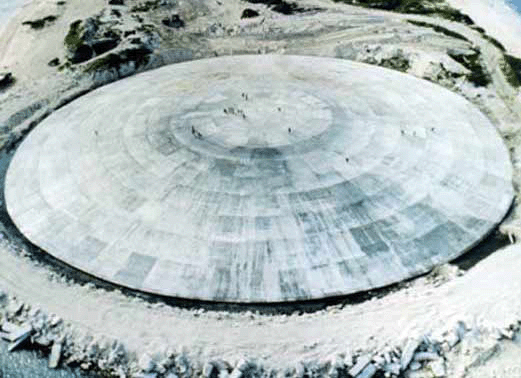
The DOE report found that Runit Dome, a repository for atomic waste the United States produced during Cold War weapons testing, is sound and that radioactive leakage into the nearby lagoon is not significant.
After Congress grew concerned last year about the leaking dome, it ordered the DOE to produce a report on the dome’s structural integrity amid climate change and rising sea levels.
The report noted that while sea level rise could increase storm surge, swells, and “lead to wave-induced over-wash of lower sections of the dome,” there is not enough definitive data to determine “how these events might impact on the environment.”
One Marshallese leader was disappointed the DOE again downplayed the risks and declined to take responsibility for Runit Dome and its leaking contents.
“We don’t expect the Enewetak community to feel any safer based on this report as it doesn’t contain any new information from what they’ve seen…and don’t trust,” said Rhea Christian-Moss, the chairperson of the Marshall Islands’ National Nuclear Commission, a government-operated nuclear waste and radiation oversight panel.
“The report offers nothing new and is more or less what we expected to see,” she said, lamenting the Senate’s redaction of a critical line in the House’s mandate, which stipulated that the Department of Energy provide a plan detailing the removal of the radioactive waste into a “safer and more stable location.”
The Department of Energy report is signed by Dan Brouillette, the agency’s secretary. Terry Hamilton, the department’s lead contractor on the project, was not available for comment.
In November last year, The Times published an investigation of the lingering radiation legacy in the Marshall Islands, and the refusal of U.S. authorities to take ownership for the hazards posed by Runit Dome
In December, Congress signed the National Defense Authorization Act for 2020, which required the DOE to provide a plan to repair the dome, evaluate the environmental effects of the dome on the lagoon over the next 20 years, and assess its structure and the potential risk to the people who live near it.
The department was also required to assess how rising sea levels could affect the dome.
Christian-Moss noted data gaps in the report, as well, including the level of radiation in groundwater leaking from the dome into the lagoon.
In 2019, at a presentation delivered in the Marshall Islands to Marshallese and U.S. officials, the DOE’s contractor, Hamilton, mentioned elevated levels of radioactivity in giant clams living near the dome.
The new report does not mention the clams but states that not enough information is available to understand how leakage from the dome is affecting marine life. However, according to the energy department, studies of people living nearby show normal levels of radiation — suggesting they are not being adversely affected.
“The absence of data to show any risk does not mean that there is no risk.” she said. “So my main takeaway from the report is that many risks are still ‘unknown.’”
Nowhere else has the United States saddled another country with so much of its nuclear waste, a product of its Cold War atomic testing program.
The waste site, known alternatively as the Tomb, holds more than 3.1 million cubic feet — or 35 Olympic-size swimming pools — of U.S.-produced radioactive soil and debris, including lethal amounts of plutonium.
The radioactive material was collected, moved and contained by U.S. soldiers during the late 1970s. Many of those veterans say they were unaware of the contents and did not wear protective equipment.
“All in all the message seems to be that we should be concerned but not alarmed,” said Michael Gerrard, a legal scholar at Columbia University’s law school. “It is as if Runit is like a radioactive sore in the middle of the Pacific, but one that can get by with band-aids for the foreseeable future unless they find more bleeding.”
The DOE authors also maintain that the lagoon’s sediments are so contaminated with radioactive elements that any additional spillage from the dome would be undetectable.
“It remains to be seen whether the Marshallese will accept this report by the Americans, given how poorly the U.S. has treated the Marshallese in so many ways since 1945,” said Gerrard.
In July 2019, DOE officials responded claiming they didn’t have the funding to build a fence and installation of a perimeter would be logistically too complex.
In 1981, the U.S. government declared in a report that the island should be quarantined indefinitely and that the “possibility would always exist that high levels of plutonium-contaminated subsurface soil could be exposed by wave or storm action.”
No comments yet.
1 This Month


Tell the Ukrainian Government to Drop Prosecution of Peace Activist Yurii Sheliazhenko

Petition to revoke the licensing of the Near Surface Nuclear Disposal Facility (NSDF) at Chalk River. https://www.ourcommons.ca/petitions/en/Petition/Details?Petition=e-7247


of the week – STOP SMALL MODULAR REACTORS IN CANADA
To see nuclear-related stories in greater depth and intensity – go to https://nuclearinformation.wordpress.com
-
Archives
- March 2026 (204)
- February 2026 (268)
- January 2026 (308)
- December 2025 (358)
- November 2025 (359)
- October 2025 (376)
- September 2025 (258)
- August 2025 (319)
- July 2025 (230)
- June 2025 (348)
- May 2025 (261)
- April 2025 (305)
-
Categories
- 1
- 1 NUCLEAR ISSUES
- business and costs
- climate change
- culture and arts
- ENERGY
- environment
- health
- history
- indigenous issues
- Legal
- marketing of nuclear
- media
- opposition to nuclear
- PERSONAL STORIES
- politics
- politics international
- Religion and ethics
- safety
- secrets,lies and civil liberties
- spinbuster
- technology
- Uranium
- wastes
- weapons and war
- Women
- 2 WORLD
- ACTION
- AFRICA
- Atrocities
- AUSTRALIA
- Christina's notes
- Christina's themes
- culture and arts
- Events
- Fuk 2022
- Fuk 2023
- Fukushima 2017
- Fukushima 2018
- fukushima 2019
- Fukushima 2020
- Fukushima 2021
- general
- global warming
- Humour (God we need it)
- Nuclear
- RARE EARTHS
- Reference
- resources – print
- Resources -audiovicual
- Weekly Newsletter
- World
- World Nuclear
- YouTube
-
RSS
Entries RSS
Comments RSS
 nuclear-news
Leave a comment