Need for action on global heating – It’s 38°C in Siberia
|
The Arctic heatwave: here’s what we know, https://www.theguardian.com/commentisfree/2020/jun/25/arctic-heatwave-38c-siberia-scienceTamsin Edwards
It’s 38°C in Siberia. The science may be complicated – but the need for action now couldn’t be clearer Fri 26 Jun 2020 There’s an Arctic heatwave: it’s 38°C in Siberia. Arctic sea ice coverage is the second lowest on record, and 2020 may be on course to be the hottest year since records began. For many people, such news induces a lurch of fear, or avoidance – closing the webpage because they don’t want to hear yet more bad news. A few might think “It’s just weather,” and roll their eyes. How can we make sense of such an event? Climate is subtle and shifting, with many drivers and timescales. But we can use this northern heatwave to illuminate the complexity of our planet. We can break this question into parts, from fast to slow. Fast: the immediate effect is to increase wildfires. Siberia has seen “zombie fires” reignited from deep smouldering embers in peatland. This is bad news, releasing particulate air pollution and more carbon in 18 months than in the past 16 years. The immediate cause? Here in the mid-high northern latitudes, we live in unstable weather under the influence of the polar jet stream. This rapid current of air high above our heads drags weather in a conveyor belt from west to east, with alternating patches of cold and warm air, low and high pressure. Sometimes the weather patterns get stuck, creating a stable period of weather, like a heatwave. This is one long, severe example. Does climate change make this “blocking” more likely? Maybe. The jet stream is created by the contrast between cold polar air and the warmer south. The Arctic is warming twice as fast as the global average: that means less north-south contrast, so the jet stream can become more wobbly and meandering. Loops break off like the oxbow lakes of school geography lessons, stranding particular weather patterns in one place. And why is the Arctic warming faster? Because sea ice and snow are so bright. When they melt with global warming, the ocean and land beneath are darker, so they absorb more of the sun’s heat. Their loss amplifies our warming. The current low in Arctic sea ice is itself partly the result of the Siberian heatwave, amplifying the usual year-to-year fluctuations. But the trend is down: the more CO2 we emit, the more the planet’s temperature rises, and the more sea ice we lose. Scientists predict the Arctic will start seeing summers without sea ice by 2050. But it’s not irreversible. It’s not a tipping point. The sea ice would return if we could cool the climate again. Unfortunately we know only three ways to do that: extract vast amounts of CO2 from the air with trees or technology; reflect the sun’s rays at a planetary scale; or wait, for many generations. This Arctic heatwave is a sharp spike on top of the global warming trend. That’s what makes it more intense, more likely and more of a warning: it’s a taste of the future predicted for Russia, if we burn quickly through our fossil fuels. The real fear around the Arctic for the longer term, I find when talking to people, comes from the idea of “runaway” warming from methane release. Warming could release stores of methane – a strong greenhouse gas – from permafrost or frozen sediments at the bottom of the ocean, which would add to the warming from our own activities. There is more than twice the amount of carbon in the permafrost as in the atmosphere, and thawing has already begun. There are big local impacts – damage to roads and buildings, because the ground can no longer bear so much weight, and an appalling story involving what appears to be anthrax release from thawing burial grounds. Permafrost thaw was even blamed by a Russian mining company for the recent collapse of a fuel reservoir, contaminating the river with 20,000 tonnes of diesel, though other factors were probably also involved. So could this Siberian heatwave, or ones like it, trigger catastrophic warming? I see much fear about amplifying methane feedbacks, including the false idea that climate scientists don’t consider them (we do, just separately to the main global climate models). Yet for several years there has been growing evidence that this risk is less than originally thought. Carbon stored in permafrost and wetlands is predicted to contribute around 100bn tonnes of CO2 this century. That’s a lot, but we add around 40bn tonnes ourselves every year. The methane at the bottom of the ocean would take centuries to release, so as long as we limit global warming we should keep those stores mostly locked up. There are uncertainties, of course, but the stores’ impact on warming is likely to be tenths of a degree, not several degrees. Yet every tonne of CO2 released from permafrost means one tonne fewer we can emit if we are to reach net zero emissions by 2050. Every year’s equivalent of our emissions brings our deadline closer. Every tenth of a degree of warming brings us closer to our target of 1.5°C and makes more permafrost thaw, and the impacts of climate change worse for the most vulnerable people and species of the world. The Arctic heatwave shows us that there are few simple stories in climate change. There is always a mix of natural and human influence, bad news and slightly-less-bad news, and occasionally even hopeful news. So, more than ever, we need to avoid over-simplifying or slipping into easy tropes like “We’re all doomed” or “It’s all weather,” but to try to understand the details. Perhaps there is one simple story though: every bit of warming we avoid will help keep our planet a more familiar and an easier place to live on. • Dr Tamsin Edwards is a senior lecturer in physical geography at King’s College London |
The world must learn to live with Covid-19

The shifting strategies are an acknowledgment that even the most successful countries cannot declare victory until a vaccine is found.
They also show the challenge presented by countries like the United States, Brazil and India, where the authorities never fully contained initial outbreaks and from where the coronavirus will continue to threaten to spread.
How the world is learning to live with a deadly pandemic, https://thenewdaily.com.au/news/world/2020/06/26/coronavirus-pandemic-2/, Sui-Lee Wee, Benjamin Mueller and Emma Bubola China is testing restaurant workers and delivery drivers block by block.
South Korea tells people to carry two types of masks for differing risky social situations.
Germany requires communities to crack down when the number of infections hits certain thresholds.
Britain will target local outbreaks in a strategy that Prime Minister Boris Johnson calls “whack-a-mole”.
Around the world, governments that had appeared to tame the coronavirus are adjusting to the reality that the disease is here to stay.
But in a shift away from damaging nationwide lockdowns, they are looking for targeted ways to find and stop outbreaks before they become third or fourth waves.
While the details differ, the strategies call for giving governments flexibility to tighten or ease as needed.
They require some mix of intensive testing and monitoring, lightning-fast response times by authorities, tight border management and constant reminders to their citizens of the dangers of frequent human contact.
They require some mix of intensive testing and monitoring, lightning-fast response times by authorities, tight border management and constant reminders to their citizens of the dangers of frequent human contact.
The strategies often force central governments and local officials to share data and work closely together, overcoming incompatible computer systems, turf battles and other long-standing bureaucratic rivalries Continue reading
Sizewell planning documents reveal higher-than-expected £20bn price tag
  Cost of new Sizewell C nuclear plant put at £20bn https://www.ft.com/content/77c209f7-6d18-4609-ac3c-77d1b5b82b34 26 June 20, Higher-than-expected price tag revealed for first time in planning documents. Nathalie Thomas in Edinburgh and Donato Paolo Mancini in London Cost of new Sizewell C nuclear plant put at £20bn https://www.ft.com/content/77c209f7-6d18-4609-ac3c-77d1b5b82b34 26 June 20, Higher-than-expected price tag revealed for first time in planning documents. Nathalie Thomas in Edinburgh and Donato Paolo Mancini in London
A new nuclear plant proposed on England’s east coast will cost £20bn, according to planning documents that reveal the higher-than-expected price of the project for the first time. The developers of the proposed plant at Sizewell in Suffolk — France’s EDF and Chinese state-owned CGN — had previously indicated the power station could be built for 20 per cent less than Hinkley Point C. Britain’s first new nuclear plant in a generation is under construction in Somerset.
This implied a cost of about £18bn for the Suffolk plant, called Sizewell C, after EDF last year said the price tag for Hinkley Point had risen to as much as £22.5bn. The first new-build project has suffered a string of cost overruns.
The revelation of Sizewell’s cost in extensive planning documents published on Thursday will reignite the ferocious debate around whether the UK should build large new nuclear plants.
Some backbench Conservative MPs, opposed to Chinese state involvement in critical national infrastructure, have concerns about the project because of the presence of CGN. The Chinese state-owned company is a junior financing partner on the Sizewell C project but hopes to install its own reactor technology in another proposed nuclear station at Bradwell-on-Sea, Essex.
The Financial Times reported on Wednesday that CGN, or China General Nuclear Power Corporation, was on a US list of 20 companies with links to the Chinese military compiled by the Pentagon. The list is part of an attempt by the White House and Congress to prevent Beijing from obtaining sensitive technologies as well as US funding.
EDF said in the planning documents that the cost estimate for Sizewell C includes design, construction and land costs associated with the proposed site, which is situated next to one of the UK’s operational nuclear plants, known as Sizewell B. It also takes into account “expected inflation and contingencies”, according to the document.
The company had previously claimed the cost savings on Sizewell could be delivered because it would be a “near identical copy” of Hinkley Point C.
EDF said the budget detailed in the planning application includes inflation over the estimated 10 years of construction, whereas the latest estimate for Hinkley Point C — estimated to be in a range of £21.5bn to £22.5bn — was based on 2015 prices.
The 20 per cent cost saving still stood if you subtracted a fifth from the Hinkley budget and then adjusted that sum for inflation, the company added.
EDF and CGN are yet to clarify how the new plant would be funded. The UK government last year launched a consultation on a so-called regulated asset base model (RAB) — used for other forms of infrastructure such as energy networks. This would lower the cost of capital of the scheme because consumers would have a surcharge added to their energy bills before the plant was completed.
Stop Sizewell C, a local campaigning group, said the funding statement was “a work of fiction” and described the £20bn pricetag as “totally eye-watering”.
Greenpeace UK’s chief scientist Doug Parr said the nuclear industry’s claim that it can always make the next power plant cheaper was “just never true.” He pointed out that the costs of renewable power had dropped below half those of nuclear “and just keep dropping”.
The government is yet to report back on the consultation. Privately, some nuclear industry leaders have been making an argument for the taxpayer to take a stake in any new project.
|
|
UK planning inspectorate accepts Sizewell C nuclear plans for examination

|
Sizewell C: Nuclear power station plans accepted for scrutiny, https://www.bbc.com/news/uk-england-suffolk-53176514, 25 June 2020
An application to build a new nuclear power station has been accepted for examination by the planning inspectorate. Plans for the Sizewell C plant on the Suffolk coast were put forward by EDF Energy after being mooted 10 years ago. The acceptance means an examining authority will now be appointed to scrutinise the application, with the government having final decision. Stop Sizewell C (SSC) group said it will continue to fight the application. EDF Energy said in a statement: “The decision means the Inspectorate is satisfied that the eight years of public consultation by the project was conducted properly and that full examination of the proposals can now take place.” But Alison Downes from SSC said the “quality of EDF’s consultations failed to provide required information”. She added EDF “had not been transparent in its disclosures of environmental assessment or transport strategy” nor the plant’s impact on the local area. Concerns about effective scrutiny of pre-application proposals during the lockdown restrictions was supported in letters from local MP Dr Dan Poulter and Suffolk County Council. In a joint statement on Wednesday Suffolk County Council and East Suffolk Council said: “The lack of a comprehensive set of documents up to this point has compromised the engagement that has taken place, and the Councils do not feel they have been able to complete their pre-application work with the Applicant (EDF Energy) to the extent set out by the Planning Act 2008,” EDF Energy said a copy of the full planning application and supporting documents would become available on the Planning Inspectorate website. |
|
The Anthropocene, begun in 16th Century colonialism, slavery -? for repair in 21st Century post-Covid-19 recovery
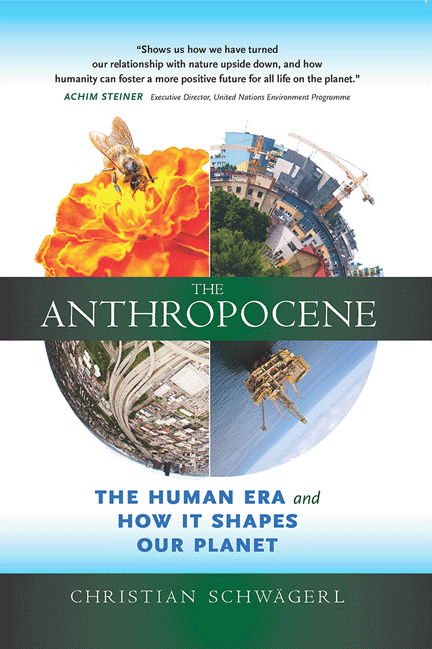
Why the Anthropocene began with European colonisation, mass slavery and the ‘great dying’ of the 16th century, The Conversation, Mark Maslin, Professor of Earth System Science, UCL, Simon Lewis, Professor of Global Change Science at University of Leeds and, UCL June 25, 2020 The toppling of statues at Black Lives Matter protests has powerfully articulated that the roots of modern racism lie in European colonisation and slavery. Racism will be more forcefully opposed once we acknowledge this history and learn from it. Geographers and geologists can help contribute to this new understanding of our past, by defining the new human-dominated period of Earth’s history as beginning with European colonialism.Today our impacts on the environment are immense: humans move more soil, rock and sediment each year than is transported by all other natural processes combined. We may have kicked off the sixth “mass extinction” in Earth’s history, and the global climate is warming so fast we have delayed the next ice age.
We’ve made enough concrete to cover the entire surface of the Earth in a layer two millimetres thick. Enough plastic has been manufactured to clingfilm it as well. We annually produce 4.8 billion tonnes of our top five crops and 4.8 billion livestock animals. There are 1.4 billion motor vehicles, 2 billion personal computers, and more mobile phones than the 7.8 billion people on Earth.
All this suggests humans have become a geological superpower and evidence of our impact will be visible in rocks millions of years from now. This is a new geological epoch that scientists are calling the Anthropocene, combining the words for “human” and “recent-time”. But debate still continues as to when we should define the beginning of this period. When exactly did we leave behind the Holocene – the 10,000 years of stability that allowed farming and complex civilisations to develop – and move into the new epoch?
Five years ago we published evidence that the start of capitalism and European colonisation meet the formal scientific criteria for the start of the Anthropocene.
Our planetary impacts have increased since our earliest ancestors stepped down from the trees, at first by hunting some animal species to extinction. Much later, following the development of farming and agricultural societies, we started to change the climate. Yet Earth only truly became a “human planet” with the emergence of something quite different. This was capitalism, which itself grew out of European expansion in the 15th and 16th century and the era of colonisation and subjugation of indigenous peoples all around the world.
In the Americas, just 100 years after Christopher Columbus first set foot on the Bahamas in 1492, 56 million indigenous Americans were dead, mainly in South and Central America. This was 90% of the population. Most were killed by diseases brought across the Atlantic by Europeans, which had never been seen before in the Americas: measles, smallpox, influenza, the bubonic plague. War, slavery and wave after wave of disease combined to cause this “great dying”, something the world had never seen before, or since.
In North America the population decline was slower but no less dramatic due to slower colonisation by Europeans. US census data suggest the Native American population may have been as low as 250,000 people by 1900 from a pre-Columbus level of 5 million, a 95% decline.
This depopulation left the continents dominated by Europeans, who set up plantations and filled a labour shortage with enslaved workers. In total, more than 12 million people were forced to leave Africa and work for Europeans as slaves. ……….
In addition to the critical task of highlighting and tackling the racism within science, perhaps geologists and geographers can also make a small contribution to the Black Lives Matter movement by unflinchingly compiling the evidence showing that when humans started to exert a huge influence on the Earth’s environment was also the start of the brutal European colonisation of the world.
In her insightful book, A Billion Black Anthropocenes or None, the geography professor Kathryn Yusoff makes it very clear that predominantly white geologists and geographers need to acknowledge that Europeans decimated indigenous and minority populations whenever so-called progress occurred.
Defining the start of the human planet as the period of colonisation, the spread of deadly diseases and transatlantic slavery, means we can face the past and ensure we deal with its toxic legacy. If 1610 marks both a turning point in human relations with the Earth and our treatment of each other, then maybe, just maybe, 2020 could mark the start of a new chapter of equality, environmental justice and stewardship of the only planet in the universe known to harbour any life. It’s a struggle nobody can afford to lose. https://theconversation.com/why-the-anthropocene-began-with-european-colonisation-mass-slavery-and-the-great-dying-of-the-16th-century-140661
Nuclear developers push UK government for prompt decision on government finance for new construction
 Nuclear developers press for ‘prompt’ decision on new UK plants , Ft.com, Nathalie Thomas in Edinburgh, JUNE 24 2020
Britain’s nuclear energy industry has said it could cut the price of power from new large power stations by more than half as it presses ministers for a “prompt” decision on government financing to support construction. …….
The NIA argues that supply chain costs would fall further if it can build further scale and experience. But it warns that new projects rely on “prompt decisions” by ministers on an alternative financing mechanism to support nuclear plant construction. Executives at EDF have made clear they will not replicate the model used for Hinkley, which has been beset by cost overruns. A government consultation on alternative funding models, launched last year, is yet to report back.
Under a RAB model, households would pay for a plant’s construction through their energy bills long before any electricity is generated, allowing developers to attract cheaper finance from investors such as pension funds. But it also leaves consumers on the hook for cost overruns.
Scientists just now realising how bad this Coronavirus is

CHICAGO (Reuters) 26 June 20, – Scientists are only starting to grasp the vast array of health problems caused by the novel coronavirus, some of which may have lingering effects on patients and health systems for years to come, according to doctors and infectious disease experts.
Besides the respiratory issues that leave patients gasping for breath, the virus that causes COVID-19 attacks many organ systems, in some cases causing catastrophic damage.
“We thought this was only a respiratory virus. Turns out, it goes after the pancreas. It goes after the heart. It goes after the liver, the brain, the kidney and other organs. We didn’t appreciate that in the beginning,” said Dr. Eric Topol, a cardiologist and director of the Scripps Research Translational Institute in La Jolla, California.
In addition to respiratory distress, patients with COVID-19 can experience blood clotting disorders that can lead to strokes, and extreme inflammation that attacks multiple organ systems. The virus can also cause neurological complications that range from headache, dizziness and loss of taste or smell to seizures and confusion.
And recovery can be slow, incomplete and costly, with a huge impact on quality of life.
The broad and diverse manifestations of COVID-19 are somewhat unique, said Dr. Sadiya Khan, a cardiologist at Northwestern Medicine in Chicago.
With influenza, people with underlying heart conditions are also at higher risk of complications, Khan said. What is surprising about this virus is the extent of the complications occurring outside the lungs.
Khan believes there will be a huge healthcare expenditure and burden for individuals who have survived COVID-19.
LENGTHY REHAB FOR MANY
Patients who were in the intensive care unit or on a ventilator for weeks will need to spend extensive time in rehab to regain mobility and strength.
“It can take up to seven days for every one day that you’re hospitalized to recover that type of strength,” Khan said. “It’s harder the older you are, and you may never get back to the same level of function.”
While much of the focus has been on the minority of patients who experience severe disease, doctors increasingly are looking to the needs of patients who were not sick enough to require hospitalization, but are still suffering months after first becoming infected. …….. https://www.reuters.com/article/us-health-coronavirus-effects/scientists-just-beginning-to-understand-the-many-health-problems-caused-by-covid-19-idUSKBN23X1BZ
European Union countries agreed to exclude nuclear, fossil gas from green transition fund
 EU ministers exclude nuclear, fossil gas from green transition fund EU ministers exclude nuclear, fossil gas from green transition fund
EURACTIV.com with Reuters European Union countries agreed on Wednesday (24 June) that the bloc’s flagship fund to wean regions off fossil fuels should not finance nuclear or natural gas projects, despite calls from some Eastern countries for gas to be eligible for EU funding. The European Commission, the EU’s executive, wants to set up a €40 billion Just Transition Fund, comprised of €30 billion from an EU coronavirus recovery fund and €10 billion from its budget for 2021-27. The fund aims to encourage a shift from high-carbon industries that would help coal miners to retrain and find new low-carbon jobs, and support regions whose economies depend on polluting sectors to build new industries. Ambassadors from the EU’s 27 member states agreed on Wednesday that the Just Transition “shall not support the decommissioning or the construction of nuclear power stations” nor “investment related to the production, processing, distribution, storage or combustion of fossil fuels,” according to a document, published on Thursday (25 June). The position is in line with the Commission’s, making it likely that the final Just Transition Fund will exclude nuclear and gas. The proposal will be finalised following negotiations between member states, the Commission and EU Parliament, with the latter typically favouring ambitious climate change policies…….. https://www.euractiv.com/section/energy/news/eu-ministers-exclude-nuclear-fossil-gas-from-green-transition-fund/ |
|
Trump’s Justice Department drumming up new allegations against Julian Assange
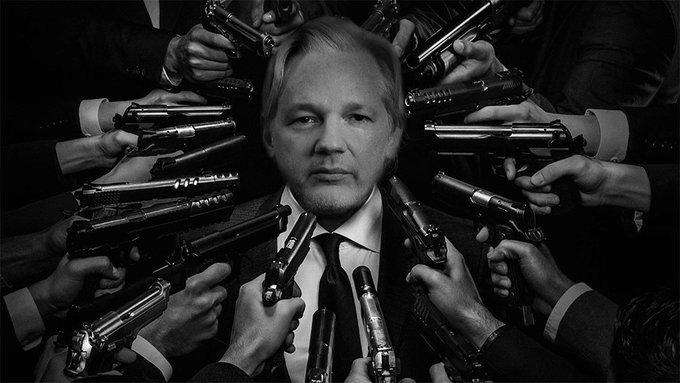 ASSANGE EXTRADITION: Assange Hit With New Superseding Indictment, Reflecting Possible FBI Sting Operation The U.S. Justice Department on Wednesday unveiled the new superseding indictment against the WikiLeaks publisher, adding to existing computer intrusion charges. By Joe Lauria, Consortium News June 24, 2020 The Justice Department on Wednesday said it had filed a second superseding indictment against imprisoned WikiLeaks publisher Julian Assange, adding to existing computer intrusion charges.“The new indictment does not add additional counts to the prior 18-count superseding indictment returned against Assange in May 2019,” the DOJ said in a press release.
“It does, however, broaden the scope of the conspiracy surrounding alleged computer intrusions with which Assange was previously charged,” the release said. “According to the charging document, Assange and others at WikiLeaks recruited and agreed with hackers to commit computer intrusions to benefit WikiLeaks.”…….
The indictment quotes Assange at hacking conferences encouraging hackers to obtain a “Most Wanted Leaks” list of classified materials that WikiLeaks sought to publish.
It provides new allegations that Assange instructed a “teenager” from an unnamed NATO country to conduct various hacks “including audio recordings of phone conversations between high-ranking officials” of the NATO nation as well as members of parliament from that country. The indictment claims Manning “downloaded classified State Department materials” about this country.
WikiLeaks has identified the “teenager” as Sigurdur Thordarson, “a diagnosed sociopath, a convicted conman, and sex criminal” who had impersonated Assange to embezzle money from WikiLeaks………..
Thordarson, an Icelander, became an FBI informant, and was flown to Washington in May 2019 for an interview with the FBI.
The superseding indictment says Assange was allegedly able to learn from “unauthorized access” to a website of this government that police from that country were monitoring him. The indictment says the source of this information was a former member of Anonymous who worked with WikiLeaks named Sabu, identified in the press as Hector Monsegur, who became an FBI informant after being arrested in June 2011.
In the same month, Iceland’s Interior Minister Ögmundur Jonasson prevented FBI agents from entering Iceland, testifying that “FBI dirty-tricks operations were afoot against WikiLeaks.” He said the agents had been sent to seek “our cooperation in what I understood as an operation to set up, to frame Julian Assange and WikiLeaks.” The possibility remains that the new evidence against Assange was obtained in an FBI sting operation.
Jeremy Hammond, a hacker arrested for obtaining the Stratfor files, is named in the new indictment has having revealed information about his activities with Assange to Sabu in December 2011. Last September, Hammond, who was serving a 10-year sentence in Memphis, TN, was brought by prosecutors investigating Assange to Alexandria, VA to compel him to give testimony against Assange. Hammond has refused.
Reiterates Original Charges
The new indictment repeats the existing espionage and computer intrusion charges………
In 2010, Robert Parry, one of the best investigative reporters of his era, and the founder of this website, wrote that the then pending plans of the Obama administration to indict Assange “for conspiring with Army Pvt. Bradley Manning to obtain U.S. secrets strikes at the heart of investigative journalism on national security scandals.”
Parry added:
“That’s because the process for reporters obtaining classified information about crimes of state most often involves a journalist persuading some government official to break the law either by turning over classified documents or at least by talking about the secret information. There is almost always some level of ‘conspiracy’ between reporter and source.” [Emphasis added.]
Parry thus admitted to encouraging his sources to turn over classified information even if it meant committing the lesser crime of leaking classified information if it could help prevent a larger crime from being committed. In this way Assange encouraged Manning to turn over material such as the “Collateral Murder” video in the hope that it could end the illegal war in Iraq…….
The New York Times reported at the time that “federal prosecutors were reviewing the possibility of indicting Assange on conspiracy charges for allegedly encouraging or assisting Manning in extracting ‘classified military and State Department files from a government computer system,’” Parry wrote.
“The Times article by Charlie Savage notes that if prosecutors determine that Assange provided some help in the process, ‘they believe they could charge him as a conspirator in the leak, not just as a passive recipient of the documents who then published them,” wrote Parry.
This is precisely what the Trump Justice Department has done in the first computer intrusion indictment against Assange and now with this superseding one. https://consortiumnews.com/2020/06/24/assange-extradition-assange-hit-with-new-superseding-indictment-broadening-computer-intrusion-charges/?fbclid=IwAR3uZdqQkMLxeheGyUVLpkUYPIo0ywUZwFiQcu6pD9woYSYyPhZtyh3kiw4
Grave concerns in New Mexico about nuclear waste plan
|
State of New Mexico says nuclear waste project poses disproportionate risk, locals supportive, Albuquerque Journal BY ADRIAN HEDDEN / CARLSBAD CURRENT-ARGUS, N.M. (TNS), Thursday, June 25th, 2020 New Mexico’s Executive Branch and activist groups continued their fight against a nuclear waste repository proposed to be built near the Eddy-Lea county line while supporters touted promises of economic benefits to the region and southeast New Mexico’s role in addressing the nation’s nuclear waste.The debate came during a Tuesday virtual public hearing hosted by the federal Nuclear Regulatory Commission (NRC) to seek public comments on an environmental impact statement (EIS) issued by the NRC for Holtec International’s application for a license to build a consolidated interim storage facility (CISF) that would temporarily hold spent nuclear fuel at the surface while a permanent underground repository is developed…….
A second public hearing was scheduled via teleconference on July 9, with in-person meetings expected in August pending the COVID-19 health crisis. The 40-year license application represented the first phase of the project, including 500 canisters of waste, but the entire project could comprise of 20 phases holding up to 173,000 metric tons of waste when complete. All 20 phases were analyzed by the EIS, but not included in the first license application. Canisters would be positioned in tunnels about 40 feet deep, and would be gradually cooled, reducing radiation. Public comments already submitted during numerous 2018 NRC scoping meetings voiced concerns for transportation, the location near the Permian Basin oilfield, along with potential groundwater and soil contamination and the safety of the facility during an incident such as a fire or flood……. State officials and residents spoke at the meeting, with some voicing support as others cited “grave concerns” for the project they contended could become permanent although it was pitched as temporary. New Mexico Gov. Michelle Lujan Grisham voiced opposition in the past, calling the proposal “economic malpractice” for the perceived risk it posed to local industries such as agriculture and oil and gas. Opposition cites environmental risk of more nuclear waste in New Mexico New Mexico Environment Department Cabinet Secretary James Kenney said New Mexico already holds risk associated with nuclear activities through Sandia and Los Alamos national laboratories along with the Waste Isolation Pilot Plant and the URENCO nuclear enrichment facility near Eunice. He said vulnerable populations reside near the proposed sight, many minority groups also reliant on groundwater that could be impacted by the project. Cabinet Secretary of the New Mexico Energy, Minerals and Natural Resources Department Sarah Cottrell Propst voiced similar concerns as Kenney, that the project could unduly impact New Mexicans by foisting nuclear waste onto the state. “New Mexicans have shouldered a disproportionate burden of the waste associated from nuclear weapons development. Holtec is asking the NRC to have New Mexico shoulder more burden with the waste from nuclear generators,” Kenney said. “The location suggested is in an area where people rely on groundwater and that is known for having sensitive karstic features.” State Sen. Jeff Steinborn (D-36) of Las Cruces expressed concerns that the project could be in operation for much longer than the 40 years stipulated in the license application. He argued that the opposition from people outside of Eddy and Lea counties was valid as the transportation routes for the waste brought to the site passed throughout New Mexico and the nation. Other state senators and representatives, mostly Republicans representing southeast New Mexico districts, were supportive of the project. Steinborn introduced legislation during New Mexico’s January Legislative Session to increase state oversight of nuclear projects, but the bill was defeated in committee. “The draft EIS cannot adequately analyze the long-term impacts of the project as there is no permanent repository. The application is for 40 years, but clearly the facility could be there much longer,” he said. “And I have to take some exception when its characterized that outsiders’ opposition is not relevant. It is an issue for all New Mexicans.” Camilla Feibelman, director of Rio Grande Chapter of Sierra Club said the project was not just an issue for southeast New Mexico to consider. She also argued that Holtec should be required to make financial assurances in case of an accident. “We believe that this waste should be stored as close to its original site as possible,” she said. “New Mexicans should not be put at risk for any sum of money.” Local leaders look to diversify economy through nuclear………. https://www.abqjournal.com/1469762/state-of-new-mexico-says-nuclear-waste-project-poses-disproportionate-risk-locals-supportive.html |
|
Small modular nuclear reactors fraught with problems
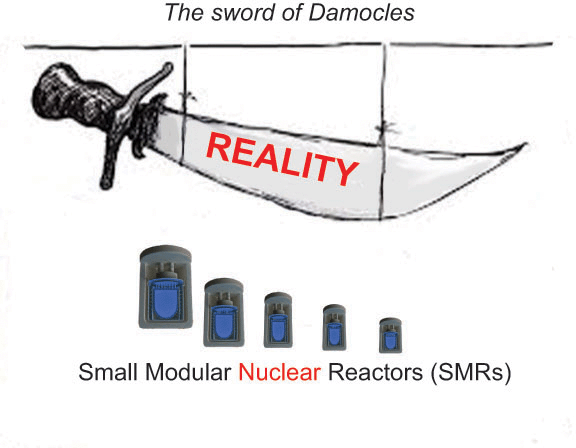 ‘Many issues’ with modular nuclear reactors says environmental lawyer
Jordan Gill · CBC News ·Dec 03, 2019 Modular nuclear reactors may not be a cure for the nation’s carbon woes, an environmental lawyer said in reaction to an idea floated by three premiers.
Theresa McClenaghan, executive director of the Canadian Environmental Law Association, said the technology surrounding small reactors has numerous pitfalls, especially when compared with other renewable energy technology.
This comes after New Brunswick Premier Blaine Higgs, Saskatchewan Premier Scott Moe and Ontario Premier Doug Ford agreed to work together to develop the technology……..
The premiers say the smaller reactors would help Canada reach its carbon reduction targets but McClenaghan, legal counsel for the environmental group, disagrees
“I don’t think it is the answer,” said McClenaghan. “I don’t think it’s a viable solution to climate change.”
McClenaghan said the technology behind modular reactors is still in the development stage and needs years of work before it can be used on a wide scale.
“There are many issues still with the technology,” said McClenaghan. “And for climate change, the risks are so pervasive and the time scale is so short that we need to deploy the solutions we already know about like renewables and conservation.”
Waste, security concerns: lawyer
While nuclear power is considered a low-carbon method of producing electricity, McClenaghan said the waste that it creates brings its own environmental concerns.
“You’re still creating radioactive waste,” said McClenaghan.
“We don’t even have a solution to nuclear fuel waste yet in Canada and the existing plans are not taking into account these possibilities.”
McClenanghan believes there are national security risks with the plan as well.
She said having more reactors, especially if they’re in rural areas, means there’s a greater chance that waste or fuel from the reactors could be stolen for nefarious purposes.
“You’d be scattering radioactive materials, potentially attractive to diversion, much further across the country,” said the environmental lawyer. https://www.cbc.ca/news/canada/new-brunswick/many-issues-modular-nuclear-1.5381804
Ontario Power Generation pulls the plug on nuclear waste project
|
OPG abandons nuclear waste burial project By Colin Perkel, T https://www.guelphmercury.com/news-story/10053446-opg-pulls-plug-on-nuclear-waste-project/
The Canadian Press, 26 June 20, TORONTO — A politically fraught plan to store hazardous nuclear waste deep underground near the Lake Huron shoreline has been formally put to rest more than 15 years after it was first proposed.In a recent letter to the federal environment minister, Ontario’s publicly owned power generator said it no longer wished to proceed with the multibillion-dollar project. “We do not intend to carry out the project and have asked that the application for a site preparation and construction licence be withdrawn,” the letter from Ontario Power Generation states. “Similarly, OPG requests the minister to cancel the environmental assessment for the project.” In response, federal Environment Minister Jonathan Wilkinson said he accepted the request, and had terminated the ongoing assessment. The project, estimated to cost more than $2.4 billion, had called for the storage of hundreds of thousands of cubic metres of low- and intermediate-level radioactive waste 680 metres underground about 1.2 kilometres from Lake Huron. TORONTO — A politically fraught plan to store hazardous nuclear waste deep underground near the Lake Huron shoreline has been formally put to rest more than 15 years after it was first proposed. The bunker was to have been built at the Bruce Nuclear Generating Station near Kincardine, Ont. While Kincardine had been a “willing host,” the proposal drew years of fierce opposition from environmentalists and hundreds of communities on both sides of the Canada-U.S. border. All argued that the threat to drinking water that serves millions of people was simply too great. OPG, for its part, steadfastly defended the planned repository as a completely safe option for storing waste that can remain hazardous for thousands of years. While a joint environmental panel gave its approval in May 2015, the project stalled. Successive environment ministers called for more information. The last request was for buy-in from the Saugeen Ojibway Nation or SON, which had complained for years about being shut out of decisions related to the Bruce power plant. The utility promised it would not proceed without that agreement. Since then, members of SON — comprising the Saugeen First Nation and Chippewas of Nawash Unceded First Nation — have debated the issue. In late January, the 4,500-member community overwhelmingly rejected the underground storage facility. “We worked for many years for our right to exercise jurisdiction in our territory and the free, prior and informed consent of our people to be recognized,” Chippewas of Saugeen Chief Lester Anoquot said at the time. “We didn’t ask for this waste to be created and stored in our territory.” OPG, which had previously said it would look for alternative storage solutions, said Friday it has spent about $200 million on the repository. The Saugeen Ojibway Nation responded immediately on Friday for a request to comment on the end of the project. n her letter, Lise Morton, vice president at OPG, said the utility remained committed to ongoing dialogue with the Saugeen Ojibway Nation about “future potential solutions” for the safe and long-term storage of nuclear waste. Separately, the federally-mandated Nuclear Waste Management Organization announced earlier this year it was proceeding with development plans for a nearby site at which to bury highly radioactive reactor waste. Landowners in South Bruce . about 30 minutes east of Kincardine, signed agreements allowing suitability testing on their properties. The only other site under consideration for high-level waste storage is in Ignace in northern Ontario. Indigenous groups have yet to indicate support for that project. About three-million highly radioactive used fuel bundles from reactors are currently stored at existing nuclear generating stations in Canada, including at the Bruce Nuclear Generating Station. Authorities have long contended the current storage system is not sustainable and have been searching for a permanent solution, with the aim of finding a site for storage by 2023. |
|
Marketing man Trump trying to sell U.S. nuclear reactors to Poland
 Duda, Trump announce nuclear energy deal, Presidents Andrzej Duda and Donald Trump announced on Wednesday the signing of a deal on development of nuclear energy in Poland, which Duda said would be signed as soon as possible.US President Donald Trump talked of the purchase of American technology.
At a press conference with Duda at the White House, Trump said they were working on a deal that would facilitate the development and building of a nuclear power plant in Poland, adding that it would work with the use of American technology bought from a large US company……… https://www.thefirstnews.com/article/duda-trump-announce-nuclear-energy-deal-13601
USA adds new indictment to charges against Julian Assange
WASHINGTON (AP) — WikiLeaks founder Julian Assange sought to recruit hackers at conferences in Europe and Asia who could provide his anti-secrecy website with classified information, and conspired with members of hacking organizations, according to a new Justice Department indictment announced Wednesday.
The superseding indictment does not contain additional charges beyond the 18 counts the Justice Department unsealed last year. But prosecutors say it underscores Assange’s efforts to procure and release classified information, allegations that form the basis of criminal charges he already faces.
Beyond recruiting hackers at conferences, the indictment accuses Assange of conspiring with members of hacking groups known as LulzSec and Anonymous. He also worked with a 17-year-old hacker who gave him information stolen from a bank and directed the teenager to steal additional material, including audio recordings of high-ranking government officials, prosecutors say.
Assange’s lawyer, Barry Pollack, said in a statement that “the government’s relentless pursuit of Julian Assange poses a grave threat to journalists everywhere and to the public’s right to know.”
“While today’s superseding indictment is yet another chapter in the U.S. Government’s effort to persuade the public that its pursuit of Julian Assange is based on something other than his publication of newsworthy truthful information,” he added, “the indictment continues to charge him with violating the Espionage Act based on WikiLeaks publications exposing war crimes committed by the U.S. Government.”
Assange was arrested last year after being evicted from the Ecuadorian Embassy in London, where he had sought refuge to avoid being sent to Sweden over allegations of rape and sexual assault, and is at the center of an extradition tussle over whether he should be sent to the United States.
The Justice Department has already charged him with conspiring with former U.S. Army intelligence analyst Chelsea Manning in one of the largest compromises of classified information in U.S. history by working together to crack a password to a government computer.
Prosecutors say the WikiLeaks founder damaged national security by publishing hundreds of thousands of classified documents, including diplomatic cables and military files on the wars in Iraq and Afghanistan, that harmed the U.S. and its allies and aided its adversaries.
Assange maintains he was acting as a journalist entitled to First Amendment protection. His lawyers have argued the U.S. charges of espionage and computer misuse were politically motivated and an abuse of power.
Assange generated substantial attention during the 2016 presidential election, and in investigations that followed, after WikiLeaks published stolen Democratic emails that U.S. authorities say were hacked by Russian military intelligence officials. An investigation by special counsel Robert Mueller revealed how Trump campaign associates eagerly anticipated the email disclosures. One Trump ally, Roger Stone, was found guilty last year of lying about his efforts to gain inside information about the emails. Assange, however, was never charged in Mueller’s Russia investigation.
The allegations in the new indictment center on conferences, in locations including the Netherlands and Malaysia in 2009, at which prosecutors say he and a WikiLeaks associate sought to recruit hackers who could locate classified information, including material on a “Most Wanted Leaks” list posted on WikiLeaks’ website.
According to the new indictment, he told would-be recruits that unless they were a member of the U.S. military, they faced no legal liability for stealing classified information and giving it to WikiLeaks “because ‘TOP SECRET’ meant nothing as a matter of law.”
At one conference in Malaysia, called the “Hack in the Box Security Conference,” Assange told the audience, “I was a famous teenage hacker in Australia, and I’ve been reading generals’ emails since I was 17.”
US, Russia nuclear arms talks end with plans for second round
US, Russia nuclear arms talks end with plans for second round, Aljazeera, 26 June 20,
US says any new agreement on curbing nuclear weapons should include China, a condition Russia calls ‘unrealistic’. US and Russian negotiators have concluded a round of nuclear arms control talks in Austria’s capital, Vienna, aimed at producing a new agreement to replace the New START treaty that expires next year.
US negotiator Marshall Billingslea told reporters on Tuesday that the day of high-level “marathon discussions” ended late on Monday.
Billingslea said the talks had been productive enough to establish several technical working groups to delve deeper into the issues in order to pave the way for a second round of talks by late July or early August…… https://www.aljazeera.com/news/2020/06/coronavirus-deaths-children-extremely-rare-live-updates-200626000914304.html
1 This Month


Tell the Ukrainian Government to Drop Prosecution of Peace Activist Yurii Sheliazhenko

Petition to revoke the licensing of the Near Surface Nuclear Disposal Facility (NSDF) at Chalk River. https://www.ourcommons.ca/petitions/en/Petition/Details?Petition=e-7247


of the week – STOP SMALL MODULAR REACTORS IN CANADA
To see nuclear-related stories in greater depth and intensity – go to https://nuclearinformation.wordpress.com
-
Archives
- March 2026 (204)
- February 2026 (268)
- January 2026 (308)
- December 2025 (358)
- November 2025 (359)
- October 2025 (376)
- September 2025 (258)
- August 2025 (319)
- July 2025 (230)
- June 2025 (348)
- May 2025 (261)
- April 2025 (305)
-
Categories
- 1
- 1 NUCLEAR ISSUES
- business and costs
- climate change
- culture and arts
- ENERGY
- environment
- health
- history
- indigenous issues
- Legal
- marketing of nuclear
- media
- opposition to nuclear
- PERSONAL STORIES
- politics
- politics international
- Religion and ethics
- safety
- secrets,lies and civil liberties
- spinbuster
- technology
- Uranium
- wastes
- weapons and war
- Women
- 2 WORLD
- ACTION
- AFRICA
- Atrocities
- AUSTRALIA
- Christina's notes
- Christina's themes
- culture and arts
- Events
- Fuk 2022
- Fuk 2023
- Fukushima 2017
- Fukushima 2018
- fukushima 2019
- Fukushima 2020
- Fukushima 2021
- general
- global warming
- Humour (God we need it)
- Nuclear
- RARE EARTHS
- Reference
- resources – print
- Resources -audiovicual
- Weekly Newsletter
- World
- World Nuclear
- YouTube
-
RSS
Entries RSS
Comments RSS
 nuclear-news