Why doesn’t debt-ridden EDF cut its losses and close its uneconomic UK nuclear reactors
|
Unanswered questions dog UK’s new nuclear plans Climate News Network June 11th, 2020, by Paul Brown A French company has designs on the United Kingdom: new nuclear plans for more reactors, with British consumers footing the bill.
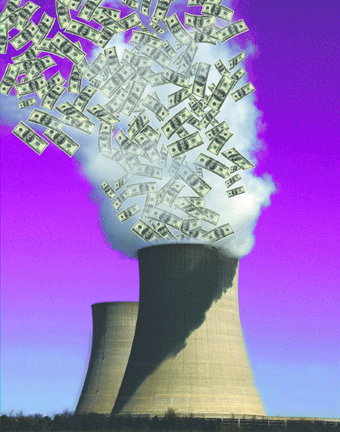
– The French company EDF, a company in a hurry, wants permission to start building two more reactors in the United Kingdom, and it hopes to save money – by arranging for British taxpayers to pay the capital costs of its new nuclear plans. EDF is already building two reactors at Hinkley Point in the West of England, and it is hoping to transfer workers from that site to Suffolk, on the east coast, believing that will help it to save up to 20% of the construction cost of the two planned reactors, because everyone employed there will know already what to do. The catch is that EDF has no money itself to finance the construction and wants the UK government to impose a new tax on British electricity consumers so that they will pay the cost through their electricity bills. The UK has yet to decide whether to go ahead with this tax, euphemistically called a Regulated Asset Base. If adopted, what the scheme means is that the UK consumer will pay EDF’s bills rather than the company having to borrow the money from banks, which are increasingly unlikely to lend money to such expensive schemes because they take so long to build and promise little return. Anxieties abound Meanwhile EDF, which has a Chinese nuclear company as its junior partner, promises to create 25,000 jobs, including 1,000 apprenticeships during construction, and says 900 full-time jobs will be available when Sizewell C, as the station will be called, is complete. If all goes to plan the company hopes to start work in 18 months and says the two reactors will take 10 years to build. It expects them to provide 7% of the UK’s electricity, enough for six million homes. There are many objectors. Some say much of the coastline will be badly affected, including internationally important nature reserves. Others fear the site is highly vulnerable to sea level rise and therefore a danger to the public. Local people also fear that the construction site, with its attendant lorry and commuter traffic, will disrupt their lives for a decade, destroying the important tourist trade. Cheaper options Other more strategic objections, which might weigh heavier with the government, are that nuclear power is very expensive and much cheaper and less controversial alternatives exist, particularly on-shore and off-shore wind and solar power, and biogas. More importantly, a drive for energy efficiency, badly neglected in the UK at present, would render the whole project unnecessary. The problem EDF has is its track record on construction and repairs. The type of reactor it plans to build, the European Pressurised Water Reactor, said by the company to be the most powerful in the world, is proving extremely difficult to build, and till now none has yet been completed outside China. Construction is running more than 10 years late in both Finland and France, and costs continue to escalate.
EDF’s debts are now huge, so big that the French state is working out how to restructure the company by splitting it into a renewables arm (which is profitable) and a nuclear branch. There are serious doubts about the reliability of EDF’s claims and timetables for fixing existing power stations and opening new ones. The company currently owns all of the UK’s operating nuclear reactors, most of which are near the end of their lives, and there are serious doubts about whether they are economic and in some cases even safe. Two reactors at Hunterston in Scotland have serious cracking in the graphite blocks that are part of the control mechanism. The company has spent two years trying to justify continuing to operate the reactors to the Office for Nuclear Regulation (ONR). Similarly, at the other end of the UK, at Dungeness in south-east England, the station is also closed for extensive repairs, an outage that was going to take weeks has now stretched to two years – and the start-up date has just been put back again. Looking on the bright side One of the features of all of EDF’s activities is the extraordinary optimism the company seems to have, particularly about when reactors will be finished or ready to restart after repairs. With the Hunterston reactors restart dates have been announced nine times, only to be postponed each time. This track record led the Climate News Network to ask EDF some searching questions, including why they continued to offer optimistic start-up dates that were repeatedly postponed. We also asked why the company kept the Hunterston and Dungeness stations open at all, since repairing them was costly and they were already near the end of their operating lives. We asked EDF: “At what point do you cut your losses and close the stations permanently?” After five days of pleading for more time to answer, it sent us already published press releases extolling the virtues of the plan to build Sizewell, and several comments. …….HTTPS://CLIMATENEWSNETWORK.NET/UNANSWERED-QUESTIONS-DOG-UKS-NEW-NUCLEAR-PLAN/, l |
|
No comments yet.
1 This Month
Chernobyl: The Lost Tapes – A good documentary on Chernobyl on SBS available On Demand for the next 3 weeks– https://www.sbs.com.au/ondemand/tv-program/chernobyl-the-lost-tapes/2352741955560

of the week–London Campaign for Nuclear Disarmament

Tell the Ukrainian Government to Drop Prosecution of Peace Activist Yurii Sheliazhenko
To see nuclear-related stories in greater depth and intensity – go to https://nuclearinformation.wordpress.com
-
Archives
- April 2026 (139)
- March 2026 (251)
- February 2026 (268)
- January 2026 (308)
- December 2025 (358)
- November 2025 (359)
- October 2025 (376)
- September 2025 (257)
- August 2025 (319)
- July 2025 (230)
- June 2025 (348)
- May 2025 (261)
-
Categories
- 1
- 1 NUCLEAR ISSUES
- business and costs
- climate change
- culture and arts
- ENERGY
- environment
- health
- history
- indigenous issues
- Legal
- marketing of nuclear
- media
- opposition to nuclear
- PERSONAL STORIES
- politics
- politics international
- Religion and ethics
- safety
- secrets,lies and civil liberties
- spinbuster
- technology
- Uranium
- wastes
- weapons and war
- Women
- 2 WORLD
- ACTION
- AFRICA
- Atrocities
- AUSTRALIA
- Christina's notes
- Christina's themes
- culture and arts
- Events
- Fuk 2022
- Fuk 2023
- Fukushima 2017
- Fukushima 2018
- fukushima 2019
- Fukushima 2020
- Fukushima 2021
- general
- global warming
- Humour (God we need it)
- Nuclear
- RARE EARTHS
- Reference
- resources – print
- Resources -audiovicual
- Weekly Newsletter
- World
- World Nuclear
- YouTube
-
RSS
Entries RSS
Comments RSS
 nuclear-news
Leave a comment