Back to “normal” or on to “new normal” ? But NORMAL IS the problem!
|
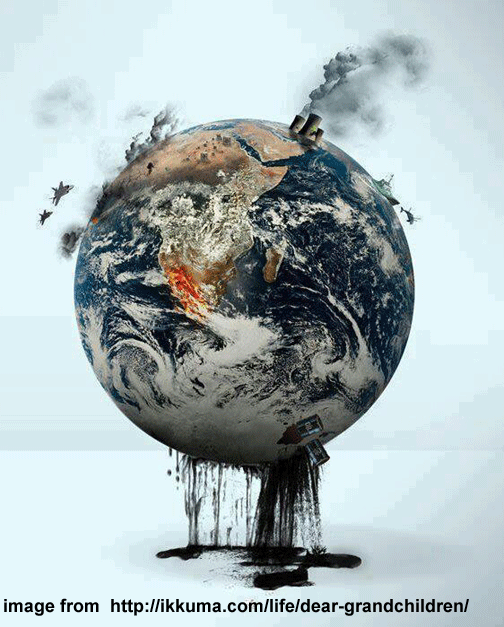
‘Normal Is the Problem’
So is normal’s idiot child, ‘the new normal.’ What we’ve made normal never was natural. Andrew Nikiforuk 30 May 2020 | TheTyee.ca Tyee contributing editor Andrew Nikiforuk’s 2006 book Pandemonium predicted the pandemic we are now …….. Normal has become a pathological state.
After the random normlessness of this pandemic, I don’t want to go back to normal either. Or its idiotic child, “the new normal.” Let’s face facts: our hi-tech, globalized-trade-anything-for-peanuts world run mostly by tyrants isn’t natural. Since 1970, an outpouring of normality has just about destroyed the Earth: It has created an abnormal economic machine, blind to energy spending, that doubled the global population and boosted per capita consumption by 45 per cent. At the same time the so-called value of global economic activity grew by 300 per cent. Meanwhile global trade has exploded like a coronavirus by 900 per cent. To support all this consumption and trade, the extraction of “living materials” from nature has jumped by 200 per cent. Now here’s just a partial list of the cost of all this exponential normality: Humans have appropriated or altered 70 per cent of the world’s lands with mines, roads, industrial farms, cities and airports. We have engineered more than 75 per cent of the world’s longest rivers. We have filled the ocean with plastics and slaughtered coral reefs. Anyone who calls that kind of behaviour normal is crackers. It’s ecological imperialism, and nothing more than a full-scale assault on the dignity of local life. The list goes on, and scientists now think it’s normal to publish papers on “the pervasive human decline of life.” Humans, for example, have destroyed 85 per cent of the wetlands. That’s like eating your kidneys for dinner, and I can’t think of anybody who would consider that normal except Hannibal Lecter. We have eliminated 40 per cent of the world’s original forests. We have extirpated (and there’s a word for these normal times) most of the world’s large mammals. An estimated one million species of animals and plants stand on the brink of extinction. Homo sapiens, another mammal, are on that list, and we pretend that’s normal. As these species disappear, our ever-expanding artificial intelligence probably won’t wave goodbye because replacing the natural with artificial is what normal is all about……. Normal really means big-box living and being a slave to machines. It means you’re so distracted by screens, speed and mobility, you can’t pay attention to what matters. Normal means you don’t have any respect for limits or sacred places. Normal means you think you can simply swap fossil fuels with so-called “clean energy” and protect the norm. But it mostly means you have surrendered your capacity to be human and to love this place. So I don’t want to go back to normal…… Normal really means big-box living and being a slave to machines. It means you’re so distracted by screens, speed and mobility, you can’t pay attention to what matters. Normal means you don’t have any respect for limits or sacred places. Normal means you think you can simply swap fossil fuels with so-called “clean energy” and protect the norm. But it mostly means you have surrendered your capacity to be human and to love this place. So I don’t want to go back to normal……. I don’t want to go back to a world where political parties cultivate men and women obsessed with power and deny the truth. That’s just evil. I don’t want to go back to world where people don’t know their neighbours, or the names of the birds in their trees. I don’t want to go back to a world where billionaires think so little of this Earth that their primary obsession is to escape to Mars. I don’t want to go back to a world where political leaders don’t have the courage to talk about cheap energy, reckless consumption, over-population and climate change in the same sentence. …. I don’t want to go back to an economy where corporations socialize all costs and privatize all gains. That’s robbery and theft. And it must end. I don’t want to go back to a world where governments subsidize bottom trawlers to scrape the floor of the ocean to support globalization… … Normal is the problem, and the normlessness of a pandemic has exposed the fat tail of normal as pathology. And I am not going back to it……..https://thetyee.ca/Culture/2020/05/30/New-Normal-Problem/ |
|
The world is sleepwalking toward a period free of nuclear arms control
 Nuclear arms control: What happens when US and Russia let it lapse? WHY WE WROTE THIS
In less than a year, the world could enter a period free of nuclear arms control treaties for the first time in more than a half-century. Is such a state of affairs sustainable? Christian Science Monitor By Fred Weir Correspondent, 2 June 20, MOSCOW
The world is sleepwalking toward a period free of nuclear arms control, as New START, the last remaining nuclear weapons treaty, is set to expire next February.
Arms control waning
Several U.S. presidents added their own contributions to the network of accords. As recently as a decade ago Barack Obama inked New START, the deal that made the deepest-ever reductions to strategic nuclear arsenals, with his Russian counterpart Dmitry Medvedev.
Things have been shaky ever since, though arms control experts on both sides have insisted until recently that the system might be revived if leaders wanted it. But the Trump administration, which seems averse to any limitations on U.S. power, has buried the whole idea by tearing up quite a few international treaties. Specifically, it recently pulled out of the 1987 Intermediate Nuclear Forces treaty, which had banned an entire class of nuclear missiles and was dubbed “the treaty that ended the Cold War.”
No choice but to come back to the table
Andrei Kortunov, head of the Russian International Affairs Council, which is affiliated with the Foreign Ministry, says new forms of arms control will undoubtedly be needed in the future. The most dangerous thing about the present moment is that the old tried-and-true framework is being destroyed before any new controls have been even envisioned. The dangers of miscalculation or misunderstanding will multiply amid that vacuum, he says.
If that common culture, all the mechanisms of dialogue, trust-building, and verification are lost, Russia will probably not try to match the U.S. missile for missile as the USSR did in the past, he adds.
“In the absence of any arms control, it will become almost impossible for the U.S. to know what we really have or what we may be able to do. Russia is likely to follow a policy of ‘strategic ambiguity,’ to keep them guessing as a means of deterrence. That would be a very dangerous state of affairs, one that nobody would wish for,” Mr. Kortunov says……..https://www.csmonitor.com/World/Europe/2020/0601/Nuclear-arms-control-What-happens-when-US-and-Russia-let-it-lapse
Species are becoming extinct at an accelerating rate
 Sixth mass extinction of wildlife accelerating, scientists warn warn Analysis shows 500 species on brink of extinction – as many as were lost over previous century Damian Carrington Environment editor, 2 Jun 2020 Sixth mass extinction of wildlife accelerating, scientists warn warn Analysis shows 500 species on brink of extinction – as many as were lost over previous century Damian Carrington Environment editor, 2 Jun 2020
The sixth mass extinction of wildlife on Earth is accelerating, according to an analysis by scientists who warn it may be a tipping point for the collapse of civilisation. More than 500 species of land animals were found to be on the brink of extinction and likely to be lost within 20 years. In comparison, the same number were lost over the whole of the last century. Without the human destruction of nature, even this rate of loss would have taken thousands of years, the scientists said. The land vertebrates on the verge of extinction, with fewer than 1,000 individuals left, include the Sumatran rhino, the Clarión wren, the Española giant tortoise and the harlequin frog. Historic data was available for 77 of the species and the scientists found these had lost 94% of their populations. The researchers also warned of a domino effect, with the loss of one species tipping others that depend on it over the edge. “Extinction breeds extinctions,” they said, noting that unlike other environmental problems extinction is irreversible. Humanity relies on biodiversity for its health and wellbeing, scientists said, with the coronavirus pandemic an extreme example of the dangers of ravaging the natural world. Rising human population, destruction of habitats, the wildlife trade, pollution and the climate crisis must all be urgently tackled, they said. “When humanity exterminates other creatures, it is sawing off the limb on which it is sitting, destroying working parts of our own life-support system,” said Prof Paul Ehrlich, of Stanford University in the US, and one of the research team. “The conservation of endangered species should be elevated to a global emergency for governments and institutions, equal to the climate disruption to which it is linked.” “We are facing our final opportunity to ensure that the many services nature provides us do not get irretrievably sabotaged,” said Prof Gerardo Ceballos of the National Autonomous University of Mexico, who led the research. The analysis, published in the journal Proceedings of the National Academy of Sciences, examined data on 29,400 land vertebrate species compiled by the IUCN Red List of Threatened Species and BirdLife International. The researchers identified 515 species with populations below 1,000 and about half of these had fewer than 250 remaining. Most of these mammals, birds, reptiles and amphibians were found in tropical and subtropical regions…….. Prof Georgina Mace, of University College London, said: “Action is important for many reasons, not least of which is that directly and indirectly we rely on the rest of life on Earth for our own health and wellbeing,” she said. “Disrupting nature leads to costly and often hard-to-reverse effects. Covid-19 is an extreme present-day example, but there are many more.” Mark Wright, the director of science at WWF, said: “The numbers in this research are shocking. However, there is still hope. If we stop the land-grabbing and devastating deforestation in countries such as Brazil, we can start to bend the curve in biodiversity loss and climate change. But we need global ambition to do that.” |
|
Global ‘hot spots’. Australia very vulnerable to droughts, as planet heats
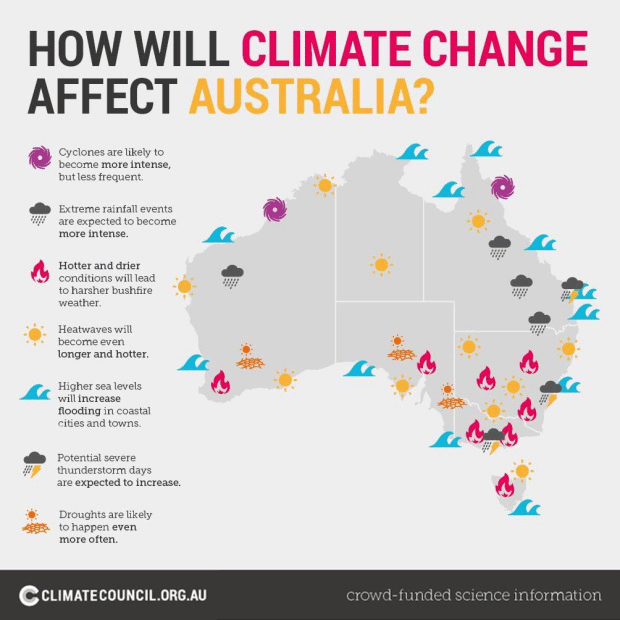
Australia among global ‘hot spots’ as droughts worsen in warming world, The Age, By Peter Hannam, June 1, 2020 The world’s major food baskets will experience more extreme droughts than previously forecast as greenhouse gases rise, with southern Australia among the worst-hit, climate projections show.
Scientists at the Australian National University and the University of NSW made the findings after running the latest generation of climate models used by the Intergovernmental Panel on Climate Change (IPCC). Future drought changes were larger and more consistent, the researchers found.
“Australia is one of the hot spots along with the Amazon and the Mediterranean, especially,” said Anna Ukkola, a research fellow at the ARC Centre of Excellence for Climate Extremes and lead author of the paper published in Geophysical Research Letters.
For southern Australia, the shift to longer, more frequent and more intense droughts up to 2100 will be due to greater variability in rainfall rather than a reduction in average rainfall. For the Amazon, both mean rain and variability changes…….
One reason for the prediction of worse droughts is that the latest models assume the climate will respond more than previously understood to increased atmospheric levels of carbon dioxide and other greenhouse gases.
Australia’s vulnerability to big shifts in annual rainfall already challenge the country’s farming sector, while also leaving much of the country’s south more at risk of bad bushfire seasons – such as last summer’s – as forests dry out.
The CSIRO has long forecast a large reduction in stream flows in the Murray-Darling Basin, for instance, as reduced cool-season rainfall combines with higher temperatures. Such a trend appears to have already begun.
While a more moderate emissions trajectory will still produce more intense, frequent and longer lasting droughts in most of the world’s mid-latitude regions than current conditions, the shift will be less than if carbon emissions remain near the top of forecasts. ……..https://www.theage.com.au/environment/climate-change/australia-among-global-hot-spots-as-droughts-worsen-in-warming-world-20200601-p54ydh.html
China’s nuclear power ambitions face delays, waste problems, and the growing success of renewables
 It’s a pity that nuclear energy is so easily described as “climate-friendly”. Yes, the actual nuclear reactor can be said to be cutting carbon emissions. But why does everyone ignore the huge carbon emissions from the entire nuclear fuel chain, from uranium mining through to burial of radioactive wastes? Why ignore the emissions of ionising radiation, another unseen, but dangerous pollutant?
And why ignore climate change’s effects on nuclear power? Far from nuclear energy stopping global heating, it’s more likely that global heating will stop nuclear power. Nuclear is highly water-guzzling, so most reactors are perched neat the sea, or near rivers – meaning in danger of sea level rise, as well as other extremes such as hurricanes. The water requirements mean that nuclear is affected by extreme heat – and plants have to cut down, or even shut down.
China to Dominate Nuclear as Beijing Bets on Homegrown Reactors
China probably won’t hit its nuclear energy target this year, but that’s unlikely to derail a broader ambition to become the planet’s chief proponent of the climate-friendly [what!!] fuel
Bloomberg, 1 June 20
An American nuclear reactor flooded by an extreme rainfall event – during the pandemic
COVID Infects World Nuclear Plants May 27, 2020, by Radio Ecoshock
“………AN AMERICAN REACTOR FLOODED BY AN EXTREME RAINFALL EVENT – DURING THE PANDEMIC
Grant Smith mentioned the climate threat to nuclear installations. We have a case of that right now. The American mid-West has experience record-setting extreme rainfall events. The City of Chicago just had it wettest May, for the third year in a row. All that rain burst two dams in Michigan, flooding out the city of Midland, population 42,000. It also flooded the Dow Chemical plant that has produced noxious chemicals for years, including Agent Orange. The company acknowledges their chemicals have leaked out over the years. It has been declared a Superfund site, among the worst in the country requiring federal cleanup funds. There are chemicals lining the river, now being stirred up by the flood, and washing down into Lake Michigan.
What is less reported is the Dow nuclear reactor at that flooded site. It is a smaller research reactor built in the 1960’s, called a TRIGA 1 model. The reactor is sunk down into the ground. It doesn’t have cooling rods, but depends on convection for water cooling. Although the reactor was not operating at the time of the flood in late May, the design suggest it probably still had nuclear materials inside. Are they now leaking out into the river and Lake Michigan. So far, the company says “no”. With no federal oversight reporting we can rely on, you just have to take the word of Dow Chemical that this reactor is perfectly safe during this extreme rainfall event. Nothing to worry about here, they say. Beyond nearly 400 very large nuclear power plants in the United States, there are thousands of smaller reactors scattered around the country, at Universities, military bases, and private companies. Who is keeping track of those as climate change and a pandemic come knocking at the door?
Here is that unusual event report to the NRC about the Dow Chemical reactor in Michigan. For those who want to dive deeper, here is a description of that Triga Mark I reactor……… https://www.ecoshock.org/2020/05/covid-infects-world-nuclear-plants.html
The European Union plus France, Germany and the UK “deeply regret” US decision on Iran sanctions
EU and others ‘regret’ US decision on Iran sanctions, WNN 01 June 2020 The European Union plus France, Germany and the UK have said they “deeply regret” the USA’s decision to end three sanction waivers covering Joint Comprehensive Plan of Action (JCPOA) projects in Iran. Separately, a spokesperson for China’s Foreign Ministry said the US decision “hampers” international non-proliferation progress…….
“We deeply regret the US decision to end the three waivers covering key JCPOA nuclear projects in Iran, including the Arak Modernisation Project,” the spokespersons of the High Representatives of the EU and the Foreign Ministries of France, Germany and the UK said in a joint statement issued on 30 May. “These projects, endorsed by UN Security Council resolution 2231, serve the non-proliferation interests of all and provide the international community with assurances of the exclusively peaceful and safe nature of Iranian nuclear activities.
“We are consulting with our partners to assess the consequences of this decision by the United States.
“The JCPOA is a key achievement of the global non-proliferation architecture and currently the best and only way to ensure the exclusively peaceful nature of Iran’s nuclear programme. That is why we have worked continuously with the aim of ensuring the full and effective implementation of commitments under the JCPOA, in particular the return of Iran to full compliance with its nuclear commitments without delay.”
Zhao Lijian, spokesman for China’s Foreign Ministry, on 29 May said the US decision to end the waiver “hampers” international non-proliferation progress and shared efforts to preserve the JCPOA.
“The Arak reactor conversion is an important part of the JCPOA and a joint project of parties to the agreement,” he said. “China is ready to work with other parties to continue upholding the deal and safeguarding its own legitimate rights and interests.”
The JCPOA was signed in July 2015 by Iran and the E3/EU+3 (China, France, Germany, Russia, the UK and the USA – also referred to as the P5+1 – plus the European Union) and implemented in January 2016, clearing the way for the lifting of nuclear-related economic sanctions against Iran. Under its terms, Iran agreed to limit its uranium enrichment activities, eliminate its stockpile of medium-enriched uranium and limit its stockpile of low-enriched uranium over the subsequent 15 years……
US President Donald Trump in 2018 announced the termination of the USA’s participation in the JCPOA, directing the US administration to begin the process of re-imposing sanctions on Iran. https://www.world-nuclear-news.org/Articles/EU-and-others-regret-US-decision-on-Iran-sanctions
Nuclear Weapons: The Reason Why Even Iran Fears Israel
Nuclear Weapons: The Reason Why Even Iran Fears Israel, Kyle Mizokami,The National Interest•June 1, 2020
German Parliament in debate on basing of nuclear weapons
|
German Politicians Renew Nuclear Basing Debate Arms Control June 2020
By Oliver Meier A senior member of the German Parliament has revitalized the debate over whether the nation should host U.S. nuclear weapons on German soil. “It is about time that Germany in the future excludes the deployment” of nuclear weapons on its territory, said Rolf Mützenich, the leader of the Social Democrat (SPD) group in the Bundestag, in a May 2 interview with Der Tagesspiegel. The German Social Democrats are coalition partners of the conservative Christian Democrat Union (CDU). The SPD leadership backed Mützenich’s comments. The discussion followed a mid-April decision by the Defense Ministry to replace Germany’s current fleet of Tornado aircraft, some of which are dual-capable with 90 Eurofighter Typhoon and 45 U.S. F-18 fighter aircraft. Thirty of the F-18s would be certified to carry U.S. nuclear weapons. Under nuclear sharing arrangements, NATO allies jointly discuss, plan, and train nuclear missions. According to Hans Kristensen of the Federation of American Scientists, Belgium, Germany, Italy, the Netherlands, and Turkey host up to 150 U.S. B-61 nuclear gravity bombs on their territory. These countries, except Turkey, provide their own aircraft capable of delivering nuclear weapons in times of war. Details of the arrangements remain shrouded in secrecy, but 20 U.S. nuclear weapons are estimated to be deployed at Büchel air base in western Germany.
The Tornado replacement has been controversial for years. Washington has been lobbying Berlin to follow the example of other host nations and buy U.S. F-35 aircraft as the future nuclear weapons carrier.
France prefers a European approach, and it is jointly developing with Germany and Spain the Future Combat Air System (FCAS), a sixth-generation fighter aircraft that will have a nuclear capability in the French Air Force. Germany’s selection of the F-18 was thus a political compromise which Defense Minister Annegret Kramp-Karrenbauer presented as a “bridge solution” until the FCAS becomes operational after 2040. Germany plans to retire the Tornado between 2025 and 2030.
Kramp-Karrenbauer may have mishandled the process by not sufficiently consulting with SPD members in the parliament. She has conceded that the Bundestag would not need to make a decision until 2022 at the earliest and said that there would thus be “space for a debate” on the dual-capable aircraft decision in the campaign for the September 2021 parliamentary elections and negotiations on a new coalition government thereafter. In a May 7 article in Internationale Politik und Gesellschaft, Mützenich took up that invitation, saying that he would like “an open and honest debate about the rationale for nuclear sharing.” Social Democrats “are not calling for the immediate denuclearization of NATO,” but want to discuss the need “to spend billions on the procurement and maintenance of U.S. aircraft whose sole purpose is to drop American nuclear bombs,” he wrote.
Katja Keul, spokeswoman on disarmament policy for the Green party, told Arms Control Today in a May 14 interview that the Greens “do not want to put Germany on a path of continued involvement in technical sharing arrangements by committing to the procurement of a new nuclear-capable aircraft now.” Based on current polls, many expect the Greens to be part of Germany’s next government. Keul, like other proponents of change, separated Germany’s role as a host nation from the continued participation in NATO political bodies associated with nuclear sharing, such as the Nuclear Planning Group. By contrast, those who have argued in favor of preserving the nuclear status quo have often conflated technical and political dimensions of sharing arrangements, equating the end of forward deployment of U.S. nuclear weapons with a denuclearization of the alliance or even the end of deterrence……..
Keul said the Greens want “Germany to push for a new consensus in NATO that would pave the way for the withdrawal of U.S. nuclear weapons from Europe. That would be our plan A.” She cautioned that “because such a consensus will be difficult to achieve, our plan B would be to ask for understanding that Germany will end the deployment of U.S. nuclear weapons on its territory once the Tornado reaches the end of its lifetime.”……
Like others, Keul believes that “the future of nuclear sharing should certainly be on the agenda of the NATO experts group” established by Secretary-General Jens Stoltenberg at end of March. Kiesewetter agrees that “we need an informed debate, including by experts, on the future of nuclear sharing arrangements.” The group, co-chaired by former U.S. diplomat A. Wess Mitchell and former German Defense Minister Lothar de Maizière, is to discuss NATO’s political role. Heinrich suggested that it would also be “useful if the experts include civil society in their deliberations.”…….https://www.armscontrol.org/act/2020-06/news/german-politicians-renew-nuclear-basing-debate
|
|
Discussion on Poland, Germany hosting nuclear weapons
Playing Warsaw against Berlin on nuclear weapons, European Leadership Network, Katarzyna Kubiak |Policy Fellow 1 June 20, The German domestic dispute about its future role in NATO nuclear sharing is heating up again. But the discussion took a new turn when in May 2020 US Ambassador to Poland Georgette Mosbacher tweeted “If Germany wants to diminish nuclear capability and weaken NATO, perhaps Poland – which pays its fair share, understands the risks, and is on NATO’s eastern flank – could house the capabilities.” How much merit does this “perhaps” have?
NATO nuclear sharing is an arrangement in which the United States deploys about 150 nuclear free-fall bombs in Germany, Italy, Belgium, the Netherlands and Turkey, of which about 80 are for delivery by European NATO aircraft. Berlin, Rome, Brussels and Amsterdam possess nuclear-certified planes and train their pilots on the nuclear mission, while several other Allies, including Poland, would support NATO nuclear operations with conventional air tactics (SNOWCAT).
In December 2015, asked if Poland would want to join NATO’s nuclear sharing program, Deputy Defence Minister Tomasz Szatkowski said, “concrete steps are currently under consideration.” The interview stirred confusion. The Polish Ministry of Defence rectified that it was not working on Poland’s accession to the program. It pointed out that Szatkowski’s statement should be read in the frame of the then on-going international discussion about widening allied participation in NATO’s nuclear sharing. It also made clear that Warsaw did not seek to acquire nuclear weapons, and that any form of Polish participation in NATO nuclear sharing requires domestic and allied political arrangements. Yet since the interview, rumours that Poland is interested in joining NATO’s nuclear sharing have become prevalent.
Limited technical merit
Poland does not host American nuclear weanuclear pons. It does not have the necessary infrastructure to do so, nor does it possess aircraft certified for the mission. Poland participates in SNOWCAT and observers spotted Polish F-16 aircraft supporting NATO’s nuclear strike exercises in 2013, 2014 and 2017. Warsaw has recently ordered 32 F-35A aircraft with the first anticipated for delivery between 2025 and 2026. The United States certified the F-35 to carry tactical nuclear weapons. Belgium, Italy and the Netherlands already procured or ordered the jets to replace their ageing dual-capable aircraft prescribed to NATO’s nuclear mission. While the Polish procurement of the F-35 could be interpreted as building readiness to receive weapons, it should be remembered that other NATO allies with no roles in nuclear sharing (like Denmark and Norway) also bought F-35.
Legal uncertainty
Moving American nuclear weapons from Germany to Poland and Polish participation in NATO nuclear sharing is not a clear-cut matter legally either. Poland is a party to the Nuclear Non-Proliferation Treaty (NPT). Article I of this treaty, applicable to nuclear-weapons states, prohibits the transfer of “control” of nuclear weapons “to any recipient whatsoever.” While some experts view existing NATO nuclear sharing arrangements compatible with the NPT, others voice scepticism.
A clear breach of political commitments……
Vague political benefits……
Questionable militarily benefits ……
The merit……
The United States never publicly offered Poland to become a host state. In October 2019, when the US government was reviewing plans for evacuating its nuclear weapons from Turkey out of political concerns, no US government representative openly suggested relocating these weapons to Poland. Ambassador Mossbacher seems to have simply instrumentalised Poland, playing
French Polynesia – call to France to pay medical costs of nuclear test victims
French Polynesia’s social security agency, the CPS, has again called on France to cover the costs of caring for the victims of the French nuclear weapons tests.
The demand by the CPS coincides with a push to change the compensation law – this time by a French Polynesian advisory body, the Economic, Social, Environmental and Cultural Council.
The French military carried out more than 40 atmospheric nuclear tests, with fallout affecting islands well beyond the Moruroa test site.
TRANSCRIPT
WZ: The social security agency the CPS has calculated that it has so far spent $US770 million on health care costs for people deemed to have radiation-induced illnesses. The CPS covers medical expenses as well as pension payments but it is struggling financially. It has now again asking for France to assume responsibility for problems caused by its tests. The demand to be reimbursed however is not new. The CPS asked in 2010 for $US240 million, a sum which rose to $US540 million in 2015.
DW: How many people have been affected?
DW: What have the implications of the latest change been?
Deep boreholes for nuclear waste disposal?
|
I’d find this more convincing if it were not so closely tied to the push for “new nukes”
Industry to Explore Decentralized Nuclear Waste Disposal. Power Mag
May 31, 2020 by Sonal Patel Efforts to explore whether it is feasible to permanently dispose of high-level nuclear waste in deep horizontal boreholes under next-generation nuclear reactor sites got a boost in late April as nuclear waste technology firm Deep Isolation signed its first contract with industry. Under the contract with independent nonprofit organization Electric Power Research Institute (EPRI), the Berkeley, California–based company will team with EPRI researchers, Southern Co., the Nuclear Energy Institute (NEI), Auburn University, and nuclear waste management consultancy J Kessler and Associates to assess how Deep Isolation’s horizontal borehole disposal solution could contribute to siting of advanced nuclear energy systems. Specifically, the team plans to explore physical site characteristics, disposal operations, safety performance analysis, and regulatory and licensing considerations. …….https://www.powermag.com/industry-to-explore-decentralized-nuclear-waste-disposal/ |
|
1 This Month


Tell the Ukrainian Government to Drop Prosecution of Peace Activist Yurii Sheliazhenko

Petition to revoke the licensing of the Near Surface Nuclear Disposal Facility (NSDF) at Chalk River. https://www.ourcommons.ca/petitions/en/Petition/Details?Petition=e-7247


of the week – STOP SMALL MODULAR REACTORS IN CANADA
To see nuclear-related stories in greater depth and intensity – go to https://nuclearinformation.wordpress.com
-
Archives
- March 2026 (204)
- February 2026 (268)
- January 2026 (308)
- December 2025 (358)
- November 2025 (359)
- October 2025 (376)
- September 2025 (258)
- August 2025 (319)
- July 2025 (230)
- June 2025 (348)
- May 2025 (261)
- April 2025 (305)
-
Categories
- 1
- 1 NUCLEAR ISSUES
- business and costs
- climate change
- culture and arts
- ENERGY
- environment
- health
- history
- indigenous issues
- Legal
- marketing of nuclear
- media
- opposition to nuclear
- PERSONAL STORIES
- politics
- politics international
- Religion and ethics
- safety
- secrets,lies and civil liberties
- spinbuster
- technology
- Uranium
- wastes
- weapons and war
- Women
- 2 WORLD
- ACTION
- AFRICA
- Atrocities
- AUSTRALIA
- Christina's notes
- Christina's themes
- culture and arts
- Events
- Fuk 2022
- Fuk 2023
- Fukushima 2017
- Fukushima 2018
- fukushima 2019
- Fukushima 2020
- Fukushima 2021
- general
- global warming
- Humour (God we need it)
- Nuclear
- RARE EARTHS
- Reference
- resources – print
- Resources -audiovicual
- Weekly Newsletter
- World
- World Nuclear
- YouTube
-
RSS
Entries RSS
Comments RSS
 nuclear-news