Hole in the ozone layer is now closed
Record Arctic ozone hole now closed: UN https://www.heraldsun.com.au/news/breaking-news/record-arctic-ozone-hole-now-closed-un/news-story/b0d4c72a9befb02c7ebc4ccc2e91a6c1
May 2, 2020 Ozone depletion over the Arctic hit a “record level” in March, the biggest since 2011, but the hole has now closed, the UN World Meteorological Organisation (WMO) says.
The springtime phenomenon in the northern hemisphere was driven by ozone-depleting substances still in the atmosphere and a very cold winter in the stratosphere, WMO spokeswoman Clare Nullis told a UN briefing in Geneva.
“These two factors combined to give a very high level of depletion which was worse than we saw in 2011. It’s now back to normal again … the ozone hole has closed,” she said on Friday.
Nullis, asked whether less pollution during the pandemic had played a role, said: “It was completely unrelated to COVID.”
Everyone is needed in bid for a future free of nuclear
Everyone is needed in bid for a future free of nuclear https://www.thenational.scot/news/18418402.everyone-needed-bid-future-free-nuclear/
To propose new reactors in the UK and transporting deadly plutonium to fuel them risks disaster.
As well as the risks, we know from numerous examples that nuclear power is enormously expensive.
Hinkley C in Somerset, currently being built, will, if completed and it actually works, produce the most expensive electricity in the world, ever!
Meanwhile cash-strapped EDF lobbies our governments hard to allow the ageing Torness and Hunterston reactors, pictured, to carry on beyond their design lives despite one Hunterston reactor having extensive cracks in its graphite blocks, vital for safety. Anyone with commonsense can see the precautionary principle applies here and that a shut down reactor in this condition should stay shut down. An accident and release of radiation from Hunterston could cause central Scotland to be evacuated – permanently.
And last but not least we have the biggest arsenal of nuclear weapons in Western Europe based a few miles from Helensburgh. These missile subs could destroy the lives of millions and are, of course, a target themselves. A government report in the late-1950s concluded that a nuclear war would annihilate the country and that civil defence was pointless. With Trump in the White House don’t assume we won’t end up in a nuclear confrontation that could take us all into the abyss. Year round the warheads are driven up and down our roads with all the risks of terrorism and crashes that entails.
Fifty years ago the UK signed up to a nuclear non-proliferation treaty that committed us to negotiating nuclear disarmament in good faith. Nothing has happened in that direction, a conspiracy of silence by the UK political parties and the media.
So, yes, HANT, you’re right, we need everyone to lobby for a nuclear-free future in Scotland and worldwide, and thank you for your campaigning.
Netanyahu’s deceitful push to try to get USA to attack Iran
 Netanyahu pushed U.S. to attack Iran with fabricated nuclear documents: report, Tehran Times May 1, 2020 – TEHRAN — The Iranian nuclear documents presented by Israeli Prime Minister Benjamin Netanyahu were an Israeli fabrication designed to trigger U.S. into a war with Iran, according to an investigation.U.S. President Donald Trump withdrew from the Iran nuclear deal on May 8, 2018 partly based on Netanyahu’s claim that Iran was determined to build nuclear weapons, the investigation said. Netanyahu pushed U.S. to attack Iran with fabricated nuclear documents: report, Tehran Times May 1, 2020 – TEHRAN — The Iranian nuclear documents presented by Israeli Prime Minister Benjamin Netanyahu were an Israeli fabrication designed to trigger U.S. into a war with Iran, according to an investigation.U.S. President Donald Trump withdrew from the Iran nuclear deal on May 8, 2018 partly based on Netanyahu’s claim that Iran was determined to build nuclear weapons, the investigation said.
In April 2018, Netanyahu claimed publicly that Israel’s Mossad spy agency had stolen Iran’s entire nuclear archive from Tehran. “You may well know that Iran’s leaders repeatedly deny ever pursuing nuclear weapons…” he declared. “Well, tonight, I’m here to tell you one thing: Iran lied. Big time.” However, an investigation of the supposed Iranian nuclear documents by The Grayzone reveals them to be the product of an Israeli disinformation operation that helped trigger the most serious threat of war since the conflict with Iran began nearly four decades ago. The following is an excerpt of an article published in The Grayzone on Wednesday: This investigation found multiple indications that the story of Mossad’s heist of 50,000 pages of secret nuclear files from Tehran was very likely an elaborate fiction and that the documents were fabricated by the Mossad itself. According to the official Israeli version of events, the Iranians had gathered the nuclear documents from various locations and moved them to what Netanyahu himself described as “a dilapidated warehouse” in southern Tehran. Even assuming that Iran had secret documents demonstrating the development of nuclear weapons, the claim that top secret documents would be held in a nondescript and unguarded warehouse in central Tehran is so unlikely that it should have raised immediate alarm bells about the story’s legitimacy. Even more problematic was the claim by a Mossad official to Israeli journalist Ronen Bergman that Mossad knew not only in what warehouse its commandos would find the documents but precisely which safes to break into with a blowtorch. The official told Bergman the Mossad team had been guided by an intelligence asset to the few safes in the warehouse contained the binders with the most important documents. Netanyahu bragged publicly that “very few” Iranians knew the location of the archive; the Mossad official told Bergman “only a handful of people” knew. No proof of authenticity Netanyahu’s April 30 slide show presented a series of purported Iranian documents containing sensational revelations that he pointed to as proof of his insistence that Iran had lied about its interest in manufacturing nuclear weapons. The visual aides included a file supposedly dating back to early 2000 or before that detailed various ways to achieve a plan to build five nuclear weapons by mid-2003. Another document that generated widespread media interest was an alleged report on a discussion among leading Iranian scientists of a purported mid-2003 decision by Iran’s defense minister to separate an existing secret nuclear weapons program into overt and covert parts. Left out of the media coverage of these “nuclear archive” documents was a simple fact that was highly inconvenient to Netanyahu: nothing about them offered a scintilla of evidence that they were genuine. For example, not one contained the official markings of the relevant Iranian agency…… Withholding access to outside experts In fact, even the most pro-Israeli visitors to Tel Aviv have been denied access to the original documents. David Albright of the Institute for Science and International Security and Olli Heinonen of the Foundation for Defense of Democracies – both stalwart defenders of the official Israeli line on Iranian nuclear policy – reported in October 2018 that they had been given only a “slide deck” showing reproductions or excerpts of the documents. When a team of six specialists from Harvard Kennedy School’s Belfer Center for Science and International Affairs visited Israel in January 2019 for briefings on the archive, they too were offered only a cursory browse of the supposedly original documents. Harvard Professor Matthew Bunn recalled in an interview with this writer that the team had been shown one of the binders containing what were said to be original documents relating to Iran’s relations with the IAEA and had “paged through a bit of it.” But they were shown no documents on Iran nuclear weapons work. As Bunn admitted, “We weren’t attempting to do any forensic analysis of these documents.”………….. The role of the MEK in passing the massive tranche of supposed secret Iranian nuclear documents to the BND and its hand-in-glove relationship with the Mossad leaves little room for doubt that the documents introduced to Western intelligence 2004 were, in fact, created by the Mossad. For the Mossad, the MEK was a convenient unit for outsourcing negative press about Iran which it did not want attributed directly to Israeli intelligence. To enhance the MEK’s credibility in the eyes of foreign media and intelligence agencies, Mossad passed the coordinates of Iran’s Natanz nuclear facility to the MEK in 2002. Later, it provided to the MEK personal information such as the passport number and home telephone number of Iranian physics professor Mohsen Fakhrizadh, whose name appeared in the nuclear documents, according to the co-authors of a best-selling Israeli book on the Mossad’s covert operations. By trotting out the same discredited technical drawing depicting the wrong Iranian missile reentry vehicle – a trick he had previously deployed to create the original case for accusing Iran of covert nuclear weapons development – the Israeli prime minister showed how confident he was in his ability to hoodwink Washington and the Western corporate media. Netanyahu’s multiple levels of deception have been remarkably successful, despite having relied on crude stunts that any diligent news organization should have seen through. Through his manipulation of foreign governments and media, he has been able to maneuver Donald Trump and the United States into a dangerous process of confrontation that has brought the U.S. to the precipice of military conflict with Iran.https://www.tehrantimes.com/news/447377/Netanyahu-pushed-U-S-to-attack-Iran-with-fabricated-nuclear |
|
This is what uranium and radon, do in drinking water
 Dr. Hans Frehly 1 May 2020, People who are exposed to relatively high levels of radionuclides in drinking water for long periods may develop serious health problems, such as cancer, anemia, osteoporosis, cataracts, bone growths, kidney disease, liver disease and impaired immune systems. https://agrilifeextension.tamu.edu/library/water/drinking-water-problems-radionuclides/
 Hundreds of foreign companies procuring nuclear materials for India and Pakistan
|
Reuters 30th April 2020, Hundreds of foreign companies are actively procuring components for India and Pakistan’s nuclear programmes, taking advantage of gaps in the global
regulation of the industry, according to a report by a U.S.-based research group.https://uk.reuters.com/article/uk-india-pakistan-nuclear-exclusive/exclusive-india-pakistan-nuclear-procurement-networks-larger-than-thought-study-shows-idUKKBN22C2JO?rpc=401& |
An Arctic island is warming SIX times faster than the global average
|
Global warming: An Arctic island is warming SIX times faster than the global average, GLOBAL WARMING threatens the planet as a whole but parts of an island in the Arctic are warming six times faster than the global average, scientists have warned. Express UK By SEBASTIAN KETTLEY Apr 30, 2020 Polar researchers stationed in the southwest of the Arctic island of Spitsbergen have found a worrying warming trend in meteorological data spanning 40 years. Temperatures in parts of the island, which is part of the Svalbard archipelago between Norway and the North Pole, have risen six times higher than the global average. Scientists from the Institute of Geophysics, Polish Academy of Sciences (IGF PAN) made the worrying discovery during expeditions to the Polish Polar Station Hornsund. The scientists presented their findings in Earth System Science Data. Professor Marzena Osuch, study co-author and hydrologist, told the Polish Press Agency (PAP): “The average temperature in Hornsund between 1979 and 2018 rose by 1.14C per decade. “The change is more than six times higher than the global change for the same period.”……. https://www.express.co.uk/news/science/1276239/Global-warming-Arctic-temperatures-Spitsbergen-warming-faster-climate-change |
|
To store surplus plutonium, USA’s Waste Isolation Pilot Plant will have to be enlarged
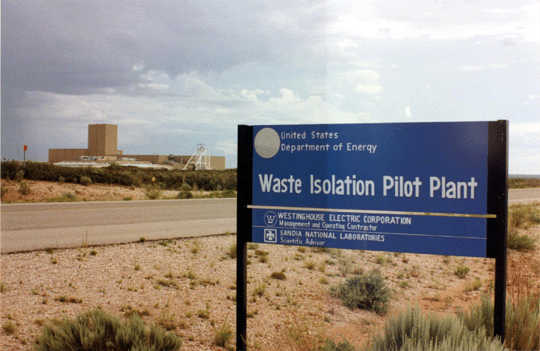 WIPP expansion needed for proposed disposal of surplus plutonium at nuclear waste repository Adrian Hedden, Carlsbad Current-Argus May 1, 2020 Numerous concerns would have to be addressed in the U.S. Department of Energy’s proposed plan to dispose of surplus plutonium at the Waste Isolation Pilot Plant for the program to be successful, per a DOE-commissioned report from the National Academies of Sciences (NAS).The organization was commissioned by the DOE to study its plan to dilute and dispose of the plutonium at WIPP over 30 years at a cost of about $18.2 billion an alternative to the stalled mixed-oxide program that would have seen the nuclear waste converted into fuel. WIPP expansion needed for proposed disposal of surplus plutonium at nuclear waste repository Adrian Hedden, Carlsbad Current-Argus May 1, 2020 Numerous concerns would have to be addressed in the U.S. Department of Energy’s proposed plan to dispose of surplus plutonium at the Waste Isolation Pilot Plant for the program to be successful, per a DOE-commissioned report from the National Academies of Sciences (NAS).The organization was commissioned by the DOE to study its plan to dilute and dispose of the plutonium at WIPP over 30 years at a cost of about $18.2 billion an alternative to the stalled mixed-oxide program that would have seen the nuclear waste converted into fuel.
The Academies convened a committee to study the dilute-and-dispose method in November 2017, releasing an interim report a year later that noted WIPP did not have the storage space to hold about 48 metric tons (MT) the DOE hoped to dispose of. The final report was released on Thursday, and renewed concerns for storage space, along with the method of disposal’s lack of approval under the Plutonium Management and Disposition Agreement (PMDA) – a deal struck in 2000 between the U.S. and Russia to each dispose of 34 MT of plutonium through jointly-approve methods. The PMDA does allow for each country to present alternatives, with such approval for the dilute-and-dispose method pending. Robert Dynes, a physics professor and former president of the University of California who chaired the NAS’ committee also pointed to challenges in scaling up the program, as it was proven viable only on a prototype scale. “Gaps do exist in implementation challenges. This is not trivial,” Dynes said. “The implementation challenges that are not addressed would result in even longer implementation times and costs.” He also pointed to the project’s reliance on WIPP as the nation’s only deep geological repository in operation or production that could hold the waste.
“It’s the nation’s only repository,” Dynes said. “Without access to WIPP, the plan cannot be completed. There’s a lot of pressure on WIPP.” Andrew Orrell, a committee member from Idaho National Laboratory said disposing of the plutonium would change the nature of WIPP, although it would be diluted so as to confirm with WIPP’s waste criteria, and the DOE must maintain public transparency and work closely with the State of New Mexico to honor the facility’s “social contract” if the project moved forward. “The committee felt there was a vulnerability in the social contract between the DOE and State of New Mexico,” Orrell said. “The committee made several recommendations encouraging greater transparency on the entire plan to dispose of this plutonium at WIPP.” Orrell also said there was likely to be competition for space at WIPP, as plutonium pit production was recently increased at Los Alamos National Laboratory. This could be a challenge for WIPP’s capacity, Orrell said, as specified in the federal Land Withdrawal Act (LWA). “Meeting or exceeding the Land Withdrawal Act is pretty easy to foresee,” he said. “The remaining space in WIPP is limited and could be oversubscribed.” This could be a challenge for WIPP’s capacity, Orrell said, as specified in the federal Land Withdrawal Act (LWA). “Meeting or exceeding the Land Withdrawal Act is pretty easy to foresee,” he said. “The remaining space in WIPP is limited and could be oversubscribed.”….. https://www.currentargus.com/story/news/local/2020/05/01/wipp-expansion-needed-proposed-nuclear-waste-disposal/3035582001/ |
|
|
Nuclear reactor pressure vessel to be shipped by rail to Utah, from Sanonofre
The reactor pressure vessel for Unit 1, the first of three reactors on site, will get a permanent home in Utah, By TERI SFORZA | tsforza@scng.com | Orange County Register, May 1, 2020 The original plan, nearly 20 years ago, was to plop the retired nuclear reactor pressure vessel on a barge and ship it off — via the Panama Canal or all the way around the tip of South America — to a final resting place in South Carolina.But there were strong objections to transporting the huge metal shell that way. After all, atoms had actually been split inside it. And so the giant, but empty, heart of San Onofre Nuclear Generating Station’s Unit 1 was packed away in a huge steel cylinder in 2002. The cylinder was filled with grout for shielding against radiation. It was sealed, and has been stored at the plant ever since.
Now — as serious tear-down work gets under way on Units 2 and 3 — the heart of long-ago-dismantled Unit 1 is finally slated to leave San Onofre forever.
Operator Southern California Edison is preparing to ship Unit 1’s reactor pressure vessel to a licensed disposal facility in Clive, Utah, which is owned by Energy Solutions, one of San Onofre’s decommissioning contractors. It will have company: San Onofre’s retired steam generators were shipped to Clive in 2012.
Though officials can’t get too specific on precisely when or how the vessel will go — for safety reasons — they’ve been preparing a rail spur to haul heavy components off site.
The reactor vessel is considered low-level waste, the least hazardous of the Nuclear Regulatory Commission’s radioactive waste classifications. Contaminated cleaning supplies, used disposable protective clothing and reactor parts are other examples of low-level waste.
How can the crucible for nuclear reactions be low-level waste? The most radioactive parts within it were removed, cut up, and stored with higher-level waste on site, said John Dobken, a spokesman for Edison. What’s left is Cobalt-60, which has a half-life of about five years.
Unit 1 was retired in 1992, and the reactor vessel has been packaged for 18 years, so it has gone through about five half-lives, reducing its radioactivity, Dobken said.The contact dose rate for the vessel package is less than 0.1 millirem an hour, which is 500 times below the Department of Transportation limit for these types of shipments, Edison said in a primer on the move. For comparison, a chest X-ray provides a dose of 10 millirem.
Since this is low-level waste, it was never part of Edison’s contract with the federal government requiring the U.S. Department of Energy to haul away high-level waste by 1998 in exchange for payments into the Nuclear Waste Fund.
The federal government’s paralysis on finding a permanent home for the nation’s high-level nuclear waste is why 40 years’ worth of it remains stuck on site, generating sharp controversy.
While critics have called on Edison to cease decommissioning work at San Onofre during the lock-down, it proceeds with “pandemic protocols” in place, Dobken said. Everyone on site must wear a mask and practice social distancing.
———————————–
By the numbers: The package weighs 770 tons, or more than 1.5 million pounds. Inside is the Unit 1 reactor pressure vessel, pieces of radioactive metal and grout for radiation shielding. It’s a 2-inch-thick carbon steel cylindrical canister with a 3-inch-thick carbon steel liner; top and bottom plates are 3 inches thick. The canister is 38.5 feet long and 15.5 feet in diameter.
-
Archives
- February 2026 (233)
- January 2026 (308)
- December 2025 (358)
- November 2025 (359)
- October 2025 (376)
- September 2025 (258)
- August 2025 (319)
- July 2025 (230)
- June 2025 (348)
- May 2025 (261)
- April 2025 (305)
- March 2025 (319)
-
Categories
- 1
- 1 NUCLEAR ISSUES
- business and costs
- climate change
- culture and arts
- ENERGY
- environment
- health
- history
- indigenous issues
- Legal
- marketing of nuclear
- media
- opposition to nuclear
- PERSONAL STORIES
- politics
- politics international
- Religion and ethics
- safety
- secrets,lies and civil liberties
- spinbuster
- technology
- Uranium
- wastes
- weapons and war
- Women
- 2 WORLD
- ACTION
- AFRICA
- Atrocities
- AUSTRALIA
- Christina's notes
- Christina's themes
- culture and arts
- Events
- Fuk 2022
- Fuk 2023
- Fukushima 2017
- Fukushima 2018
- fukushima 2019
- Fukushima 2020
- Fukushima 2021
- general
- global warming
- Humour (God we need it)
- Nuclear
- RARE EARTHS
- Reference
- resources – print
- Resources -audiovicual
- Weekly Newsletter
- World
- World Nuclear
- YouTube
-
RSS
Entries RSS
Comments RSS
 nuclear-news