Iran’s Nuclear and Military Efforts in the Shadow of Coronavirus and Economic Collapse
EXECUTIVE SUMMARY: Notwithstanding the difficult challenges of the coronavirus crisis and a deteriorating economy, Iran is pushing ahead with its uranium enrichment and missile and space programs as well as its activities in Syria. It also has yet to concede to the US in their clash over sailing in the Gulf. Tehran fears that any sign of weakness might endanger the Islamist regime, particularly as resentment continues to grow among ordinary Iranians. With that in mind, it is doing all it can to flex its muscles for both domestic and international audiences………
The latest IAEA report says the agency continues to liaise with Iranian authorities regarding IAEA inspections of natural (non-enriched) uranium particles of an anthropogenic (i.e., man-made) source from an Iranian site that has not yet been declared to IAEA: the warehouse in Turkuzabad, a suburb of Tehran, which was unveiled by Israeli PM Benjamin Netanyahu in a speech to the UN General Assembly on September 27, 2018. According to the BBC on March 3, the IAEA dispatched a document to several member states claiming that Iran has rejected a request to allow inspection access to three other unidentified sites as well. According to the document, the inspectors want to find out if natural uranium is being used at any of the sites from which they are being barred. At another site, the IAEA says there have been activities that are “consistent with efforts to sanitize part of the location.”
Iran’s violations of the nuclear agreement—its raising of the uranium enrichment rate to 4.5% and accumulation of uranium in excess of the 300 kg UF6 limit—does not currently have a military aspect. This is because uranium enriched at a rate of less than 5% is suitable solely as a nuclear fuel for power reactors and cannot be used for nuclear weapons (for which the enrichment degree required is at least 90%). Iranian officials claim these violations are meant to pressure the EU into neutralizing the sanctions imposed on Iran by the US……..
Iran’s overall situation is quite distressing. The Iranian people have lost faith in the regime—especially now, in view of the ravages of the coronavirus pandemic. The people (along with the rest of the world) doubt the official casualty figures. At this writing, the regime is claiming about 110,000 cases and about 6,800 deaths, but the true numbers are estimated to be much higher. This distrust became stronger against the backdrop of the authorities’ false reporting of the downing of a Ukrainian passenger jet on January 8 after takeoff from Tehran (most of its passengers were either Iranian or of Iranian origin).
The coronavirus outbreak has dealt a new blow to the Iranian economy, which had already collapsed in 2018 as a result of US sanctions. The real (the Iranian currency) plummeted to unprecedented lows, and the Iranian street expressed its anger that the regime had wasted so much money on its operations in Syria. According to the London Arab newspaper al-Sharq al-Awsat on January 1, 2020, Iranian president Rouhani said damage to the Iranian economy resulting from sanctions by the end of 2019 was $200 billion…….
It is highly doubtful that the Iranian people are ready to eat grass in order to bring the regime’s dreams of an Iranian nuclear bomb to fruition. Though the mullahs’ goal of becoming a regional power that controls Shiite Islam across the Middle East remains unfulfilled, the regime continues to do what it can to demonstrate its power. The object is to show the world that Iran is not capitulating to the US in any way—not regarding its nuclear and space programs, and not militarily. It also seeks to project an image of strength to the increasingly resentful Iranian people, as it fears that signs of weakness could bring an end to its rule. However, the regime’s investments in security at the expense of the nation’s welfare may turn out to boomerang against it. https://besacenter.org/perspectives-papers/iran-nuclear-military-efforts/
Latest climate models suggest global heating could be worse than we thought
 Just how hot will it get this century? Latest climate models suggest it could be worse than we thought, The Conversation, May 18, 2020 , Michael Grose, Climate Projections Scientist, CSIRO, Julie Arblaster, Associate Professor, Monash University Climate scientists use mathematical models to project the Earth’s future under a warming world, but a group of the latest models have included unexpectedly high values for a measure called “climate sensitivity”.
Climate sensitivity refers to the relationship between changes in carbon dioxide in the atmosphere and warming.
The high values are an unwelcome surprise. If they’re right, it means a hotter future than previously expected – warming of up to 7℃ for Australia by 2100 if emissions continue to rise unabated.
South Africa’s nuclear waste problem- why plan to increase it?
 The nuclear option https://www.businesslive.co.za/bd/opinion/letters/2020-05-17-letter-the-nuclear-option/ 17 MAY 2020, Keith Gottschalk, It is bizarre that a government department is advocating the building of more nuclear power stations with the slogan “a no-regret option”! (“ANC government is determined to pursue nuclear at any cost”, May 12).
Try selling that slogan to the people of Fukushima and Chernobyl.
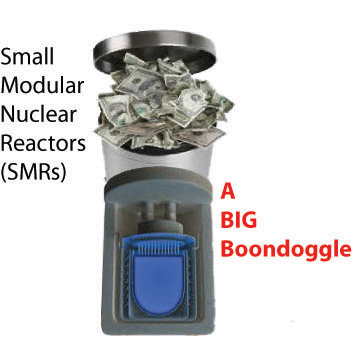
University experts urge that UK promote renewable energy, drop expensive plans for small nuclear reactors
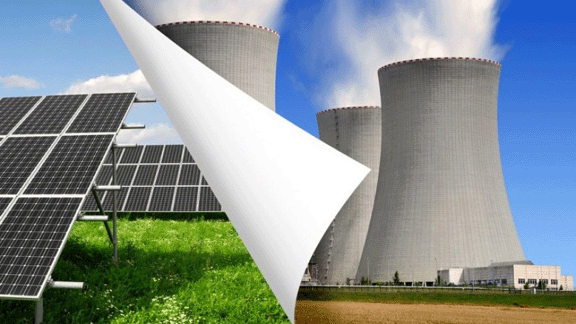 Observer 17th May 2020. Professor Andy Stirling, Sussex University; Professor Andrew Blowers, OpenUniversity; Dr Phil Johnstone, Sussex University; Dr David Lowry, Institute
for Resource and Security Studies, Cambridge, Massachusetts; Dr Ian
Fairlie, formerly UK committee examining the radiation risks of internal
 emitters.
 Even well-established forms of nuclear are rapidly declining in competitiveness worldwide. The nuclear industry has a track record of catastrophically expensive hype and disappointment on speculative new ventures like this, so there are no rational grounds to divert investment or employment away from renewables in the way you urge so strongly.
https://www.theguardian.com/commentisfree/2020/may/17/letters-isolated-in-care-home-lockdown-hell
How an innovative community overcame Ukraine’s nuclear trauma.
FoE Europe 15th May 2020 How an innovative community overcame Ukraine’s nuclear trauma. All over Europe, people are rising up to fix climate breakdown – demanding urgent
transformation to a fair, fossil free future. Communities, cities and
people are at the forefront of building community-owned renewable energy,
creating green jobs, and tackling energy poverty. Here is one such story
from the frontlines of climate hope, from Ukraine.
Pacific nuclear bomb tests interfered with rain patterns in UK
Pacific nuclear bomb tests made it rain 1,000s of miles away in UK, Reading University scientists find, Berkshire Live
During the Cold War, detonations in locations as remote as the Nevada Desert or Pacific islands had unforeseen consequences elsewhere in the world By Ian Hughes 17 MAY 2020
Nuclear bomb tests during the Cold War changed rainfall patterns thousands of miles from the detonation sites, according to scientists at the University of Reading.
They found electric charge released by radiation from detonations – carried out predominantly by the US and Soviet Union in the 1950s and 1960s – affected rain clouds at the time.
It means tests in remote locations such as the Nevada Desert or Pacific islands, had an effect on precipitation as far away as the Shetlands – 300 miles off the coast of Scotland.
A study used historic records between 1962-64 from a research station on the Scottish island.
Scientists compared days with high and low radioactively-generated charge, finding that clouds were visibly thicker, and there was 24 per cent more rain on average on the days with more radioactivity…………
It is thought researchers will now have a better understanding of important weather processes.
Although detonations were carried out in remote parts of the world during the Cold War, radioactive pollution spread widely throughout the atmosphere.
Radioactivity ionises the air, releasing electric charge.
The researchers, from the Universities of Reading, Bath and Bristol, studied records from well-equipped Met Office research weather stations at Kew near London and Lerwick in the Shetland Isles.
Shetland, in particular, was relatively unaffected by other sources of anthropogenic pollution. This made it well suited as a test site to observe rainfall effects which, although likely to have occurred elsewhere too, would be much more difficult to detect.
The Shetland rainfall on more than 150 days showed differences which vanished after the major radioactivity episodes were over.
The study was published in Physical Review Letters. https://www.getreading.co.uk/news/reading-berkshire-news/pacific-nuclear-bomb-tests-made-18248407
The race to nuclear suicide continues despite Covid-19 crisis
The race to nuclear suicide continues despite Covid-19 crisis https://www.thenational.scot/news/18453817.world-presses-race-suicide/, By Brian Quail. 17 May 20, Glasgow AT the dawn of the nuclear age, the Russell-Einstein Manifesto warned us all: “Remember your humanity and forget the rest. If you can do so, the way lies open to a new paradise; if you cannot, there lies before you the risk of universal death.”
That was back in 1955. Nobody listened. What did Albert Einstein known about the real world? Untold trillions were wasted on the nuclear arms race and unimaginable cruelty inflicted on our test victims – the aborigines of Australia at Maralinga and Montebello, the victims of the USSR in Semipalatinsk in Kazakhstan, and of the USA, the Shoshone people of Nevada whose land is now permanently contaminated. Add the long forgotten British servicemen used as human guinea pigs at Christmas Island, and the many other unnamed and unnumbered victims of our nuclear idolatry. Never mind all those we condemned to poverty and destitution by squandering our resources.I had hoped that the global threat of Covid-19 might call us back to the ineluctable truth of the dilemma posited in the Manifesto, but no. We press blindly on in the lunatic race to suicide.
While the rest of us are staying at home in lockdown, on Wednesday May 13 a convoy carrying nuclear warheads (eight Hiroshimas) left Burghfield. It came up the M6 and M74, over the Erskine Bridge and past Loch Lomond to arrive at Coulport at 9.20. Nukewatch was, for obvious reasons, unable to follow this or attempt to hinder its illegal ploys.
Will nothing open the eyes or touch the hearts of our nuclear jihadis? Must we surrender our future and the fate of the planet to these deranged souls?
Alice Walker said: “Our last five minutes on earth are running out. We can spend those minutes in meanness … or we can spend them consciously embracing every glowing soul who wanders within our reach” Can we not stop this madness now, at 90 seconds to midnight?
Radiation leak at nuclear research reactor
 Germany: Radiation leak detected at research reactor, DW, 17 May 20,
A research reactor near Munich has emitted excess C-14 radiation, says the Bavarian city’s technical university. The “slight” leak late March had shown up Thursday when monthly readings were collated.
Munich’s technical university (TUM) said Saturday a neutron reactor located at Garchingjust north of the metropole was found to have leaked nuclides into the atmosphere “slightly” above the level permitted annually in its license.
Neither human beings nor the surrounding environment had been endangered, said the TUM and Bavaria’s environmental ministry — responsible for oversight.
Monthly figures collated on Thursday had shown an excess in C-14 particles 15% above the permitted yearly level, with the potential to cause “theoretically” a load for the public of 3 Mikrosieverts at the maximum…….
The facility was put on hold on March 17 because of the current pandemic, leaving many scientists unable to glean results for industry and medicine, said Görg.
The FRMII reactor, inaugurated in 2005, remains controversial among organizations like Germany’s branch of Friends of the Earth (BUND) and opposition Greens in Bavaria’s state assembly……. https://www.dw.com/en/germany-radiation-leak-detected-at-research-reactor/a-53467330
Preventing a climate catastrophe in the middle of a coronavirus catastrophe
 Times 17th May 2020, Chris Stark is trying to save the world from his bedroom in the leafy West
End of Glasgow. As chief executive of the Committee on Climate Change, the
independent organisation charged by parliament with holding the British
government to account on greenhouse gas emissions, Stark is attempting to
prevent a future global catastrophe in the middle of a global catastrophe.
“The interesting thing is that, while that is true, even in a moment as
tough as this, it does almost nothing at all for climate change. The
problem is that you have a chronic cumulative problem. It’s like water in
a bath and, even this year, we are adding water to the bath. The CO2 in the
atmosphere is being added to. We are still making climate change worse this
year — we have just turned the tap down a bit.
This doesn’t crack the problem. What you need is long-term structural change that guides those
emissions down permanently. We will see those emissions rebound immediately
as economic activity restarts, but there are interesting questions about
what may or may not last after this period.” In the past few weeks the
committee has sent a letter to the Scottish government, at its request, on
how to rebuild the economy, post-Covid, in a manner that best tackles
climate change.
As Stark explained: “Coming out of this there is a moment
of unfreezing of several things which means you can change the trajectory
of climate-change policy and grow the economy. “The straightforward
question of what you do is that there are four or five priorities coming
out of it. One is to use the government’s ability to invest, to get the
economy going, but in areas that you know you will need in a net-zero
future — and that means renewable energy, electric vehicles, cycling and
walking provision, and digging up the ground to make sure the energy
networks are ready when we need them in the future.
“What will matter most is, when we are able to, going in and improving the fabric of our
housing stock so that we are more energy-efficient and ready for different
sources of heating in our homes. The last thing is tree planting. It is a
really sensible thing for the government to support because it has many
added benefits, and gives lots of new jobs in new areas.”
Nuclear war between India and Pakistan very unlikely
|
‘Very dim chances of India, Pakistan nuclear war’
2 neighbors became nuclear power in May 1998 triggering new arms race in region, AA, Aamir Latif |15.05.2020 KARACHI, PakistanPakistan’s top nuclear scientist sees “very dim” chances of a nuclear war with neighboring India despite mounting tensions between the two arch-rivals in recent months. “I won’t say a zero chance but there are very dim chances of a war between the two neighbors involving nuclear arsenal despite escalating tensions,” Samar Mubarakmand, a former chairman of Pakistan Atomic Energy Commission (PAEC), and head of a team of the scientists that conducted six “successful” nuclear tests in remote Chaghi district of southwestern Balochistan province on May 28, 1998……… “The leadership of both countries are fully aware of the catastrophe a nuclear war can cause. They won’t go for that option no matter how tense the situation is,” observed Mubarakmand, who served at PAEC from 1962 to 2007 and played a key role in developing the country’s nuclear program. Conventional provocations, he said, would continue between the two longtime rivals but, he reckoned, both sides would not “cross the limit” to go for nuclear option. Both countries have long been reeling from poverty, illiteracy, and other health and economic issues. Wars or undue competition in arms race are not in the interest of the two nations,” he maintained. Nuclear powers India boasts the world’s third-largest army after the US and China, with an active troop strength of over 1.3 million. Pakistan, meanwhile, stands eighth on the list with a 600,000-man army……… https://www.aa.com.tr/en/asia-pacific/-very-dim-chances-of-india-pakistan-nuclear-war/1841657 |
|
|
Physicians for Social Responsibility Comments on US EPA Proposed Rule; Deadline to Comment is Tomorrow Night at 11.59 PM EDT — Mining Awareness +
Comment by May 18th on the Environmental Protection Agency (EPA) Proposed Rule, which is misnamed “Strengthening Transparency in Regulatory Science”. Related information, Open Docket Folder and comment here: https://www.regulations.gov/docket?D=EPA-HQ-OA-2018-0259 Comments can be anonymous. Comment and Memo from PSR: “Physicians for Social Responsibility (PSR) respectfully submits the attached comments regarding the U.S. Environmental Protection Agency (EPA)’s […]
US EPA Proposed Rule Comments of the Oregon Health Authority and Oregon Dept of Environmental Quality; Comments Accepted Until Tomorrow Night 11.59 PM EDT — Mining Awareness +
Comment by May 18th on the Environmental Protection Agency (EPA) Proposed Rule, which is misnamed “Strengthening Transparency in Regulatory Science”. Related information, Open Docket Folder and comment here: https://www.regulations.gov/docket?D=EPA-HQ-OA-2018-0259 Comments can be anonymous. Strengthening Transparency in Regulatory Science Proposed Rule Comments of the Oregon Health Authority and Oregon Department of Environmental Quality April 16, 2020: […]
Comment from the Endocrine Society on US EPA Proposed Rule; Comments Accepted Until Tomorrow Night 11.59 PM EDT

Comment by May 18th on the Environmental Protection Agency (EPA) Proposed Rule, which is misnamed “Strengthening Transparency in Regulatory Science”. Related information, Open Docket Folder and comment here: https://www.regulations.gov/docket?D=EPA-HQ-OA-2018-0259 Comments can be anonymous.
“We also note with concern that the supplement provides the Administrator with significant leeway to provide exemptions to the rule without defining the criteria and considerations that the Administrator would use. This creates a de facto loophole that could further decrease transparency by permitting studies submitted by regulated entities to be prioritized above academic studies that must adhere to strict participant confidentiality agreements.” (Excerpted from comment, below.)
Comment from the Endocrine Society:
“The Honorable Andrew Wheeler Administrator
United States Environmental Protection Agency
1200 Pennsylvania Ave, NW Washington, DC 20460
April 6, 2020
Re: EPA-HQ-OA-2018-0259
Dear Administrator Wheeler,
The Endocrine Society appreciates the opportunity to comment on the supplemental notice of proposed rulemaking for…
View original post 981 more words
Comment from Harvard School of Public Health on US EPA Proposed Rule; Comments Accepted Until Tomorrow Night 11.59 PM EDT
Comment on the Environmental Protection Agency (EPA) Proposed Rule, which is misnamed “Strengthening Transparency in Regulatory Science” by May 18, 2020. Related information, Open Docket Folder and comment here: https://www.regulations.gov/docket?D=EPA-HQ-OA-2018-0259
“Comment submitted by Ronnie Levin et al., Department of Environmental Health, Harvard School of Public Health
We appreciate the opportunity to provide comments on EPA’s supplemental notice of proposed rulemaking, “Strengthening Transparency in Regulatory Science”.
We submitted comments opposing the initial proposal in 2018, along with the International Society for Environmental Epidemiology, the National Academies of Sciences, the American Lung Association, the American Association for the Advancement of the Sciences, and other leading public health, medical and scientific organizations.
To date, EPA has yet to respond to those comments or engage with these affected stakeholders. EPA’s supplemental proposal does not address the substantive scientific, technical and legal issues raised in the earlier public comments and the original…
View original post 735 more words
Keweenaw Bay Indian Community Letter Urging Withdrawal of Proposed EPA Rule; Comments on Rule Accepted Until May 18th, 11.59 PM Eastern
Comment on the Environmental Protection Agency (EPA) Proposed Rule, which is misnamed “Strengthening Transparency in Regulatory Science” by May 18, 2020, Eastern. Related information, Open Docket Folder and comment here: https://www.regulations.gov/docket?D=EPA-HQ-OA-2018-0259
Excerpts from Keweenaw Bay [American] Indian Community letter: “On April 30, 2018, the United States Environmental Protection Agency (EPA) published a notice of proposed rule that would drastically reduce the types of scientific studies that can be used to inform EPA regulations protecting public health under the guise of improving transparency.
On August 13, 2018, the National Tribal Air Association (NTAA) submitted comments opposing the proposed rule, explaining, among other things, that the rule would undermine EPA’s mission to protect human health and the environment.
The NTAA explained that the proposed rule was vague, purported to addresss a non-existent and unsubstantiated problems, and would result in EPA failing to rely on the best available science in…
View original post 220 more words
1 This Month


Tell the Ukrainian Government to Drop Prosecution of Peace Activist Yurii Sheliazhenko

Petition to revoke the licensing of the Near Surface Nuclear Disposal Facility (NSDF) at Chalk River. https://www.ourcommons.ca/petitions/en/Petition/Details?Petition=e-7247


of the week – STOP SMALL MODULAR REACTORS IN CANADA
To see nuclear-related stories in greater depth and intensity – go to https://nuclearinformation.wordpress.com
-
Archives
- March 2026 (204)
- February 2026 (268)
- January 2026 (308)
- December 2025 (358)
- November 2025 (359)
- October 2025 (376)
- September 2025 (258)
- August 2025 (319)
- July 2025 (230)
- June 2025 (348)
- May 2025 (261)
- April 2025 (305)
-
Categories
- 1
- 1 NUCLEAR ISSUES
- business and costs
- climate change
- culture and arts
- ENERGY
- environment
- health
- history
- indigenous issues
- Legal
- marketing of nuclear
- media
- opposition to nuclear
- PERSONAL STORIES
- politics
- politics international
- Religion and ethics
- safety
- secrets,lies and civil liberties
- spinbuster
- technology
- Uranium
- wastes
- weapons and war
- Women
- 2 WORLD
- ACTION
- AFRICA
- Atrocities
- AUSTRALIA
- Christina's notes
- Christina's themes
- culture and arts
- Events
- Fuk 2022
- Fuk 2023
- Fukushima 2017
- Fukushima 2018
- fukushima 2019
- Fukushima 2020
- Fukushima 2021
- general
- global warming
- Humour (God we need it)
- Nuclear
- RARE EARTHS
- Reference
- resources – print
- Resources -audiovicual
- Weekly Newsletter
- World
- World Nuclear
- YouTube
-
RSS
Entries RSS
Comments RSS
 nuclear-news