This is what uranium and radon, do in drinking water
 Dr. Hans Frehly 1 May 2020, People who are exposed to relatively high levels of radionuclides in drinking water for long periods may develop serious health problems, such as cancer, anemia, osteoporosis, cataracts, bone growths, kidney disease, liver disease and impaired immune systems. https://agrilifeextension.tamu.edu/library/water/drinking-water-problems-radionuclides/
 Hundreds of foreign companies procuring nuclear materials for India and Pakistan
|
Reuters 30th April 2020, Hundreds of foreign companies are actively procuring components for India and Pakistan’s nuclear programmes, taking advantage of gaps in the global
regulation of the industry, according to a report by a U.S.-based research group.https://uk.reuters.com/article/uk-india-pakistan-nuclear-exclusive/exclusive-india-pakistan-nuclear-procurement-networks-larger-than-thought-study-shows-idUKKBN22C2JO?rpc=401& |
An Arctic island is warming SIX times faster than the global average
|
Global warming: An Arctic island is warming SIX times faster than the global average, GLOBAL WARMING threatens the planet as a whole but parts of an island in the Arctic are warming six times faster than the global average, scientists have warned. Express UK By SEBASTIAN KETTLEY Apr 30, 2020 Polar researchers stationed in the southwest of the Arctic island of Spitsbergen have found a worrying warming trend in meteorological data spanning 40 years. Temperatures in parts of the island, which is part of the Svalbard archipelago between Norway and the North Pole, have risen six times higher than the global average. Scientists from the Institute of Geophysics, Polish Academy of Sciences (IGF PAN) made the worrying discovery during expeditions to the Polish Polar Station Hornsund. The scientists presented their findings in Earth System Science Data. Professor Marzena Osuch, study co-author and hydrologist, told the Polish Press Agency (PAP): “The average temperature in Hornsund between 1979 and 2018 rose by 1.14C per decade. “The change is more than six times higher than the global change for the same period.”……. https://www.express.co.uk/news/science/1276239/Global-warming-Arctic-temperatures-Spitsbergen-warming-faster-climate-change |
|
To store surplus plutonium, USA’s Waste Isolation Pilot Plant will have to be enlarged
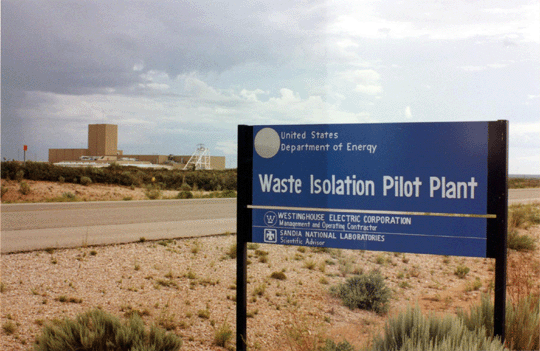 WIPP expansion needed for proposed disposal of surplus plutonium at nuclear waste repository Adrian Hedden, Carlsbad Current-Argus May 1, 2020 Numerous concerns would have to be addressed in the U.S. Department of Energy’s proposed plan to dispose of surplus plutonium at the Waste Isolation Pilot Plant for the program to be successful, per a DOE-commissioned report from the National Academies of Sciences (NAS).The organization was commissioned by the DOE to study its plan to dilute and dispose of the plutonium at WIPP over 30 years at a cost of about $18.2 billion an alternative to the stalled mixed-oxide program that would have seen the nuclear waste converted into fuel. WIPP expansion needed for proposed disposal of surplus plutonium at nuclear waste repository Adrian Hedden, Carlsbad Current-Argus May 1, 2020 Numerous concerns would have to be addressed in the U.S. Department of Energy’s proposed plan to dispose of surplus plutonium at the Waste Isolation Pilot Plant for the program to be successful, per a DOE-commissioned report from the National Academies of Sciences (NAS).The organization was commissioned by the DOE to study its plan to dilute and dispose of the plutonium at WIPP over 30 years at a cost of about $18.2 billion an alternative to the stalled mixed-oxide program that would have seen the nuclear waste converted into fuel.
The Academies convened a committee to study the dilute-and-dispose method in November 2017, releasing an interim report a year later that noted WIPP did not have the storage space to hold about 48 metric tons (MT) the DOE hoped to dispose of. The final report was released on Thursday, and renewed concerns for storage space, along with the method of disposal’s lack of approval under the Plutonium Management and Disposition Agreement (PMDA) – a deal struck in 2000 between the U.S. and Russia to each dispose of 34 MT of plutonium through jointly-approve methods. The PMDA does allow for each country to present alternatives, with such approval for the dilute-and-dispose method pending. Robert Dynes, a physics professor and former president of the University of California who chaired the NAS’ committee also pointed to challenges in scaling up the program, as it was proven viable only on a prototype scale. “Gaps do exist in implementation challenges. This is not trivial,” Dynes said. “The implementation challenges that are not addressed would result in even longer implementation times and costs.” He also pointed to the project’s reliance on WIPP as the nation’s only deep geological repository in operation or production that could hold the waste.
“It’s the nation’s only repository,” Dynes said. “Without access to WIPP, the plan cannot be completed. There’s a lot of pressure on WIPP.” Andrew Orrell, a committee member from Idaho National Laboratory said disposing of the plutonium would change the nature of WIPP, although it would be diluted so as to confirm with WIPP’s waste criteria, and the DOE must maintain public transparency and work closely with the State of New Mexico to honor the facility’s “social contract” if the project moved forward. “The committee felt there was a vulnerability in the social contract between the DOE and State of New Mexico,” Orrell said. “The committee made several recommendations encouraging greater transparency on the entire plan to dispose of this plutonium at WIPP.” Orrell also said there was likely to be competition for space at WIPP, as plutonium pit production was recently increased at Los Alamos National Laboratory. This could be a challenge for WIPP’s capacity, Orrell said, as specified in the federal Land Withdrawal Act (LWA). “Meeting or exceeding the Land Withdrawal Act is pretty easy to foresee,” he said. “The remaining space in WIPP is limited and could be oversubscribed.” This could be a challenge for WIPP’s capacity, Orrell said, as specified in the federal Land Withdrawal Act (LWA). “Meeting or exceeding the Land Withdrawal Act is pretty easy to foresee,” he said. “The remaining space in WIPP is limited and could be oversubscribed.”….. https://www.currentargus.com/story/news/local/2020/05/01/wipp-expansion-needed-proposed-nuclear-waste-disposal/3035582001/ |
|
|
Nuclear reactor pressure vessel to be shipped by rail to Utah, from Sanonofre
The reactor pressure vessel for Unit 1, the first of three reactors on site, will get a permanent home in Utah, By TERI SFORZA | tsforza@scng.com | Orange County Register, May 1, 2020 The original plan, nearly 20 years ago, was to plop the retired nuclear reactor pressure vessel on a barge and ship it off — via the Panama Canal or all the way around the tip of South America — to a final resting place in South Carolina.But there were strong objections to transporting the huge metal shell that way. After all, atoms had actually been split inside it. And so the giant, but empty, heart of San Onofre Nuclear Generating Station’s Unit 1 was packed away in a huge steel cylinder in 2002. The cylinder was filled with grout for shielding against radiation. It was sealed, and has been stored at the plant ever since.
Now — as serious tear-down work gets under way on Units 2 and 3 — the heart of long-ago-dismantled Unit 1 is finally slated to leave San Onofre forever.
Operator Southern California Edison is preparing to ship Unit 1’s reactor pressure vessel to a licensed disposal facility in Clive, Utah, which is owned by Energy Solutions, one of San Onofre’s decommissioning contractors. It will have company: San Onofre’s retired steam generators were shipped to Clive in 2012.
Though officials can’t get too specific on precisely when or how the vessel will go — for safety reasons — they’ve been preparing a rail spur to haul heavy components off site.
The reactor vessel is considered low-level waste, the least hazardous of the Nuclear Regulatory Commission’s radioactive waste classifications. Contaminated cleaning supplies, used disposable protective clothing and reactor parts are other examples of low-level waste.
How can the crucible for nuclear reactions be low-level waste? The most radioactive parts within it were removed, cut up, and stored with higher-level waste on site, said John Dobken, a spokesman for Edison. What’s left is Cobalt-60, which has a half-life of about five years.
Unit 1 was retired in 1992, and the reactor vessel has been packaged for 18 years, so it has gone through about five half-lives, reducing its radioactivity, Dobken said.The contact dose rate for the vessel package is less than 0.1 millirem an hour, which is 500 times below the Department of Transportation limit for these types of shipments, Edison said in a primer on the move. For comparison, a chest X-ray provides a dose of 10 millirem.
Since this is low-level waste, it was never part of Edison’s contract with the federal government requiring the U.S. Department of Energy to haul away high-level waste by 1998 in exchange for payments into the Nuclear Waste Fund.
The federal government’s paralysis on finding a permanent home for the nation’s high-level nuclear waste is why 40 years’ worth of it remains stuck on site, generating sharp controversy.
While critics have called on Edison to cease decommissioning work at San Onofre during the lock-down, it proceeds with “pandemic protocols” in place, Dobken said. Everyone on site must wear a mask and practice social distancing.
———————————–
By the numbers: The package weighs 770 tons, or more than 1.5 million pounds. Inside is the Unit 1 reactor pressure vessel, pieces of radioactive metal and grout for radiation shielding. It’s a 2-inch-thick carbon steel cylindrical canister with a 3-inch-thick carbon steel liner; top and bottom plates are 3 inches thick. The canister is 38.5 feet long and 15.5 feet in diameter.
1 This Month


Tell the Ukrainian Government to Drop Prosecution of Peace Activist Yurii Sheliazhenko

Petition to revoke the licensing of the Near Surface Nuclear Disposal Facility (NSDF) at Chalk River. https://www.ourcommons.ca/petitions/en/Petition/Details?Petition=e-7247


of the week – STOP SMALL MODULAR REACTORS IN CANADA
To see nuclear-related stories in greater depth and intensity – go to https://nuclearinformation.wordpress.com
-
Archives
- March 2026 (204)
- February 2026 (268)
- January 2026 (308)
- December 2025 (358)
- November 2025 (359)
- October 2025 (376)
- September 2025 (258)
- August 2025 (319)
- July 2025 (230)
- June 2025 (348)
- May 2025 (261)
- April 2025 (305)
-
Categories
- 1
- 1 NUCLEAR ISSUES
- business and costs
- climate change
- culture and arts
- ENERGY
- environment
- health
- history
- indigenous issues
- Legal
- marketing of nuclear
- media
- opposition to nuclear
- PERSONAL STORIES
- politics
- politics international
- Religion and ethics
- safety
- secrets,lies and civil liberties
- spinbuster
- technology
- Uranium
- wastes
- weapons and war
- Women
- 2 WORLD
- ACTION
- AFRICA
- Atrocities
- AUSTRALIA
- Christina's notes
- Christina's themes
- culture and arts
- Events
- Fuk 2022
- Fuk 2023
- Fukushima 2017
- Fukushima 2018
- fukushima 2019
- Fukushima 2020
- Fukushima 2021
- general
- global warming
- Humour (God we need it)
- Nuclear
- RARE EARTHS
- Reference
- resources – print
- Resources -audiovicual
- Weekly Newsletter
- World
- World Nuclear
- YouTube
-
RSS
Entries RSS
Comments RSS
 nuclear-news