UK govt again to try “astronomically expensive” plutonium reprocessing nuclear reactors
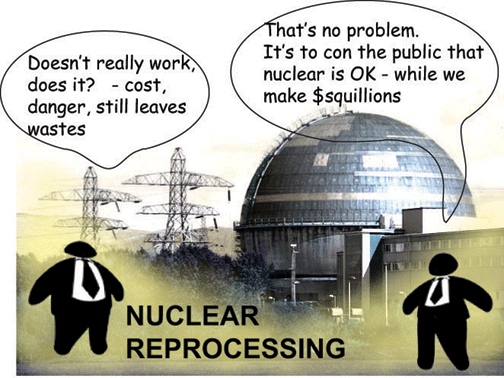 Westminster relaunches plutonium reactors despite ‘disastrous’ experience, The National, 26 April, 20 By Rob Edwards This article was brought to you by The Ferret.
THE UK Government is trying to resurrect plutonium-powered reactors despite abandoning a multi-billion bid to make them work in Scotland.
Documents released by the UK Office for Nuclear Regulation (ONR) under freedom of information law reveal that fast reactors, which can burn and breed plutonium, are among “advanced nuclear technologies” being backed by UK ministers.
Two experimental fast reactors were built and tested at a cost of £4 billion over four decades at Dounreay in Caithness. But the programme was closed in 1994 as uneconomic after a series of accidents and leaks.
Now ONR has been funded by the Department for Business, Energy and Industrial Strategy (BEIS) in London to boost its capacity to regulate new designs of fast reactors, along with other advanced nuclear technologies.
Campaigners have condemned the moves to rehabilitate plutonium as a nuclear fuel as “astronomically expensive”, “disastrous” and “mind-boggling”. They point out that it can be made into nuclear bombs and is highly toxic – and the UK has 140 tonnes of it…….
ONR released 23 documents about advanced nuclear technologies in response to a freedom of information request by Dr David Lowry, a London-based research fellow at the US Institute for Resource and Security Studies. They include redacted minutes and notes of meetings from 2019 discussing fast reactors, and are being published by The Ferret.
One note of a meeting in November 2019 shows that ONR attempted to access a huge database on fast reactors maintained by the UK Government’s National Nuclear Laboratory (NNL) in Warrington, Cheshire…..
Two companies have so far won funding under this heading to help develop fast reactors that can burn plutonium. The US power company, Westinghouse, is proposing lead-cooled fast reactors, while another US company called Advanced Reactor Concepts wants to build sodium-cooled fast reactors.
In November 2019 BEIS also announced an £18 million grant to a consortium led by reactor manufacturer, Rolls Royce, to develop a “small modular reactor designed and manufactured in the UK capable of producing cost effective electricity”.
According to Dr Lowry, fast reactors would require building a plutonium fuel fabrication plant. Such plants are “astronomically expensive” and have proved “technical and financial disasters” in the past, he said.
“Any such fabrication plant would be an inevitable target for terrorists wanting to create spectacular iconic disruption of such a high profile plutonium plant, with devastating human health and environmental hazards.”
Lowry was originally told by ONR that it held no documents on advanced nuclear technologies. As well as redacting the 23 documents that have now been released, the nuclear safety regulator is withholding a further 13 documents as commercially confidential – a claim that Lowry dismissed as “fatuous nonsense”.
THE veteran nuclear critic and respected author, Walt Patterson, argued that no fast reactor programme in the world had worked since the 1950s. Even if it did, it would take “centuries” to burn the UK’s 140 tonne plutonium stockpile, and create more radioactive waste with nowhere to go, he said.
“Extraordinary – they never learn do they? I remain perpetually gobsmacked at the lobbying power of the nuclear obsessives,” he told The Ferret. “The mind continue to boggle.”
The Edinburgh-based nuclear consultant, Pete Roche, suggested that renewable energy was the cheapest and most sustainable solution to climate change. “The UK Government seems to be planning some kind of low carbon dystopia with nuclear reactors getting smaller, some of which at least will be fuelled by plutonium,” he said.
“The idea of weapons-useable plutonium fuel being transported on our roads should send shivers down the spine of security experts and emergency planners.”
Another nuclear expert and critic, Dr Ian Fairlie, described BEIS’s renewed interest in fast reactors as problematic. “Experience with them over many years in the US, Russia, France and the UK has shown them to be disastrous and a waste of taxpayers’ money,” he said.
This is not the view taken by the UK Nuclear Industry Association, which brings together nuclear companies. It wants to see the UK’s plutonium being used in reactors rather than disposed of as waste……
“The Scottish Government remains opposed to new nuclear power plants in Scotland,” a spokesperson told The Ferret. “The Scottish Government believes our long term energy needs can be met without the need for new nuclear capacity.”
The UK Department for Business, Energy and Industrial Strategy did not respond to repeated requests to comment. https://www.thenational.scot/news/18405852.westminster-relaunches-plutonium-reactors-despite-disastrous-experience/
No comments yet.
1 This Month


Tell the Ukrainian Government to Drop Prosecution of Peace Activist Yurii Sheliazhenko

Petition to revoke the licensing of the Near Surface Nuclear Disposal Facility (NSDF) at Chalk River. https://www.ourcommons.ca/petitions/en/Petition/Details?Petition=e-7247


of the week – STOP SMALL MODULAR REACTORS IN CANADA
To see nuclear-related stories in greater depth and intensity – go to https://nuclearinformation.wordpress.com
-
Archives
- March 2026 (204)
- February 2026 (268)
- January 2026 (308)
- December 2025 (358)
- November 2025 (359)
- October 2025 (376)
- September 2025 (258)
- August 2025 (319)
- July 2025 (230)
- June 2025 (348)
- May 2025 (261)
- April 2025 (305)
-
Categories
- 1
- 1 NUCLEAR ISSUES
- business and costs
- climate change
- culture and arts
- ENERGY
- environment
- health
- history
- indigenous issues
- Legal
- marketing of nuclear
- media
- opposition to nuclear
- PERSONAL STORIES
- politics
- politics international
- Religion and ethics
- safety
- secrets,lies and civil liberties
- spinbuster
- technology
- Uranium
- wastes
- weapons and war
- Women
- 2 WORLD
- ACTION
- AFRICA
- Atrocities
- AUSTRALIA
- Christina's notes
- Christina's themes
- culture and arts
- Events
- Fuk 2022
- Fuk 2023
- Fukushima 2017
- Fukushima 2018
- fukushima 2019
- Fukushima 2020
- Fukushima 2021
- general
- global warming
- Humour (God we need it)
- Nuclear
- RARE EARTHS
- Reference
- resources – print
- Resources -audiovicual
- Weekly Newsletter
- World
- World Nuclear
- YouTube
-
RSS
Entries RSS
Comments RSS
 nuclear-news
Leave a comment