United Arab Emirates’ new ‘cheap and cheerful’ Barakah nuclear reactor adds to danger and Middle East tensions
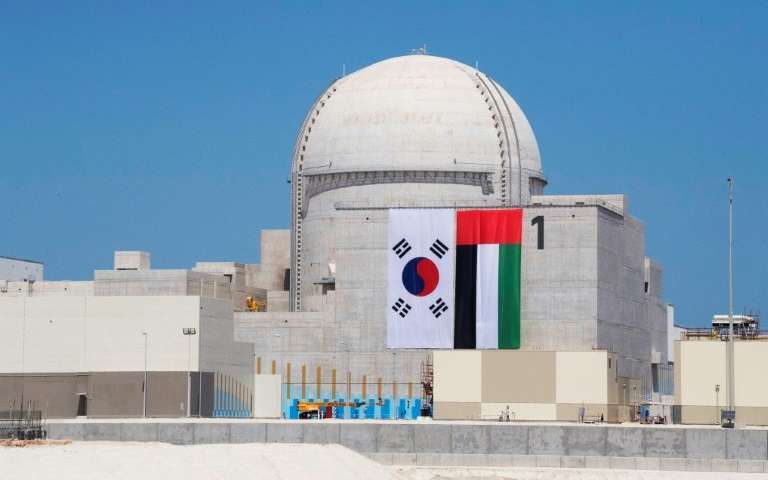
|
The wrong reactor at the wrong time”: inside the UAE’s Barakah nuclear , Power Technology, JP Casey, 17 Apr 20,
The UAE has announced that the first reactor of its under-construction Barakah nuclear power plant is scheduled to come online within “a few months”. The country’s first nuclear plant could address a key energy need in the region, but questions remain as to its usefulness and safety in a geopolitically tense environment.
……. Located 53km from the city of Ruwais in Abu Dhabi’s Gharbiya region, construction on the $20bn project began in 2012, and is finally nearing completion. With four reactors, developed by the state-owned Emirates Nuclear Energy Corporation and the South Korea-based Korean Electric Power Corporation (KEPCO), the plant is expected to have an operating capacity of 5.6GW, which will account for one quarter of the country’s energy needs.
But behind these grand claims, the project has been dogged by controversy. From macro problems, such as the inherent dangers of building a nuclear reactor in a geopolitically tense region, to specific weaknesses with Barakah, such as the cracking of the cement used to build the facility itself, the project has no shortage of critics. With the UAE eager to continue with the project, its completion appears a matter of when, not if, opening up a series of lessons to learn ahead of new nuclear construction……
The plant is expected to produce 5.6GW of power once fully operational, with four reactors powered with APR-1400 technology, developed in South Korea, driving this production. This figure would make the plant the sixth-largest nuclear facility in the world by net production capacity, and its backers hope the project will help to kick-start an energy revolution in the Middle East. However, questions remain about the ultimate suitability of the plant, considering the risks inherent in nuclear and the potential for alternative sources of clean energy in the region. Dr Paul Dorfman, an honorary research associate at UCL and founder and chair of the Nuclear Consulting Group, an independent group of academics that aim to assess the risks and merits of nuclear projects, is sceptical about the suitability of Barakah for the UAE. So, given the fact – and it is a fact – that nuclear investment generates significant financial losses, one wonders if there are other reasons for Barakah,” he said. “Especially because nuclear energy seems to make limited economic sense for the Gulf States. As desert kingdoms, they have some of the best solar resources in the world, with solar having much, much lower investment and generation costs than nuclear.”
These solar resources are particularly significant considering the relative importance of renewable technology and nuclear power to the UAE’s 2050 climate goals. The nation aims to develop renewables as a primary source of power, and nuclear as a backup, a policy that could positively impact the solar industry, but hamstring the nuclear sector.
“Saudi recently tripled its renewable energy targets, and has successfully tended for large scale projects in wind and solar, with a Saudi-based consortium launching a world record low price of $17 per megawatt hour for a 900 megawatt solar park in Dubai itself,” said Dorfman. “So, worldwide and in the Gulf, the fate of new nuclear is linked to and determined by renewable energy technology rollout.” ……..
Dorfman is again concerned about these safety assurances, not only because of alleged mishaps at Barakah, but the generally lax approach to safety regulation across the nuclear sector.
“And what’s particularly worrying is the lack of a core catcher, which in the event of a failure of the emergency reactor core systems, would retain the nuclear fuel once it breached the reactor pressure vessel. On top of that, concrete cracking in all four reactor containment buildings hasn’t helped, nor has installation of faulty pilot-operated safety relief valves.”
 He also noted that KEPCO’s reputation has been somewhat tarnished by a series of scandals originating in 2013, where top safety officials were sentenced for falsifying safety documents for parts used in its nuclear reactors. 100 people were ultimately charged, as six of the country’s 23 operating nuclear reactors were shut down between late 2012 and late 2013, discrediting the reputation in which the UAE has placed such high stock to justify its safety moves at Barakah. He also noted that KEPCO’s reputation has been somewhat tarnished by a series of scandals originating in 2013, where top safety officials were sentenced for falsifying safety documents for parts used in its nuclear reactors. 100 people were ultimately charged, as six of the country’s 23 operating nuclear reactors were shut down between late 2012 and late 2013, discrediting the reputation in which the UAE has placed such high stock to justify its safety moves at Barakah.Finances may have played a key role in the involvement of KEPCO. The UAE awarded KEPCO a contract worth $20bn for the construction of the plant, a much lower bid than was made by other firms. In 2008, Synapse Energy predicted that new nuclear construction could cost up to $9bn for each 1.1GW plant; while this figure is not a specific measurement for all nuclear facilities, this prediction would place the expected cost of Barakah at around $45bn, more than double what KEPCO invested into the facility. “It’s a bit of a ‘cheap and cheerful’ reactor,” Dorfman added. Political damage The impact of these uncertain safety credentials could significantly discredit many of the world’s nuclear regulatory bodies, which have signed off on the Barakah plant despite these risks. Dorfman said that the plight of the facility highlights the “discretionary rather than mandatory” nature of nuclear regulation, where national governments are given exclusive responsibility to enforce operational and safety standards without the support of a strong international body. “The International Atomic Energy Association can attempt to control what’s happening, but it can’t necessarily say to anybody: ‘you will do this’ or ‘you will do that’, as we’ve found out to a cost in Iran, Pakistan, or Israel,” he said. The lack of a central global executive to take responsibility for safety, and the resulting burden on national governments, means nuclear power and nuclear safety are tied to national policy and local geopolitics in a way that is unlike any other energy source. Dorfman pointed to the example of the Houthi insurgency in Yemen, which saw rebel groups overthrow the Yemeni president Abd-Rabbu Mansour Hadi, who was allied with the Gulf states, in 2015. Two years later, the rebels claimed to have fired rockets at Barakah as a warning to the UAE against future involvement in Yemeni affairs, with the prospect of military strikes launched at a nuclear facility an obvious political, and potentially humanitarian, emergency.
“Following a very recent military strike against Saudi oil refineries, and all that implies, nuclear safety in the region increasingly revolves around the broader issue of security,” Dorfman continued, highlighting the pressure on the UAE government to ensure the security of the Barakah plant. “Tense Gulf strategic geopolitics makes new civil nuclear construction more controversial there than elsewhere,” said Dorfman, summarising many of the threats to local people and regional stability posed by the plant, which remain unresolved. “Once Barakah begins full-scale generation there will be a major maritime risk, whether directly intended or unintentional. “It’s the wrong reactor in the wrong place at the wrong time.” https://www.power-technology.com/features/the-wrong-reactor-at-the-wrong-time-inside-the-uaes-barakah-nuclear-plant/ |
|

No comments yet.
1 This Month


Tell the Ukrainian Government to Drop Prosecution of Peace Activist Yurii Sheliazhenko

Petition to revoke the licensing of the Near Surface Nuclear Disposal Facility (NSDF) at Chalk River. https://www.ourcommons.ca/petitions/en/Petition/Details?Petition=e-7247


of the week – STOP SMALL MODULAR REACTORS IN CANADA
To see nuclear-related stories in greater depth and intensity – go to https://nuclearinformation.wordpress.com
-
Archives
- March 2026 (212)
- February 2026 (268)
- January 2026 (308)
- December 2025 (358)
- November 2025 (359)
- October 2025 (376)
- September 2025 (258)
- August 2025 (319)
- July 2025 (230)
- June 2025 (348)
- May 2025 (261)
- April 2025 (305)
-
Categories
- 1
- 1 NUCLEAR ISSUES
- business and costs
- climate change
- culture and arts
- ENERGY
- environment
- health
- history
- indigenous issues
- Legal
- marketing of nuclear
- media
- opposition to nuclear
- PERSONAL STORIES
- politics
- politics international
- Religion and ethics
- safety
- secrets,lies and civil liberties
- spinbuster
- technology
- Uranium
- wastes
- weapons and war
- Women
- 2 WORLD
- ACTION
- AFRICA
- Atrocities
- AUSTRALIA
- Christina's notes
- Christina's themes
- culture and arts
- Events
- Fuk 2022
- Fuk 2023
- Fukushima 2017
- Fukushima 2018
- fukushima 2019
- Fukushima 2020
- Fukushima 2021
- general
- global warming
- Humour (God we need it)
- Nuclear
- RARE EARTHS
- Reference
- resources – print
- Resources -audiovicual
- Weekly Newsletter
- World
- World Nuclear
- YouTube
-
RSS
Entries RSS
Comments RSS
 nuclear-news
Leave a comment