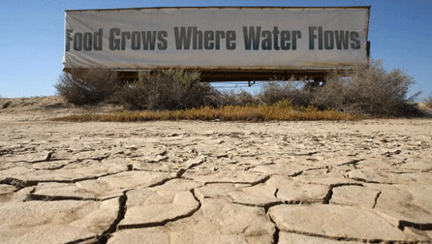
Global heating dries up vast areas of the American West, could bring long-lasting megadroughts
|
The Parched West is Heading Into a Global Warming-Fueled Megadrought That Could Last for Centuries,
Warmer temperatures and shifting storm tracks are drying up vast stretches of land in North and South America.BY BOB BERWYN, INSIDECLIMATE NEWS, APR 16, 2020 The American West is well on its way into one of the worst megadroughts on record, a new study warns, a dry period that could last for centuries and spread from Oregon and Montana, through the Four Corners and into West Texas and northern Mexico.Several other megadroughts, generally defined as dry periods that last 20 years or more, have been documented in the West going back to about 800 A.D. In the study, the researchers, using an extensive tree-ring history, compared recent climate data with conditions during the historic megadroughts. They found that in this century, global warming is tipping the climate scale toward an unwelcome rerun, with dry conditions persisting far longer than at any other time since Europeans colonized and developed the region. The study was published online Thursday and appears in the April 17 issue of the journal Science. Human-caused global warming is responsible for about half the severity of the emerging megadrought in western North America, said Jason Smerdon, a Columbia University climate researcher and a co-author of the new research. “What we’ve identified as the culprit is the increased drying from the warming. The reality is that the drying from global warming is going to continue,” he said. “We’re on a trajectory in keeping with the worst megadroughts of the past millennia.” The ancient droughts in the West were caused by natural climate cycles that shifted the path of snow and rainstorms. But human-caused global warming is responsible for about 47 percent of the severity of the 21st century drought by sucking moisture out of the soil and plants, the study found. The regional drought caused by global warming is plain to see throughout the West in the United States. River flows are dwindling, reservoirs holding years worth of water supplies for cities and farms have emptied faster than a bathtub through an open drain, bugs and fires have destroyed millions of acres of forests, and dangerous dust storms are on the rise. A similar scenario is unfolding in South America, especially in central Chile, a region with a climate similar to that in western North America. Parts of the Andes Mountains and foothills down to the coast have been parched by an unprecedented 10-year dry spell that has cut some river flows by up to 80 percent. In both areas, research shows, global warming could make the droughts worse than any in at least several thousand years, drying up the ground and shifting regional weather patterns toward drier conditions. This is bad news for modern civilizations that have developed in the last 500 years, during which they enjoyed an unusually stable and wet climate. And assumptions about water availability based on that era are not realistic, said climate scientist Edward Cook, another co-author on the study who is also with the Lamont-Doherty Earth Observatory. The impacts of a long-lasting drought in the West could also affect adjacent regions. A 2019 study showed that dry conditions in upwind areas may be intensifying agricultural droughts. With west winds prevailing across North America, hot and dry conditions in the Southwest could reduce the amount of atmospheric moisture available to produce rainfall farther east, in Oklahoma and Texas, for example. The study found that such drought linkages accounted for 62 percent of the precipitation deficit during the 2012 Midwest drought. In Chile, A Shared, Drought-Prone ClimateIn Chile, the current drought, with rainfall deficits of 20 to 40 percent, started in 2010, said René Garreaud, a climate researcher at the Universidad de Chile. Common threads run through the research on the two hemispheres because the climate system is globally linked. Large-scale changes in the tropical Pacific affect both regions, Garreaud said……. The only real long-term solution is to halt greenhouse gas pollution, he said. “It’s like with the coronavirus pandemic, we have to flatten the curve of global warming. We do that by removing the emissions.” https://insideclimatenews.org/news/15042020/megadrought-american-west-south-america-drought-climate-change |
|
2 Comments »
Leave a comment
1 This Month


Tell the Ukrainian Government to Drop Prosecution of Peace Activist Yurii Sheliazhenko

Petition to revoke the licensing of the Near Surface Nuclear Disposal Facility (NSDF) at Chalk River. https://www.ourcommons.ca/petitions/en/Petition/Details?Petition=e-7247


of the week – STOP SMALL MODULAR REACTORS IN CANADA
To see nuclear-related stories in greater depth and intensity – go to https://nuclearinformation.wordpress.com
-
Archives
- March 2026 (212)
- February 2026 (268)
- January 2026 (308)
- December 2025 (358)
- November 2025 (359)
- October 2025 (376)
- September 2025 (258)
- August 2025 (319)
- July 2025 (230)
- June 2025 (348)
- May 2025 (261)
- April 2025 (305)
-
Categories
- 1
- 1 NUCLEAR ISSUES
- business and costs
- climate change
- culture and arts
- ENERGY
- environment
- health
- history
- indigenous issues
- Legal
- marketing of nuclear
- media
- opposition to nuclear
- PERSONAL STORIES
- politics
- politics international
- Religion and ethics
- safety
- secrets,lies and civil liberties
- spinbuster
- technology
- Uranium
- wastes
- weapons and war
- Women
- 2 WORLD
- ACTION
- AFRICA
- Atrocities
- AUSTRALIA
- Christina's notes
- Christina's themes
- culture and arts
- Events
- Fuk 2022
- Fuk 2023
- Fukushima 2017
- Fukushima 2018
- fukushima 2019
- Fukushima 2020
- Fukushima 2021
- general
- global warming
- Humour (God we need it)
- Nuclear
- RARE EARTHS
- Reference
- resources – print
- Resources -audiovicual
- Weekly Newsletter
- World
- World Nuclear
- YouTube
-
RSS
Entries RSS
Comments RSS
 nuclear-news
These areas were never meant to be intensively occupied either. They are a fragile ecosystem like Australia. But, no one wants to talk about that angle. A lot of the places were seasonal camps for American Indians and not permanently settled. Nor does anyone talk of the deforestation. No one wants to talk about overpopulation and its impacts. The idea of stuffing us all in smaller and smaller spaces doesn’t allow for social distancing either. Then there is corruption making high rises which are unfit to live in. Some places are more unfit for high population than others. And, deforestation is created drought in areas that never had it. If countries want to continue to have large populations they shouldn’t inflict it upon low population countries.
I forgot to mention the devastation of mining.