Opening the lid on Russia’s super-secretive nuclear industry

“Our country will receive waste from foreign nuclear power plants built by Rosatom from time to time” https://realnoevremya.com/articles/4406-vladimir-slivyak-on-import-of-radioactive-waste-to-russia By  Matvey Antropov, 14.04.2020
Environmentalist Vladimir Slivyak on the industry that “always kept its affairs secret”
On March 19 and April 6 of this year, German eco-activists protested against the export of new shipments of radioactive waste to Russia, “cynically undertaken in the midst of the pandemic to safely avoid protests.” Realnoe Vremya spoke with Vladimir Slivyak, co-chairman of the Russian environmental group Ecozaschita!, author of the book From Hiroshima to Fukushima, about how nuclear waste is imported to Russia, how open information is about Rosatom’s activities, and whether a nuclear power plant will be built in Tatarstan.
“We will know that certain wastes are imported to Russia after their transportation or arrival”
Vladimir, let’s first determine what is considered to be radioactive waste.
There are different points of view on this issue. There is a view of the nuclear industry, which is the position of the state, and there is a view of environmentalists, which, of course, is fundamentally different. The first is that if you plan to use radioactive waste (RW) further, then they are not considered waste. Environmentalists believe that any action with radioactive materials leaves waste (by-products). This can be work at nuclear power plants, in places where uranium is extracted and enriched — there are a lot of such places. In general, the discussion about what is considered waste in Russia has been going on for many years.
It should also be noted that when it comes to importing nuclear waste to Russia, it is most often waste from uranium enrichment — depleted uranium hexafluoride UF6 or spent fuel from nuclear power plants.
How many tonnes of radioactive waste are imported to Russia and who is their main exporter?
There is a contract, under which from 2019 to 2022, 12,000 tonnes of depleted uranium hexafluoride should be imported to our country from the plant in Gronau (North Rhine —Westphalia), owned by Urenco. Approximately 6,000 tonnes have already been imported. Of course, we don’t know about all the contracts. From 2016 to at least 2019, Russia received depleted uranium hexafluoride from the British plant in Capenhurst of the same company Urenco. It is unknown exactly how much it was imported.
The nuclear industry has always kept its business secret and still does. All the words that they want to be open and engage with the public are conversations in favour of the poor. Of course, all the information in Rosatom is classified. We will know that certain wastes are imported to Russia after their transportation or arrival to Russia. We have colleagues abroad who monitor the movement of nuclear waste. So we will only find out about this through our own channels of civil cooperation of activists. Reports from representatives of the nuclear industry are very rare in the media, so it is quite difficult for us to navigate. But the data on the movement of uranium hexafluoride from the plant in Gronau are accurate — they were obtained by a member of the Bundestag from the official response of the German government.
It should also be noted that Rosatom builds nuclear power plants in different countries of the world. Last year, we conducted the first independent study in Russia to find out where Rosatom operates, where nuclear power plants are actually being built, and where only the appearance of construction is being created. We have a corresponding report on our website. Usually, the priority option when signing an agreement on the construction of a nuclear power plant involves the return of spent nuclear fuel to Russia, of course, for a lot of money. In other words, our country will receive waste from foreign nuclear power plants built by Rosatom from time to time. Ecologists consider them to be one of the most dangerous among the nuclear waste.
“They say that this is not waste but valuable raw materials. At the same time, a million tonnes of ‘raw materials’ lie idle for decades”
As far as I know, the import of nuclear waste in Russia was not always allowed, right?
Yes, in the ’90s, spent nuclear fuel from nuclear power plants could not be transported. And then it was considered waste. There was also a complete ban on the import of other raw materials. The nuclear industry (then ministry of atomic energy) came out of the situation in the following way: referring to long-concluded agreements that need to be fulfilled, the ministry for atomic energy asked to make an exception for them. And the government agreed with these arguments.
And in 2001, a bill was passed allowing the import of spent fuel from foreign nuclear power plants and removing it from the category of waste (because it can be used further). Although the essence of the question on this topic is as follows: during the production of electricity at nuclear power plants, nuclear waste occurs. Whether you use them in the future or not -it’s still waste. Besides, not all spent fuel is used in any way in industry.
Our legislation has done everything for Rosatom’s comfortable operation. If the latter has indicated somewhere that it plans to use the waste in some way in the future, this means that it ceases to be radioactive waste. But this is absurd.
Rosatom is committed to disposing of all depleted uranium hexafluoride available in Russia by 2080. Here is a quote on this topic from Novaya Gazeta: “But against the background of the international outcry, Rosatom announced the launch of a programme for the management of DUHF, in which uranium “tails” are called raw materials for nuclear power of the future, a source of hydrogen fluoride and fluorine. One of the goals of the programme is the complete elimination of DUHF reserves at all Russian landfills by 2080. “Our activities can be designated with the Recycling sign,” said the acting CEO of Techsnabexport (Rosatom’s subsidiary) Yury Ulyanin.”
Does anyone believe that Rosatom will be able to recycle millions of tonnes of UF6 by 2080? In Russia, any documents that speak of such a distant time are perceived as absurd. At the moment, more than one million tonnes of depleted uranium hexafluoride are stored at enterprises and in places where radioactive waste is stored in Russia. A very small part has been converted to a different form that is more convenient for storage, but this is not even disposal or recycling.
Now, when the issue of importing UF6 from Germany has been raised, Rosatom insists that it is not waste but insanely valuable and necessary raw materials. But at the same time, they have a million tonnes of this raw material without any use for decades
“We were brought and showed absolutely nothing”
Under what conditions are nuclear waste stored? How safe is it?
For example, waste from Germany is being transported to a landfill in the closed city of Novouralsk in Sverdlovsk Oblast. No one is allowed in this city to see what kind of radioactive waste is stored there. There are satellite photos that show that the containers are under the open sky. In some photos in Google Maps or Google Earth, one can see that some containers are subject to corrosion.
This information is also available from government agencies, but it is from the second half of the 2000s. Since then, publication of information on nuclear waste had been restricted. In the 2000s, Rostekhnadzor made reports on dangerous types of industry in Russia, in which the risks were described in detail. It said that a significant number of containers are subject to corrosion and there is a threat of their depressurization.
Now Rosatom says that everything is fine, take our word for it. Word — because an ordinary person can not get to the places where any radioactive waste is transported. For the most part, these are closed cities with access control. Even if someone is allowed on them as an exception, they only show a small piece of territory. You can’t freely study containers, you don’t decide what they show you.
I had a single experience of visiting a closed city in the 2000s. Then there was a fire at one of the enterprises of the uranium industry in the city of Lesnoy, Sverdlovsk Oblast. We distributed information about the fire through our channels, and a representative of Rosatom told us something like this: “Let’s take you to that company, and you will see for yourself that the information about the fire is not true.” My colleague and I were brought and showed absolutely nothing. We were taken to the house of culture, where the employees of this enterprise were sitting, and they began to express something to us. We asked: “Will you show us anything?” They told us they wouldn’t show us anything, and sent us back.
Apart from satellite images, there is no other open information on radioactive waste in closed cities.
Where and how are other types of radioactive waste stored in Russia? Are there any radiation leak?
If we take spent nuclear fuel from a nuclear power plant, then after removing it from the reactor, it is stored in pools, where it lies in the water for several years and cools down. Spent fuel can be stored dry for a long time in containers on special sites.
By default, we should assume that in theory, radiation leakage is always possible, and therefore we need to achieve the most reliable barrier between RW and the environment. Once radiation enters the environment, you can no longer control it. The rain or wind blows, and the radioactive trace spreads further and further. The only chance to contain radiation is to organize very well the places where radioactive substances are stored.
A person cannot imagine all the combinations of extreme circumstances that can lead to the depressurization of a container with radioactive substances or to the destruction of a storage facility. Accidents happen because people can’t calculate everything. Each accident is an example of some new combination of circumstances that we could not have predicted.
The nuclear industry remains the most classified in Russia. They try never to talk about any problems or accidents, and this is contrary to the interests of public safety. From the latest news, we can recall how last year the media reported about a suspected radiation leak in Novouralsk. We haven’t really found out what happened there.
Impacts of coronavirus on the technical, financial and legal mess that is the Vogtle nuclear project in Georgia, USA

 Work continues on Georgia nuclear reactors as coronavirus hits, The Bond Buyer, By Shelly Sigo Work continues on Georgia nuclear reactors as coronavirus hits, The Bond Buyer, By Shelly Sigo
April 15, 2020, Construction continues on new nuclear reactors in Georgia as COVID-19 impacts workers, and as a Florida city tries in court to vacate its contract with a public power agency that has a stake in the nuclear project.
Georgia Power Co., the investor owned utility heading up construction, reports that 35 employees have tested positive for the novel coronavirus that causes COVID-19, which has killed more than 26,000 people in the United States since late February. More than 9,000 workers are on site at Plant Vogtle in Waynesboro, Georgia, about 25 miles from Augusta. GPC owns 45.7% of the reactor project, while three public power agencies have a majority stake and combined ownership of 54.3%. …… The Georgia Department of Health reported 14,987 positive cases of the virus, 552 deaths, and 2,922 hospitalizations across the state Wednesday….. The impacts from the virus “could disrupt or delay construction, testing, supervisory and support activities at Plant Vogtle Units 3 and 4,” the notice said. “It is too early to determine what impact, if any, the COVID-19 outbreak will have on the current construction schedule or budget for Plant Vogtle Units 3 and 4,” the notice concluded. With the onslaught of the coronavirus pandemic, S&P Global Ratings revised the North America regulated utility industry outlook to negative from stable on April 2. Southern’s A-minus long-term rating was placed on creditwatch negative, though it already had a negative outlook due to the Vogtle project’s construction and financial risks….. While GPC is overseeing construction and owns a minority stake in the nearly $30 billion project, three public power agencies hold a majority interest. Those are Oglethorpe Power Corp. with 30%, Municipal Electric Authority of Georgia (or MEAG Power) with 22.7% and Dalton Utilities with 1.6% of the ownership. MEAG remains locked in a federal lawsuit with the city of Jacksonville, Florida, and its utility, JEA. JEA has a 20-year, take-or-pay power purchase agreement to pay debt service on a portion of bonds MEAG issued to finance part of its stake in the Vogtle project. Under the agreement, JEA is paying 41% of MEAG’s cost to finance the new reactors, and will also receive power from the units when completed. In a limited public offering memorandum last year, MEAG said the capital requirements for JEA’s PPA were estimated at about $2.9 billion, most of which were financed with $2.004 billion of long-term Project J bonds and $575.7 million of U.S Department of Energy loan guarantees. As project costs rose, JEA and MEAG sued each other in September 2018 over the PPA, with JEA and Jacksonville contending that the agreement was improperly approved and should be vacated. The legal challenge landed in the Atlanta Division of the United States District Court Northern District of Georgia. In December, MEAG filed a motion for a declaratory judgment in an attempt to enforce the PPA. JEA opposed MEAG’s motion and filed its own for a declaratory judgment stating, in part, that neither JEA nor the city can be bound by Georgia’s bond validation proceedings…….. In other arguments in the case, JEA and Jacksonville have cited increased costs from the delayed nuclear reactors, most of which occurred when the first primary contractor, Westinghouse, filed for bankruptcy. After that, GPC and the public utilities sharing costs in the project voted to continue construction. JEA said it complained about what it considers a subsequent “new uncapped cost-plus construction contract.”…… https://www.bondbuyer.com/news/work-continues-on-georgia-nuclear-reactors-as-coronavirus-hits |
|
|
Will nuclear refuelling workers at Limerick nuclear station spread Coronavirus to each other, and to the wider community?
 Coronavirus cases at Limerick nuclear station raised concern. Pa. plants say they’re working to prevent outbreaks during refueling outages, State Impact 15 Apr 20, Coronavirus cases at Limerick nuclear station raised concern. Pa. plants say they’re working to prevent outbreaks during refueling outages, State Impact 15 Apr 20,
Pennsylvania’s nuclear operators said they are taking extra steps to safeguard the health of workers involved in springtime shutdowns for refueling, following the positive testing of two workers for COVID-19 at Exelon’s Limerick plant in Montgomery County.
The cases of the two workers – who Exelon said Monday were resting at home – raised concerns that the hundreds of contractors who are needed to refuel the plants every 18-24 months would be unable to effectively practice social distancing, and would end up infecting each other and the wider community…….. https://stateimpact.npr.org/pennsylvania/2020/04/15/coronavirus-cases-at-limerick-nuclear-station-raised-concern-pa-plants-say-theyre-working-to-prevent-outbreaks-during-refueling-outages/ |
|
Coronavirus cases at Hanford nuclear waste site and at Nuclear Fuel Services
 Hanford Employee Being Tested for COVID-19; Cases Confirmed at Nuclear Fuel Services BY EXCHANGEMONITOR, 15 Apr, 20, Hanford Employee Being Tested for COVID-19; Cases Confirmed at Nuclear Fuel Services BY EXCHANGEMONITOR, 15 Apr, 20, An employee at the Hanford Site in Washington state is being tested for COVID-19, the Department of Energy said in an overnight post. …….
Hanford, like most other DOE nuclear cleanup sites, has drawn down to minimal operations during the federal public health emergency. Probably no more than 20% of its usual workforce remains on-site. To date, Hanford has not reported any positive COVID-19 results among its workforce of about 11,000 federal and contractor employees. Meanwhile, BWX Technologies subsidiary Nuclear Fuel Services on Tuesday reported multiple cases of COVID-19 among its workforce. The Erwin, Tenn., defense-uranium contractor did not say how many employees were infected, or how many potentially exposed employees were in quarantine following contact with the sick workers……
It was not clear whether the COVID-19 emergency response might delay any Nuclear Fuel Services contract milestones. Among other things, the company is producing low-enriched uranium to produce tritium in civilian nuclear reactors for National Nuclear Security Administration (NNSA) nuclear weapons programs. Nuclear Fuel Services also could wind up purifying defense uranium for the weapons program around 2023. The NNSA is negotiating with the company to act as a backstop for the Y-12 National Security Complex in Oak Ridge, Tenn., in a few years.
As of late last week, there were more than 50 confirmed cases across the NNSA’s nuclear weapons sites. There are currently at least nine confirmed cases at nuclear-cleanup programs overseen by the DOE Office of Environmental Management. https://www.exchangemonitor.com/nuclear-fuel-services-reports-covid-19-cases/?printmode=1
|
|
America’s eternal nuclear waste problem
After burning at 550 degrees Fahrenheit for several years, the fuel in the cores of nuclear reactors (uranium, in most cases) will experience diminishing returns of energy output. The 700-pound, 14.5’-tall uranium fuel assemblies must be replaced, but what to do with the street lamp-sized chunk of (very) heavy metal that will leak radiation for the next 100,000 years?
For nearly 40 years, federal officials have grappled with the question of nuclear waste disposal. There’s no easy answer.
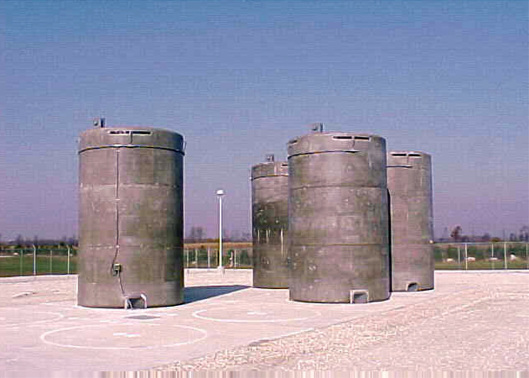
All the uranium ever burned and extracted from reactors at Exelon’s Nine Mile Point and James A. FitzPatrick nuclear facilities remains at the sites, within sight of the Lake Ontario shoreline in Scriba. After several years in a cooling pool adjacent to the reactor itself, the depleted uranium is entombed in steel and concrete silos (known as dry cask storage) at a separate part of the plants’ campuses.
Dry cask storage is “designed to contain radiation, manage heat and prevent nuclear fission. They must resist earthquakes, projectiles, tornadoes, floods, temperature extremes and other scenarios,” according to the Nuclear Regulatory Commission (NRC), which oversees all nuclear plants in the United States. While licensed on a 20-year basis and in most cases built to be effective for more than 100 years, dry cask installations are nevertheless not designed to last forever — unlike the radiation emanating from the uranium.
There’s a lot of science involved in using uranium to power our homes and businesses, but the solution to its waste problem is undeniably a political one.
The federal Nuclear Waste Policy Act of 1982 mandated the Department of Energy to find a solution to the problem of how to collect, transport and store American nuclear waste in a central location. Four decades later, the spent uranium from FitzPatrick and Nine Mile Point’s reactors still sits in Scriba, enjoying its lakeside view.
In 1987, Yucca Mountain, Nevada, was selected from a pool of eight potential sites to host the nation’s geological repository for high-level nuclear waste.

According to the NRC, the Yucca Mountain facility would look basically as follows:
1. Canisters of waste, sealed in special casks, are shipped to the site by truck or train.
2. Shipping casks are removed, and the inner tubes with the waste are placed in steel, multilayered storage containers.
3. An automated system sends storage containers underground to the tunnels.
4. Containers are stored along the tunnels, on their sides.
Unsurprisingly, this was not a universally popular decision with the people of Nye County, Nevada, where Yucca Mountain is located.
NRC documents describe the scenes at the first public hearings in Nye County about the project in 1999 and 2000, after more than a decade of geological studies and environmental impact research.
“The citizens expressed concern about why they felt they couldn’t trust the government and were afraid of being lied to,” read one section of a report prepared by the Center for Nuclear Waste Regulatory Analyses.
In addition to the scientific challenges of building a facility capable of withstanding one million years of natural disasters (an actual court-ordered requirement), the NRC found they had to deal with unexpected human hurdles
“At one of the meetings a local politician attended the meeting with his own television reporter and used the meeting as a venue for grandstanding,” the report said. “His comments off camera to the NRC staff were very complimentary, but on camera he took a much harsher stance.”
U.S. Sen. Kirsten Gillibrand, D-NY, has indicated that while she believes a federal repository is the best solution to spent uranium storage, she would not demand the construction of one without the consent of its local communities.
“Senator Gillibrand believes we must find a permanent solution for spent fuel storage and the Department of Energy should work with the states and with Congress to find an acceptable site,” said Gillibrand spokesperson Miriam Cash. “There should be a federal repository for permanently storing civilian nuclear waste and communities in New York should not have to be required to store it on-site for decades.”
Funds for the Yucca Mountain licensing review process finally ran out in 2011 and no meaningful progress has been made since that point, according to federal nuclear officials.
Secretary of Energy Stephen Chu, a member of President Barack Obama’s administration, dubbed Yucca Mountain “off the table” in 2009, but clearly, the table still has room to accommodate its return.
Yucca Mountain sits in the middle of the Nevada desert roughly 100 miles northwest of Las Vegas. Since the site’s selection in 1987 as the national spent fuel repository from a pool of eight other locations, the Department of Energy has run into roadblocks from local and environmental interests and, perhaps most importantly, opposition from Nevada Democrat Harry Reid. Reid represented Nevada in the U.S. Senate for 30 years beginning in 1987 and deftly wielded his influence, including as Senate majority leader, to stifle Yucca Mountain progress until his 2017 retirement. That was the same year President Donald Trump’s first executive budget contained funds to restart the research into a feasible transition from individual reactor site dry cask storage to a national repository system.
Executive budgets are not law, however, and while Trump’s public support for more than $100 million in funding symbolized yet another component in his industry-friendly administration’s larger platform, Congress has yet to approve any of the dollars.
“The political debate rages on,” Rod McCullum of the Nuclear Energy Institute, an industry advocacy group based in Washington, D.C., told The Palladium-Times in a recent interview. “The scientific and technical basis is as strong as ever, but the political will to move forward is as weak as ever.”
Any meaningful change in funding for the Yucca Mountain licensing review would would need to come from Congress, but in a legislative body where in the best of times progress is measured in subatomic increments, the current health crisis has brought all non-COVID-19 discussion to an indefinate halt.
In a statement on the topic of dry cask storage versus a federal repository, U.S. Rep. Anthony Brindisi, D-Utica, expressed support for a “bipartisan solution that identifies and funds a permanent storage solution” and removing the spent uranium from its sites. Brindisi is also a co-sponsor on H.R. 2314, the Nuclear Powers America Act, which provides investment tax credits for nuclear power plants.
The course reversal (and back again) by the federal government isn’t helping matters. As recently as 2018, legislation was proposed funding Yucca Mountain’s review process. For many, the term “nuclear waste” evokes images of leaking barrels of glowing, toxic goo; the boring truth is that spent fuel’s true danger lies more in the quantity than its lack-of-quality. As long as nuclear plants continue to operate in the United States, they will continue to produce waste uranium that must be carefully stored on site in dry cask facilities.
Yucca Mountain’s license application is for a term of 10,000 years. It is unclear if that is a long enough span of time for officials to come to a final decision.
Seth Wallace is the managing editor of The Palladium-Times and a nuclear energy policy enthusiast.
For UK’s new Labour leader, climate action and Green New Deal will be key goals
Business Green 14th April 2020, Newly appointed Labour leader Sir Keir Starmer completed his front bench
team late last week, handing key green positions to a raft of experienced
MPs. Starmer is widely expected to make climate action and Labour’s Green
New Deal a key plank in the Opposition’s offer to the public – a fact
underlined by the handing of specific green briefs to senior MPs. But it
remains to be seen if he retains the unprecedented levels of low carbon
infrastructure funding pledges and nationalisation programmes proposed
under Corbyn’s leadership.
https://www.businessgreen.com/news/4013864/labour-completes-green-shadow-ministerial-lin
President Trump ‘talked about nuclear weapons’ with Vladimir Putin in a call to the Kremlin over the weekend as START Treaty’s expiration looms
- resident Trump told reporters Monday that he discussed nuclear arms control during his latest conversation with Russian President Vladimir Putin
- The president shared phone call with Putin on Sunday just hours after he helped broker a historic deal with the OPEC+ to shore up plummeting oil prices
- Trump revealed the contents of the call during the White House’s daily coronavirus press briefing on Monday evening
- ‘We did talk about the arms. Yes, we did,’ Trump told reporters from the podium. ‘It was a very important part of the call actually’
- Though Trump failed to divulge specifics the Russian president’s press secretary said Putin and Trump spoke of the START Treaty, which is set to expire next year……….. https://www.dailymail.co.uk/news/article-8216245/President-Trump-talked-nuclear-weapons-Vladimir-Putin-call-weekend.html
Multiple COVID-19 cases confirmed among Nuclear Fuel Services employees in Erwin
by WCYB, Wednesday, April 15th 2020 ERWIN, Tenn. — Multiple COVID-19 cases have been confirmed among Nuclear Fuel Services employees in Erwin.
The exact number of employees was not given.
EDF cutting back on its nuclear energy goals
EDF pulls financial targets in response to pandemic, WNN, 15 April 2020 EDF said on 23 March it would lower its 2020 nuclear power production target of 375-390 TWh, but did not say by how much. On 8 April French transmission system operator RTE said that electricity demand in the country had fallen between15% and 20% since the lockdown.
“The economic turmoil that follows from the current health crisis is causing a drop in power demand and is significantly impacting many of the group’s businesses, namely nuclear generation (which EDF indicates is currently under review and will be adjusted significantly below the initial assumption), new-build projects and services,” EDF said. “Consequently, the EDF Group withdraws all its financial targets for 2020, including the lower end of the EBITDA range of EUR17.5 billion, as well as for 2021.”…….
A new decree – published in the Official Journal on 27 March – postponed the deadline for loading of first fuel at EDF’s EPR unit at its Flamanville site in Normandy by four years, to April 2024. Under the currect schedule, the loading of fuel is planned by the end of 2022. …… https://www.world-nuclear-news.org/Articles/EDF-pulls-financial-targets-in-response-to-pandemi
U.S. Energy Dept awards for nuclear students (not for renewable energy ones)
 U.S. Department of Energy Announces Education Awards for the Next Generation of Nuclear Scientists and Engineers, APRIL 14, 2020 WASHINGTON, D.C. – The U.S. Department of Energy (DOE) today announced more than $5 million in awards through the Office of Nuclear Energy’s Integrated University Program. The program offers undergraduate scholarships and graduate fellowships to students pursuing nuclear engineering degrees and other nuclear science and engineering programs relevant to nuclear energy. The awards include 42 scholarships and 34 fellowships for students at 32 U.S. colleges and universities.
“The Integrated University Program is focused on attracting the best and the brightest to nuclear energy professions,” ….https://www.energy.gov/ne/articles/us-department-energy-announces-education-awards-next-generation-nuclear-scientists-and-0
April 15 Energy News — geoharvey
Science and Technology: ¶ “Stronger Action On Climate Change Would Benefit The Economy, Study Finds” • One main argument against taking action on climate change has always been that it’s too expensive. But research published in the journal Nature finds the opposite is true. The net global economic benefit would range between $127 trillion and […]
Coronavirus doubters follow climate denial playbook — RenewEconomy
Observing the US political leaders’ responses to the coronavirus pandemic has been like watching the climate crisis unfold on fast-forward. The post Coronavirus doubters follow climate denial playbook appeared first on RenewEconomy.
via Coronavirus doubters follow climate denial playbook — RenewEconomy
1 This Month

10 March A LIVE WEBINAR THE REAL EFFECTS OF NUCLEAR POWER
What the Industry Isn’t Telling Us
1:00 PM Mountain, 2 pm Central, 3 pm Eastern. Live on the Keepers of the Water Facebook page


18 March Webinar @ 1 PM EST: An Assessment of SMR Projects: The Case of Canada
register for the zoom:
https://us02web.zoom.us/webinar/register/WN_o8BIIOUvQ2ONJR1nta65DQ#/registration


of the week – STOP SMALL MODULAR REACTORS IN CANADA
To see nuclear-related stories in greater depth and intensity – go to https://nuclearinformation.wordpress.com
-
Archives
- March 2026 (18)
- February 2026 (268)
- January 2026 (308)
- December 2025 (358)
- November 2025 (359)
- October 2025 (376)
- September 2025 (258)
- August 2025 (319)
- July 2025 (230)
- June 2025 (348)
- May 2025 (261)
- April 2025 (305)
-
Categories
- 1
- 1 NUCLEAR ISSUES
- business and costs
- climate change
- culture and arts
- ENERGY
- environment
- health
- history
- indigenous issues
- Legal
- marketing of nuclear
- media
- opposition to nuclear
- PERSONAL STORIES
- politics
- politics international
- Religion and ethics
- safety
- secrets,lies and civil liberties
- spinbuster
- technology
- Uranium
- wastes
- weapons and war
- Women
- 2 WORLD
- ACTION
- AFRICA
- Atrocities
- AUSTRALIA
- Christina's notes
- Christina's themes
- culture and arts
- Events
- Fuk 2022
- Fuk 2023
- Fukushima 2017
- Fukushima 2018
- fukushima 2019
- Fukushima 2020
- Fukushima 2021
- general
- global warming
- Humour (God we need it)
- Nuclear
- RARE EARTHS
- Reference
- resources – print
- Resources -audiovicual
- Weekly Newsletter
- World
- World Nuclear
- YouTube
-
RSS
Entries RSS
Comments RSS
 nuclear-news