Artificial Intelligence in nuclear weapons and military systems
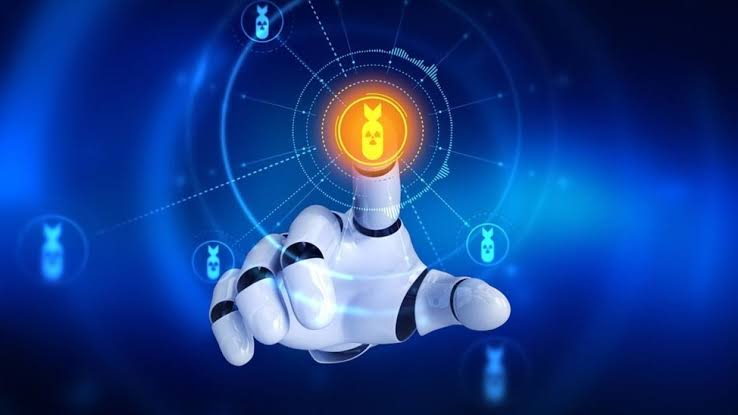
Inside the grave new world of Atomic AI While AI is shifting Asia’s nuclear battle space, it has the potential not only to destroy humanity – but also to shield it, Asia Times, By ANDREW SALMON, APRIL 13, 2020 Stand by. Terminator-style nuclear weapons and systems are coming to a military near you.
Unmanned aerial vehicles, unmanned underwater vehicles and space planes are likely to be “the AI-enabled weapons of choice for future nuclear delivery,” a leading military think tank revealed during a recent seminar in Seoul.
AI, or artificial intelligence, enables faster decision-making than humans and can replace humans in the decision matrix at a time when leadership reacts too slowly – or is dead.
The Stockholm International Peace Research Institute, or SIPRI, released its report The Impact of Artificial Intelligence on Strategic Stability and Nuclear Risk Volume II; East Asian Perspectives in a forum hosted by the Swedish Embassy in Seoul.
|
The question is whether weaponized AI, through its deterrent or defensive purposes, is a risk ameliorator or whether by either bringing new or enhanced capabilities to new theaters of combat, and by obviating existing systems and weapons, it generates yet steeper risks. Lora Saalman, the report’s editor, notted that AI is “a suite of technologies, not a technology.”………. The development and deployment of AI-enhanced platforms “have both been shaped by and have contributed to an interlocking series of national biases and assumptions that are driving AI integration and decision-making,” SIPRI noted. One area where these biases and assumptions interlock is in “Dead Hand” – the autonomous capability of a state to retaliate even when its leadership has been wiped out……… other assets are downright alarming. Underwater atomic drones On the offensive front, strategic bombers and missile-armed submarines may be replaced by robots. Platforms such as unmanned underwater vehicles (UUVs), unmanned aerial vehicles (UAVs) and spaceplanes “… provide resiliency and survivability,” SIPRI noted. “These two aims indicate why such vehicles are likely to be the AI-enabled platforms of choice for future nuclear delivery.” One such asset is a Russian nuclear-powered, nuclear-capable underwater drone “Poseidon.” Torpedo-shaped, 25-meters long, with a modular nuclear reactor, it can move at more than 100km/h at a depth of 1000 meters and is armed with cobalt weapons. Though not yet in service, in 2019 the Russian Navy ordered 30. “Poseidon is a fantastic machine, but its consequences could be catastrophic,” said South Korean Hwang Il-soon, a nuclear engineer at the School of Mechanical Aerospace and Nuclear Engineering. “It is a kind of dirty bomb – it creates very strong alpha radiation.” “Weapons like Poseidon should be banned not just for their environmental impact but for their negative impact on strategic stability,” said Michiru Nishida, Special Assistant for Arms Control, Disarmament and Non-Proliferation Policy at Japan’s Ministry of Foreign Affairs. “But it is different for a country like Russia that sees it as a stabilizing factor.” Space robot missile killersSome A1-enabled weapons, while defensive in nature, could obviate current weapons and take the arms race into new fields. Russian Vadim Kozyulin, of Moscow’s Pir Center, noted that there is little transparency about the US X-38B orbital test vehicle, a re-entry spacecraft that can land horizontally on runways, but “… it is a Pentagon project … so is designed for military purposes.”……. The Pentagon is developing a new strategy of deploying “ghost fleets” of surface and undersea drones – a doctrine is expected to appear in September, Kozyulin said. With these weapons posing a risk to nuclear submarines, “the Russian and Chinese navies will no longer be sure of their nuclear weapons’ reliability,” he said. ……. In East Asia, remote sensing via reconnaissance satellite networks has already undermined nuclear deterrence. It can also threaten the survivability of nuclear assets, so undermining confidence in deterrence, which “forces parties to rely on more survivable, but less controlled, platforms,” Saalman noted. She noted that in the region, “the AI-enhanced arms race can become more prominent …India, China and the US all working on this.”……. Human vs AI The ultimate fear – one widely featured in science fiction – is whether weaponized AI could supplant or overrule humans……..all depends on the algorithms installed in the machines; once approved by a human leader, those algorithms can enable an autonomous, decision-making machine. ……. Kozyulin suggested that if an appropriate international treaty could be crafted, AI could be embedded in competing nations’ early warning systems, providing autonomous monitoring, fail-safe and de-escalation mechanisms. https://asiatimes.com/2020/04/inside-the-grave-new-world-of-atomic-ai/ |
|
No comments yet.
1 This Month
Chernobyl: The Lost Tapes – A good documentary on Chernobyl on SBS available On Demand for the next 3 weeks– https://www.sbs.com.au/ondemand/tv-program/chernobyl-the-lost-tapes/2352741955560

of the week–London Campaign for Nuclear Disarmament

Tell the Ukrainian Government to Drop Prosecution of Peace Activist Yurii Sheliazhenko
To see nuclear-related stories in greater depth and intensity – go to https://nuclearinformation.wordpress.com
-
Archives
- April 2026 (139)
- March 2026 (251)
- February 2026 (268)
- January 2026 (308)
- December 2025 (358)
- November 2025 (359)
- October 2025 (376)
- September 2025 (257)
- August 2025 (319)
- July 2025 (230)
- June 2025 (348)
- May 2025 (261)
-
Categories
- 1
- 1 NUCLEAR ISSUES
- business and costs
- climate change
- culture and arts
- ENERGY
- environment
- health
- history
- indigenous issues
- Legal
- marketing of nuclear
- media
- opposition to nuclear
- PERSONAL STORIES
- politics
- politics international
- Religion and ethics
- safety
- secrets,lies and civil liberties
- spinbuster
- technology
- Uranium
- wastes
- weapons and war
- Women
- 2 WORLD
- ACTION
- AFRICA
- Atrocities
- AUSTRALIA
- Christina's notes
- Christina's themes
- culture and arts
- Events
- Fuk 2022
- Fuk 2023
- Fukushima 2017
- Fukushima 2018
- fukushima 2019
- Fukushima 2020
- Fukushima 2021
- general
- global warming
- Humour (God we need it)
- Nuclear
- RARE EARTHS
- Reference
- resources – print
- Resources -audiovicual
- Weekly Newsletter
- World
- World Nuclear
- YouTube
-
RSS
Entries RSS
Comments RSS
 nuclear-news
Leave a comment