 Wildfires near Chernobyl under control, Ukrainian authorities say, By Jack Guy and Mary Ilyushina, CNN, April 14, 2020 The fires reportedly came within two kilometers of the Chernobyl nuclear power plant.
April 14, 2020
Posted by Christina Macpherson |
incidents, Ukraine |
Leave a comment

Blaze rages near Chernobyl, endangering abandoned nuclear plant https://www.mercurynews.com/2020/04/13/blaze-rages-near-chernobyl-endangering-abandoned-nuclear-plant/
“A fire approaching a nuclear or hazardous radiation facility is always a risk” By Margaryta Chornokondratenko and Alexander Marrow | Reuters
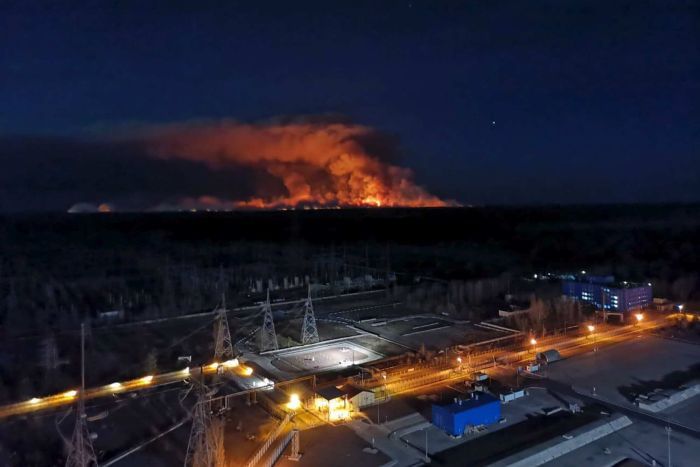
KIEV – A huge forest fire in Ukraine that has been raging for more than a week is now just one kilometer from the defunct Chernobyl nuclear power plant and poses a radiation risk, Greenpeace Russia warned on Monday, citing satellite images.
Ukraine’s Emergency Situations Service said it was still fighting the fires, but that the situation was under control.
Video footage shot by Reuters on Sunday showed plumes of black smoke billowing into the sky and trees still
ablaze, with firefighters in helicopters trying to put out the fires.
Aerial images of the 19 mile exclusion zone around the plant, site of the world’s worst nuclear accident in 1986, showed scorched, blackened earth and the charred stumps of still smoldering trees.
The Emergency Situations Service said radiation levels in the exclusion zone had not changed and those in nearby Kiev, the Ukrainian capital, “did not exceed natural background levels.”
Greenpeace Russia said the situation is much worse than Ukrainian authorities believe, and that the fires cover an area one thousand times bigger than they claim.
On April 4 Ukrainian authorities said the blaze covered an area of 20 hectares, but Greenpeace cited satellite images showing it was around 12,000 hectares in size at that time.
“According to satellite images taken on Monday, the area of the largest fire has reached 34,400 hectares,” it said, adding that a second fire, stretching across 12,600 hectares, was just one kilometer away from the defunct plant.
Ukrainian officials did not immediately respond to a request for comment on those claims.
Rashid Alimov, head of energy projects at Greenpeace Russia, said the fires, fanned by the wind, could disperse radionuclides, atoms that emit radiation.
“A fire approaching a nuclear or hazardous radiation facility is always a risk,” Alimov said. “In this case we’re hoping for rain tomorrow.”
Chernobyl tour operator Yaroslav Yemelianenko, writing on Facebook, described the situation as critical.
He said the fire was rapidly expanding and had reached the abandoned city of Pripyat, two kilometers from where “the most highly active radiation waste of the whole Chernobyl zone is located.” He called on officials to warn people of the danger.
Satellite images taken by NASA Worldview and seen by Reuters showed the two fires had extended far into the exclusion zone.
The fires, which follow unusually dry weather, began on April 3 in the western part of the exclusion zone and spread to nearby forests. Police say they have identified a 27-year old local resident who they accuse of deliberately starting the blaze.
It remains unclear if the person, who has reportedly confessed to starting a number of fires “for fun,” is partly or fully responsible.
April 14, 2020
Posted by Christina Macpherson |
incidents |
Leave a comment


The major impact of coronavirus on the trajectory of climate change must not be a temporary reduction in emissions from cars, trucks and airplanes. It must be a collective recognition that rapid and significant voluntary changes in our behavior are possible. For individual climate action to be sustained, people must find honor and joy in it. And that action must also be supported by government leadership and coordination. We must advocate now, as vocally as we can, for immediate and significant investments in green infrastructure. To avert disaster, we must change how we live.
The Coronavirus and Climate Action https://blogs.scientificamerican.com/observations/the-coronavirus-and-climate-action/ Confronting global warming will take a completely different approach from confronting the pandemic, By Laura J. Martin on April 10, 2020
In recent weeks, many Americans have voluntarily and radically altered their behavior in order to protect others from the novel coronavirus. Those who are less vulnerable are making sacrifices in order to protect those who are more vulnerable: the elderly, the immunocompromised, and—in our country, with its broken social safety net—the uninsured and the poor.
Climate scientists have been quick to draw parallels between the need to “flatten the curve” of coronavirus spread and the need to flatten the carbon emissions curve. The Intergovernmental Panel on Climate Change states that we must reduce emissions by about 45 percent from 2010 levels by 2030 in order to lessen the severity of future emergency; to reduce, but not eliminate, the probability of catastrophic changes in sea level, ocean acidity, extreme weather, food security and biodiversity.
But confronting climate change will require a completely different generational politics than confronting coronavirus. Rather than young people changing their lifestyles to protect the elderly, the large and growing proportion of older citizens in industrialized countries will have to change their lifestyles in order to protect children and those not yet born. Those with power and resources today will have to change their lifestyles dramatically in order to protect the world’s poorest and most marginalized, those who will not be able to move away from climate hazards. This is the message that youth activists like Zero Hour, Isra Hirsi and Greta Thunberg implore us to heed. It is also the premise of DearTomorrow, a storytelling project where people write climate messages to loved ones living in the future.
While such activists argue that individuals must opt to change their lifestyles, to travel less and consume less, others contend that voluntary climate action is a pipe dream. They refer to psychologists and economists who argue that we humans are “hardwired” to prioritize the present over the future, and thereby make decisions that benefit us today, even if they harm us later. This second camp of environmentalists argues that policy makers must enact laws and regulations that radically reshape energy infrastructure and national economies.
Who is right? Continue reading →
April 14, 2020
Posted by Christina Macpherson |
climate change, USA |
Leave a comment

But the speed of the “return to normal” is not the only thing that matters. The manner in which the world’s leaders manage the colossal economic and political shocks caused by the virus is also of the utmost importance. And at the top of their list of priorities, alongside human welfare, must be the biosphere and its future.
It’s too soon to say with any confidence what impact coronavirus will have on the climate emergency. The brakes placed on economic activities of many kinds, worldwide, have led to carbon emission cuts that would previously have been unthinkable: 18% in China between February and March; between 40% and 60% over recent weeks in Europe. Habits and behaviours once regarded as sacrosanct have been turned on their heads: road traffic in the UK has fallen by 70%. Global air traffic has halved. Meanwhile, a much-needed spotlight has been thrown on humans’ troubling relationship to wildlife, with some experts arguing that the degradation of the natural world and exploitation of other species is among the pandemic’s causes.
In human terms, the economic contraction precipitated by the virus – and predicted by the World Bank to lead to a severe depression – is sure to be brutal. No one, and least of all an elected government, would have chosen to limit emissions in this way. But if further savage waves of destruction to people’s livelihoods are to be avoided, rather than simply stored up or ignored until they become unignorable, just as coronavirus was, every possible effort must now be made to ensure that the recovery, when it comes, is as green as possible; that any and every stimulus package is directed towards renewable energy and zero- or low-carbon infrastructure and transport.
The urgency and desperation surrounding all such efforts are likely to militate against progressive measures. Already, governments are coming under huge pressure to bail out oil and gas companies (in the US and Canada this has already begun). But while in the short term the low oil price, which is also the result of a price war being waged by Saudi Arabia and Russia, could have the damaging effect of making oil more competitive against renewables, plunging demand and turmoil in the industry provide an opportunity that must be seized by all who oppose the continued dominance of fossil fuels.
There are other questions besides the future of oil that the crisis has opened up in unexpected ways. Huge political shifts are under way, with fiscally conservative governments such as Boris Johnson’s intervening in economies to an unprecedented extent. What was once impossible (socialist, reckless) now turns out not to be, at all. Could the renewed shock of human vulnerability in the face of Covid-19 make way for an increased willingness to face other perils, climate chaos among them?
Impossible to say at this stage, perhaps. Certainly not without a fight against all those who will promote a return to business (and emissions) as usual. But with the postponement of crucial UN biodiversity and climate conferences, it has never been more important to keep up the pressure. There is no exit strategy from our planet.
|
|
April 14, 2020
Posted by Christina Macpherson |
2 WORLD, climate change |
Leave a comment
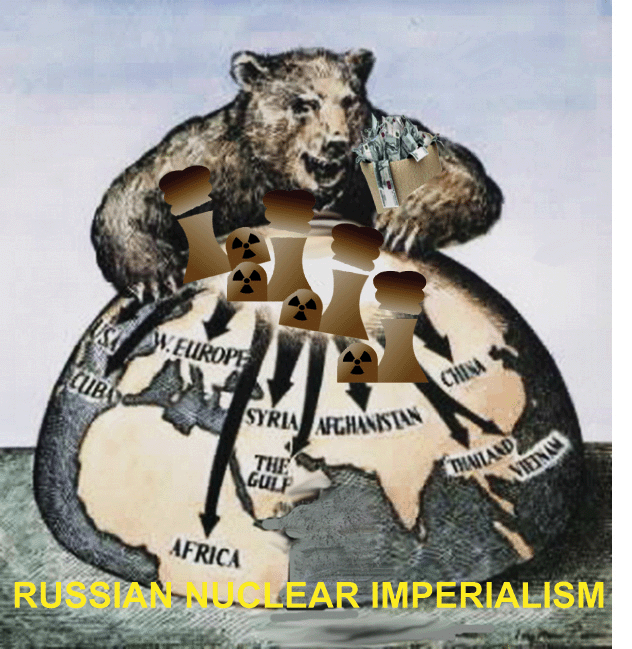
Belarus Says New Nuclear Power Plant To Go Online In Autumn, Radio Free Europe, 13 Apr 20, Officials in Minsk say a nuclear power plant being constructed in western Belarus will be launched during the summer and start producing electricity in the autumn…..
The plant is being built in the town of Astravets near the border with Lithuania. It is just 40 kilometers from Lithuania’s capital, Vilnius.
In January, Lithuanian Energy Minister Zygimantas Vaiciunas told RFE/RL that the Belarusian plant is “a threat to our national security, public health, and environment.”
“The key question is the site selection, which was done politically — geopolitically,” Vaiciunas told RFE/RL.
Plans for the nuclear plant were unveiled by Belarusian President Alyaksandr Lukashenka in 2008 when Minsk received a $10 billion loan from Moscow for the project.
The general contractor for the Belarusian nuclear power plant building is Atomstroiexport, an affiliate of Russia’s state-owned Rosatom. Based on reporting by TASS, ONT, and RFE/RL correspondent Matthew Luxmoore
April 14, 2020
Posted by Christina Macpherson |
Belarus, politics international |
Leave a comment
 Radioactive Waste Regulations – Scotland

The Ferret 12th April 2020, More than 5,000 business sites across Scotland are going to escape
judgement on their environmental breaches in 2020 because of the coronavirus pandemic. Environmental rules governing radioactive waste, fish farming, recycling and other sectors are also being relaxed by the Scottish
Environment Protection Agency (Sepa) to help companies cope with Covid-19.
The Faslane nuclear base and nuclear power plants have been given the green light to break safety limits on radioactive waste. Sepa has relaxed environmental rules for specific sectors, notably the military and civil
nuclear industry. A “temporary regulatory position statement” posted on its website offered radioactive waste exemptions to the Faslane navel base on the Clyde, as well as nuclear plants at Hunterston in North Ayrshire,
Torness in East Lothian and Dounreay in Caithness.
“During a significant outbreak of Covid-19 the ability of operators to run their operations may be compromised by a lack of available staff,” the statement said. “We expect operators to be ensuring that the impacts of Covid-19 on the environment are minimised. We recognise, however, that in some cases operators may be unable to comply for reasons beyond their control.” It added: “Any failure by the operator to comply with the conditions of their authorisation will not be treated as a non-compliance”. This only applied “where non-compliance with authorisation conditions is unavoidable and a direct result of emergency resulting from Covid-19 outbreak and will not lead to significant environmental harm,” Sepa said.
The Scottish Campaign for Nuclear Disarmament warned that more dangerous radioactivity could be discharged into the environment. “It is outrageous to suggest that the pandemic is a reason for relaxation of the regulatory
requirements,” said campaign chair, Lynn Jamieson. “Willingness to tolerate possible breaches of regulations by civil or military nuclear facilities demonstrates shocking inadequacy on the part of the Scottish Environment Protection Agency. Whose environment are they in place to protect?”
The nuclear-free group of local authorities also expressed concern. “These new rules from Sepa seem to allow further leeway on nuclear sites over the handling of radioactive waste,” said the group’s vice convenor in Scotland, Renfrewshire SNP councillor Audrey Doig. “Sepa should be very wary of relaxing rules and find ways of continuing to
regulate the industry in the robust, safe and secure way the public expects.”
https://theferret.scot/pollution-checks-coronavirus-crisis-sepa/
The National 12th April 2020
https://www.thenational.scot/news/18374483.polluters-given-free-pass-coronavirus-crisis/
April 14, 2020
Posted by Christina Macpherson |
safety, UK |
Leave a comment

Inside the grave new world of Atomic AI While AI is shifting Asia’s nuclear battle space, it has the potential not only to destroy humanity – but also to shield it, Asia Times, By ANDREW SALMON, APRIL 13, 2020 Stand by. Terminator-style nuclear weapons and systems are coming to a military near you.
Unmanned aerial vehicles, unmanned underwater vehicles and space planes are likely to be “the AI-enabled weapons of choice for future nuclear delivery,” a leading military think tank revealed during a recent seminar in Seoul.
AI, or artificial intelligence, enables faster decision-making than humans and can replace humans in the decision matrix at a time when leadership reacts too slowly – or is dead.
The Stockholm International Peace Research Institute, or SIPRI, released its report The Impact of Artificial Intelligence on Strategic Stability and Nuclear Risk Volume II; East Asian Perspectives in a forum hosted by the Swedish Embassy in Seoul.
|
The question is whether weaponized AI, through its deterrent or defensive purposes, is a risk ameliorator or whether by either bringing new or enhanced capabilities to new theaters of combat, and by obviating existing systems and weapons, it generates yet steeper risks.
Lora Saalman, the report’s editor, notted that AI is “a suite of technologies, not a technology.”……….
The development and deployment of AI-enhanced platforms “have both been shaped by and have contributed to an interlocking series of national biases and assumptions that are driving AI integration and decision-making,” SIPRI noted.
One area where these biases and assumptions interlock is in “Dead Hand” – the autonomous capability of a state to retaliate even when its leadership has been wiped out………
other assets are downright alarming. Underwater atomic drones
On the offensive front, strategic bombers and missile-armed submarines may be replaced by robots. Platforms such as unmanned underwater vehicles (UUVs), unmanned aerial vehicles (UAVs) and spaceplanes “… provide resiliency and survivability,” SIPRI noted. “These two aims indicate why such vehicles are likely to be the AI-enabled platforms of choice for future nuclear delivery.”
One such asset is a Russian nuclear-powered, nuclear-capable underwater drone “Poseidon.” Torpedo-shaped, 25-meters long, with a modular nuclear reactor, it can move at more than 100km/h at a depth of 1000 meters and is armed with cobalt weapons. Though not yet in service, in 2019 the Russian Navy ordered 30.
“Poseidon is a fantastic machine, but its consequences could be catastrophic,” said South Korean Hwang Il-soon, a nuclear engineer at the School of Mechanical Aerospace and Nuclear Engineering. “It is a kind of dirty bomb – it creates very strong alpha radiation.”
“Weapons like Poseidon should be banned not just for their environmental impact but for their negative impact on strategic stability,” said Michiru Nishida, Special Assistant for Arms Control, Disarmament and Non-Proliferation Policy at Japan’s Ministry of Foreign Affairs. “But it is different for a country like Russia that sees it as a stabilizing factor.”
Space robot missile killers
Some A1-enabled weapons, while defensive in nature, could obviate current weapons and take the arms race into new fields.
Russian Vadim Kozyulin, of Moscow’s Pir Center, noted that there is little transparency about the US X-38B orbital test vehicle, a re-entry spacecraft that can land horizontally on runways, but “… it is a Pentagon project … so is designed for military purposes.”…….
The Pentagon is developing a new strategy of deploying “ghost fleets” of surface and undersea drones – a doctrine is expected to appear in September, Kozyulin said. With these weapons posing a risk to nuclear submarines, “the Russian and Chinese navies will no longer be sure of their nuclear weapons’ reliability,” he said.
……. In East Asia, remote sensing via reconnaissance satellite networks has already undermined nuclear deterrence. It can also threaten the survivability of nuclear assets, so undermining confidence in deterrence, which “forces parties to rely on more survivable, but less controlled, platforms,” Saalman noted.
She noted that in the region, “the AI-enhanced arms race can become more prominent …India, China and the US all working on this.”…….
Human vs AI The ultimate fear – one widely featured in science fiction – is whether weaponized AI could supplant or overrule humans……..
all depends on the algorithms installed in the machines; once approved by a human leader, those algorithms can enable an autonomous, decision-making machine. …….
Kozyulin suggested that if an appropriate international treaty could be crafted, AI could be embedded in competing nations’ early warning systems, providing autonomous monitoring, fail-safe and de-escalation mechanisms. https://asiatimes.com/2020/04/inside-the-grave-new-world-of-atomic-ai/
|
|
April 14, 2020
Posted by Christina Macpherson |
2 WORLD, weapons and war |
Leave a comment
|
A necessary win-win for Washington and Pyongyang?
by Cynthia Lazaroff Follow @CynthiaLazaroff on Twitter 13 Apr 20, Amidst the existential nightmare unfolding with the coronavirus, comes the news that North Korea has ramped up its missile testing and lost all interest in a dialogue with the United States. At a March meeting with G-7 Foreign Ministers, Secretary of State Pompeo called on all nations to maintain diplomatic and economic pressure on North Korea over its nuclear and ballistic missile programs. Pompeo’s ill-timed call to uphold sanctions even during the global pandemic escalated tensions and triggered Pyongyang’s chilling response: North Korea has become “more zealous for our important planned projects aimed to repay the U.S. with actual horror and unrest for the sufferings it has inflicted upon our people.”
While some may call this mere bluster, Pyongyang’s warning serves as a grim reminder that the existential nuclear threat is not going on lockdown during this pandemic. It is a clear and present danger like COVID-19, invisible but very much alive. And like the virus, it has been ignored for perilously too long. Former U.S. Secretary of Defense William J. Perry has sounded the alarm: “Today, the danger of some sort of a nuclear catastrophe is greater than it was during the Cold War and most people are blissfully unaware of this danger.”
We are now awake to the COVID-19 catastrophe, the enormity of the pain and suffering, the staggering human and economic costs. Worst case projections estimate that COVID-19 deaths could be in the millions globally, with variable forecasts over the past month for America. Estimates show Americans could lose anywhere from 60,000 to 2.2 million or more of their loved ones to the virus because Washington ignored repeated warnings and failed to act before it was too late. This is the price of sleepwalking in the face of this existential threat, which is horrific, but these numbers nonetheless pale in comparison to the estimated tens of millions in North and South Korea, Japan, Guam, Hawaii and beyond who could die in the mass carnage if nuclear weapons were to be launched by Kim or Trump in a moment of anger, accident, miscalculation or mistake.
Existential threats by nature do not discriminate. Like nuclear weapons, COVID-19 attacks human beings indiscriminately, oblivious to race, religion, gender, ideology or country of origin. Like radioactive fallout, the virus does not recognize borders, and like nuclear war, it spares no one—whether rich, poor, Korean, American, sanctioned or unsanctioned.
If Washington doesn’t take emergency measures to stop the spread of COVID-19 in the human population as a whole, America fails to do so at its own peril. Outbreaks in other countries increase the risk of outbreaks around the world. This is why it makes no sense to uphold sanctions that in any way hinder a country’s capacity to combat the virus. U.N. High Commissioner for Human Rights Michelle Bachelet has called for humanitarian exemptions to sanctions because “in a context of global pandemic, impeding medical efforts in one country heightens the risk for all of us.” In other words, what America does to the people of North Korea, Iran, Venezuela, Russia, Cuba and other sanctioned countries, America does to itself.
If Washington doesn’t take emergency measures to stop the spread of COVID-19 in the human population as a whole, America fails to do so at its own peril. Outbreaks in other countries increase the risk of outbreaks around the world. This is why it makes no sense to uphold sanctions that in any way hinder a country’s capacity to combat the virus. U.N. High Commissioner for Human Rights Michelle Bachelet has called for humanitarian exemptions to sanctions because “in a context of global pandemic, impeding medical efforts in one country heightens the risk for all of us.” In other words, what America does to the people of North Korea, Iran, Venezuela, Russia, Cuba and other sanctioned countries, America does to itself.
Guterres calls on Americans further to unite now in solidarity to protect the most vulnerable and susceptible to COVID-19 everywhere—those ravaged by war, women, children, the elderly, homeless and displaced populations, along with those living in the poorest countries with weak health care infrastructures like North Korea. During this global existential crisis, Bachelet and Guterres are inviting Americans to rise to the better angels of our nature, transcend our differences and get our priorities straight: to stop wasting precious time and resources on conflict and war and mobilize as a “human family” to give it everything we’ve got to save lives.
If the United States applies Bachelet and Guterres’ recommendations to North Korea, Washington can make progress on the existential threat of COVID-19 and the existential threat of a nuclear exchange with Pyongyang. America and North Korea can work together to halt the spread of COVID-19, thereby create goodwill and de-escalate tensions. Washington can and should take further steps to reduce tensions and the risk of a nuclear missile launch due to anger, accident, miscalculation or mistake.
Here are five steps the United States should take right now:
-
Provide broad exemptions for sanctions to make possible the immediate and widespread distribution of critical medical aid, testing equipment and supplies. While North Korea has not admitted to a single case of COVID-19, this is disputed and considered highly unlikely. Whatever the case may be, it is critical to provide exemptions for North Korea and all sanctioned countries to contain the spread of the virus.
-
Take the lead by providing direct cooperation and medical aid to North Korea to contain the spread of COVID-19 as offered by President Trump in his recent letter to Kim Jong-un.
-
Fund and cooperate fully with the international initiatives underway at the United Nations and World Health Organization to stop the transmission of COVID-19 in North Korea and all countries. COVID-19 is a global challenge requiring global solutions implemented both locally and globally. The UN and WHO are best positioned to coordinate efforts on a global scale fairly and effectively.
-
Sign a Peace Agreement to end the Korean War. This will immediately reduce tensions and rebuild trust, reunite families and directly impact the lives of seventy million Koreans living in the world today.
-
Adopt a no-first-use policy for nuclear weapons. A no-first use pledge would send an important signal to Kim Jong-un and America’s other adversaries. It would eliminate the threat of a U.S. preemptive first strike and demonstrate that the United States views its weapons as deterrents to nuclear warfare, not as tools of aggression. It would further reduce the risk of a nuclear exchange and help create the conditions to make it possible for North Korea to denuclearize.
Americans wake up every morning to soaring death tolls, the tragic cost of waiting too long to act to contain COVID-19. It is already late—for the United States, for North Korea, for the world. Millions of lives are at stake. The time to act on these existential threats is now.
Cynthia Lazaroff is an expert on U.S.-Russia relations, a documentary film producer, and environmental activist. She has been engaged in Track II and 1.5 dialogue for the past forty years and has directed several films on the Soviet Union and nuclear proliferation. You can follow her on Twitter @CynthiaLazaroff.
|
|
April 14, 2020
Posted by Christina Macpherson |
North Korea, politics international, USA |
Leave a comment






 nuclear-news