Confusion over which American military satellites are “nuclear” and which are “nonnuclear.”
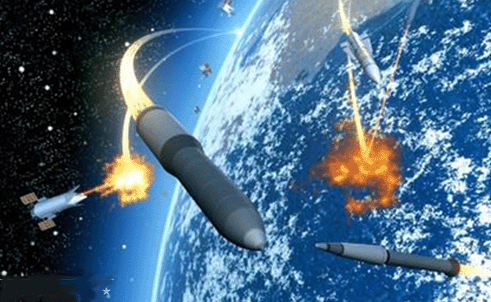 Space-Based Nuclear Command and Control and the ‘Non-Nuclear Strategic Attack’ Space-Based Nuclear Command and Control and the ‘Non-Nuclear Strategic Attack’Counterspace capabilities may meet dual-purpose command and control assets to create new risks. The Diplomat, By Ankit Panda, April 08, 2020 The Trump administration’s 2018 Nuclear Posture Review (NPR) drew much attention for the inclusion of language expanding the scope under which the United States might employ nuclear weapons. Specifically, the document observed that certain “extreme circumstances,” which “could include significant non-nuclear strategic attacks,” would rise to the level of meriting a nuclear response. In remarks delivered during an online video conference this week, Christopher Ford, U.S. assistant secretary at the State Department’s Bureau of International Security and Nonproliferation, discussed this language in the context of space security. Ford emphasized that for the purposes of parsing that bit of the 2018 NPR, American adversaries should understand that U.S. space-based dual-use (nuclear and nonnuclear) command and control assets qualified as what the 2017 National Security Strategy had dubbed a “vital U.S. interest.” Accordingly, Ford continues: “I need hardly point out — but I will nonetheless, for emphasis — that the U.S. National nuclear Command, Control, and Communications (NC3) architecture depends to some extent upon space-based systems.” He is clear therefore that nonnuclear attacks on this architecture would potentially rise to the level of a nuclear response: “Any harmful interference with or attacks upon such components of our space architecture at any time, even if undertaken only with non-nuclear tools, thus starts to move into ‘significant non-nuclear strategic attack’ territory, and would lead to a significant and potentially drastic escalation of a crisis or conflict.” Much of what Ford says here is not new or surprising, but his remarks offer one of the starker presentations of these ideas by a U.S. official in recent years — at least since the release of the 2018 NPR. The problem that arises is one of “entanglement,” where a crisis might escalate to the nuclear level inadvertently if an adversary — say China — is attempting to degrade U.S. conventional operations by taking aim at certain space-based assets. Though the United States openly acknowledges the role of space-based assets in nuclear command and control, there is no explicit tabulation of which American military satellites are “nuclear” and which are “nonnuclear.”….. https://thediplomat.com/2020/04/space-based-nuclear-command-and-control-and-the-non-nuclear-strategic-attack/ |
|
|
No comments yet.
1 This Month


Tell the Ukrainian Government to Drop Prosecution of Peace Activist Yurii Sheliazhenko

Petition to revoke the licensing of the Near Surface Nuclear Disposal Facility (NSDF) at Chalk River. https://www.ourcommons.ca/petitions/en/Petition/Details?Petition=e-7247


of the week – STOP SMALL MODULAR REACTORS IN CANADA
To see nuclear-related stories in greater depth and intensity – go to https://nuclearinformation.wordpress.com
-
Archives
- March 2026 (204)
- February 2026 (268)
- January 2026 (308)
- December 2025 (358)
- November 2025 (359)
- October 2025 (376)
- September 2025 (258)
- August 2025 (319)
- July 2025 (230)
- June 2025 (348)
- May 2025 (261)
- April 2025 (305)
-
Categories
- 1
- 1 NUCLEAR ISSUES
- business and costs
- climate change
- culture and arts
- ENERGY
- environment
- health
- history
- indigenous issues
- Legal
- marketing of nuclear
- media
- opposition to nuclear
- PERSONAL STORIES
- politics
- politics international
- Religion and ethics
- safety
- secrets,lies and civil liberties
- spinbuster
- technology
- Uranium
- wastes
- weapons and war
- Women
- 2 WORLD
- ACTION
- AFRICA
- Atrocities
- AUSTRALIA
- Christina's notes
- Christina's themes
- culture and arts
- Events
- Fuk 2022
- Fuk 2023
- Fukushima 2017
- Fukushima 2018
- fukushima 2019
- Fukushima 2020
- Fukushima 2021
- general
- global warming
- Humour (God we need it)
- Nuclear
- RARE EARTHS
- Reference
- resources – print
- Resources -audiovicual
- Weekly Newsletter
- World
- World Nuclear
- YouTube
-
RSS
Entries RSS
Comments RSS
 nuclear-news
Leave a comment