U.S. Nuclear Regulatory Commission proposing dumping some nuclear wastes in landfills – a huge public health danger
|
NRC Proposes Allowing Nuclear Waste at Dumps, Recycling Sites https://www.publicnewsservice.org/2020-04-06/nuclear-waste/nrc-proposes-allowing-nuclear-waste-at-dumps-recycling-sites/a69794-1 April 6, 2020. BOISE, Idaho — The Nuclear Regulatory Commission may change its rules to allow the nuclear industry to dump some of its waste in landfills. Opponents say the change poses a public health risk and would allow waste to go unmonitored. The proposal would enable the NRC to reinterpret the meaning of low-level radioactive waste so that it could be accepted at dumps and hazardous waste sites, rather than regulated storage facilities. Daniel Hirsch is president of Committee to Bridge the Gap, an organization that focuses on nuclear safety. He says a dump site in Idaho would benefit from this change. “In addition to the waste potentially going to everyone’s municipal landfill, the real focus of this is to allow the U.S. Ecology facility in Idaho to — without a license — start taking the material that up until today you’re required to have a license for,” he points out. On Friday, the public comment period was extended from April 20 to July 20. But Hirsch and other opponents say the COVID-19 pandemic isn’t allowing for proper scrutiny of the rule. They want it picked back up six months after the coronavirus crisis is over. Diane D’Arrigo, radioactive waste project director for the Nuclear Information and Resource Service, says the change would allow the industry to dispose of any waste other than irradiated fuel at landfills. That includes concrete, soil, clothing or any material where radiation still exists. The limit would be 25 millirem per year, a unit of absorbed radiation. D’Arrigo says the change poses a big public health risk. “There’s some so-called low-level waste that could give a lethal dose in 15 minutes if you’re exposed unshielded,” Terry Lodge, an attorney who works on nuclear safety issues, says the industry has been working for this change for decades because of the cost of disposing waste at radioactive-storage facilities. “The utilities build the expense of disposing of the waste into their electrical charges to us customers,” he points out. “So it’s not as though they don’t have the money. But there is a relentless search for quick and dirty solutions.” |
|
As at 5 April, radiation levels in Chernobyl area were 16 times above normal, due to forest fires
 A FIRE AT CHERNOBYL IS RELEASING LARGE AMOUNTS OF RADIATION, https://futurism.com/the-byte/fire-chernobyl-releasing-radiation APRIL 6TH 20__JON CHRISTIAN__ Ukrainian authorities say a forest fire is causing radiation levels to spike in the area of Chernobyl, a nuclear power plant that melted down in 1986.“There is bad news — in the center of the fire, radiation is above normal,” wrote Egor Firsov, the head of Ukraine’s ecological inspection service, in a Facebook post. “As you can see in the video, the readings of the [Geiger counter] are 2.3, when the norm is 0.14. But this is only within the area of the fire outbreak.” A FIRE AT CHERNOBYL IS RELEASING LARGE AMOUNTS OF RADIATION, https://futurism.com/the-byte/fire-chernobyl-releasing-radiation APRIL 6TH 20__JON CHRISTIAN__ Ukrainian authorities say a forest fire is causing radiation levels to spike in the area of Chernobyl, a nuclear power plant that melted down in 1986.“There is bad news — in the center of the fire, radiation is above normal,” wrote Egor Firsov, the head of Ukraine’s ecological inspection service, in a Facebook post. “As you can see in the video, the readings of the [Geiger counter] are 2.3, when the norm is 0.14. But this is only within the area of the fire outbreak.”
Since Chernobyl’s deadly 1986 meltdown, the area around the plant has remained uninhabited — allowing nature to take over the abandoned town. But now the blaze is reigniting the specter of the decades-old disaster site. Residents of the Ukranian capital of Kiev are even concerned about breathing in the radiation, according to The Guardian, which is about 60 miles south of Chernobyl, though Firsov said there was not yet cause for alarm. Authorities say that a 27-year-old man has admitted that he set the fires “for fun,” according to The Guardian. It’s unclear whether the radiation levels will continue to spike or die down as firefighters continue their work in the area, but Firsov said that as of Sunday, radiation levels at the site were about sixteen times the norm. |
|
Georgia’s Vogtle nuclear project way over budget, way behind time, and now Coronavirus hits

First coronavirus case reported at Georgia nuclear plant project, William Freebairn Editor, Richard Rubin 6 Apr 20,
- Too early to say if completion delayed: Southern Company
- Additional worker test results pending
Washington — The first coronavirus infection has been confirmed at Georgia Power’s Vogtle nuclear plant construction site, the utility said Monday.There was one confirmed positive test result out of 69 people at the site tested, the company said in a statement. There were 54 negative test results, with 14 results still pending, it added.
Georgia Power and three partners are completing two 1,150-MW nuclear units at Vogtle, near Augusta, with the first new unit scheduled to enter commercial operation in November 2021. The project is the largest industrial construction site
in Georgia, with 9,000 workers, most of them contractors, at the plant, trade union officials have said.
There is a risk the coronavirus pandemic could delay the completion and testing of the two new reactors, although it is too soon to tell for certain, Southern Co., Georgia Power’s parent company, said in a financial filing April 1, before the positive test result.
Construction of the project is about five years behind schedule and has exceeded the initial budget by more than $10 billion as the result of first-of-a-kind design, licensing and construction issues.
The company notified and sent home those who worked with the person who tested positive, Georgia Power said.
“Construction work continues at the site under continuing enhanced protocols designed to reduce worker-to-worker contact and keep areas that workers frequent cleaned and sanitized,” the company said.
In a filing with the Georgia Public Service Commission April 1, Georgia Power officials said the construction site had established an expanded on-site medical clinic and put in place “aggressive” measures to keep workers in the field further apart.
More delay in planning application for UK’s Wylfa Newydd nuclear project
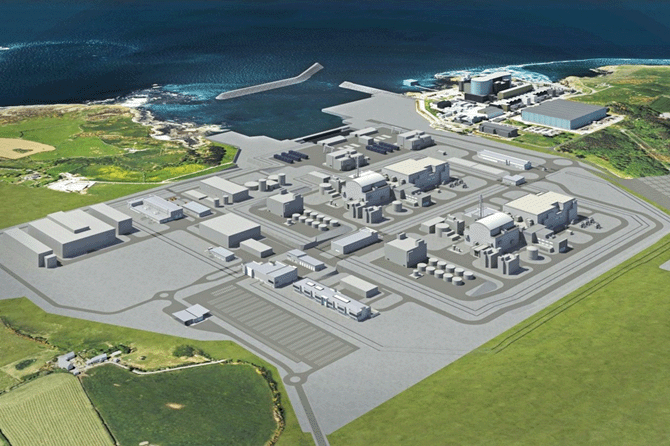
Wylfa Newydd planning decision delayed again, NEI, 6 April 2020 A planning decision over the Wylfa Newydd nuclear power plant in Anglesey has been deferred, the UK Government has confirmed.
The Wylfa Newydd project, which envisaged the construction of two UK advanced boiling water reactors (ABWRs), was suspended in January 2019 after Hitachi, failed to reach a funding deal with the UK government. However, the government had been expected to grant a Development Consent Order to construct the £12 billion power station on 31 March…… The Secretary of State (Alok Sharma) has decided to re-set the statutory deadline for this application to 30 September 2020….'”
…..EDF Energy announced last month that it was delaying submission of its planning application for Sizewell C by a “few weeks” due to the coronavirus crisis. Construction work at Hinkley Point C has also been scaled back. https://www.neimagazine.com/news/newswylfa-newydd-planning-decision-delayed-again-7859280
USA has helped Israel to develop a mighty armory of nuclear missiles

 Israel’s Nuclear Missiles Could Smash You Back to the Stone Age, And that’s just for starters. National Interest, by Caleb Larson 6 Apr 20, Israel’s missile capabilities are perhaps among the most advanced in the Middle East. Through extensive aid from the United States and Europe, as well as collaboration in developing missiles, Israel has been able to nurture a mature domestic missile production capability that has been successful as exports.
Most of Israel’s missiles are relatively short- to medium-range, they also have several missiles in the Jericho family that can reach out into the 1,500 to 4,800-kilometer range (930 to 3000 miles). …… https://nationalinterest.org/blog/buzz/israels-nuclear-missiles-could-smash-you-back-stone-age-141242
277,700 Vietnamese support “Appeal of the Hibakusha ” – call to eliminate nuclear weapons
 Over 277,700 signatures collected in Hanoi supporting elimination of nuclear weapons https://en.vietnamplus.vn/over-277700-signatures-collected-in-hanoi-supporting-elimination-of-nuclear-weapons/171278.vnp Over 277,700 signatures collected in Hanoi supporting elimination of nuclear weapons https://en.vietnamplus.vn/over-277700-signatures-collected-in-hanoi-supporting-elimination-of-nuclear-weapons/171278.vnp
Hanoi (VNA) – Over 277,700 signatures have been collected in Hanoi in the first phase of a campaign called “Appeal of the Hibakusha (atomic bomb survivors)”, which calls for the elimination of nuclear weapons. VNA Monday, April 06, 2020
Collected by the Hanoi Union of Friendship Organisations (HUFO), the signatures have been handed over to the Vietnam Peace Committee (VPC), HUFO said on April 6. According to HUFO Vice President Tran Thi Phuong and Hanoi Peace Committee President Tran Thi Ngoc Thanh, the signatures were collected from people at government offices and residential zones as well as at bus stations and public spaces around Hanoi. They expect to gain more signatures from students in the capital during subsequent phases, when local schools and universities re-open after the COVID-19 pandemic ends. VPC Secretary General Dong Huy Vuong spoke highly of HUFO and the Hanoi Peace Committee’s contributions to the campaign./.
|
|
The Carbon Brief Profile: South Korea
 COUNTRY PROFILES 6 April 2020 The Carbon Brief Profile: South Korea, 6 Apr 20,
As part of its series on how key emitters are responding to climate change, Carbon Brief looks at South Korea’s attempts to balance its high-emitting industries with its “green”aspirations.
the nation has drawn criticism for not always matching its green-growth rhetoric with action. Proposed phaseouts of coal and nuclear have been prompted primarily by concerns about air pollution and safety,as opposed to climate.
With an election approaching, many environmental groups joined together to call for more action from the major parties, which they claimed have prepared virtually “no countermeasures” against climate change.
In March, a group of Korean youth activists sued the government over its climate framework, which they deemed insufficient to meet the nation’s Paris Agreement targets.
According to a 2019 study by the Pew Research Centre, South Koreans place climate change highest in their list of potential national threats…….. Recent polling suggests 77% of voters would vote for political parties promising to respond to the threat of climate change in the general election……
This year, nations are expected – though not strictly required – under the Paris Agreement to come forward with updated plans that scale up the ambition of their original target. South Korea has yet to indicate whether it intends to meet this expectation. …….
Finally, South Korea is home to the Green Climate Fund (GCF), a UN body based in the “international business district” of Songdo, near the north-western city of Incheon. The fund is the main mechanism set up for mobilising $100bn every year “by 2020” from richer countries to finance climate mitigation and adaptation in the developing world…….
‘Green growth’ policies
In keeping with South Korea’s rapid industrialisation over the past few decades, the nation’s approach to climate and energy is best summarised by the principle of “green growth”.
Upon the inauguration of President Lee Myung-bak in 2008, he made it clear his overarching philosophy would be based on clean-energy technologies and environmentally friendly development in order to fuel long-term economic growth. In a speech at the time, he said:
“If we make up our minds before others and take action, we will be able to lead green growth and take the initiative in creating a new civilisation.”
This was reflected in the flagship Framework Act on Low Carbon, Green Growth (pdf), which was passed in 2009 and provided the legislative framework for emissions targets and renewable energy expansion, as well as the basis for a carbon trading system.
A five-year plan implemented the same year saw South Korea commit 2% of its GDP through to 2013 to invest in the green economy, which included investing in renewable energy, smart grids and green homes.
According to the World Bank, this focus on green investment is partly credited with the nation’s early recovery from the global financial crisis…….
there are concerns that this system still does not make it attractive enough for private entities to invest in renewables, with insufficient subsidies for solar and wind while coal is still being incentivised .
Another issue with the current Korean system concerns the electricity grid, with renewable energy facilities facing delays in being connected due to inadequate substations.
The government-owned KEPCO controls the grid and has a monopoly on electricity generation. The International Energy Agency (IEA) has identified restructuring of KEPCO as a key recommendation for energy reform.
There are also concerns in South Korea that expanding renewable capacity only benefits foreign companies that already dominate these markets. Earlier this year, the Ministry of Trade, Industry and Energy issued a press release reassuring people that reports of Chinese companies dominating the Korean solar market were “not true”.
Despite all these issues, the SFOC has identified the “biggest problem” facing renewable expansion as conflicts arising with local communities, when trying to construct new renewable facilities in their vicinity.
Conservatives politicians and news outlets, often with a pro-nuclear slant, have been blamed for “tarnishing” the reputation of renewables by stating that solar projects in particular are the cause of “environmental destruction”. According to SFOC:
“As a result, there is an increasing number of local governments autonomously establishing ordinances and rules restricting the sites for solar PV and wind power.”
Nuclear
Around a quarter of South Korea’s electricity comes from its 24 nuclear reactors, placing it “among the world’s most prominent nuclear energy countries”, according to the World Nuclear Association. Its nuclear power output is the fifth largest in the world…….
However, the nation has been shaken by two events that have, ultimately, left the future of South Korea’s
First came the Fukushima nuclear disaster in 2011. Most reactors in South Korea are located close nuclear energy looking highly uncertain.together, often near major population centres, and the accident in neighbouring Japan galvanised anti-nuclear movements across the country who feared a similar event closer to home.
The impact of the disaster on South Korea is reflected in the country’s NDC, which states:
“Given the decreased level of public acceptance following the Fukushima accident, there are now limits to the extent that Korea can make use of nuclear energy, one of the major mitigation measures available to it.”
Next, the industry was hit by a major scandal in which 100 people were indicted for corruption after fake safety certificates were issued at nuclear facilities.
This “mafia-style behaviour”, as one government official put it, led to several reactors being shut down so that cabling could be replaced after it emerged it had received certification through the corrupt operation.
The culmination of this was President Moon and his Democratic Party coming to power in 2017 with a pledge to phase out nuclear energy in South Korea.
While new reactors are still being constructed, Moon said they would not extend the operation of ageing reactors which will be decommissioned in the 2020s and 2030s. This is in line with “deliberative polling” conducted by the government to give a sense of the Korean population’s views on nuclear energy.
Analysis by SFOC found that South Korean public financial institutions have provided around $17bn (£13.7bn) of financial support for coal-power projects since 2008, around half of which was for schemes overseas.The group concludes that without this “easily available financing…such proliferation of coal-fired power plants would not have been possible”.
Another report by Carbon Tracker questions the economic viability of South Korean coal power, identifying the country as having “the highest stranded asset risk in the world” due to market structures which effectively guarantee high returns for coal.
It concludes that South Korea “risks losing the low-carbon technology race” by remaining committed to coal. A newer report from the thinktank says it is already cheaper to invest in new renewables than build new coal in South Korea and it will be cheaper to invest in new renewables than to operate existing coal in 2022. ………
https://www.carbonbrief.org/the-carbon-brief-profile-south-korea
U.S. taxpayers might cough up for a private company’s new “Small Nuclear” space travel gimmick
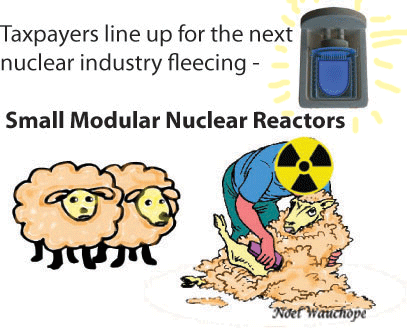 Private companies find role in developing nuclear power for space travel, Space.com By JoAnna Wendel – Space.com contributor 6 Apr 20,
Nuclear-powered spacecraft could cut our travel time to Mars in half. Space is abouto go nuclear — at least if private companies get their way.
At the 2 t3rd annual Commercial Space Transportation Conference (CST) in Washington, D.C., in January, a panel of nuclear technology experts and leaders in the commercial space industry spoke about developments of the technology that could propel future spacecraft faster and more efficiently than current systems can.
Nuclear technology has powered spacecraft such as NASA’s Mars rovers, the Cassini mission and the two Voyagers that are currently exploring the outer reaches of our solar system. But those fuel sources rely on the passive decay of radioactive plutonium, converting heat from that process into electricity to power the spacecraft.
Instead, the CST panelists discussed Nuclear Thermal Propulsion (NTP), a technology developed in the 1960s and ’70s that relies on the splitting, or fission, of hydrogen atoms. Although fission is associated with more warlike images, the panel’s experts emphasized the safety of nuclear thermal propulsion, which would use low-enriched uranium.
An NTP-powered spacecraft would pump hydrogen propellant through a miniature nuclear reactor core. Inside this reactor core, high energy neutrons would split uranium atoms in fission reactions; those freed neutrons would smack into other atoms and trigger more fission. The heat from these reactions would convert the hydrogen propellent into gas, which would produce thrust when forced through a nozzle.
This chain reaction is the key to NTP’s power, panelist Venessa Clark, CEO of Atomos Space, a company that’s developing thermonuclear propulsion powered spacecraft to provide in-space transportation options to satellite operators, told Space.com. A soda-can-size fission reactor could propel humans to Mars in just three to four months, she said, about twice as fast as the currently estimated time it could take a chemically propelled ship to carry humans to the Red Planet. …..
But the government still has to play some role, both Clark and Thornburg said. Government agencies like NASA and the military branches may be the first clients for these commercial companies. Clark noted NASA’s recent pushes to partner with the private sector, such as its commercial lunar payload services program and its commercial crew program.
“Government players, NASA and also now the Air Force are looking at procuring services rather than funding the development of technology, which is really exciting for us,” Clark said…. https://www.space.com/commercial-nuclear-power-for-faster-space-travel.
COMMENT. newtons_laws 06 April 2020 14:47
1 This Month
To see nuclear-related stories in greater depth and intensity – go to https://nuclearinformation.wordpress.com/
Now until to February 10, 2026 Radioactive waste storage in France: the debate is finally open! How to participate?
12 February – Webinar The Big Push: New Nuclear Projects in Canada
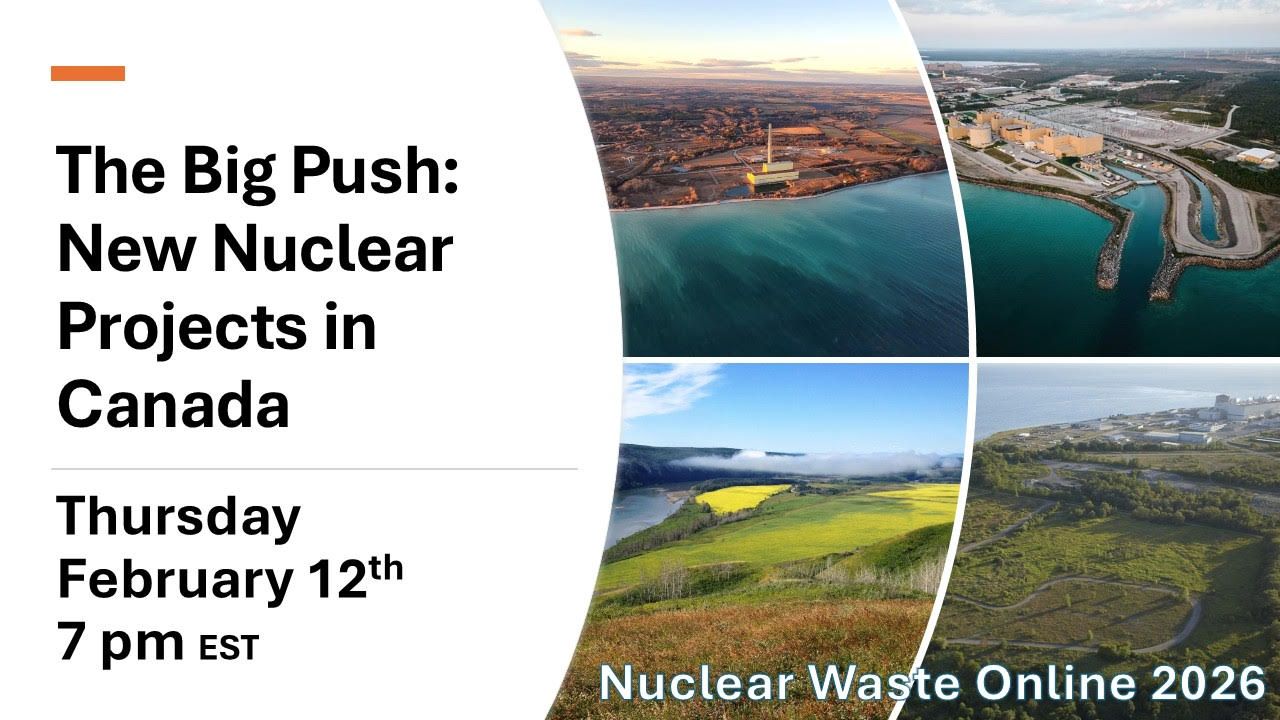
Thursday, February 12, 7 pm Eastern | 2nd of 4 sessions in the 2026 Nuclear Waste Online webinar series.
Join a webinar on the push for new nuclear generation in Canada. Go to Northwatch.org to register or use the registration link https://us02web.zoom.us/webinar/register/WN_ZfWOf1GITqSRIZX8CB-A9w

-
Archives
- February 2026 (76)
- January 2026 (308)
- December 2025 (358)
- November 2025 (359)
- October 2025 (376)
- September 2025 (258)
- August 2025 (319)
- July 2025 (230)
- June 2025 (348)
- May 2025 (261)
- April 2025 (305)
- March 2025 (319)
-
Categories
- 1
- 1 NUCLEAR ISSUES
- business and costs
- climate change
- culture and arts
- ENERGY
- environment
- health
- history
- indigenous issues
- Legal
- marketing of nuclear
- media
- opposition to nuclear
- PERSONAL STORIES
- politics
- politics international
- Religion and ethics
- safety
- secrets,lies and civil liberties
- spinbuster
- technology
- Uranium
- wastes
- weapons and war
- Women
- 2 WORLD
- ACTION
- AFRICA
- Atrocities
- AUSTRALIA
- Christina's notes
- Christina's themes
- culture and arts
- Events
- Fuk 2022
- Fuk 2023
- Fukushima 2017
- Fukushima 2018
- fukushima 2019
- Fukushima 2020
- Fukushima 2021
- general
- global warming
- Humour (God we need it)
- Nuclear
- RARE EARTHS
- Reference
- resources – print
- Resources -audiovicual
- Weekly Newsletter
- World
- World Nuclear
- YouTube
-
RSS
Entries RSS
Comments RSS
 nuclear-news