The Russian point of view on nuclear arms control
|
Russia’s View on Nuclear Arms Control: An Interview With Ambassador Anatoly Antonov, Arms Control Association April 2020Arms Control Today conducted a written interview in early March with Anatoly Antonov, Russian ambassador to the United States on issues including the current status of U.S.-Russian strategic security talks, the future of New START, talks on intermediate-range missile systems, engaging China in arms control, and President Vladimir Putin’s proposal for a summit of the leaders of the five permanent members of the UN Security Council……..
Amb. Anatoly Antonov: Russia and the United States are the largest nuclear weapons powers and permanent members of the UN Security Council. They bear a special responsibility for preserving world peace and security. That is why it is crucial to maintain the bilateral strategic stability dialogue at any given circumstance, regardless of political situation. It goes without saying that such engagement should be conducted on a regular basis. ……. As for the consultations in January, our reaction can be described as “cautious optimism.” On the bright side is the fact that the meeting did take place, even though it exposed serious disagreements between our countries on a number of topics. ….. There is no doubt that the Russian-U.S. bilateral arms control agenda remains relevant. We are open to discussing within the strategic dialogue the issue of the newest and prospective weapons that do not fall under New START. ……. https://www.armscontrol.org/act/2020-04/interviews/russias-view-nuclear-arms-control-interview-ambassador-anatoly-antonov |
|
Different federal laws complicate legal case about radiation exposure and teenager’s brain cancer
The appellate panel must decide how two different federal laws should intersect. Law.com By Raychel Lean | April 01, 2020 A federal wrongful death lawsuit alleging exposure to radiation from nuclear materials caused a South Florida teenager’s brain cancer had its moment before the U.S. Court of Appeals for the Eleventh Circuit on Wednesday as attorneys debated whether Florida’s four-year statute of limitations should apply.
The appellate panel must decide how two different federal laws should intersect. While 42 U.S.C. § 9658 preempts state time limits for lawsuits involving nuclear incidents, the Price-Anderson Act adopts state law as “the rules for decision.”
The question arose after Palm Beach County resident Cynthia Santiago sued in the Southern District of Florida in 2014, five years after she was diagnosed with a brain tumor at 13. When she died about two years later, her parents Joselyn and Steve Santiago became personal representatives.
The complaint blamed Connecticut-based aircraft maker United Technologies Corp., alleging its Palm Beach County engineering facility released radioactive materials, heavy metals and semi-volatiles in The Acreage, where several children were also reportedly diagnosed with brain tumors. …… https://www.law.com/dailybusinessreview/2020/04/01/clock-ticking-for-florida-family-alleging-radiation-exposure-caused-teens-cancer/?slreturn=20200301190656
The court has yet to rule.
New hypersonic weaponry complicates Nuclear Arms Control Regime
The advent of hypersonic weaponry introduces a new complication to the arms control landscape. Fortunately, New START is a flexible treaty. It includes specific provisions for dealing with emerging weapon systems via its Bilateral Consultative Commission. And, as Russia has demonstrated, hypersonic weapons can be incorporated into existing arms control protocols.
With the United States and Russia suddenly in agreement on the need to limit the deployment of hypersonic missiles, now is an ideal time to explicitly and transparently address these weapons under the New START framework. Doing so would ensure that nuclear arms limitations remain robust, even as tensions flare. With the clock ticking on renewal, neither nation can afford to let a hypersonic arms race get in the way of a proven instrument of global security. https://allthingsnuclear.org/ctracy/fitting-hypersonic-weapons-into-the-nuclear-arms-control-regime
New START’s hypersonic gap
New START sets limits on the deployment of US and Russian nuclear forces. Because these nations possess the vast majority of the world’s nuclear weapons, it constitutes the bedrock of modern nuclear arms control.
The treaty’s core provisions were carefully crafted to address the complexities of nuclear weapons technology. It does not directly limit the number of nuclear warheads either nation may possess, as these are difficult to track and account for. Rather, it focuses on the nuclear warhead delivery systems—ground-launched missiles, submarine-launched missiles, and heavy bomber aircraft—by which these destructive payloads can be carried intercontinental distances. New START limits the number of these systems each nation may possess (up to 800) and deploy (up to 700), as well as the number of warheads that can be mounted on them (up to 1,550).
Nuclear Regulatory Commissions plans for lengthy lifetimes for U.S. nuclear power plants
 THE BIG PICTURE (Infographic): U.S. Nuclear Lifetimes, [ Excellent graph and table on original] https://www.powermag.com/the-big-picture-infographic-u-s-nuclear-lifetimes/ Mar 31, 2020. by Sonal Patel The U.S. has 96 licensed-to-operate nuclear power reactors and two reactors under construction. But the average age of the nation’s 96 licensed nuclear units is about 39 years old. That has been of some concern to the nuclear industry, which has provided roughly a fifth of the nation’s power since the 1990s. About 88 of the 96 reactors have already renewed their operating license once, extending their lifetimes from 40 to 60 years, but the majority of these will be “nearing the end of that 20-year extension by 2029 and will be seeking to renew their license a second time, for another 20-year period,” the Nuclear Energy Institute (NEI) has said.In December 2019, marking a major milestone, the Nuclear Regulatory Commission (NRC) granted the first-ever subsequent license renewal (SLR) applications to Turkey Point 3 and 4, and then to Peach Bottom 2 and 3 in March 2020, extending these reactors’ operating licenses from 60 to 80 years. THE BIG PICTURE (Infographic): U.S. Nuclear Lifetimes, [ Excellent graph and table on original] https://www.powermag.com/the-big-picture-infographic-u-s-nuclear-lifetimes/ Mar 31, 2020. by Sonal Patel The U.S. has 96 licensed-to-operate nuclear power reactors and two reactors under construction. But the average age of the nation’s 96 licensed nuclear units is about 39 years old. That has been of some concern to the nuclear industry, which has provided roughly a fifth of the nation’s power since the 1990s. About 88 of the 96 reactors have already renewed their operating license once, extending their lifetimes from 40 to 60 years, but the majority of these will be “nearing the end of that 20-year extension by 2029 and will be seeking to renew their license a second time, for another 20-year period,” the Nuclear Energy Institute (NEI) has said.In December 2019, marking a major milestone, the Nuclear Regulatory Commission (NRC) granted the first-ever subsequent license renewal (SLR) applications to Turkey Point 3 and 4, and then to Peach Bottom 2 and 3 in March 2020, extending these reactors’ operating licenses from 60 to 80 years.
More SLRs are expected this June for Surry 1 and 2. Meanwhile, owing to market conditions, technical issues, political pressure, and financial stresses, nine reactors have retired before their licenses expired since 2013, and an additional six units are slated to retire by 2026. The NEI suggests that half the nation’s nuclear fleet will need to obtain SLRs by 2040 to continue operating or be forced to retire. Sources: NRC, POWER |
|
Montgomery County officials not happy with Exelon’s Limerick Nuclear Power Plant plans for addressing Covid19
A parking lot has been designated for the new contractors that have been hired as the annual refuel of the reactor maintenance project is underway.
Dr. Valerie A. Arkoosh, chair of the Montgomery County Board of Commissioners, says back on March 16, Exelon, the company that runs the Limerick nuclear plant, gave them a lackluster social distancing plan.
She said, “We learned of plans to bring approximately 1,800 workers into our region from around the United States. We asked Exelon to postpone this refuel until a time when the disease burden from COVID-19 was lower.” …….. https://6abc.com/limerick-plant-exelon-corporation-covid19-cases/6067085/
Morgan, Gardner: More Time Needed For Nuclear Storage Discussion
Morgan, Gardner: More Time Needed For Nuclear Storage Discussion https://www.wortfm.org/morgan-gardner-more-time-needed-for-nuclear-storage-discussion/
APRIL 1, 2020 BY 8 O’CLOCK BUZZ Interim nuclear storage is a problem, not just with where the highly radioactive materials are stored, but the routes of transportation on rail, highways, and waterways. Leona Morgan from the Nuclear Issues Study Group and Rose Gardner from the Alliance for Environmental Strategies discuss the current proposals and are urging an extension to the public comment period for the bill.
1 This Month
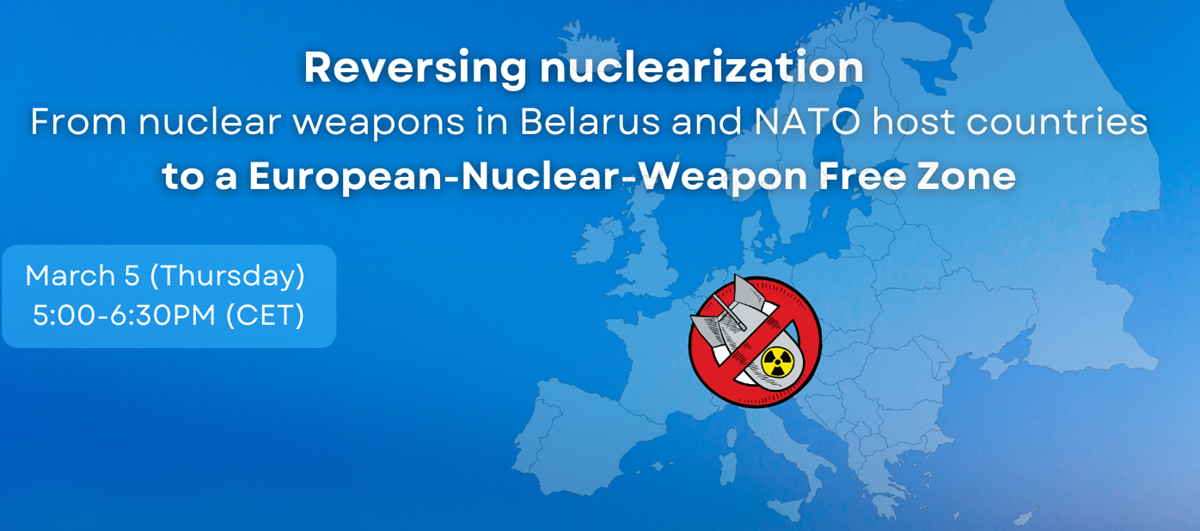
5 March -Online – Reversing nuclearization:
From nuclear weapons in Belarus and NATO host countries to a European-Nuclear-Weapon Free Zone
11am-12:30pm Eastern Time USA / 5pm-6:30pm CET

of the week – Advocating for a
nuclear free beach – https://www.samuellawrencefoundation.org/
The Samuel Lawrence Foundation advocates for a Nuclear Waste Free Beach at San Onofre, join us and take action!

10 March A LIVE WEBINAR THE REAL EFFECTS OF NUCLEAR POWER
What the Industry Isn’t Telling Us
1:00 PM Mountain, 2 pm Central, 3 pm Eastern. Live on the Keepers of the Water Facebook page

18 March Webinar @ 1 PM EST: An Assessment of SMR Projects: The Case of Canada
register for the zoom:
https://us02web.zoom.us/webinar/register/WN_o8BIIOUvQ2ONJR1nta65DQ#/registration

of the week – STOP SMALL MODULAR REACTORS IN CANADA
To see nuclear-related stories in greater depth and intensity – go to https://nuclearinformation.wordpress.com
-
Archives
- March 2026 (38)
- February 2026 (268)
- January 2026 (308)
- December 2025 (358)
- November 2025 (359)
- October 2025 (376)
- September 2025 (258)
- August 2025 (319)
- July 2025 (230)
- June 2025 (348)
- May 2025 (261)
- April 2025 (305)
-
Categories
- 1
- 1 NUCLEAR ISSUES
- business and costs
- climate change
- culture and arts
- ENERGY
- environment
- health
- history
- indigenous issues
- Legal
- marketing of nuclear
- media
- opposition to nuclear
- PERSONAL STORIES
- politics
- politics international
- Religion and ethics
- safety
- secrets,lies and civil liberties
- spinbuster
- technology
- Uranium
- wastes
- weapons and war
- Women
- 2 WORLD
- ACTION
- AFRICA
- Atrocities
- AUSTRALIA
- Christina's notes
- Christina's themes
- culture and arts
- Events
- Fuk 2022
- Fuk 2023
- Fukushima 2017
- Fukushima 2018
- fukushima 2019
- Fukushima 2020
- Fukushima 2021
- general
- global warming
- Humour (God we need it)
- Nuclear
- RARE EARTHS
- Reference
- resources – print
- Resources -audiovicual
- Weekly Newsletter
- World
- World Nuclear
- YouTube
-
RSS
Entries RSS
Comments RSS
 nuclear-news