USA nuclear industry exploits coronavirus, seeking tax-payer funds
 Nuclear Industry Effort to Exploit Coronavirus Crisis for Backdoor Bailout Decried as ‘Disaster Capitalism at its Worst’ https://www.commondreams.org/news/2020/03/23/nuclear-industry-effort-exploit-coronavirus-crisis-backdoor-bailout-decried-disaster Nuclear Industry Effort to Exploit Coronavirus Crisis for Backdoor Bailout Decried as ‘Disaster Capitalism at its Worst’ https://www.commondreams.org/news/2020/03/23/nuclear-industry-effort-exploit-coronavirus-crisis-backdoor-bailout-decried-disaster
“The nuclear industry begged for a bailout last fall and is now using coronavirus to try and brazenly grab more cash,” warned Friends of the Earth. by Andrea Germanos, staff writer, Jon Queally, staff writer According to E&E News, which focuses on the energy industry, the request came in a letter sent to congressional leaders and White House officials on Friday by Nuclear Energy Institute president and CEO Maria Korsnick. In addition to other forms of aid—including sick leave for employees and “prioritized access” to testing and masks—the letter requested taxpayer-funded grants in the form of broad tax credits and waivers for existing regulatory fees. “Our member companies are anticipating—or are already experiencing—severe financial strain as product orders are delayed or canceled, as industrial electricity demand falls, and as workforce availability becomes increasingly constrained,” Krosnick wrote to in a letter sent to lawmakers, Treasury Sectary Steven Mnuchin, and Larry Kudlow, director of the National Economic Council. In reaction, Friends of the Earth senior policy analyst Lukas Ross called the request a bald effort to exploit the current outbreak and economic downturn to obtain the same kind of financial bailout it has repeatedly sought from the U.S. government in recent years. “Demanding a $23 billion gift from taxpayers during an unprecedented public health crisis sets a new low bar,” said Lukas Ross, senior policy analyst with Friends of the Earth. “The nuclear industry begged for a bailout last fall and is now using coronavirus to try and brazenly grab more cash.” The industry proposal, added Ross, “would hurt ratepayers and the climate at a time when immediate need for people must be the first priority. The nuclear lobby should be ashamed. This is disaster capitalism at its worst.” |
|
Tokyo Olympic Games’ costly chaos: they can’t be held in 2020
|
“It’s important that not only our country but also all the other participating countries can take part in the games fully prepared,” Abe said. The premier’s comments came a day after the IOC said it will study alternative plans for the Tokyo Olympics, scheduled to open on July 24, amid the global outbreak, and make an assessment within the next four weeks. The Japanese government will soon tell the IOC it will accept a postponement if the organization decides on it as a precaution against the coronavirus, a source familiar with the plan said. Tokyo Olympic organizing committee President Yoshiro Mori said he supports the IOC’s decision to review existing plans, adding representatives from Japan and the IOC will hold discussions to examine possible scenarios closely. “Japan is in a critical state, and the situations in the United States and Europe have been abnormal,” Mori said. “We are not so foolish as to say we will do it under our first (plan).” Abe, who has previously said he aims to hold the major sporting event in its “complete form,” told the parliamentary session, “If it is difficult to hold the games in such a way, we have to decide to postpone it, giving top priority to (the health of the) athletes.” “Although the IOC will make the final decision (on the matter), we are of the same view that cancellation is not an option,” Abe said while vowing to work closely with the IOC and the Tokyo metropolitan government. The IOC on Sunday officially admitted the possibility of pushing back the quadrennial event, saying it will examine various scenarios, adding that it will finalize discussions “within the next four weeks.” “These scenarios relate to modifying existing operational plans for the games to go ahead on 24 July 2020, and also for changes to the start date of the games,” the IOC said in a statement. Speaking at a press conference, organizing committee CEO Toshiro Muto said reviewing the possibilities, including postponement, is “not easy” and the organizers are open to “all options.” Mori said some of the challenges organizers will face in terms of postponement include handling the costs of delaying and the availability of venues. Meanwhile, Tokyo Gov. Yuriko Koike told reporters, “(The IOC) clearly stated that cancellation will not happen, and I am glad to share that view.” “There are lots of issues, but I would like to discuss possible scenarios over the next four weeks with the IOC and the organizing committee,” she said. “The Tokyo Games now have another goal, to defeat the novel coronavirus.” Mori said local organizers will decide in the coming days whether to go ahead with the opening of the domestic leg of the torch relay in Fukushima Prefecture on Thursday, as developments surrounding the pandemic have been changing rapidly. Mori added that Bach told him that the Japanese organizers have the authority to make decisions about the domestic leg of the torch relay. Members of the organizing committee revealed Monday they may drastically reduce the scale of the torch relay, including canceling the participation of members of the public. Under modified plans, the Olympic flame may be carried by car in the initial stages of the relay. Muto and Olympics minister Seiko Hashimoto each said Monday the relay will proceed as planned for the moment. Mori also revealed that Abe is now reluctant to attend the kick-off ceremony since the Japanese government has been requesting people refrain from holding large events to prevent the spread of the virus. Olympic torchbearers in Japan expressed concerns over the IOC’s new direction. Both runners and spectators of the relay would be half-hearted. I wonder whether they will let us run again if (the sporting event) is postponed,” said 66-year-old Yumiko Nishimoto, who is scheduled to run in Fukushima on Thursday as one of the 10,000 torchbearers in Japan. The 121-day Japanese leg is scheduled to kick off at the J-Village soccer training center, which served as a frontline base of operations to battle the 2011 nuclear crisis caused by the March 11 quake-tsunami disaster that year. A decision on postponement “should be made before the torch relay starts,” Nishimoto said. “I have mixed feelings as I feel that we are being messed around.” The global coronavirus pandemic has cast a cloud over the hosting of the Tokyo Olympics from July 24 to Aug. 9 and the Paralympics from Aug. 25 to Sep. 6. In recent days, national Olympic committees in Brazil, Norway and the Netherlands have called for postponements. Japanese government officials have repeatedly said preparations are under way for the games to go ahead as scheduled, and the flame for the Olympics arrived on Friday in Japan. During a videoconference with other leaders from the Group of Seven industrialized nations earlier in the month, Abe secured support for holding “complete” games, meaning they should be held with spectators and without any downsizing. “I think U.S. President (Donald) Trump and other G-7 leaders will support my decision,” Abe said in the parliamentary session. |
|
|

“Balance” a dangerous practice – journalists presenting as equal -Trump’s and scientists’ opinion on coronavirus science
 Presenting Trump and Science as Equals Isn’t Balanced, It’s Dangerous, FAIR, NEIL DEMAUSE, 23 Mar 20, With more than 32,000 COVID-19 infections and 400 deaths in the US to date, and Surgeon General Jerome Adams predicting that “this week, it’s going to get bad,” as hospitals prepare for the eventuality of rationing treatment for patients least likely to survive, the president of the United States hit his caps lock key and typed out a tweet:
Sellafield nuclear facility cuts back drastically on staff working onsite

 In Cumbria 22nd March 2020, Sellafield is telling the vast majority of its workers to stay away from its main site and satellite offices and to work from home. Mark Neate,
director of environment, safety and security with Sellafield Ltd, has told
employees: “We will minimise attendance at all of our sites and wherever
possible everyone should continue (or start) working from home.
https://www.in-cumbria.com/news/18325910.sellafield-workforce-told-stay-home/
Coronavirus means staff shortages at North Carolina nuclear power stations
|
NC nuclear plants brace to operate during coronavirus pandemic, Carolina Public Press, MARCH 23, 2020, BY JACK IGELMAN Duke Energy is bracing for the impact of the coronavirus pandemic and the possibility of staffing shortages in the operation of its six nuclear energy power facilities in the Carolinas. Three locations in North Carolina house five reactors in Brunswick, Mecklenburg and Wake counties…….Among the actions the company has taken to ensure the safe operation of the nuclear plants and the safety of its employees are social distancing, a no-visitor policy, increased cleaning at plants and use of screening measures before employees enter facilities.
Duke has directed employees who are not involved with power generation or other critical functions to work from home. However, areas of a nuclear plant, such as the control room, cannot be operated remotely and are staffed by rotating shifts……. Across the industry, said Korsnick, “there is capacity within the normal operator staffing to address some increase in absenteeism.” .., maintaining qualified personnel could become a critical factor in operating nuclear energy if the coronavirus spread worsens…… On Friday, March 20, the NRC hosted a phone meeting with the nuclear industry to discuss regulatory impacts due to COVID-19. The meeting was open to the public. Among the topics discussed were exemptions and regulatory relief, such as allowing power companies to extend work shifts beyond current regulations, considering exemptions or waivers to licensing, or conducting inspections off-site and deferring some inspection activities. Ho Nieh, director of the NRC’s Office of Nuclear Reactor Regulation, said on the public call that having a sufficient number of qualified operators is an important issue……. Kevin Kamps of the organization Beyond Nuclear, a watchdog organization based in Maryland that advocates for abandoning nuclear power, participated in the meeting and told CPP that “most of the content of the call was about waivers from existing regulations.” “But during a crisis, requirements should be strengthened, not weakened,” he said. Additional shift hours, Kamps said, will place additional “stress and strain on workers that need to be fully attentive and alert in sensitive jobs.” A better strategy than permitting regulatory relief, he said, would be to proactively power down reactors until the threat of the coronavirus ends…… https://carolinapublicpress.org/30062/nc-nuclear-plants-brace-to-operate-during-coronavirus-pandemic/ |
|
The lingering horror of the nuclear bomb tests at Maralinga, South Australia
|
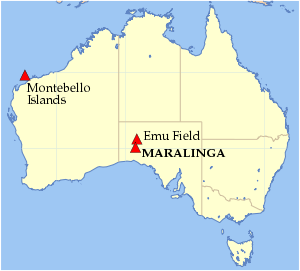
Maralinga is 54 kilometres north-west of Ooldea, in South Australia’s remote Great Victoria Desert. Between 1956 and 1963 the British detonated seven atomic bombs at the site; one was twice the size of the bomb dropped on Hiroshima. There were also the so-called “minor trials” where officials deliberately set fire to or blew up plutonium with TNT — just to see what would happen. One location called “Kuli” is still off-limits today, because it’s been impossible to clean up. I went out to the old bomb sites with a group of Maralinga Tjarutja people, who refer to the land around ground zero as “Mamu Pulka”, Pitjantjatjara for “Big Evil”. “My dad passed away with leukaemia. We don’t know if it was from here, but a lot of the time he worked around here,” says Jeremy Lebois, chairperson of the Maralinga Tjarutja council. Thirty per cent of the British and Australian servicemen exposed to the blasts also died of cancer — though the McClelland royal commission of 1984 was unable to conclude that each case was specifically caused by the tests. It’s not until you stand at ground zero that you fully realise the hideous power of these bombs. Even after more than 60 years, the vegetation is cleared in a perfect circle with a one kilometre radius. “The ground underneath is still sterile, so when the plants get down a certain distance, they die,” explains Robin Matthews, who guided me around the site. The steel and concrete towers used to explode the bombs were instantly vaporised. The red desert sand was melted into green glass that still litters the site. Years ago it would have been dangerous to visit the area, but now the radiation is only three times normal — no more than what you get flying in a plane. The Line of FireAustralia was not the first choice for the British, but they were knocked back by both the US and Canada. Robert Menzies, Australia’s prime minister at the time, said yes to the tests without even taking the decision to cabinet first. David Lowe, chair of contemporary history at Deakin University, thinks Australia was hoping to become a nuclear power itself by sharing British technology, or at least to station British nuclear weapons on Australian soil. “In that period many leaders in the Western world genuinely thought there was a real risk of a third world war, which would be nuclear,” he says. The bombs were tested on the Montebello Islands, at Emu Field and at Maralinga. At Woomera in the South Australian desert, they tested the missiles that could carry them. The Blue Streak rocket was developed and test-fired right across the middle of Australia, from Woomera all the way to the Indian Ocean, just south of Broome. This is known as “The Line of Fire” The Line of Fire from Woomera to Broome is, funnily enough, the same distance from London to Moscow,” Mr Matthews says. Just as the Maralinga Tjarutja people were pushed off their land for the bomb tests, the Yulparitja people were removed from their country in the landing zone south of Broome. Not all the Blue Streak rockets reached the sea. Some crashed into the West Australian desert. The McClelland royal commission showed that the British were cavalier about the weather conditions during the bomb tests and that fallout was carried much further than the 100-mile radius agreed to, reaching Townsville, Brisbane, Sydney and Adelaide. “The cavalier attitude towards Australia’s Indigenous populations was appalling and you’d have to say to some extent that extended towards both British and Australian service people,” Professor Lowe says. There are also questions over whether people at the test sites were deliberately exposed to radiation. “You can’t help but wonder the extent to which there was a deliberate interest in the medical results of radioactive materials entering the body,” Professor Lowe says. “Some of this stuff is still restricted; you can’t get your hands on all materials concerning the testing and it’s quite likely both [British and Australian] governments will try very hard to ensure that never happens.” Project SunshineWe do know that there was a concerted effort to examine the bones of deceased infants to test for levels of Strontium 90 (Sr-90), an isotope that is one of the by-products of nuclear bombs. These tests were part of Project Sunshine, a series of studies initiated in the US in 1953 by the Atomic Energy Commission. They sought to measure how Sr-90 had dispersed around the world by measuring its concentration in the bones of the dead. Young bones were chosen because they were particularly susceptible to accumulating the Sr-90 isotope. Around 1,500 exhumations took place, in both Britain and Australia — often without the knowledge or permission of the parents of the dead. Again, it was hard to prove conclusively that spikes in the levels of Strontium 90 during the test period caused bone cancers around the world. The Maralinga tests occurred during a period that Professor Lowe describes as “atomic utopian thinking”. “Remember at that time Australians were uncovering pretty significant discoveries of uranium and they hoped that this would unleash a vast new capacity for development through the power of the atom,” he says. Some of the schemes were absurdly optimistic. Project Ploughshare grew out of a US program which proposed using atomic explosions for industrial purposes such as canal-building. In 1969 Australia and the US signed a joint feasibility study to create an instant port at Cape Keraudren in the Kimberley using nuclear explosions. The plan was dropped, but it was for economic not environmental or social reasons. The dream (or was it a nightmare?) of sharing nuclear weapons technology with the British was never realised. All Australia got out of the deal was help building the Lucas Heights reactor. The British did two ineffectual clean-ups of Maralinga in the 1960s. The proper clean-up between 1995 and 2000 cost more than $100 million, of which Australia paid $75 million. It has left an artificial mesa in the desert containing 400,000 cubic metres of plutonium contaminated soil. The Maralinga Tjarutja people received only $13 million in compensation for loss of their land, which was finally returned to them in 1984. As we were leaving the radiation zone, the Maralinga Tjarutja people spotted some kangaroos in the distance. Over the years some of the wildlife has started to return. Mr Lebois takes it as a good sign. “Hopefully, hopefully everything will come back,” he says. |
|
Bill McKibben on the Virus and the Climate Movement
How the Virus Has Hit the Climate Movement: Bill McKibben
The Tyee talks to the prominent activist and author about fighting on two fronts. Geoff Dembicki 23 Mar 20 | TheTyee.ca
Geoff Dembicki reports for The Tyee. His work also appears in Vice, Foreign Policy and the New York Times. A few weeks ago, this was looking like a big year for Canada’s climate movement.
After years of grassroots opposition to the Trans Mountain pipeline in B.C., an eruption of rail blockades across the country in solidarity with the Wet’suwet’en natural gas fight and Teck Resources shelving a major new oil sands mine for economic reasons, all the conditions seemed there to push for economy-transforming policies on the scale of the Green New Deal.
Then the coronavirus hit.
At a time when climate leaders in Canada, the U.S. and Europe imagined millions of people on the streets pressuring financial institutions to ditch fossil fuels and forcing political leaders to enact bold legislation, people are now fearful and physically alone, stuck in their homes to prevent a public health catastrophe as outside ecosystems veer towards collapse.
To help Tyee readers make sense of this new reality, we reached out to author and activist Bill McKibben, co-founder of the climate group 350 and a global authority on what must be done to fight the climate emergency. It was McKibben who wrote the book The End of Nature about climate change in 1989 that put the threat firmly on the public radar.
On the impact of coronavirus on the climate movement:
In a conversation that has been edited for length and clarity, he urges Canadians to pressure politicians to keep the climate emergency front and centre as we navigate this crisis, while using these terrifying and inexplicable times as a chance to reflect on the fairer and more sustainable world we must build after the crisis is over.
On the similarities between coronavirus and climate change:
There’s a sense in which something like coronavirus is like climate change except encapsulated in a few months instead of a few decades…The biggest difference is that there’s no enormous industry that gets rich off of coronavirus, so there’s not like a built-in opposition to doing what needs to be done and that’s always been one of the problems with climate change.
On how coronavirus is helping kill off the fossil fuel industry:
One thing that’s happening I think is that last year will mark the peak of fossil fuel demand. I don’t think fossil fuels will be able to recover to the point they were at before. I can’t imagine anyone deciding that what they’re going to invest their money now in is another tar sands mine. I find it hard to imagine that even the Canadian government is going to want to spend $12 billion to build its pipeline out to Burnaby. I think we’re going to be reminded that there are other more important things to spend money on.
It seems to me that probably some of the landscape of oil and gas is getting rewritten even as we watch. That is a direct testament to the power of protest and organization over this last decade and to the incredible work of people, especially Indigenous organizers, pushing this case for a very long time. And it’s gotten through. Earlier this winter, the decision of investors that they weren’t going to throw more money into the Teck Frontier mine was a kind of bell ringing and those echoes will reverberate for a long time.
On the message Canadians should send to businesspeople and politicians:
I do think that the best thing for people to be doing in North America at the moment is to be putting huge pressure on the banks and financial institutions that fund fossil fuels, like JPMorgan Chase, BlackRock, Liberty Mutual, RBC, all the Toronto banks, reminding them that it’s not ok to be trying to profit off the end of the world.
Some of these banks are going to need bailouts as the economy tanks and it should be pretty clear that we should not be bailing out them without making sure that they’re not going to contribute to the next even larger crisis facing the planet. https://thetyee.ca/News/2020/03/22/How-The-Virus-Has-Hit-Climate-Movement-McKibben/
America’s economic plan for Covid19 directs money to big corporations
Democrats are balking at the Senate GOP’s version of the bill because it is far too top-heavy with financial assistance to corporations and lacks sufficient assistance for working families.

The Virus of Capitalism Has Infected the COVID-19 Fight, William Rivers Pitt, Truthout, 23 Mar 20, …….. Under vastly different circumstances, perhaps it would have been possible to argue for a different path of action than dramatic physical-distancing measures, following from the idea that to develop a herd immunity to COVID-19, a certain number of people have to contract it and recover (assuming we are even capable of developing an immunity, which is not yet confirmed). To even countenance this idea, however, we would need a robust and fully functional health care system to aid in the recovery process.
Why? Money.
And then there is the currently stalled $1.8 trillion COVID-19 relief bill, which hit the reef in Congress over the weekend. Democrats are balking at the Senate GOP’s version of the bill because it is far too top-heavy with financial assistance to corporations and lacks sufficient assistance for working families.
Natch. These fellows never, ever, ever miss an opportunity to loot the till.
And therein lies the rub. The priority of the people (for the most part) is to stay safe, to get well if they fall ill, and to do what must be done to eventually return to some semblance of a normal life. The priority of the capitalists is to get the money machine going again, to take full advantage of the crisis in the name of profit, and to defend their well-staked financial turf from any reforms that may be proposed in the aftermath.
U.S.-style capitalism is also a virus, and it has infected every aspect of this situation. Worker safety, insurance coverage and costs, medical preparedness, and vital supplies — even the bill intended to rescue the country from some final financial calamity: All have been perverted and disrupted by the profit motive that never, ever, ever sleeps. https://truthout.org/articles/the-virus-of-capitalism-has-infected-the-covid-19-fight/?eType=EmailBlastContent&eId=e1200502-b139-4a26-8fdd-b7207fc3df68
A new low-cost solar technology for environmental cooling
A new low-cost solar technology for environmental cooling https://www.eurekalert.org/pub_releases/2020-03/pdt-anl032320.php POLITECNICO DI TORINO Space cooling and heating is a common need in most inhabited areas. In Europe, the energy consumed for air conditioning is rising, and the situation could get worse in the near future due to the temperature increase in different regions worldwide. The increasing cooling need in buildings especially during the summer season is satisfied by the popular air conditioners, which often make use of refrigerants with high environmental impact and also lead to high electricity consumption. So, how can we reduce the energy demand for building cooling?
A new study comes from a research group based at the Politecnico di Torino (SMaLL) and the National Institute of Metrological Research (INRiM), who has proposed a device capable of generating a cooling load without the use of electricity: the research has been published in Science Advances*. Like more traditional cooling devices, this new technology also exploits the evaporation of a liquid. However, the key idea proposed by the Turin researchers is to use simple water and common salt instead of chemicals that are potentially harmful for the environment. The environmental impact of the new device is also reduced because it is based on passive phenomena, i.e. spontaneous processes such as capillarity or evaporation, instead of on pumps and compressors that require energy and maintenance.
“Cooling by water evaporation has always been known. As an example, Nature makes use of sweat evaporation from the skin to cool down our body. However, this strategy is effective as long as air is not saturated with water vapour. Our idea was to come up with a low-cost technology capable to maximize the cooling effect regardless of the external water vapour conditions. Instead of being exposed to air, pure water is in contact with an impermeable membrane that keeps separated from a highly concentrated salty solution. The membrane can be imagined as a porous sieve with pore size in the order of one millionth of a meter. Owing to its water-repellent properties, our membrane liquid water does not pass through the membrane, whereas its vapour does. In this way, the fresh and salt water do not mix, while a constant water vapour flux occurs from one end of the membrane to the other. As a result, pure water gets cooled, with this effect being further amplified thanks to the presence of different evaporation stages. Clearly, the salty water concentration will constantly decrease and the cooling effect will diminish over time; however, the difference in salinity between the two solutions can be continuously – and sustainably – restored using solar energy, as also demonstrated in another recent study from our group**”, explains Matteo Alberghini, PhD student of the Energy Department of the Politecnico di Torino and first author of the research.
The interesting feature of the suggested device consists in its modular design made of cooling units, a few centimetres thick each, that can be stacked in series to increase the cooling effect in series, as happens with common batteries. In this way it is possible to finely tune the cooling power according to individual needs, possibly reaching cooling capacity comparable to those typically necessary for domestic use. Furthermore, water and salt do not need pumps or other auxiliaries to be transported within the device. On the contrary, it “moves” spontaneously thanks to capillary effects of some components which, like in kitchen paper, are capable of absorbing and transporting water also against gravity.
“Other technologies for passive cooling are also being tested in various labs and research centres worldwide, such as those based on infrared heat dissipation into the outer space – also known as radiative passive cooling. Those approaches, although promising and suitable for some applications, also present major limitations: the principle on which they are based may be ineffective in tropical climates and in general on very humid days, when, however, the need for conditioning would still be high; moreover, there is a theoretical limit for the maximum cooling power. Our passive prototype, based instead on evaporative cooling between two aqueous solutions with different salinities, could overcome this limit, creating a useful effect independent of external humidity. Moreover, we could obtain an even higher cooling capacity in the future by increasing the concentration of the saline solution or by resorting to a more sophisticated modular design of the device” commented the researchers.
Also due to the simplicity of the device assembly and the required materials, a rather low production cost can be envisioned, in the order of a few euros for each cooling stage. As such, the device could be ideal for installations in rural areas, where the possible lack of well-trained technicians can make operation and maintenance of traditional cooling systems difficult. Interesting applications can also be envisioned in regions with large availability in water with high saline concentration, such as coastal regions in the vicinity of large desalination plants or nearby salt marshes and salt mines.
As of now, the technology is not yet ready for an immediate commercial exploitation, and further developments (also subject to future funding or industrial partnerships) are necessary. In perspective, this technology could be used in combination with existing and more traditional cooling systems for effectively implementing energy saving strategies.
[*] Matteo Alberghini, Matteo Morciano, Matteo Fasano, Fabio Bertiglia, Vito Fernicola, Pietro Asinari, Eliodoro Chiavazzo. Multistage and passive cooling process driven by salinity difference, SCIENCE ADVANCES (2020), URL: https://advances.sciencemag.org/content/6/11/eaax5015
[**] Eliodoro Chiavazzo, Matteo Morciano, Francesca Viglino, Matteo Fasano, Pietro Asinari, Passive solar high-yield seawater desalination by modular and low-cost distillation, NATURE SUSTAINABILITY (2018), URL: https://www.nature.com/articles/s41893-018-0186-x
In the current mood – time for international co-operation and prompt action to stall global heating
Canada pushing Small Modular Nuclear Reactors, but the outlook for uranium/nuclear industry is bleak
 Nuclear power, and Canada’s uranium industry, are struggling to find their place in a green energy future, CIM Magazine, 23 Mar , 2020 NuScale Power submitted its small modular nuclear reactor (SMR) design to the Canadian Nuclear Safety Commission for a pre-licensing vendor design review. This came just over a month after the leaders of three Canadian provinces – Ontario premier Doug Ford, New Brunswick premier Blaine Higgs and Saskatchewan premier Scott Moe – signed a memorandum of understanding to develop SMRs in their respective provinces.
Why using hydrogen to supply heating would be a terrible choice
energy. Even if the hydrogen was sourced from renewable energy (and not much of it will be) the result would be a grandiose waste of renewable energy. This is because using hydrogen from renewable energy to heat buildings is around four times less energy efficient compared to using heat pumps (using renewable electricity) to supply heating in buildings.
enough to 100 per cent. Second, such a programme will provide support for a continued fossil fuel industry. A third reason is that using ‘blue’ hydrogen, in as much as it succeeds in paving the way for supply of renewable hydrogen, will lock in a huge wastage of renewable energy
compared to using this renewable energy much more efficiently.http://realfeed-intariffs.blogspot.com/2020/03/why-using-hydrogen-to-supply-heating.html
March 23 Energy News — geoharvey

Opinion: ¶ “Seven Reasons Why Tesla Will Benefit From The Current Crisis – #1 Safety” • This is the first article in a series of seven articles, each with a video, that explain why Tesla is perfectly positioned and will emerge stronger and faster out of the crisis than other auto manufacturers. Tesla offers superior […]
Don Lemon: Trump is Gaslighting US on Coronavirus & Plays Clips to Prove It; Death Rate from Coronavirus in Lombardy is 13%; Italy 9% as of March 22, 5 pm — Mining Awareness +

“Don Lemon says Trump is gaslighting you and rolls the tape” Link: https://youtu.be/NYUP95sw1IM It’s apparently even worse than Dr. Fauci says in the above video, especially if you are left untreated. The overall death (mortality) rate from Coronavirus in Italy (March 22, 2019, 5 pm) was 9.3%, and in Lombardy it was 13%, which exceeds […]
Tokyo Olympics will take place next year — BCNN1 WP

The Tokyo Olympics are going to happen — but almost surely in 2021 rather than in four months as planned.
-
Archives
- February 2026 (228)
- January 2026 (308)
- December 2025 (358)
- November 2025 (359)
- October 2025 (376)
- September 2025 (258)
- August 2025 (319)
- July 2025 (230)
- June 2025 (348)
- May 2025 (261)
- April 2025 (305)
- March 2025 (319)
-
Categories
- 1
- 1 NUCLEAR ISSUES
- business and costs
- climate change
- culture and arts
- ENERGY
- environment
- health
- history
- indigenous issues
- Legal
- marketing of nuclear
- media
- opposition to nuclear
- PERSONAL STORIES
- politics
- politics international
- Religion and ethics
- safety
- secrets,lies and civil liberties
- spinbuster
- technology
- Uranium
- wastes
- weapons and war
- Women
- 2 WORLD
- ACTION
- AFRICA
- Atrocities
- AUSTRALIA
- Christina's notes
- Christina's themes
- culture and arts
- Events
- Fuk 2022
- Fuk 2023
- Fukushima 2017
- Fukushima 2018
- fukushima 2019
- Fukushima 2020
- Fukushima 2021
- general
- global warming
- Humour (God we need it)
- Nuclear
- RARE EARTHS
- Reference
- resources – print
- Resources -audiovicual
- Weekly Newsletter
- World
- World Nuclear
- YouTube
-
RSS
Entries RSS
Comments RSS
 nuclear-news