The Climate Crisis Will Be Just as Shockingly Abrupt as the Coronavirus Pandemic

The Climate Crisis Will Be Just as Shockingly Abrupt https://newrepublic.com/article/157078/climate-crisis-will-just-shockingly-abrupt The coronavirus isn’t a reason to put climate policy on hold. It’s a warning of the calamities ahead., By MELODY SCHREIBER, March 27, 2020
The coronavirus pandemic has reshaped the way we live, work, and interact in a matter of weeks. It has also shown that governments are able—and in many cases are expected—to take swift, significant action on crises. “Under these extraordinary circumstances, there can be quite decisive action from governance and policy that changes the way we’re all living day to day,” Lenton said. “It is possible to change large-scale patterns of human behavior, pretty quickly.”
The question is whether governments, and voters, can appreciate the true urgency of the task. In reality, the climate crisis cannot be solved incrementally, Lenton said, because it’s taken too long to spur action: Many warming-related changes are already underway. Global greenhouse gas emissions must be dramatically reduced and eventually eliminated. “If we’re going to avoid the worst of bad climate tipping points, then we’re going to need to find some positive tipping points in society and ourselves to transform the way we live—in a generation—to a more sustainable but also perhaps a more flourishing kind of future,” Lenton said.
Pandemics like this are expected to rise as the climate changes. The SARS-CoV-2 virus causing the disease known as Covid-19, scientists suspect, may have originated in a wild animal, like a bat, and transferred through an intermediate animal to people. Zoonotic spillovers like these, as well as illnesses carried by mosquitoes, ticks, and other animals, will likely increase on a hotter planet. It’s not just because more people are pressing into areas where wildlife lives; as their habitats change in new climate conditions, more animals are adapting to new environments and seeking relief in places where people live, thus increasing the chance of contact between people and animals.
“We are really messing up with the natural world, and with the climate system, and things like this can be expected to happen more often,” Otto said. “It’s one reason to think that climate change is actually a permanent threat and we have to think of fixing the whole system, not only the economy.”
The coronavirus is a real and urgent threat. But there’s also a pressing danger in failing to address climate change in policies and funding, both now and in the future. What’s happening to the planet, experts agree, isn’t going to stop just because we’re dealing with another crisis, and this is no time to ease up on the climate fight. In fact, because of the ways climate change contributes to poor health, it makes action even more urgent.
Melody Schreiber is a freelance journalist based in Washington, D.C. @m_scribe
A creeping catastrophe: the world’s nuclear reactors are getting dangerously old.
 Nuclear Power Plant Lifetime Extension: A creeping catastrophe, https://bellona.org/publication/nuclear-power-plant-lifetime-extension-a-creeping-catastrophe March 30, 2020 Nuclear Power Plant Lifetime Extension: A creeping catastrophe, https://bellona.org/publication/nuclear-power-plant-lifetime-extension-a-creeping-catastrophe March 30, 2020
Any discussion of nuclear disasters brings events like Chernobyl and Fukushima to mind. But the civilian nuclear industry could be facing a quieter nuclear failure. Simply put, the world’s nuclear reactors are getting dangerously old. Yet more and more often, countries operating nuclear reactors are deciding to run them for longer than they were designed to run – which has implications not only for their own populations, but for those in neighboring countries as well – including Norway. The majority of the world’s 442 commercially operated reactors were built nearly four decades ago – and that’s all the time they were designed to run. Some of the oldest are located in European area and there’s little hope that newer units will replace them. Private investors view new reactors as a risky prospect. Smart money is gravitating toward alternative forms of energy production like solar and wind. Given the high costs of building new reactors – costs that run to several billion dollars – many plant operators are leaning into extensions, making them a common – but dangerous – practice. Our new working paper examines this practice and the science that needs to be taken into account when nuclear power plant operators consider extending the runtimes of old reactors. We also propose that national and international regulations need to be put in place that would guide decisions on which reactors can safely be upgraded – and which should be decommissioned. PLEX working_2 |
|
|
Our war against the environment is bringing pandemics upon us
 Coronavirus is a wake-up call: our war with the environment is leading to pandemics, The Conversation, Fiona Armstrong Executive Director, Climate and Health Alliance, Occasional Lecturer, School of Public Health and Human Biosciences, La Trobe University, Anthony Capon, Director, Monash Sustainable Development Institute, Monash University, Ro McFarlane, Assistant Professor in Ecological Public Health, University of Canberra, March 31, 202 The COVID-19 pandemic sweeping across the world is a crisis of our own making.
That’s the message from infectious disease and environmental health experts, and from those in planetary health – an emerging field connecting human health, civilisation and the natural systems on which they depend.
They might sound unrelated, but the COVID-19 crisis and the climate and biodiversity crises are deeply connected.
Each arises from our seeming unwillingness to respect the interdependence between ourselves, other animal species and the natural world more generally.
To put this into perspective, the vast majority (three out of every four) of new infectious diseases in people come from animals – from wildlife and from the livestock we keep in ever-larger numbers.
To understand and effectively respond to COVID-19, and other novel infectious diseases we’ll likely encounter in the future, policymakers need to acknowledge and respond with “planetary consciousness”. This means taking a holistic view of public health that includes the health of the natural environment.
Risking animal-borne diseases
Biodiversity (all biological diversity from genes, to species, to ecosystems) is declining faster than at any time in human history.
We clear forests and remove habitat, bringing wild animals closer to human settlements. And we hunt and sell wildlife, often endangered, increasing the risk of disease transmission from animals to humans.
The list of diseases that have jumped from animals to humans (“zoonotic diseases”) includes HIV, Ebola, Zika, Hendra, SARS, MERS and bird flu.
Like its precursor SARS, COVID-19 is thought to have originated in bats and subsequently transmitted to humans via another animal host, possibly at a wet market trading live animals.
Ebola virus emerged in central Africa when land use changes and altered climatic conditions forced bats and chimpanzees together around concentrated areas of food resources. And Hendra virus is associated with urbanisation of fruit bats following habitat loss. Such changes are occurring worldwide.
What’s more, human-caused climate change is making this worse. Along with habitat loss, shifting climate zones are causing wildlife to migrate to new places, where they interact with other species they haven’t previously encountered. This increases the risk of new diseases emerging.
COVID-19 is just the latest new infectious disease arising from our collision with nature……. https://theconversation.com/coronavirus-is-a-wake-up-call-our-war-with-the-environment-is-leading-to-pandemics-135023
Countries may use coronavirus crisis to rein in climate commitments: Japan a case in point
Campaigners attack Japan’s ‘shameful’ climate plans release
Proposals criticised amid fears countries may use coronavirus crisis to rein in commitments, Guardian, Fiona Harvey Environment correspondent 30 Mar 20, Japan has laid out its plans to tackle greenhouse gas emissions under the Paris agreement in the run-up to UN climate talks this year, becoming the first large economy to do so.
But its proposals were criticised by campaigners as grossly inadequate, amid fears the Covid-19 crisis could prompt countries to try to water down their climate commitments.
The UK, which will host the talks, hopes every country will produce renewed targets on curbing emissions and achieving net zero carbon by 2050.
New commitments are needed to achieve the Paris goals of holding temperature rises to no more than 2C, and ideally 1.5C, above pre-industrial levels, as on current national targets the world would far exceed those limits.
Japan’s carbon targets – known as its nationally determined contribution (NDC) in the UN jargon – as announced on Monday morning are almost unchanged from its commitments made in 2015 towards the Paris accord, however.
The country’s target of a 26% reduction in emissions by 2030, based on 2013 levels, is rated as “highly insufficient” by the Climate Action Tracker analysis, meaning that if all targets were at this level, temperature rises would exceed 3C.
The country, the world’s fifth biggest emitter and third biggest economy, is one of the only developed countries still building new coal-fired power stations, although there are signs it may hold back……
Campaigners fear the coronavirus pandemic will be seen by some countries as a way to weaken their commitment to the Paris accord and present less stringent targets instead of the strong cuts needed.
“Japan should not slow down climate actions even amid the Covid-19 global fights, and must revisit and strengthen this plan swiftly in order to be in line with the Paris agreement,” said Kimiko Hirata, the international director of the Kiko Network, a climate group in Japan……
Environmental regulations and climate commitments have come under attack in the context of the coronavirus crisis. Under Donald Trump’s administration in the US, the Environmental Protection Agency has rolled back key regulations including car efficiency standards. In the EU, carmakers wrote to the European commission last week to demand a loosening of requirements on them to cut carbon.
There is still scope for Japan to revise its targets. Other countries have yet to submit their detailed NDCs, but several – including the UK and the EU, and more than 70 smaller economies – made public their intention to reach net zero carbon by 2050, at last year’s UN climate talks in Madrid……. https://www.theguardian.com/environment/2020/mar/30/campaigners-attack-japan-shameful-climate-plans-release
Some politicians realising that climate change needs dramatic action, too
 FT 30th March 2020 As the coronavirus pandemic has sent governments scrambling to respond, many politicians have drawn a parallel with another global threat: climate change. “We have to act dramatically, boldly, if we’re going to save lives in this country and around the world,” Bernie Sanders, one of the Democratic presidential contenders, said recently. “I look at climate
change in the exact same way.”
Yet while the principles may be the same, the politics of the two pressing challenges are very different. The analogies between the coronavirus and climate change are easy to understand. The radical measures adopted to fight the pandemic look like precedents for addressing the potentially greater danger from climate change.
Fatih Birol, executive director of the International Energy Agency, has suggested that the need for widespread intervention by governments to
prevent economic collapse should be seen as a “historic opportunity” to
direct energy investment into technologies that reduce greenhouse gas
emissions. Large-scale investment to support solar and wind power,
batteries, hydrogen and carbon capture and storage would “bring the twin
benefits of stimulating economies and accelerating clean energy
transitions,” he wrote earlier this month.
https://www.ft.com/content/13ce469c-68fa-11ea-a6ac-9122541af204
Scientists struggle with problems like corrosion in nuclear waste containers (but nobody suggests stopping making radioactive trash)
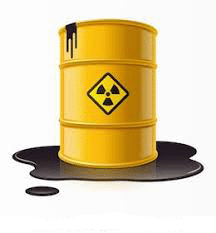 As nuclear waste piles up, scientists seek the best long-term storage solutions. Researchers study and model corrosion in the materials proposed for locking away the hazardous waste C and EN, by Mitch Jacoby, MARCH 30, 2020 | APPEARED IN VOLUME 98, ISSUE 12
Regardless of whether you are for or against nuclear power, and no matter what you think of nuclear weapons, the radioactive waste is already here, and we have to deal with it.”
IN BRIEF
More than a quarter million metric tons of highly radioactive waste sits in storage near nuclear power plants and weapons production facilities worldwide, with over 90,000 metric tons in the US alone. Emitting radiation that can pose serious risks to human health and the environment, the waste, much of it decades old, awaits permanent disposal in geological repositories, but none are operational. With nowhere to go for now, the hazardous materials and their containers continue to age. That unsustainable situation is driving corrosion experts to better understand how steel, glass, and other materials proposed for long-term nuclear waste storage containers might degrade. Read on to learn how these researchers’ findings might help protect people and the environment from waste leakages.
That’s Gerald S. Frankel’s matter-of-fact take on the thousands of metric tons of used solid fuel from nuclear power plants worldwide and the millions of liters of radioactive liquid waste from weapons production that sit in temporary storage containers in the US. While these waste materials, which can be harmful to human health and the environment, wait for a more permanent home, their containers age. In some cases, the aging containers have already begun leaking their toxic contents.
“It’s a societal problem that has been handed down to us from our parents’ generation,” says Frankel, who is a materials scientist at the Ohio State University. “And we are—more or less—handing it to our children.”……..
Vitrification of nuclear waste seems to be well established by now, but actually it still faces complex problems,” says Ashutosh Goel, a materials scientist at Rutgers University. The plan at Hanford, for example, calls for entombing nuclear waste in borosilicate glass and encasing the glass in stainless-steel canisters. Yet the exact formulation of the glass, or glasses, is still under investigation.
Coronavirus: USA Nuclear Sites Could Run Out of Critical Supplies
 Coronavirus and the states: Plastic bag bans on hold; nuclear plants run low on gloves, masks, wipes. Missoula, BY MATT VASILOGAMBROS, 30 Mar 20
“…… Nuclear Sites Could Run Out of Critical Supplies. Nuclear sites across the country might soon run out of gloves, masks and wipes. The U.S. Energy Department said the priority was to supply those items to health care workers and others on the frontline of the coronavirus epidemic.
That means thousands of nuclear power plant workers across the country may not have the protection needed to do their jobs. Nuclear Energy Institute CEO Maria Korsnick anticipated the shortage as early as last week, when she asked U.S. Energy Secretary Dan Brouillette for supplies and testing kits.
To be sure, not every plant expects to run out of masks. The Tennessee Valley Authority this week donated more than 50,000 masks to state emergency responders, according to spokeswoman Melinda Hunter.
Still, the TVA has worked to adapt to the crisis, including reducing power at some plants. One of its plants, Sequoyah, downsized its refueling crew from 1,000 to 800. No TVA worker had tested positive for COVID-19 as of Thursday.
Regulators also have been scrambling to adapt. The U.S. Nuclear Regulatory Commission will allow plants to operate with fewer workers on duty for longer hours, said Scott Burnell, a spokesman for the agency, in an email.
Environmental activists say now is not the time to cut corners and risk a nuclear accident. “An accident with a major release of radiation or the threat of it during this time of pandemic and social isolation would be a double whammy,” said Don Safer, a member of the board of the Tennessee Environmental Council, which advocates for renewable energy. “A major evacuation now would be chaos.”….. https://missoulacurrent.com/government/2020/03/states-coronavirus/
U.S. Nuclear Regulatory Commission (NRC) may exempt some nuclear stations from work-hour controls
NRC to Consider COVID-19 Exemptions for Nuclear Plant Work-Hour Controls https://www.powermag.com/nrc-to-consider-covid-19-exemptions-for-nuclear-plant-work-hour-controls– Sonal Patel , POWER senior associate editor (@sonalcpatel, @POWERmagazine). 30 Mar 20,
The Nuclear Regulatory Commission (NRC) on March 28 told industry that it is prepared to grant requests from individual nuclear generators for exemptions from work-hour controls specified in its rules to help provide more flexibility to the sector as it grapples with workforce issues related to the COVID-19 public health emergency.
The objective of the exemptions from Title 10 of the Code of Federal Regulations (10 CFR 26.205(d)(1)-(7)) is to ensure that the “control of work hours and management of worker fatigue do not unduly limit licensee flexibility in using personnel resources to most effectively manage the impacts of the COVID-19 [public health emergency (PHE)] on maintaining the safe operation of these facilities,” NRC Director of Nuclear Reactor Regulation Ho Nieh wrote in letters sent to the Nuclear Energy Institute (NEI), Entergy Nuclear, and Florida Power and Light over the weekend.
Nieh wrote that the exemptions will apply narrowly—only to nuclear plants whose staffing levels are affected by the pandemic. Licensees must also show they can no longer meet the work-hour controls outlined in the rules, and they can institute site-specific administrative controls for pandemic fatigue-management for personnel as outlined in the rules.
Alternative fatigue-management controls, for example, should ensure employees do not work more than 16 work-hours in any 24-hour period and not more than 86 work-hours in any 7-day period, excluding shift turnover; a minimum 10-hour break is provided between successive work periods; 12 hour shifts are limited to not more than 14 consecutive days; and a minimum of six days off are provided in any 30-day period.
Nuclear licensees that cannot meet the rule’s requirements should notify the NRC in writing, including by email, no less than 24 hours before they would be out of compliance with the rules, Nieh said. The NRC plans to consider requests on a case-by-case basis and, if approved, provide exemptions for a period of 60 days. “If the COVID-19 PHE condition does not improve before expiration of the exemption, then the NRC may consider an additional exemption period,” he added.
(This story is being updated; check back later for more details.)
—
EDF workers at Hinkley Point C nuclear site are a major health risk to local residents

 accommodation around Hinkley Point are a major health risk to residents and should be moved out to purpose-built campuses which have strict health precautions, local councillors urged this week.
workforce by half to around 2,000 in the coming days in an attempt to limit
the spread of the coronavirus, it was claimed that while residents were in
lockdown, HPC construction workers could “come and go as they wish”.
“People are very scared and concerned,” said Cllr Chris Morgan,
chairman of Stogursey Parish Council and the area’s councillor on
Somerset West and Taunton Council. “What is happening is a recipe for
disaster.”
Hinkley workforce, “you have still got a very large group of people doing
what everyone else has been told not to do. “We have a large multiple
occupation building (HMO) in the middle of the village, another in Castle
Street, one in Burton and many rented rooms, all full of people going to
work, coming back, using the shops, all mixing together.
particularly in Stogursey parish, is that we still have contractors who
quite rightly go home at the weekends, some to the Covid 19 hotspots of
South Wales and the West Midlands, and then return to the middle of our
local community, totally untested, before they return to the site.
measures can be taken, but at the moment it seems that the only real
control over the situation would be to shut the site down, which I don’t
think will happen because it is a critical national infrastructure
project.” https://www.wsfp.co.uk/article.cfm?id=123896&headline=Health%20fears%20over%20Hinkley%20workers
China is Willing to Negotiate on Nuclear Arms, But Not on Trump’s Terms

 China is Willing to Negotiate on Nuclear Arms, But Not on Trump’s Terms, Defense One, BY GREGORY KULACKI, 30 Mar 20
President Trump announced to the world in a March 5 tweet that he would propose “a bold new trilateral arms control initiative with China and Russia.” China immediately rejected the idea the very next day. It would be wrong, however, to infer that Chinese leaders are opposed to nuclear arms control. They are not. They are just not interested in what Trump appears to be offering.
There are good reasons for China to suspect Trump’s motives. He used China as a scapegoat when withdrawing from the Intermediate Nuclear Forces Treaty, for example, and he may be using this vague new initiative to justify allowing the New START Treaty to expire. China was not a party to either agreement. Walking away from treaties with Russia and blaming China for it is unlikely to encourage Chinese leaders to come to the negotiating table.
Trump premised his announcement of this new initiative with a questionable claim that China will “double the size of its nuclear stockpile” before the end of the decade. That sounds ominous, but in fact China has only about 300 warheads and barely enough plutonium to get to 600. Meanwhile, the United States and Russia each possess more than 6,000 warheads. Any new agreement based on parity among the three states would require steep U.S. and Russian cuts even if China did indeed double its arsenal.
China certainly would welcome major U.S. and Russian reductions. But there is no sign either nation is willing to make them. On the contrary, Trump and President Putin have announced ambitious nuclear modernization programs that dwarf China’s. Since neither of the two countries are planning to reduce their arsenals, it is difficult for Chinese leaders to understand what Trump wants to discuss. Neither the president nor his aides have provided a tentative agenda or cited desired outcomes.
Despite Trump’s apparent failure to engage China, if he or his successor wants to bring China to the negotiating table, there is a path to follow. Below are four steps the United States can take to convince Chinese leaders to negotiate on nuclear arms.
Step 1. Pursue International, not Multilateral, Negotiations
There is a marked difference between international and multilateral negotiations, and it matters to China……..
Step 2. Accept Mutual Vulnerability
Accepting mutual vulnerability sounds defeatist. But all it means is that no one can win a nuclear arms race. The United States cannot prevent China from being able to retaliate and deliver some number of nuclear weapons if the United States should ever choose to use nuclear weapons first during a war……
Step 3. Take No-First-Use Seriously
China is serious about not using its nuclear weapons first in an armed conflict. In a statement after its first nuclear test in 1964, the Chinese government declared it will “never at any time and under any circumstances be the first to use nuclear weapons.”…
Step 4. Discuss Limits on Missile Defense
When the United States and the Soviet Union finally realized that no one could win a nuclear arms race, they decided to talk. Negotiators quickly discovered that limiting offense was impossible without limiting defense as well, since an effective way to counter defenses is to build more offensive weapons…..https://www.defenseone.com/ideas/2020/03/china-willing-negotiate-nuclear-arms-not-trumps-terms/164204/
1 This Month
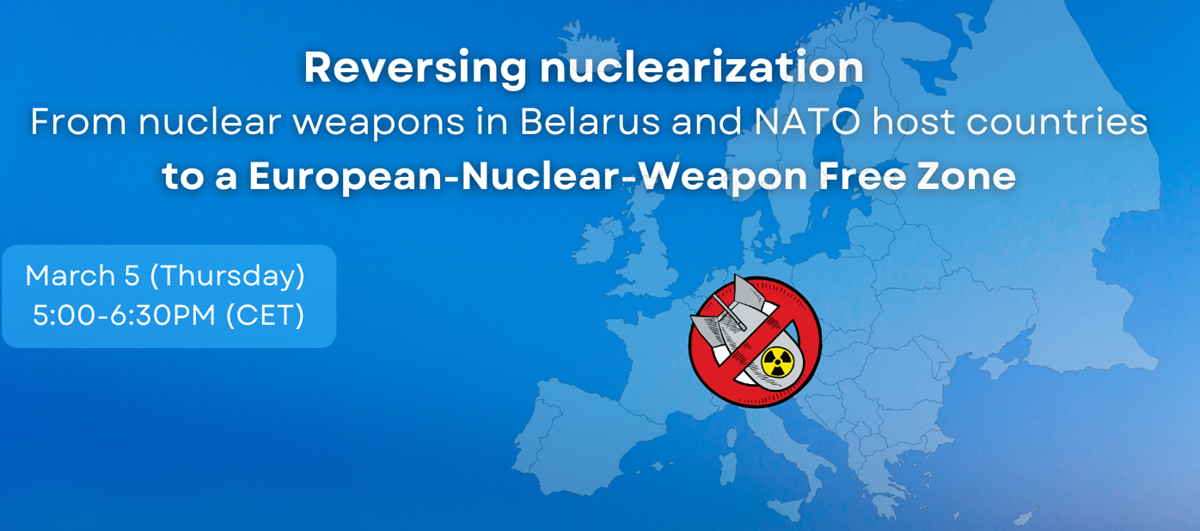
5 March -Online – Reversing nuclearization:
From nuclear weapons in Belarus and NATO host countries to a European-Nuclear-Weapon Free Zone
11am-12:30pm Eastern Time USA / 5pm-6:30pm CET

of the week – Advocating for a
nuclear free beach – https://www.samuellawrencefoundation.org/
The Samuel Lawrence Foundation advocates for a Nuclear Waste Free Beach at San Onofre, join us and take action!

10 March A LIVE WEBINAR THE REAL EFFECTS OF NUCLEAR POWER
What the Industry Isn’t Telling Us
1:00 PM Mountain, 2 pm Central, 3 pm Eastern. Live on the Keepers of the Water Facebook page

18 March Webinar @ 1 PM EST: An Assessment of SMR Projects: The Case of Canada
register for the zoom:
https://us02web.zoom.us/webinar/register/WN_o8BIIOUvQ2ONJR1nta65DQ#/registration

of the week – STOP SMALL MODULAR REACTORS IN CANADA
To see nuclear-related stories in greater depth and intensity – go to https://nuclearinformation.wordpress.com
-
Archives
- March 2026 (38)
- February 2026 (268)
- January 2026 (308)
- December 2025 (358)
- November 2025 (359)
- October 2025 (376)
- September 2025 (258)
- August 2025 (319)
- July 2025 (230)
- June 2025 (348)
- May 2025 (261)
- April 2025 (305)
-
Categories
- 1
- 1 NUCLEAR ISSUES
- business and costs
- climate change
- culture and arts
- ENERGY
- environment
- health
- history
- indigenous issues
- Legal
- marketing of nuclear
- media
- opposition to nuclear
- PERSONAL STORIES
- politics
- politics international
- Religion and ethics
- safety
- secrets,lies and civil liberties
- spinbuster
- technology
- Uranium
- wastes
- weapons and war
- Women
- 2 WORLD
- ACTION
- AFRICA
- Atrocities
- AUSTRALIA
- Christina's notes
- Christina's themes
- culture and arts
- Events
- Fuk 2022
- Fuk 2023
- Fukushima 2017
- Fukushima 2018
- fukushima 2019
- Fukushima 2020
- Fukushima 2021
- general
- global warming
- Humour (God we need it)
- Nuclear
- RARE EARTHS
- Reference
- resources – print
- Resources -audiovicual
- Weekly Newsletter
- World
- World Nuclear
- YouTube
-
RSS
Entries RSS
Comments RSS
 nuclear-news