Proponents of Small Nuclear Reactors need a reality check – about the STAGGERING COST
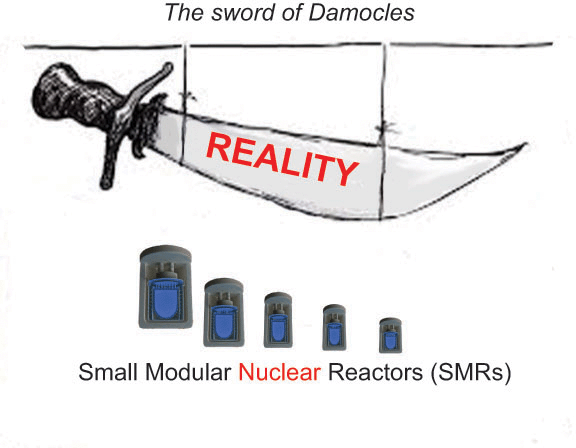 a reality check is in order. A handful of small reactors is under construction but they have been subject to huge cost overruns and delays. William Von Hoene, senior vice-president of Exelon ‒ the largest operator of nuclear power plants in the US ‒ says that no more large reactors will be built in the US and that the cost of small reactors is “prohibitive”.
Rolls-Royce sharply reduced its small-reactor investment to “a handful of salaries” in 2018 and is threatening to abandon its R&D altogether unless the British government agrees to an outrageous set of demands and subsidies.
|
Supporters of nuclear need a reality check: it’s staggeringly expensive, https://www.smh.com.au/environment/climate-change/supporters-of-nuclear-need-a-reality-check-it-s-staggeringly-expensive-20200308-p547wv.html, By Jim Green March 10, 2020 The NSW Parliament’s State Development Committee released its report into nuclear power last week. Conservative committee members recommended repeal of state laws banning uranium mining and nuclear power, while Labor members want to retain the legal bans.
What the conservatives and other supporters of nuclear power ignore is that it has priced itself out of the energy debate. Its costs are staggering and the worldwide pattern for the industry is one of stagnation and decline. In the US, the cost of the only two reactors under construction has skyrocketed to between $20.4 billion and $22.6 billion for one reactor. In 2006, Westinghouse said it could build a reactor for 10 times less than that amount. Another project in the US, a twin-reactor project in South Carolina, was abandoned in 2017 after the expenditure of at least $13.4 billion. Over in New Mexico, the world’s only deep underground nuclear waste repository was closed for three years following a chemical explosion in an underground nuclear waste barrel in 2014. In Britain, the estimated cost of the only two reactors under construction is $25.9 billion each. In the mid-2000s, the estimated cost was almost seven times lower. The British National Audit Office estimates that taxpayer subsidies for the project will amount to $58 billion. The cost of the only reactors under construction in France and Finland has nearly quadrupled and now stands at $17.7 billion to $20 billion per reactor. Both projects are 10 years behind schedule. Tomorrow, Japan will commemorate the ninth anniversary of the meltdowns, fires and explosions at the Fukushima nuclear plant. The Japanese government’s estimate of clean-up and compensation costs is over $300 billion, and rising. Insiders and lobbyists freely acknowledge that the nuclear power industry is in crisis and that worldwide decline is certain. But its Australian supporters are unfazed. Their only sideways nod to reality is to argue that even if large, conventional reactors are too expensive, the emerging “small modular reactors” would be a good fit for Australia. Continue reading |
The Virus of Nuclear Proliferation — limitless life

Demilitarization, Immorality, World The Virus of Nuclear Proliferation By Alice Slater, In Depth News, March 8, 2020 The writer serves on the Board of World BEYOND War, and represents the Nuclear Age Peace Foundation at the United Nations. NEW YORK (IDN) — In an avalanche of reporting we are now assaulted with information about how the world is […]
And they say that small nuclear reactors do not have military applications
Pentagon awards contracts to design mobile nuclear reactor Defense News
The department awarded contracts to BWX Technologies, Inc. of Virginia, for $13.5 million; Westinghouse Government Services of Washington, D.C. for $11.9 million; and X-energy, LLC of Maryland, for $14.3 million, to begin a two-year engineering design competition for a small nuclear microreactor designed to potentially be forward deployed with forces outside the continental United States.
The combined $39.7 million in contracts are from “Project Pele,” a project run through the Strategic Capabilities Office (SCO), located within the department’s research and engineering side. The prototype is looking at a 1-5 megawatt (MWe) power range. The Department of Energy has been supporting the project at its Idaho National Laboratory…….
If the testing goes well, a commercially developed, Nuclear Regulatory Commission licensed reactor will be demonstrated on a “permanent domestic military installation by 2027,” according to DoD spokesman Lt. Col. Mike Andrews. “If the full demonstration proves to be a cost effective energy resilience alternative, NRC-licensed [reactors] will provide an additional option for generating power provided to DoD through power purchase agreements.”
The best way to differentiate between the programs may be to think of the A&S effort as the domestic program, built off commercial technology, as part of an effort to get off of local power grids that are seen as weak targets, either via physical or cyber espionage. Pele is focused on the prototyping a new design, with forward operations in mind — and may never actually produce a reactor, if the prototype work proves too difficult…… https://www.defensenews.com/smr/nuclear-arsenal/2020/03/09/pentagon-to-award-mobile-nuclear-reactor-contracts-this-week/
High Courts in Japan to assess government liability for Fukushima nuclear disaster
|
Attention is on how the courts will assess the liability of the government, which has flatly denied responsibility over the accident at Tokyo Electric Power Company Holdings Inc.’s Fukushima No. 1 nuclear plant. The plant suffered meltdowns in three of its reactors after being hit by a massive earthquake and tsunami on March 11, 2011, forcing many residents to evacuate. So far, six of 10 district courts have found the government responsible for the nuclear accident, while the other four did not recognize government liability. The key issues are whether the government was able to predict the huge tsunami and was able to avert the catastrophe by taking preventive measures. The plaintiffs claim that the government could have prevented the accident if it had urged Tepco to take measures by exercising its regulatory power, based on its long-term earthquake prediction issued in 2002. All of the 10 district courts recognized Tepco’s responsibility to pay damages to the plaintiffs based on a law obliging a plant operator to pay damages over a nuclear accident, regardless of whether it was negligent or not. The Maebashi District Court and five others found that the long-term earthquake assessment was reliable, saying it was a reasonable prediction that should have been taken into account when considering tsunami countermeasures. The courts thus recognized the government’s responsibility, finding that it acted illegally by neglecting to order Tepco to take preventive measures — such as relocating power sources to a higher location at the plant. By contrast, two separate rulings issued by the Chiba District Court did not support the claim of government responsibility, reaching verdicts that the nuclear accident could not have been avoided even if preventive measures had been taken. Still, all district court rulings found that the government had been able to foresee the possibility of a huge tsunami hitting the plant. “Based on the premise that a nuclear plant should be protected at any cost, the government should exercise its regulatory power soon after it predicts a tsunami,” said Izutaro Managi, a lawyer involved in a case filed with the Fukushima District Court. The Fukushima case involves some 3,800 plaintiffs — the largest number among suits filed against Tepco and the government over the nuclear accident. The first high court ruling is expected later this year. “If high courts issue rulings in succession recognizing state responsibility over the nuclear accident, the Japanese government as a perpetrator should act to address damages from the accident,” Managi said. Specifically, he called on the government to review its compensation guidelines, which include measures such as monthly payments of ¥100,000 to each resident in evacuation zones. |
|

Iran continues to provide international inspectors access to its nuclear facilities
“The agency has not observed any changes to Iran’s implementation of its nuclear-related commitments under the JCPOA in connection with this announcement, or in the level of cooperation by Iran in relation to agency verification and monitoring activities under the JCPOA,” Grossi said in prepared remarks……..
The JCPOA promised Iran economic incentives in return for the curbs on its nuclear program, but since President Donald Trump pulled the U.S. out of the deal unilaterally in 2018 and imposed new sanctions, the country’s economy has been struggling.
Its violations of the pact are intended to pressure the other nations involved to increase economic incentives to make up for the American sanctions. So far, attempts by the other members of the JCPOA have fallen short of Iran’s demands.
In a separate report to members last week, the IAEA said it had identified three locations in Iran where the country possibly stored undeclared nuclear material or undertook nuclear-related activities without declaring it to international observers.
The activities at those locations are believed to have dated from the early 2000s, before the nuclear deal, and Iran responded to the report by suggesting that the IAEA had no legal basis to inspect those sites.
In his speech to the board members, Grossi called on “Iran to cooperate immediately and fully with the agency, including by providing prompt access to the locations specified by the agency.”
“The agency has identified a number of questions related to possible undeclared nuclear material and nuclear-related activities at three locations that have not been declared by Iran,” Grossi said, according to his prepared remarks. “The agency sought access to two of the locations. Iran has not provided access to these locations and has not engaged in substantive discussions to clarify the agency’s questions.” https://www.japantimes.co.jp/news/2020/03/09/world/u-n-atomic-watchdog-says-iran-still-providing-nuclear-access/#.XmbVIagzbIU
Snazzy little nuclear reactors the next big thing for Australia? I don’t think so
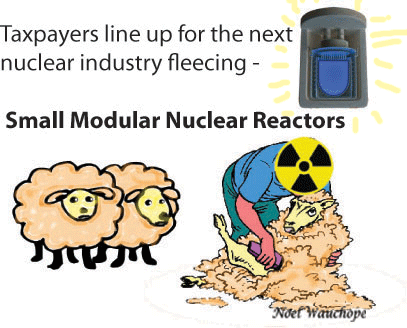
NUCLEAR PRICES ITSELF OUT OF THE FUTURE, HTTPS://WWW.AUMANUFACTURING.COM.AU/NUCLEAR-PRICES-ITSELF-OUT-OF-THE-FUTURE BY PETER ROBERTS, 9 Mar 20,
I was at lunch the other day and out came the familiar theme – Australia should go nuclear to de-carbonise the economy.
Well, a just-released report from the NSW Parliament’s State Development Committee should put an end to such talk – it is just too expensive and problematic.
The report, detailed in Channel 9 media, found the cost of the two reactors being built in the US is now thought to be between $20.4 billion and $22.6 billion for each reactor.
In the UK the cost of two reactors being build has jumped seven-fold to $25.9 billion each.
And those being built in France and Finland are now costed at upwards of $17.7 billion each.
Cost over-runs and delays mean that big nuclear power plants are only going to be built where there are massive government subsidies.
And this is even before factoring in the cost of the odd Fukushima or Chernobyl.
This morning on social media the pro-nuclear trolls were out in force – people are living happily now at Chernobyl one said.
Well I visited Chernobyl 18 months ago and there is nothing normal about it.
Maintaining the remains of the reactors at Chernobyl consumes 10 per cent of Ukraine’s admittedly modest GDP, and the long term effects of radiation continue to be felt.
This is why nuclear proponents now talk about snazzy new small reactors which are going to be the next big thing.
The same story is unfolding in small reactor construction as large – cost over-runs, very few small reactors actually under construction, and the need for massive, yes there’s that word again, government subsidies.
We already know what the answer to our carbon crisis is – renewables. Wind and solar plus storage is already cheaper and getting cheaper every day.
The future is not nuclear.
Uranium is also a feminist issue — IPPNW peace and health blog

by Angelika Claussen Around the world, women are resisting the civil and military use of nuclear technology Women have always and everywhere been part of the history of uranium processing and nuclear technology—as workers in uranium production, as residents in the vicinity of mines, or as victims of military and civilian nuclear disasters. Women are particularly vulnerable to the health […]
via Uranium is also a feminist issue — IPPNW peace and health blog
Peach Bottom nuclear station can struggle on for 80 years!

It’s getting a bit tiresome – this endless, mindless repetition of “carbon-free”  “clean energy” “zero-carbon” nuclear energy. Why don’t Larry Pearl and other writers, who otherwise provide thorough and well-researched information – why don’t they do their homework on the full carbon emissions of the entire nuclear fuel chain? Even the reactors themselves release a tiny an mount of Carbon 14. There is not only the chain of construction and demolition, but also the continuing fuel chain of mining through to radioactive waste disposal.
Exelon’s Peach Bottom becomes second US nuclear plant to get license 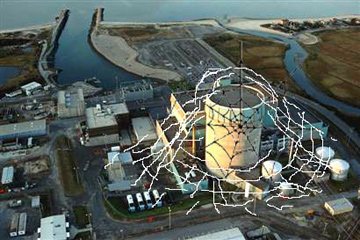 approval to 80 years, Utility Dive , By Larry Pearl March 9, 2020
Dive Brief:
- Exelon’s Peach Bottom plant became the second nuclear power reactor in the U.S. to get permission to operate out to 80 years, after the Nuclear Regulatory Commission approved another 20-year extension on Friday.
- Last December, Florida Power & Light’s Turkey Point units 3 and 4 got the first such approval as utilities work to retain a major source of carbon-free [?] as long as possible.
- Dominion has applied for a similar license extension for its Surry nuclear plant and plans to request for at least two more, while Duke plans to do the same for all 11 of its nuclear plants, Bloomberg reported last month.
Dive Insight:
Peach Bottom Unit 2 in York County, Pennsylvania, is now licensed to operate through August 2053 and Unit 3 through July 2054. The approvals come as more and more states move to adopt aggressive clean energy goals and the nuclear industry looks to advance a new generation of reactors.
But the economics of the current generation of U.S. reactors remains challenging, especially for new plants, and the industry and a number of states have adopted programs to recognize the zero emission attributes of nuclear.
While Exelon Nuclear’s Chief Nuclear Officer Bryan Hanson called the license extension, “good news for the environment, our employees and the community,” he noted that “nuclear plants must remain financially viable to continue to operate. ….
But FERC’s move in December to effectively raise the price floor for subsidized resources attempting to bid into the PJM wholesale capacity market complicates state efforts to support nuclear plants in Pennsylvania and elsewhere.
A variety of stakeholders have petitioned FERC to reconsider its decision.
The NRC’s decision to move forward with Peach Bottom’s license extension is also being challenged…. https://www.utilitydive.com/news/exelons-peach-bottom-becomes-second-us-nuclear-plant-to-get-license-approv/573690/
1 This Month

of the week – Shut Down Drone Warfare!


Tell the Ukrainian Government to Drop Prosecution of Peace Activist Yurii Sheliazhenko

Petition to revoke the licensing of the Near Surface Nuclear Disposal Facility (NSDF) at Chalk River. https://www.ourcommons.ca/petitions/en/Petition/Details?Petition=e-7247
To see nuclear-related stories in greater depth and intensity – go to https://nuclearinformation.wordpress.com
-
Archives
- April 2026 (91)
- March 2026 (251)
- February 2026 (268)
- January 2026 (308)
- December 2025 (358)
- November 2025 (359)
- October 2025 (376)
- September 2025 (257)
- August 2025 (319)
- July 2025 (230)
- June 2025 (348)
- May 2025 (261)
-
Categories
- 1
- 1 NUCLEAR ISSUES
- business and costs
- climate change
- culture and arts
- ENERGY
- environment
- health
- history
- indigenous issues
- Legal
- marketing of nuclear
- media
- opposition to nuclear
- PERSONAL STORIES
- politics
- politics international
- Religion and ethics
- safety
- secrets,lies and civil liberties
- spinbuster
- technology
- Uranium
- wastes
- weapons and war
- Women
- 2 WORLD
- ACTION
- AFRICA
- Atrocities
- AUSTRALIA
- Christina's notes
- Christina's themes
- culture and arts
- Events
- Fuk 2022
- Fuk 2023
- Fukushima 2017
- Fukushima 2018
- fukushima 2019
- Fukushima 2020
- Fukushima 2021
- general
- global warming
- Humour (God we need it)
- Nuclear
- RARE EARTHS
- Reference
- resources – print
- Resources -audiovicual
- Weekly Newsletter
- World
- World Nuclear
- YouTube
-
RSS
Entries RSS
Comments RSS
 nuclear-news