Dr Chris Busby exposes the facts on Cancer in US Navy Nuclear Powered Ships

Cancer in US Navy Nuclear Powered Ships https://www.counterpunch.org/2020/03/06/cancer-in-us-navy-nuclear-powered-ships/ by CHRIS BUSBY Here is a good one. In 2011, the nuclear-powered aircraft carrier USS Ronald Reagan was about 100km off the coast of Japan at the time of the Tsunami and the subsequent Fukushima reactor explosions. It was directed by the US government to ride to the rescue in what was later called Operation Tomodachi (friendship)–to provide assistance to the victims of the floods. What no-one on board was told was that the reactors had exploded and a plume of highly radioactive material was blowing east from the site into the path of the vessel. Of course, when this arrived, all the radiation monitors on the boat started screaming, and the planes and helicopters that had flown the rescue sorties were contaminated.
In 2014, following all the publicity about the cancers, a number of US Senators and important people were asking pertinent questions—the Navy had to do something to answer the accusations that the Fukushima radiation was killing those who sailed on Operation Tomodachi. They panicked. A big report was prepared by the US Defense Threat Reduction Agency (DTRA), entitled: Final Report to the Congressional Defense Committees in Response to the Joint Explanatory Statement Accompanying the Department of Defense Appropriations Act, 2014, page 90, “Radiation Exposure” [2]. Never use one word when ten will do
What I discuss in the paper to explain the result is my usual argument about how the radiation protection legislation is wildly incorrect when dealing with internal contamination from radionuclides. The legal limits in USA and the West are based on the comparison of cancers in those exposed to acute external gamma ray doses to the Japanese A-Bomb populations and cannot apply to internal exposures to substances which target DNA (Uranium, Strontium-90) or which provide huge local ionisation to some living cells but nothing at all to others (DU particles, reactor discharge particles).
Nuclear workers work outside at a nuclear site where the discharges get dispersed. Nuclear sailors live in a tin box that also contains the reactors. Nuclear worker studies are based on data that is provided by the nuclear industry to show there are no cancers. The DTRA study had to show more cancers in order to swamp the Ronald Reagan sailors’ cancers. But to do this, they brought out their Queen. And it was taken
Notes.
1) https://www.courthousenews.com/us-sailors-face-grim-diagnoses-after-fukushima-mission/
3) https://seer.cancer.gov/data/
4) https://www.tandfonline.com/doi/abs/10.1080/07357907.2020.1731526?journalCode=icnv20
5) https://www.genetics.org/content/204/4/1627
6) https://royalsocietypublishing.org/doi/10.1098/rspb.2017.1070
7) https://royalsocietypublishing.org/doi/10.1098/rspb.2017.1070
Dr Chris Busby is the Scientific Secretary of the European Committee on Radiation Riskand the author of Uranium and Health – The Health Effects of Exposure to Uranium and Uranium Weapons Fallout (Documents of the ECRR 2010 No 2, Brussels, 2010). For details and current CV see chrisbusbyexposed.org. For accounts of his work see greenaudit.org, llrc.org and nuclearjustice.org.
Trump’s America prepares to use low-level nuclear weapons as “a viable option” – Russia fears
 Russia Fears US Under Trump Now Ready to Use Nuclear Weapons as ‘Viable Political Option’ https://www.commondreams.org/news/2020/03/06/russia-fears-us-under-trump-now-ready-use-nuclear-weapons-viable-political-option“This dramatically increases the chance of a nuclear exchange due to miscalculation or human error.”by Eoin Higgins, staff writer
 |
“Washington is not just modernizing its nuclear forces, but is striving to give them new capabilities, which greatly expands the likelihood of their use,” Russian Foreign Ministry spokeswoman Maria Zakharova said Friday. Zakharova told reporters that the U.S. increase in nuclear weapons capabilities earlier in the year, when the military deployed a low-yield ballistic warhead to its submarines, reduces the threshhold for using the weapons and brings the world closer to the possibility of nuclear war. As Common Dreams reported, the move was seen by International Campaign to Abolish Nuclear Weapons treaty coordinator Tim Wright as “an alarming development that heightens the risk of nuclear war.” “Of particular concern is the expansion of the range of U.S. low-yield weapons in its nuclear arsenal, including the development and deployment of such munitions for strategic carriers,” said Zakharova. The U.S. in February angered Russian officials for a war game in which the Pentagon ran a scenario where Russia attacked a NATO ally with a low-yield nuclear weapon and the U.S. responed with a “limited” nuclear strike. According to RT, the Russian government’s concerns are based in part on the U.S.’s nuclear doctrines:
As the Washington Physicians for Social Responsibility’s Bruce Amundson and Joseph Berkson wrote for the Seattle Times in February after the U.S. deployment of low-yield weapons was announced, the deployment raises the risk of overreaction and escalation:
In her remarks Friday, Zakharova said Moscow was treating U.S. moves as a sign the country “has made a decision to consider a nuclear conflict as a viable political option and are creating the potential [scenario] necessary for it.” President Donald Trump and his administration have been reluctant to commit to renewing the Nuclear Nonproliferation Treaty in April 2021. The treaty turned 50-years-old on March 5, leading United Nations General Secretary António Guterres in a statement to call on treaty signatories to recommit to world peace. “The Secretary-General calls on States parties to make the most of this opportunity to strengthen international peace and security through the promotion of non-proliferation of nuclear weapons and nuclear disarmament, as well as measures to strengthen implementation of the NPT and achieve its universality,” said Guterres. |
Deceit and Dark Money -Ohio’s nuclear subsidy saga

Dark money dominated Ohio’s nuclear subsidy saga ENERGY NEWS NETWORK, Kathiann M. Kowalski, March 5, 2020
FirstEnergy Solutions paid nearly $2 million to at least one group, but  most other data remains hidden.

After-the-fact filings show that FirstEnergy’s generation subsidiary paid nearly $2 million to Generation Now, one of the special interest groups that orchestrated ads, political donations and other efforts behind Ohio’s nuclear and coal bailout.
But legal loopholes make it harder to find out the total spent and who else was behind xenophobic advertising, dueling voter petitions, alleged intimidation and other claims of foul play. And none of those actions fully disclosed who was behind them.
The scant public filings that are available show additional connections to FirstEnergy Solutions (now Energy Harbor), as well as the law firm of an outspoken legislator who has long fought the state’s clean energy standard, and others with high-level political influence.
House Bill 6 gutted Ohio’s renewable energy and energy efficiency standards while putting ratepayers on the hook for nearly $1 billion in subsidies for nuclear power plants, plus an additional amount for aging coal plants. Multiple groups spent heavily to promote HB 6 and prevent a referendum on the law following its passage.
In some cases, nonprofit and for-profit organizations funded each other or shared the same spokesperson. Groups active in the HB 6 campaign also had links to some of the same lobbyists and consultants who acted for companies that stood to benefit from HB 6, or unions with workers at their plants. But only limited amounts of funding could be traced.
ON ORIGINAL – INTRIGUING INTERACTIVE DIAGRAM HERE _ shows interrelationships of individuals and groups Continue reading
Big Oil Big Soda and plastically polluted Planet Earth.
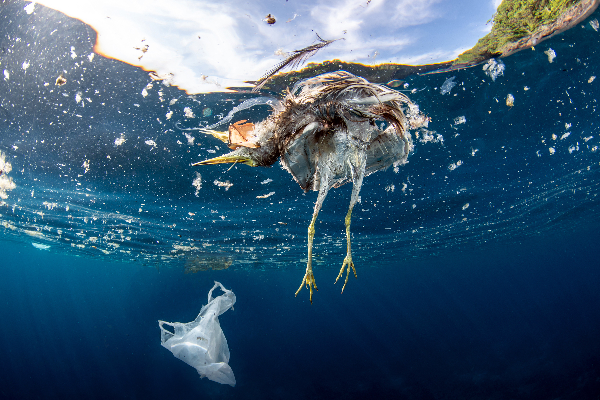
“They really sold people on the idea that plastics can be recycled because there’s a fraction of them that are,”..“It’s fraudulent. When you drill down into plastics recycling, you realize it’s a myth.” …… “Recycling delays, rather than avoids, final disposal,” the Science authors write. And most plastics persist for centuries. …….
We are all guinea pigs in this experiment, as plastics accumulate in the food web, appearing in seafood, table salt, and ironically even in bottled water. Many plastics are mixed with a toxic brew of colorants, flame retardants, and plasticizers.
 PLANET PLASTIC, How Big Oil and Big Soda kept a global environmental calamity a secret for decades, Rolling Stone, By TIM DICKINSON, MARCH 3, 2020
Every human on Earth is ingesting nearly 2,000 particles of plastic a week. These tiny pieces enter our unwitting bodies from tap water, food, and even the air, according to an alarming academic study sponsored by the World Wildlife Fund for Nature, dosing us with five grams of plastics, many cut with chemicals linked to cancers, hormone disruption, and developmental delays. Since the paper’s publication last year, Sen. Tom Udall, a plain-spoken New Mexico Democrat with a fondness for white cowboy hats and turquoise bolo ties, has been trumpeting the risk: “We are consuming a credit card’s worth of plastic each week,” Udall says. At events with constituents, he will brandish a Visa from his wallet and declare, “You’re eating this, folks!”
With new legislation, the Break Free From Plastic Pollution Act of 2020, Udall is attempting to marshal Washington into a confrontation with the plastics industry, and to force companies that profit from plastics to take accountability for the waste they create. …….
The battle pits Udall and his allies in Congress against some of the most powerful corporate interests on the planet, including the oil majors and chemical giants that produce the building blocks for our modern plastic world — think Exxon, Dow, and Shell — and consumer giants like Coca-Cola, Nestlé, and Unilever that package their products in the stuff. Big Plastic isn’t a single entity. It’s more like a corporate supergroup: Big Oil meets Big Soda — with a puff of Big Tobacco, responsible for trillions of plastic cigarette butts in the environment every year. And it combines the lobbying and public-relations might of all three………
Massive quantities of this forever material are spilling into the oceans — the equivalent of a dump-truck load every minute. Plastic is also fouling our mountains, our farmland, and spiraling into an unmitigatable environmental disaster. John Hocevar is a marine biologist who leads the Oceans Campaign for Greenpeace, and spearheaded the group’s response to the BP oil spill in the Gulf. Increasingly, his work has centered on plastics. “This is a much bigger problem than ‘just’ an ocean issue, or even a pollution issue,” he says. “We’ve found plastic everywhere we’ve ever looked. It’s in the Arctic and the Antarctic and in the middle of the Pacific. It’s in the Pyrenees and in the Rockies. It’s settling out of the air. It’s raining down on us.”
More than half the plastic now on Earth has been created since 2002, and plastic pollution is on pace to double by 2030. At its root, the global plastics crisis is a product of our addiction to fossil fuels. The private profit and public harm of the oil industry is well understood: Oil is refined and distributed to consumers, who benefit from gasoline’s short, useful lifespan in a combustion engine, leaving behind atmospheric pollution for generations. But this same pattern — and this same tragedy of the commons — is playing out with another gift of the oil-and-gas giants, whose drilling draws up the petroleum precursors for plastics. These are refined in industrial complexes and manufactured into bottles, bags, containers, textiles, and toys for consumers who benefit from their transient use — before throwing them away. Continue reading
Japan may have to cancel the Olympics – a “cruise ship on land”
|
Covid-19 could scupper Prime Minister Abe Shinzo’s pet project “……. To contain the damage to his reputation as well as the coronavirus, on February 27th Mr Abe took the initiative, telling all schools to close until April. Preparing for the worst, he rushed through legislation this week allowing a state of emergency to be declared. And he unveiled an emergency spending package…… The government claims that Japan will return to normal in April. That seems implausible. A state visit by China’s president, Xi Jinping, which was supposed to put the two countries’ listing relationship on an even keel, has already been postponed. ….. Much more rides on the Olympic Games in Tokyo this summer. Mr Abe intends them to foster the patriotism whose absence among ordinary Japanese he laments. He wants the games to make Japan seem open, global and even multicultural. And, though vastly over budget, they are to crown the prime minister’s seven-year rule. To cancel the games would generate not only disappointment among ordinary Japanese but anger at the wasted expense they have already had to bear. But a pandemic would take the decision out of his hands—not least, says Nakano Koichi of Sophia University, because the Olympic village would be “a cruise ship on land”. Bet on a postponement of the games at the very least, and on a long delay before the prime minister’s popularity shines again.https://www.economist.com/asia/2020/03/07/japan-may-have-to-cancel-the-olympics?cid1=cust/ednew/n/bl/n/2020/03/5n/owned/n/n/nwl/n/n/EU/420030/n |
|

Westinghouse nuclear reactors – a very poor deal for India
Pushing the wrong energy buttons, https://www.thehindu.com/opinion/op-ed/pushing-the-wrong-energy-buttons/article30965454.ece?fbclid=IwAR1ymOL6TLlSxlUKkVVSL6_ukPPeiSzDlI_JM-He3CMG2qBD4HaBU0vezog, M.V. Ramana, Suvrat Raju, MARCH 03, 2020
The idea of India importing nuclear reactors is a zombie one with serious concerns about their cost and safety
Red flags in the U.S. deal
Because of serious concerns about cost and safety, the two organisations should have been told to abandon, not finalise, the proposal.
Indeed, it has been clear for years that electricity from American reactors would be more expensive than competing sources of energy. Moreover, nuclear reactors can undergo serious accidents, as shown by the 2011 Fukushima disaster. Westinghouse has insisted on a prior assurance that India would not hold it responsible for the consequences of a nuclear disaster, which is effectively an admission that it is unable to guarantee the safety of its reactors.
The main beneficiaries from India’s import of reactors would be Westinghouse and India’s atomic energy establishment that is struggling to retain its relevance given the rapid growth of renewables. But Mr. Trump has reasons to press for the sale too. His re-election campaign for the U.S. presidential election in November, centrally involves the revival of U.S. manufacturing and he has been lobbied by several nuclear reactor vendors, including  Westinghouse, reportedly to “highlight the role U.S. nuclear developers can play in providing power to other countries”. Finally, he also has a conflict-of-interest, thanks to his son-in-law and adviser, Jared Kushner, who accompanied him during the India visit.
In 2018, the Kushner family’s real-estate business was bailed out by a Canadian company that invested at least $1.1-billion in a highly unprofitable building in New York. Earlier that year, Brookfield Business Partners, a subsidiary of that Canadian company, acquired Westinghouse Electric Company. It violates all norms of propriety for Mr. Kushner to be anywhere near a multi-billion dollar sale that would profit Brookfield enormously.
What renewables can offer
Analysts estimate that each of the two AP1000 units being constructed in the U.S. state of Georgia may cost about $13.8 billion. At these rates, the six reactors being offered to India by Westinghouse would cost almost ₹6 lakh crore. If India purchases these reactors, the economic burden will fall upon consumers and taxpayers. In 2013, we estimated that even after reducing these prices by 30%, to account for lower construction costs in India, the first year tariff for electricity would be about ₹25 per unit. On the other hand, recent solar energy bids in India are around ₹3 per unit. Lazard, the Wall Street firm, estimates that wind and solar energy costs have declined by around 70% to 90% in just the last 10 years and may decline further in the future.
How safe?
Nuclear power can also impose long-term costs. Large areas continue to be contaminated with radioactive materials from the 1986 Chernobyl accident and thousands of square kilometres remain closed off for human inhabitation. Nearly a decade after the 2011 disaster, the Fukushima prefecture retains radioactive hotspots and the cost of clean-up has been variously estimated to range from $200-billion to over $600-billion.
The Fukushima accident was partly caused by weaknesses in the General Electric company’s Mark I nuclear reactor design. But that company paid nothing towards clean-up costs, or as compensation to the victims, due to an indemnity clause in Japanese law. Westinghouse wants a similar arrangement with India. Although the Indian liability law is heavily skewed towards manufacturers, it still does not completely indemnify them. So nuclear vendors have tried to chip away at the law. Instead of resisting foreign suppliers, the Indian government has tacitly supported this process.
Starting with the Tarapur 1 and 2 reactors, in Maharashtra, India’s experiences with imported reactors have been poor. The Kudankulam 1 and 2 reactors, in Tamil Nadu, the only ones to have been imported and commissioned in the last decade, have been repeatedly shut down. In 2018-19, these reactors produced just 32% and 38%, respectively, of the electricity they were designed to produce. These difficulties are illustrative of the dismal history of India’s nuclear establishment. In spite of its tall claims, the fraction of electricity generated by nuclear power in India has remained stagnant at about 3% for decades.
The idea of importing nuclear reactors is a “zombie idea” that, from a rational viewpoint, should have been dead long ago. In fact an earlier plan to install AP1000s in Mithi Virdi, Gujarat was cancelled because of strong local opposition. In 2018, Gujarat Chief Minister Vijay Rupani declared that the reactors “will never come up” in Gujarat. The Prime Minister should take a cue from his own State and make a similar announcement for the rest of the country.
Why don’t we treat the climate crisis with the same urgency as coronavirus?
Why don’t we treat the climate crisis with the same urgency as coronavirus? Owen Jones Guardian, 6 Mar 2020 No Cobra meetings, no sombre speeches from No 10, yet the consequences of runaway global heating are catastrophic, It is a global emergency that has already killed on a mass scale and threatens to send millions more to early graves. As its effects spread, it could destabilise entire economies and overwhelm poorer countries lacking resources and infrastructure. But this is the climate crisis, not the coronavirus. Governments are not assembling emergency national plans and you’re not getting push notifications transmitted to your phone breathlessly alerting you to dramatic twists and developments from South Korea to Italy.More than 3,000 people have succumbed to coronavirus yet, according to the World Health Organization, air pollution alone – just one aspect of our central planetary crisis – kills seven million people every year. There have been no Cobra meetings for the climate crisis, no sombre prime ministerial statements detailing the emergency action being taken to reassure the public. In time, we’ll overcome any coronavirus pandemic. With the climate crisis, we are already out of time, and are now left mitigating the inevitably disastrous consequences hurtling towards us. While coronavirus is understandably treated as an imminent danger, the climate crisis is still presented as an abstraction whose consequences are decades away. Unlike an illness, it is harder to visualise how climate breakdown will affect us each as individuals. Perhaps when unprecedented wildfires engulfed parts of the Arctic last summer there could have been an urgent conversation about how the climate crisis was fuelling extreme weather, yet there wasn’t. In 2018, more than 60 million people suffered the consequences of extreme weather and climate change, including more than 1,600 who perished in Europe, Japan and the US because of heatwaves and wildfires. Mozambique, Malawi and Zimbabwe were devastated by cyclone Idai, while hurricanes Florence and Michael inflicted $24bn (£18.7bn) worth of damage on the US economy, according to the World Meteorological Organization.As the recent Yorkshire floods illustrate, extreme weather – with its terrible human and economic costs – is ever more a fact of British life. Antarctic ice is melting more than six times faster than it was four decades ago and Greenland’s ice sheet four times faster than previously thought. According to the UN, we have 10 years to prevent a 1.5C rise above pre-industrial temperature but, whatever happens, we will suffer.
Pandemics and the climate crisis may go hand in hand, too: research suggests that changing weather patterns may drive species to higher altitudes, potentially putting them in contact with diseases for which they have little immunity. “It’s strange when people see the climate crisis as being in the future, compared to coronavirus, which we’re facing now,” says Friends of the Earth’s co-executive director, Miriam Turner. “It might be something that feels far away when sitting in an office in central London, but the emergency footing of the climate crisis is being felt by hundreds of millions already.”
Imagine, then, that we felt the same sense of emergency about the climate crisis as we do about coronavirus. What action would we take? ….. https://www.theguardian.com/commentisfree/2020/mar/05/governments-coronavirus-urgent-climate-crisis
Middle East nuclear arms race to begin, as United Arab Emirates to open world’s largest nuclear reactor?
State-run Korea Electric Power Corporation of South Korea is finishing work on four nuclear reactors in the Al Dhafra region of Abu Dhabi. Known as Barakah and owned by Emirates Nuclear Energy Corporation, the plant is scheduled to go online later this month with a capacity of 5.6 gigawatts.
Barakah is likely to fuel fears in the already tense region, given the uncertainty over the Joint Comprehensive Plan of Action, or Iran nuclear deal, and Israel’s lack of transparency over its nuclear program. Experts warn about more nuclear plants, increased uranium enrichment, and a possible nuclear arms race in what is arguably the most volatile region in the world……
the UAE’s neighbors are far from comfortable with the new plant.
Qatar expressed concern in a letter to the International Atomic Energy Agency, stating that an accidental discharge of radioactive material from Barakah could reach the capital of Doha in under 13 hours.
There are also concerns that the facility could be attacked. Paul Dorfman, researcher at University College London, told Nikkei that the risk of a missile attack on a nuclear facility is not to be discounted. Yemeni rebels claimed responsibility for just such an attack that targeted Barakah while still under construction in 2017. ……
Egypt and Jordan have also jumped on board the nuclear bandwagon. Egypt is set to build four nuclear reactors this year in collaboration with Russia in the El Dabaa region west of Cairo. Lawmaker Ahmed al Tantawi is wary of his country’s nuclear program, stating that Egypt already has a surplus of electricity.
Jordan’s nuclear program, however, faces problems such as financing and how to mitigate potential terrorist attacks. There is also a shortage of water needed to cool reactors, as it is one of the world’s most arid countries.
Iran’s nuclear ambitions are the most alarming. The country already has one nuclear power reactor at the Bushehr power plant and has two other Russian-designed reactors in the works. Construction on one began in November 2019 and is scheduled to finish in 2023. Another is still in the planning stage.
Tehran had curtailed enrichment under the nuclear deal, from which the U.S. withdrew in 2018. But the situation drastically changed in January after the U.S. drone assassination of Iranian Gen. Qassim Soleimani.
“Iran is still adhering to some of its duties under the JCPOA, such as International Atomic Energy Agency oversight,” Mohammed Marandi, political analyst at the University of Tehran, told Nikkei. “But with regards to research and development, the Iranians will no longer accept limitations due to the Europeans and Japanese [not cooperating],” he added.
The European Union tried to save the Iran Nuclear Deal after the administration of U.S. President Donald Trump withdrew. Later, however, the U.K., France and Germany invoked the dispute settlement framework in the deal after Iran increased enrichment activities on the heels of Soleimani’s assassination. Even Japan tried to help by mediating between Tehran and Washington but ultimately failed to ease tensions.
Israel, which is notably not a signatory to the Treaty on the Non-Proliferation of Nuclear Weapons, has a highly advanced military. The Nuclear Threat Initiative, a U.S. nuclear research entity, warns that Israel possesses nuclear weapons along with a large supply of ballistic and cruise missiles to deliver them. And there is no open consensus among experts as to the extent of Israel’s nuclear program.
Analysts say that U.S. policy is encouraging a Middle East nuclear arms race in two ways. First, the U.S. defense and nuclear industries view the region as a lucrative market, with Saudi Arabia being a key buyer. Second, the inaction of Europe, Russia and China to counter U.S. sanctions against Iran do not encourage Tehran to remain a party to the nuclear deal. https://asia.nikkei.com/Politics/International-relations/UAE-s-nuclear-plant-fuels-fears-of-Middle-East-arms-race
Film lauding Japan’s Fukushima heroes warns against complacency,
 Film lauding Japan’s Fukushima heroes warns against complacency, Elaine Lies TOKYO (Reuters) – As aftershocks rock the Fukushima nuclear plant, a small band of workers defy their bosses to stay on and fight to stop an even bigger disaster from irradiating a wide swathe of Japan.
The scene is from a movie that opened on Friday – “Fukushima 50”, which tells the true story of the hours after a quake and tsunami set off meltdowns at the Fukushima Daiichi reactors on March 11, 2011.
Almost nine years to the day after that disaster, its depiction of individual heroism in the face of official bungling and overwhelming catastrophe has struck a chord with early viewers……
nine years on, workers in protective suits are still removing radioactive material from Fukushima’s reactors, and the film’s scenes – mixed in with news footage from the time – still pack an emotional punch. ……
“The Fukushima Fifty” was the name given to the group of workers and engineers who stayed behind after the tsunami knocked out the power and cooling systems at the plant, run by Tokyo Electric Power Co (TEPCO)……
“When I made the film ‘Letters from Iwo Jima,’ I felt that Japan isn’t very good at learning lessons from the past,” Watanabe told a news conference after filming finished last year, referring to the Clint Eastwood film depicting the World War Two battle.
“I feel the same way about Fukushima,” he added.
Editing by Andrew Heavens https://www.reuters.com/article/us-japan-fukushima-film/film-lauding-japans-fukushima-heroes-warns-against-complacency-idUSKBN20T1GV
Belgian nuclear plants now could shut down earlier than planned
 Court ruling could close Doel nuclear reactors earlier, Friday, 06 March 2020 A ruling by the Constitutional Court could mean the nuclear power stations Doel 1 and Doel 2 have to close down earlier than the government planned. Brussels Times, Court ruling could close Doel nuclear reactors earlier, Friday, 06 March 2020 A ruling by the Constitutional Court could mean the nuclear power stations Doel 1 and Doel 2 have to close down earlier than the government planned. Brussels Times, The Court this week struck down a law passed in 2015 which extended the lifetime of the reactors by ten years. The case was brought by two environmental organisations, Bond Beter Leefmilieu (BBL) and Inter-Environnement Wallonie. The two reactors came into service in 1975, and should have closed in 2015. But to fill the requirements of the electricity industry at the time, a law was passed extending the lifetime of the reactors for ten years. However, the Court ruled, that law is unconstitutional, as it required an environmental assessment report be carried out, which never happened. That effectively suspends the 2015 law, but the court said it would allow it to remain in force until the end of 2022. The government must now organise the lengthy procedure to take place of commissioning an environmental assessment report and the public enquiry procedure that goes with it. It must then pass a new law through the various stages in parliament. If that is not completed by the end of 2022, the two reactors will have to close down then, three years earlier than planned. To make matters more complicated still, the government also needs to enter into talks with the Dutch authorities, since Doel – an abandoned village on the estuary of the Scheldt river in the municipality of Beveren in East Flanders – is a stone’s throw from the border with the Netherlands…….. https://www.brusselstimes.com/all-news/belgium-all-news/98803/court-ruling-could-close-doel-nuclear-reactors-earlier-environmental-report-constitutional-court/ |
|
Dark nuclear-lobby money effects political changes in Ohio, and where next?
 Support for HB 6 comes from beyond the state and reaches into some top levels of national politics.
The forces that passed Ohio’s subsidy law are poised for further action to shore up utilities and protect fossil fuel interests.
Dark money helped shift leadership in the General Assembly.Dark money dominated Ohio’s nuclear subsidy saga ENERGY NEWS NETWORK, Kathiann M. Kowalski, March 5, 2020 “…………..Dark money groups such as Generation Now and the Growth & Opportunity PAC spent roughly $1 million in the 2018 election cycle. That election replaced Kasich with Mike DeWine as governor.
Other groups were also active, sometimes popping up for just a few months. At least one group launched a $100,000 negative ad campaign against an Ohio representative running in a congressional primary after she opposed subsidies for FirstEnergy.
The 2018 election also led to a leadership shift in the Ohio House of Representatives. Larry Householder, R-Glenford, the new speaker, proved to be a major force shepherding HB 6 through the General Assembly, even to the point of holding up a budget agreement last summer until the subsidy bill passed.
Dark money efforts while the bill was pending included advertising, coordination of bill testimony, and blocking a referendum effort that would have let voters reject HB 6 this November. Groups’ actions sparked critics to complain about misleading ads, alleged harassment of signature collectors, buyouts of petition workers, and even alleged assault.
At the end of the day, someone paid big money” for all those efforts, Hill said. “They didn’t do that [as] an un-self-interested contribution to a public policy debate.”
Groups’ efforts overlapped and linked with each other from before 2017 through the present.
Public reports reflect partial funding and cross-transfers among organizations whose backers remain secret.
Generation Now formed in 2017 as a tax-exempt organization under Section 501(c)(4) of the Internal Revenue Code. That code section covers a broad range of civic and “social welfare” organizations. An IRS filing identified its president/secretary as JPL & Associates, rather than a specific individual.
Generation Now gave $1,050,000 to the Growth & Opportunity PAC in 2018, which in turn ran ads and took other steps to support candidates who would favor Householder’s selection as House speaker, preparing the way for the subsidy bill. In 2019, Generation Now continued to spend money for pro-HB 6 ads and to discourage voters from signing referendum petitions. The total amount of its spending is not yet known.
Neither Generation Now spokesperson Curt Steiner nor Jeff Longstreth, a principal at JPL & Associates, responded to questions about the organization’s funding and its activities.
Unions reported giving $840,000 to Generation Now in 2018 and 2019. Generation Now also got money from other 501(c)(4) organizations, according to IRS filings. A group called Empowering Ohio’s Economy gave $100,000 to Generation Now in 2017 and another $50,000 for advocacy in 2018. That group also gave $200,000 for public advocacy to the Coalition for Growth & Opportunity in 2017, which in turn gave $59,000 to Generation Now over the course of 2017 to 2018.
The Coalition for Growth & Opportunity has also donated money to the Growth & Opportunity PAC. And it paid roughly $103,000 in 2018 for services from Communications Counsel, Inc., a public relations firm that has represented many Republicans in Ohio politics. Mark Weaver, a principal in the firm, is also an attorney with the Isaac Wiles law firm in Columbus. Other lawyers there filed incorporation papers and serve as registered agents for Ohioans for Energy Security. That group was formed on July 30, a week after Gov. DeWine signed HB 6.
When asked about that organization, Weaver said the law firm “represent[s] a wide range of political action committees and non-profit organizations” that have free speech rights and that its lawyers “follow the law and ethical rules in every respect.” He did not answer questions about the group’s funding.
As a for-profit entity, Ohioans for Energy Security doesn’t have to report its funding sources or spending. The group’s print and video ads featured a debunked Chinese conspiracy claim. The group also took part in some blocking activities related to the referendum, such as working to hire or otherwise “buy out” workers who had been hired to collect signatures from voters.
An affidavit filed in federal court in October provides a copy of a form contract for one of those proposed buyouts. The contracting party is shown as Ohioans for Energy Security. However, it said, any notices for Ohioans for Energy Security should go to Generation Now, care of Jeff Longstreth in Columbus.
Additional blocking efforts included the circulation of rival petitions, arranged by Ohioans for Energy Security. Those petitions had no binding value. Yet they looked enough like the real thing to cause some confusion, said critics, such as Hill.
“Under the shroud of disclosure loopholes, corporations can outright lie to voters without any accountability,” said Jen Miller, executive director of the League of Women Voters of Ohio. “This is particularly concerning about complex issues like Ohio’s energy policy, which ultimately will affect Ohioans economically and environmentally for years to come.”
Yet another group, Protect Ohio Clean Energy Jobs, bought Facebook ads urging people to remove their names from referendum petitions. Its treasurer, Alex Thomas, also played a coordinating role for the Ohio Clean Energy Jobs Alliance. The alliance’s website says it’s a “coalition of Ohio community leaders and organizations” and is “powered by FirstEnergy Solutions.” The spokesperson, Carlo LoParo, also acted as spokesperson and president for Ohioans for Energy Security.
LoParo did not answer questions about funding for either Ohioans for Energy Security or the Ohio Clean Energy Jobs Alliance.
FirstEnergy Solutions is connected to dark money groups through its spending and through several consultants and lobbyists.
Even before the July 2019 wire payment from FirstEnergy Solutions to Generation Now, its lobbyists, Matt Borges and Alex Thomas, then with Roetzel Consulting Services, worked behind the scenes for passage of HB 6. During that time, Thomas helped get organizations to sign on to a June 12 letter to the Ohio Senate Energy and Public Utilities Committee in support of HB 6. Committee records show that letter as coming from the Ohio Clean Energy Jobs Alliance.
Other FirstEnergy Solutions lobbyists and consultants coordinated efforts on HB 6. Among other things, materials in the FirstEnergy Solutions bankruptcy case reflected payments to help get the Ohio Clean Energy Jobs Alliance underway. A former FirstEnergy external affairs director, Murphy Montler, who is now deceased, was a consultant for FirstEnergy Solutions. He provided local public officials linked to the alliance with drafts of their testimony on HB 6.
Labor unions that provided funds to Generation Now also appear to have members who work at the Davis-Besse and Perry nuclear power plants. The political education arm of International Union of Operating Engineers, Local 18 gave $250,000 in 2018 and another $105,000 through November 2019. The AFL-CIO also ran anti-referendum ads in 2019. And an AFL-CIO affiliate gave $250,000 to Generation Now in 2018.
Meanwhile, employee “contests” at the Davis-Besse and Perry nuclear plants recruited workers as part of the Ohio Clean Energy Jobs Alliance’s “employee ambassador” program. FirstEnergy Solutions employees appeared in a pro-HB 6 ad presented by the Ohio Clean Energy Jobs Alliance.
At least two employees at FirstEnergy Solutions’ nuclear plants are also in a video ad from Ohioans for Energy Security. “Don’t sign the petition to allow China to control Ohio’s power,” the ad’s voiceover announcer said.
FirstEnergy Solutions’ spokesperson declined to answer questions about the company’s relationship with the nonprofits.
Law firm links also factor prominently in activities linked to HB 6.
Australia’s former foreign minister calls on Australian govt to intervene to release Julian Assange
As anger mounts over Assange’s persecution, former foreign minister Carr calls for moral appeals to Australian government, WSWS, By Richard Phillips, 6 March 2020
Popular opposition to the ongoing imprisonment and state persecution of WikiLeaks publisher Julian Assange is increasing following last week’s extradition hearing in Britain. The four-day show trial, which blatantly violated Assange’s basic legal rights and subjected him to even more psychological torture, has deeply shocked many people and intensified the determination of those fighting for Assange’s release.
Addressing a public meeting last week in the New South Wales (NSW) parliament, Bob Carr, a former federal foreign minister and state Labor premier from 1995–2005, denounced the bogus espionage charges against Assange and warned that if extradited to the US, he would die.
Carr and other speakers, including Assange’s Australian lawyer Greg Barns and former SBS television journalist Mary Kostakidis, insisted, however, that those defending Assange should concentrate on lobbying state and federal MPs.
This orientation, they suggested, would pressure the Liberal-National Coalition government and Foreign Minister Marisa Payne to ask Washington to release the WikiLeaks publisher.
Carr called for Payne to have a “friendly chat” with Mike Pompeo, the former CIA chief and current US Secretary of State, and offered some talking points…….
Carr said nothing about Pompeo’s threatening denunciations of WikiLeaks as a “non-state hostile intelligence service,” his visit to Sydney last August when he demanded greater Australian involvement in Washington’s aggressive confrontations with Beijing and Iran, or his role as former CIA chief.
As for Payne, she rejected any defence of Assange, declaring in the Senate a day earlier that the WikiLeaks publisher would receive a fair trial and disparaging UN Special Rapporteur on Torture Nils Melzer’s reports on the decade-long persecution of Assange.
Carr’s opposition to the US-led vendetta against Assange, which he first voiced in May, appears to constitute a remarkable political turn around. Eight years ago, as foreign minister in the Labor government of Prime Minister Julia Gillard—from early 2012 to September 2013—Carr, like other federal Labor MPs and the party as a whole, was virulently hostile to Assange…….
The demonisation of Assange by Australia’s political establishment and the corporate media, which is part and parcel of its commitment to the US alliance, has not convinced tens of thousands of ordinary Australians. Important layers of workers, young people, students and middle-class people have taken up Assange’s defence as part of a growing international movement. …… https://www.wsws.org/en/articles/2020/03/06/carr-m06.html
The world’s Big Oil giants now turn to plastics to grow their industries
PLANET PLASTIC, How Big Oil and Big Soda kept a global environmental calamity a secret for decades, Rolling Stone, By TIM DICKINSON, MARCH 3, 2020
|
As the world begins to wean itself off of fossil fuel for transportation, Big Oil giants from Texas to Saudi Arabia are turning to plastic to support future growth. The International Energy Agency predicts that “oil demand related to plastic consumption overtakes that for road-passenger transport by 2050,” and its top executive warns plastics are “one of the key blind spots in the global energy debate.” The industry is counting on a tidal wave of new demand from emerging economies. A 2018 IEA report underscores that advanced economies use up to 20 times more plastic per capita than consumers do in India or Indonesia. And it warns that increased recycling and single-use bans in places like Europe and Japan “will be far outweighed by developing economies sharply increasing their shares of plastic consumption (as well as its disposal).” Global plastics production and incineration currently creates the CO2 pollution of 189 coal plants. By 2050, that’s expected to more than triple, to the equivalent of 615 coal plants. At that rate, plastics would hog about 15 percent of the world’s remaining “carbon budget,” or what can be emitted without crossing the 2-degrees Celsius threshold in global temperature rise that scientists warn can trigger calamity. The plastic industry’s damage to the planet is vast, but not immeasurable. In fact, the industry has published a detailed accounting that reveals its pollution is on pace to cause trillions in environmental harm by midcentury……… “The environmental cost to society of consumer plastic products and packaging was over $139 billion in 2015,” the report reveals. Without a dramatic change in course, Trucost predicts, that annual figure will soar to “$209 billion by 2025.”……… Much of the world is waking up to the plastics crisis. As China has shut its doors to the global plastic-waste trade, the European Union, Canada, and India are stepping up bans on single-use plastics like cutlery, plates, straws, and ear swabs. “How do you explain dead whales washing up on beaches across the world, their stomachs jam packed with plastic bags?” Canadian Prime Minister Justin Trudeau asked, introducing his country’s initiative. “As a dad, it is tough trying to explain this stuff to my kids.” But under President Trump, the United States is lurching in the opposite direction, promoting the plastic industry’s aggressive expansion. “It’s war,” says Puckett of BAN, “between policies that are totally at odds with each other — of making more plastics and banning plastic.” American fracking is literally fueling the global surge in plastics. The glut of cheap natural gas here has sparked an explosion in new plastics infrastructure. Since 2010, according to the ACC, U.S. companies have ramped up “334 chemical and plastics projects cumulatively valued at $204 billion.” Europe has built new plastics plants fed by fracked U.S. exports. Environmentalists warn that these facilities will lock in demand for fossil-fuel consumption for a generation. Trump is an unabashed booster of plastics — in keeping with his service to the fossil-fuel industry. The former CEO of Dow led Trump’s manufacturing council. And last July, the president visited a new Shell plastics complex outside Pittsburgh. “This facility will transform abundant natural gas — and we have a lot of it — fracked from Pennsylvania wells into plastic,” Trump said. That material, he boasted, would be embossed with “that very beautiful phrase: ‘Made in the USA.’” With the president championing its interests in Washington — and even triggering the libs with Trump 2020 campaign-branded plastic straws — the plastics industry is working to undermine grassroots activism in cities and states across the country. The Plastics Industry Association, or PLASTICS, is a top trade group headquartered on K Street in Washington, D.C. Hiding its handiwork inside a nesting doll of front groups, PLASTICS has worked to thwart state and municipal bans on single-use plastics. PLASTICS has gotten an assist from the American Legislative Exchange Council, or ALEC, which pushes right-wing state legislatures to pass nearly identical bills. In 2013, the plastic trade group wrote a pitch to ALEC members, arguing a ban on plastic “results in the picking of winners and losers in a ‘not-so-free’ marketplace.” By 2015, ALEC began advocating state laws best known for “banning bans” on plastic bags, but which are often far more sweeping, prohibiting limits on styrofoam and “auxiliary containers” — a catchall term for to-go packaging. PLASTICS obscures its involvement in these state fights through a “special purpose” front group called the Progressive Bag Alliance, which rebranded in January as the American Recyclable Plastic Bag Alliance. The organization runs public relations through another front group, Bag the Ban, which touts plastic as “the most environmentally friendly option at the checkout.” (The bag alliance claims it is self-funding, but PLASTICS employs its director, per IRS filings, and the groups share offices and overhead.)…… The success of blue states, from Hawaii to New York, in banning plastic bags has been countered by the industry-led push. PLASTICS says it has parted ways with ALEC, but some 15 red states now have laws pre-empting local plastic bans, with Oklahoma, North Dakota, and Tennessee joining the pack in 2019. (ALEC did not respond to questions from Rolling Stone.) For now, the state bans on bans are holding up in court……. As the global plastics crisis grows — and photos of albatross chicks decomposing around the indigestible plastic waste that killed them go viral — the industry is quietly agonizing over backlash from the metal-straw and Hydroflask-toting members of Generation Z. “The [plastic] water bottle has, in some way, become the mink coat or the pack of cigarettes,” a senior sustainability manager for Nestlé Waters confessed at a conference last year. “It’s socially not very acceptable to the young folks, and that scares me.” In contrast to climate change, the plastics crisis has not been met with corporate denial. The companies of Big Plastic are instead seeking to convince consumers and regulators that — despite having unleashed this torrent of pollution on the planet — they can be trusted to pioneer solutions that will make plastic use sustainable. They’re touting a “circular economy,” in which used plastic doesn’t become waste but, instead, a feedstock for new products. A cynic might translate the concept into: Recycling, but for real this time. “There are a lot of different corporate commitments,” says Shilpi Chhotray, a leader of the Break Free From Plastics movement. While some show promise, others “are just greenwashing,” she insists, with the intent of giving the industry cover for its true aim: “growth.”……… The industry’s voluntary actions to curb plastic pollution are driven by two clear motives: One is protecting the environment, the other is protecting profits from regulation…….. In Washington, the plastics industry is asking government, and American taxpayers, to foot the bill to revitalize the moribund recycling industry. The RECOVER Act — backed by both PLASTICS and the ACC — would offer $500 million in federal-matching funds for investment in new infrastructure……. For Sen. Tom Udall, our involuntary ingestion of plastic waste is proof that the country can’t wait decades for plastic polluters to reform their own practices, or rely on half-measures to bolster the current recycling system. “We are beyond the crisis point on plastic waste,” he says, “and people are starting to wake up.” Udall wants consequences for an industry that has sloughed its environmental harms onto the rest of us for long enough. Washington is late to the game when it comes to plastics regulation, and Udall’s strategy is to adopt best practices from across the globe. . The Break Free From Plastic Pollution Act would mimic Europe in banning commonly polluted single-use plastics, including plastic bags, styrofoam cups and carry-out containers, and plastic utensils. Plastic straws would be allowed only by request. The bill would expand the market for recycled plastics by creating a minimum recycled content for beverage containers, while also imposing a 10-cent deposit on each container sold — roughly nationalizing the models of Michigan and Oregon, where residents return nearly nine in 10 containers for recycling. The bill would create “extended producer responsibility” — making the industry responsible for the waste it creates by requiring that producers “design, manage, and finance programs to collect and process waste that would normally burden state and local governments.” Udall emphasizes that today’s industry is hardly trying, often slapping an unrecyclable label on an otherwise recyclable bottle….. The companies of the plastics industry, Lowenthal says, are ultimately “going to have to deal with the sticker shock that they are now responsible and they’re going to have to pay” to keep plastics out of the environment. The alternative, he insists, has become untenable: “What we have in plastic is something that has made our lives more convenient and easier. But unless we figure out how to keep this out of the waste stream, it’s just going to kill us.” https://www.rollingstone.com/culture/culture-features/plastic-problem-recycling-myth-big-oil-950957/?fbclid=IwAR2i19CqoMXj7HMbvmzM6uGkEx02ESd69vjlxVVgpUZV-VMbhPQJ_iZ3o3w
|
|
1 This Month


Tell the Ukrainian Government to Drop Prosecution of Peace Activist Yurii Sheliazhenko

Petition to revoke the licensing of the Near Surface Nuclear Disposal Facility (NSDF) at Chalk River. https://www.ourcommons.ca/petitions/en/Petition/Details?Petition=e-7247


of the week – STOP SMALL MODULAR REACTORS IN CANADA
To see nuclear-related stories in greater depth and intensity – go to https://nuclearinformation.wordpress.com
-
Archives
- March 2026 (204)
- February 2026 (268)
- January 2026 (308)
- December 2025 (358)
- November 2025 (359)
- October 2025 (376)
- September 2025 (258)
- August 2025 (319)
- July 2025 (230)
- June 2025 (348)
- May 2025 (261)
- April 2025 (305)
-
Categories
- 1
- 1 NUCLEAR ISSUES
- business and costs
- climate change
- culture and arts
- ENERGY
- environment
- health
- history
- indigenous issues
- Legal
- marketing of nuclear
- media
- opposition to nuclear
- PERSONAL STORIES
- politics
- politics international
- Religion and ethics
- safety
- secrets,lies and civil liberties
- spinbuster
- technology
- Uranium
- wastes
- weapons and war
- Women
- 2 WORLD
- ACTION
- AFRICA
- Atrocities
- AUSTRALIA
- Christina's notes
- Christina's themes
- culture and arts
- Events
- Fuk 2022
- Fuk 2023
- Fukushima 2017
- Fukushima 2018
- fukushima 2019
- Fukushima 2020
- Fukushima 2021
- general
- global warming
- Humour (God we need it)
- Nuclear
- RARE EARTHS
- Reference
- resources – print
- Resources -audiovicual
- Weekly Newsletter
- World
- World Nuclear
- YouTube
-
RSS
Entries RSS
Comments RSS
 nuclear-news