Trump’s toxic nuclear sales pitch to India- undermining India’s nuclear liability law
|
In a rush to please the Americans, no matter the cost The recently concluded US President’s visit to India was marked by the odious displays of pomposity for which both Modi and Trump are known to have a soft spot. Even as Delhi burned, with deadly riots engineered and unleashed by majoritarian mobs backed by the ruling party, Modi and Trump continued their photo-ops around the Taj Mahal and Gandhi Ashram. What risks being ignored amid this deafening cacophony are crucial issues concerning the US-imported nuclear reactor project in India, to which both the media and civil society have not paid adequate attention, perhaps due to the fact that these nuclear negotiations have been in the pipeline for more than twelve years now and their mention in bilateral summits and statements appears little more than ceremonious. However, there are additional twists to the India-US nuclear story that deserve our attention. To recap, in 2008, in exchange for the American heavy-lifting of the decades-long nuclear embargo that India faced internationally for testing atomic weapons, a massive contract for a 6-unit nuclear power park was signed with the US nuclear giant, Westinghouse. In a reciprocal gesture for this diplomatic favour, India announced the project without any cost-benefit calculation, safety or environmental impact analysis, and in the stark absence of dialogue, negotiations or the consent of the local communities in Kovvada, a site on India’s eastern coast in Andhra Pradesh. Although the Indian government, in a rush to please its American counterpart, has already pushed through land acquisition in Kovvada, bulldozing grassroots dissent and even resolutions passed by democratically elected local bodies, the project has been stalled by a number of other factors, including the global decline of the nuclear industry post-Fukushima, which led Westinghouse to first sell its stakes to Toshiba and then eventually, declare itself bankrupt.
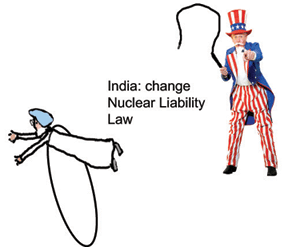
Additionally, certain other India-specific factors have stalled the nuclear power projects which corporations in the US, France and Russia have been eyeing in order to resurrect themselves. Nuclear liability tops the list here – foreign vendors have been wary of the 2010 liability law enacted by the Indian parliament, which they view as overly restrictive, even as civil society activists and safety experts consider the legislation extremely weak. The Indian law provides for a ‘right of recourse’ in Clause 17(b) under which, in case of a future nuclear accident, the nuclear operator can demand liability from the equipment suppliers.
The nuclear industry lobbies have found this provision to be an anathema and the US government has taken the lead in pressuring successive Indian governments to do away with it.
Despite his party’s vociferous criticism of such moves
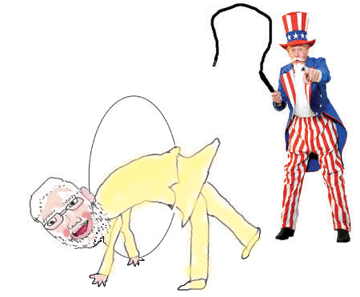 by the earlier Singh-led government when in opposition, Modi’s unabashed dalliance with the US has barely remained under wraps – he and Obama jointly declared in 2015 that India would actively take steps to limit liability in the case of a nuclear accident. by the earlier Singh-led government when in opposition, Modi’s unabashed dalliance with the US has barely remained under wraps – he and Obama jointly declared in 2015 that India would actively take steps to limit liability in the case of a nuclear accident.However, Modi didn’t stop at that. Not only did his government ensure that the liability rules were dubbed ‘ultra vires’ and against the spirit of the law by former Solicitor-General Soli Sorabjee, entered into force in 2016, it also went on to ratify the Convention on Supplementary Compensation (CSC) – an international template promoted by the nuclear lobbies to ensure a liability-free market, thereby deliberately creating a contradiction between India’s domestic law and its international commitments. Ever since it assumed power, the Modi government has consistently undermined nuclear liability provisions meant to safeguard the interests of the Indian people.
If the recent utterances of senior officials from the US Department of Energy offer any clues, the American nuclear vendors do not want to settle for anything short of amending the original Nuclear Liability Act – “to be clear, there are still open issues around the liability issue,” the US DoE Assistant Secretary is reported to have said in a Reuters report published last week. As the street protests by indignant survivors of Bhopal’s gas accident during Trump’s recent visit suggest, Indian citizens have had an agonising experience due to the apathy of governments and judicial processes, with the most vulnerable sections having been denied both compensation and justice in the case of the world’s worst industrial disaster. Successive governments in both the US and India have managed to ensure that concerned corporations remain unscathed and that their owners go unpunished.
Neither the routine exhortations of India-US summits being spaces for a rendezvous between two democracies, nor Modi’s much celebrated cleanliness drive, have translated into an open dialogue with the victims of the Bhopal disaster, or the detoxification of the accident site even three decades after the horrific chemical industrial accident.
Trump’s domestic energy policy and budget allocations disproportionately favour the nuclear industry, and exporting American nuclear reactors to developing countries is also a key part of this policy shift. The US under Trump has concluded nuclear deals with the UAE despite massive proliferation concerns………. Despite the hype that Trump’s recent visit generated – of an upgrade of US-India relations to a ‘Comprehensive Global Strategic Partnership’ and so on – there is very little that India stands to gain. In the absence of any new meaningful and people-centric cooperation on trade, environment, education or technology, this nuclear tango will only remain a farcical buildup at the cost of the safety and livelihoods of Indian citizens.
Not long ago, Modi’s own home state of Gujarat had rejected a US-imported nuclear project labeling it unacceptably risk-prone, especially in the wake of the 2011 Fukushima accident. This leaves the Modi government with no moral right to impose the US reactors on people in other parts of the country. Kumar Sundaram is founding editor of DiaNuke.org, an international platform for nuclear-related discussions and campaigns. https://www.thecitizen.in/index.php/en/NewsDetail/index/6/18388/Namaste-Nukes-Trumps-Toxic-Sales-Pitch-for-the-Stalled-Westinghouse-Nuclear-Project-in-India |
|


No comments yet.
1 This Month

Petition to revoke the licensing of the Near Surface Nuclear Disposal Facility (NSDF) at Chalk River. https://www.ourcommons.ca/petitions/en/Petition/Details?Petition=e-7247


of the week – STOP SMALL MODULAR REACTORS IN CANADA
To see nuclear-related stories in greater depth and intensity – go to https://nuclearinformation.wordpress.com
-
Archives
- March 2026 (153)
- February 2026 (268)
- January 2026 (308)
- December 2025 (358)
- November 2025 (359)
- October 2025 (376)
- September 2025 (258)
- August 2025 (319)
- July 2025 (230)
- June 2025 (348)
- May 2025 (261)
- April 2025 (305)
-
Categories
- 1
- 1 NUCLEAR ISSUES
- business and costs
- climate change
- culture and arts
- ENERGY
- environment
- health
- history
- indigenous issues
- Legal
- marketing of nuclear
- media
- opposition to nuclear
- PERSONAL STORIES
- politics
- politics international
- Religion and ethics
- safety
- secrets,lies and civil liberties
- spinbuster
- technology
- Uranium
- wastes
- weapons and war
- Women
- 2 WORLD
- ACTION
- AFRICA
- Atrocities
- AUSTRALIA
- Christina's notes
- Christina's themes
- culture and arts
- Events
- Fuk 2022
- Fuk 2023
- Fukushima 2017
- Fukushima 2018
- fukushima 2019
- Fukushima 2020
- Fukushima 2021
- general
- global warming
- Humour (God we need it)
- Nuclear
- RARE EARTHS
- Reference
- resources – print
- Resources -audiovicual
- Weekly Newsletter
- World
- World Nuclear
- YouTube
-
RSS
Entries RSS
Comments RSS
 nuclear-news
Leave a comment