Kazakhstan local residents may be stuck with costs of decommissioning nuclear reactor
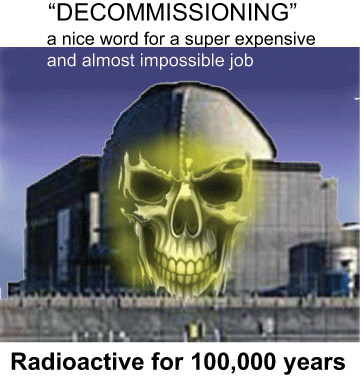 Local residents pay for decommissioning of Kazakhstan’s BN-350 reactor https://www.neimagazine.com/news/newslocal-residents-pay-for-decommissioning-of-kazakhstans-bn-350-reactor-7796914 27 February 2020 During a public hearing of the feasibility study on the environmental impact of decommissioning of the BN-350 fast reactor in Kazakhstan, Bulat Zhumakanov, representative of regional utility MAEK-Kazatomprom, said residents Aktau in Mangystau province, where the reactor is sited, will continue to pay for its maintenance.The BN-350, a sodium-cooled industrial fast neutron reactor, was physically launched in 1972, and was connected to the Mangystau power system in 1973. In 1998, it was closed down and formally began decommissioning the following year. Local residents pay for decommissioning of Kazakhstan’s BN-350 reactor https://www.neimagazine.com/news/newslocal-residents-pay-for-decommissioning-of-kazakhstans-bn-350-reactor-7796914 27 February 2020 During a public hearing of the feasibility study on the environmental impact of decommissioning of the BN-350 fast reactor in Kazakhstan, Bulat Zhumakanov, representative of regional utility MAEK-Kazatomprom, said residents Aktau in Mangystau province, where the reactor is sited, will continue to pay for its maintenance.The BN-350, a sodium-cooled industrial fast neutron reactor, was physically launched in 1972, and was connected to the Mangystau power system in 1973. In 1998, it was closed down and formally began decommissioning the following year.
MAEK-Kazatomprom has supplied Mangystau region of Kazakhstan with electricity, heat and water since 1967. It is responsible for three gas and oil power plants with total installed capacity 1330MWe, a desalination plant and for decommissioning the BN-350 reactor. According to representatives of the development company, METR, preliminary information, puts the total cost of decommissioning the BN-350 at KZT125 billion ($330m) excluding inflation. Zhumakanov said this year Kazakhstani Wealth Fund Samruk-Kazyna has allocated KZT1.2 billion for the maintenance of the reactor. However, funds will still be taken from local residents through the electricity tariff for repair work. An application has been made to the federal budget, but whether money will be allocated from the republican budget in future “remains open”, he said. The tariff has been in place for 20 years and residents have been pressing the government to provide the necessary funding. Decommissioning of the BN-350 reactor is planned in three stages:
From 1999 to 2016, with the financial support of the US government, nuclear fuel was removed, primary circuit sodium was treated to remove from caesium radionuclides, a project was implemented to process the used fuel, to passivate sodium residues in the first circuit, and other work. The decommissioning process must be continued and cannot be delayed, said representatives of MAEK-Kazatomprom. The tanks in which radioactive waste is stored have been in operation since 1972, and need upgrading. Some 3000 cubic metres of liquid radioactive waste, mainly sodium and caesium-137, which has a half-life of 30 years, are stored at MAEK-Kazatomprom. |
|
No comments yet.
1 This Month
Chernobyl: The Lost Tapes – A good documentary on Chernobyl on SBS available On Demand for the next 3 weeks– https://www.sbs.com.au/ondemand/tv-program/chernobyl-the-lost-tapes/2352741955560

of the week–London Campaign for Nuclear Disarmament

Tell the Ukrainian Government to Drop Prosecution of Peace Activist Yurii Sheliazhenko
To see nuclear-related stories in greater depth and intensity – go to https://nuclearinformation.wordpress.com
-
Archives
- April 2026 (114)
- March 2026 (251)
- February 2026 (268)
- January 2026 (308)
- December 2025 (358)
- November 2025 (359)
- October 2025 (376)
- September 2025 (257)
- August 2025 (319)
- July 2025 (230)
- June 2025 (348)
- May 2025 (261)
-
Categories
- 1
- 1 NUCLEAR ISSUES
- business and costs
- climate change
- culture and arts
- ENERGY
- environment
- health
- history
- indigenous issues
- Legal
- marketing of nuclear
- media
- opposition to nuclear
- PERSONAL STORIES
- politics
- politics international
- Religion and ethics
- safety
- secrets,lies and civil liberties
- spinbuster
- technology
- Uranium
- wastes
- weapons and war
- Women
- 2 WORLD
- ACTION
- AFRICA
- Atrocities
- AUSTRALIA
- Christina's notes
- Christina's themes
- culture and arts
- Events
- Fuk 2022
- Fuk 2023
- Fukushima 2017
- Fukushima 2018
- fukushima 2019
- Fukushima 2020
- Fukushima 2021
- general
- global warming
- Humour (God we need it)
- Nuclear
- RARE EARTHS
- Reference
- resources – print
- Resources -audiovicual
- Weekly Newsletter
- World
- World Nuclear
- YouTube
-
RSS
Entries RSS
Comments RSS
 nuclear-news
Leave a comment