Reprocessing is NOT a solution to the nuclear waste problem
|
The Yucca Mountain nuclear waste site has always been a political
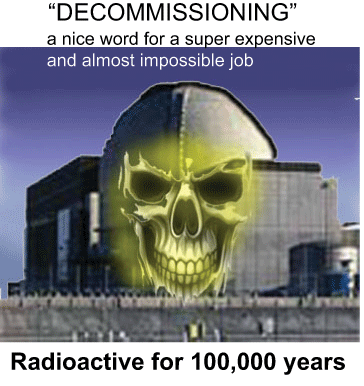
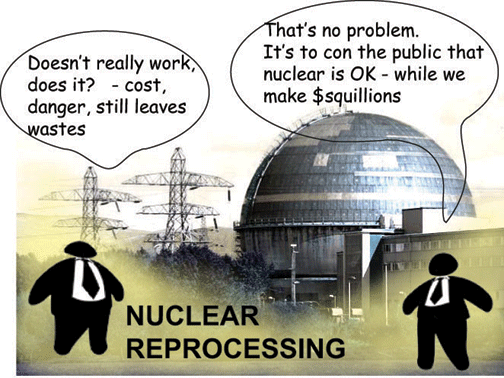
Ideas such as “advanced” reactors that use waste as fuel, deep borehole disposal, and the perpetually-proposed reprocessing of spent nuclear fuel have all been presented as solutions to our current dilemma. None are. Studies that my colleagues and I have done, and the National Research Council consensus report, show that all reactors and reprocessing schemes produce wastes that are highly active and long-lived and therefore still require disposal.
Deep boreholes, though perhaps appropriate for some radioactive wastes, would be hard-pressed to handle spent fuel due in part to the narrow borehole diameter, limited to thin-walled canisters that can only hold one spent fuel assembly each. The thin walls and significantly more numerous canisters would increase worker doses and reduce the canisters’ strength to resist the overlying rock burden. The depth of the boreholes—up to 5 kilometers—and the limited ability to access them without disturbing the natural environment would result in a limited capability to adequately characterize the geologic environment at depth. Even more challenging would be to ensure that radioactivity cannot escape up the backfilled borehole. Political innovations needed. All countries with commercial nuclear energy programs agree that geologic repositories are the only solution to the problem of spent nuclear fuel and high-level radioactive waste. The problems facing repositories are not primarily technical (though these exist), but political. Political innovations are truly needed to successfully site these facilities. Such innovations already exist: Finland is currently constructing its deep geologic repository, and Sweden isn’t far behind. Switzerland, France, and Canada have all made significant progress in the last few years. The United States, in fact, is the only country with an operating deep geologic repository—the Waste Isolation Pilot Project that houses transuranic waste from the nuclear weapons complex in southeastern New Mexico—proving that it can be done here. There are important lessons to learn from the mistakes and successes of these other programs: The host community must accept the site by a large majority; the host community must be compensated; it must be allowed to veto the site, up to a predefined point in the process; the process works best when the host community is allowed to participate in site development and conduct its own independent research; the nuclear waste management organization and the nuclear regulator must be trusted institutions; and the waste management organization must have the ability to manage its own budget and plan for the long term. None of this is rocket science, and these lessons have been spelled out numerous times in the United States. The real question is whether anyone with political power is listening. https://thebulletin.org/2020/02/the-yucca-mountain-nuclear-waste-site-has-always-been-a-political-football-trump-is-the-latest-president-to-fumble/#
omigawd, she’s ever so slightly raised what is the bleeding obvious! THEY SHOULD NOT BE BUILDING NUCLEAR REACTORS UNTIL THE WASTE PROBLEM IS SOLVED. |
|



JP Morgan economists warn climate crisis is threat to human race
|
Leaked report for world’s major fossil fuel financier says Earth is on unsustainable trajectory, Patrick Greenfield and Jonathan Watts The world’s largest financier of fossil fuels has warned clients that the climate crisis threatens the survival of humanity and that the planet is on an unsustainable trajectory, according to a leaked document.The JP Morgan report on the economic risks of human-caused global heating said climate policy had to change or else the world faced irreversible consequences. The study implicitly condemns the US bank’s own investment strategy and highlights growing concerns among major Wall Street institutions about the financial and reputational risks of continued funding of carbon-intensive industries, such as oil and gas. JP Morgan has provided $75bn (£61bn) in financial services to the companies most aggressively expanding in sectors such as fracking and Arctic oil and gas exploration since the Paris agreement, according to analysis compiled for the Guardian last year. Its report was obtained by Rupert Read, an Extinction Rebellion spokesperson and philosophy academic at the University of East Anglia, and has been seen by the Guardian. The research by JP Morgan economists David Mackie and Jessica Murray says the climate crisis will impact the world economy, human health, water stress, migration and the survival of other species on Earth. “We cannot rule out catastrophic outcomes where human life as we know it is threatened,” notes the paper, which is dated 14 January. Drawing on extensive academic literature and forecasts by the International Monetary Fund and the UN Intergovernmental Panel on Climate Change (IPCC), the paper notes that global heating is on course to hit 3.5C above pre-industrial levels by the end of the century. It says most estimates of the likely economic and health costs are far too small because they fail to account for the loss of wealth, the discount rate and the possibility of increased natural disasters. The authors say policymakers need to change direction because a business-as-usual climate policy “would likely push the earth to a place that we haven’t seen for many millions of years”, with outcomes that might be impossible to reverse. “Although precise predictions are not possible, it is clear that the Earth is on an unsustainable trajectory. Something will have to change at some point if the human race is going to survive.” The investment bank says climate change “reflects a global market failure in the sense that producers and consumers of CO2 emissions do not pay for the climate damage that results.” To reverse this, it highlights the need for a global carbon tax but cautions that it is “not going to happen anytime soon” because of concerns about jobs and competitiveness. The authors say it is “likely the [climate] situation will continue to deteriorate, possibly more so than in any of the IPCC’s scenarios”. Without naming any organisation, the authors say changes are occurring at the micro level, involving shifts in behaviour by individuals, companies and investors, but this is unlikely to be enough without the involvement of the fiscal and financial authorities. Last year, analysis compiled for the Guardian by Rainforest Action Network, a US-based environmental organisation, found JP Morgan was one of 33 powerful financial institutions to have provided an estimated total of $1.9tn (£1.47tn) to the fossil fuel sector between 2016 and 2018. A JP Morgan spokesperson told the BBC the research team was “wholly independent from the company as a whole, and not a commentary on it”, but declined to comment further. The metadata on the pdf of the report obtained by Read said the document was created on 13 January and that the author of the file was Gabriel de Kock, executive director of JP Morgan. The Guardian has approached the investment bank for comment. Pressure from student strikers, activist shareholders and divestment campaigners has prompted several major institutions to claim they will make the climate more of a priority. The business model of fossil fuel companies is also weakening as wind and solar become more competitive. Earlier this month, the influential merchant bank Goldman Sachs downgraded ExxonMobil from a “neutral” to a “sell” position. In January, BlackRock – the world’s biggest asset manager – said it would lower its exposure to fossil fuels ahead of a “significant reallocation of capital”. Environmental groups remain wary because huge sums are invested in petrochemical firms, but some veteran financial analysts say the tide is changing. The CNBC money pundit Jim Cramer shocked many in his field when he declared: “I’m done with fossil fuels. They’re done. They’re just done.” Describing how a new generation of pension fund managers was withdrawing support, he claimed oil and gas firms were in the death knell phase. “The world has turned on them. It’s actually happening kind of quickly. You’re seeing divestiture by a lot of different funds. It’s going to be a parade that says, ‘Look, these are tobacco. And we’re not going to own them,’” he said. “We’re in a new world.”
|
|

All the world is betraying the world’s children, the World Health Organisation has found

|
Every country on Earth failing to provide world fit for children, landmark report warns‘Predatory marketing’ and wealthy countries’ high carbon emissions among chief concerns for health of future generations, says major WHO, Lancet and Unicef report Independent UK, Harry Cockburn, 20 Feb 20, Every country in the world is failing to protect children’s health, their environment and their futures, a landmark report for the World Health Organisation has found. The damning findings pull back the curtain on an increasingly fragile world in which unbridled industrialism is already sabotaging the lives of younger generations. The report, based on a commission of more than 40 child and adolescent health experts from around the world, said every child on Earth is now “under immediate threat from ecological degradation, climate change and exploitative marketing practices that push heavily processed fast food, sugary drinks, alcohol and tobacco at children”. Despite improvements in child and adolescent health over the past 20 years, progress has stalled, and is set to reverse,” said Helen Clark, the former prime minister of New Zealand and co-chair of the commission. The report, by the WHO, the United Nations Children’s Fund (Unicef) and the Lancet Commission, ranked 180 countries on the conditions they provide for a child to “thrive and survive”…….. The report said while wealthier countries generally have better child health and development outcomes it is them in particular who “threaten the future of all children through carbon pollution, on course to cause runaway climate change and environmental disaster”. When authors took per capita CO2 emissions into account, the rankings told a very different story. Norway ranked 156th, the Republic of Korea 166 and the Netherlands 160. Each of these countries emits 210 per cent more CO2 per capita than their 2030 target. The UK ranked 136th on this measure. The US, Australia and Saudi Arabia are among the 10 worst emitters. “It has been estimated that around 250 million children under five years old in low- and middle-income countries are at risk of not reaching their developmental potential, based on proxy measures of stunting and poverty. But of even greater concern, every child worldwide now faces existential threats from climate change and commercial pressures,” Ms Clark said. The authors of the report said: “Governments must harness coalitions across sectors to overcome ecological and commercial pressures to ensure children receive their rights and entitlements now and a liveable planet in the years to come.”…….
Dr Tedros Adhanom Ghebreyesus, the director-general of the WHO, described the report as a “wakeup call”. He said: “This report shows that the world’s decision-makers are, too often, failing today’s children and youth: failing to protect their health, failing to protect their rights, and failing to protect their planet…… To protect children, the independent commission authors call for a new global movement driven by and for children. Specific recommendations include: Stop CO2 emissions with the utmost urgency, to ensure children have a future on this planet; Place children and adolescents at the centre of our efforts to achieve sustainable development; New policies and investment in all sectors to work towards child health and rights; Incorporate children’s voices into policy decisions;……. Henrietta Fore, Unicef’s executive director, said: “From the climate crisis to obesity and harmful commercial marketing, children around the world are having to contend with threats that were unimaginable just a few generations ago. ….. https://www.independent.co.uk/environment/children-future-planet-world-health-organisation-report-climate-crisis-capitalism-advertising-lancet-a9343856.html |
|
Anti nuclear activists break into France’s Tricastin nuclear station
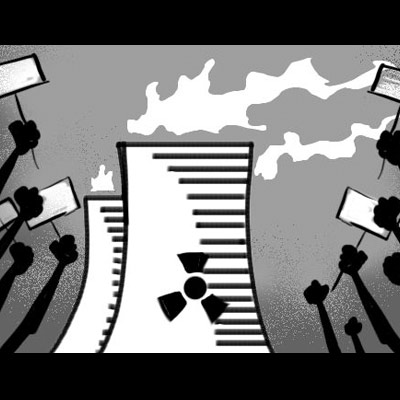 Reuters 21st Feb 2020. Activists from Greenpeace broke into the Tricastin nuclear power plant in southern France in order to demand its closure, the environmental pressure group said on Friday. “Some 50 Greenpeace activists gained access to several points at the Tricastin nuclear power plant this morning,” said Greenpeace spokeswoman Cecile Genot. “We are protesting and drawing attention to an aging nuclear power plant that is dangerous and should be shut down.” Officials for French state-controlled power group EDF, which runs Tricastin, had no immediate comment on the situation.
 |
ReplyForward
|
All wars are serious, but this climate war could have the direst consequences

THE ONE WAR THAT THE HUMAN SPECIES CAN’T LOSE The New Yorker, By Robin Wright, 20 Feb 2020 “……… For almost a half century, I’ve covered wars, revolutions and uprisings on four continents, many for years on end. I’ve always been an outside observer watching as others killed each other. I lamented the loss of human life—and the warring parties’ self-destructive practices—from an emotional distance. In Antarctica, I saw war through a different prism. And I was the enemy. “ “Humans will be but a blip in the span of Earth’s history,” Wayne Ranney, a naturalist and geologist on the expedition, told me. “The only question is how long the blip will be.”
Last week, the temperature in Antarctica hit almost seventy degrees—the hottest in recorded history. It wasn’t a one-day fluke. Famed for its snowscapes, the Earth’s coldest, wildest, windiest, highest, and most mysterious continent has been experiencing a heat wave. A few days earlier, an Antarctic weather station recorded temperatures in the mid-sixties. It was colder in Washington, D.C., where I live. Images of northern Antarctica captured vast swaths of barren brown terrain devoid of ice and with only small puddle-like patches of snow.
The problem is not whether a new record was set, “it’s the longer-term trend that makes those records more likely to happen more often,” John Nielsen-Gammon, the director of the Texas Center for Climate Studies at Texas A. & M. University, told me this week……
The iceberg that I watched break off from Antarctica was part of a process called calving. It’s normal and a necessary step in nature’s cycle, except that it’s now happening a lot faster and in larger chunks—with existential stakes. The ice in Antarctica is now melting six times faster than it did forty years ago, Eric Rignot, an Earth scientist at the University of California, Irvine, and a co-author of a major study of the continent’s ice health, told me.
This month, an iceberg measuring more than a hundred square miles—the size of the Mediterranean island of Malta, or twice the size of Washington, D.C.—broke off the Pine Island Glacier (lovingly known as pig, for short) in West Antarctica. It then broke up into smaller “pig-lets,” according to the European Space Agency, which tracked them by satellite. The largest piglet was almost forty square miles.
The frozen continent is divided into West Antarctica and East Antarctica. (The South Pole is in East Antarctica.) Most of the melting and much of the big calving has happened in the West and along its eight hundred-mile peninsula. But, in September, an iceberg measuring more than six hundred square miles—or twenty-seven times the size of Manhattan—calved off the Amery Ice Shelf, in East Antarctica. Calving has accelerated in startling style. Two other huge soon-to-be bergs are being tracked as their crevices and cracks become visible from space. One is from pig in the West, the other is forming off the Brunt Ice Shelf in the East……….
“By 2035, the point of no return could be crossed,” Matthew Burrows, a former director at the National Intelligence Council, wrote in a report last year about global risks over the next fifteen years. That’s the point after which stopping the Earth’s temperature from rising by two degrees Celsius—or 3.6 degrees Fahrenheit—will be extremely difficult, if not impossible, in turn triggering “a dangerous medley of global disasters.”
And that, in turn, goes back to ice and its role in fostering human civilization. “What’s coming—or is happening—is the end of the earth’s stability,” Glendon told me. “In human terms, that means a return to migration, but in a population of not just a few million, but several billion.”
Before I went to Antarctica, I checked in with Donald Perovich, a geophysicist at Dartmouth who tracks sea ice. We got to talking about wars. “You can argue that in all wars, there are winners and losers. Afterward, societies go on. There’s an opportunity to recover and move forward. If you approach climate change as a war, there are some really severe consequences across the board,” he told me. “This,” he added, “is the one war we can’t lose.” https://www.newyorker.com/news/dispatch/antarcticas-ice-the-one-war-that-the-human-species-cant-lose?source=EDT_NYR_EDIT_NEWSLETTER_0_imagenewsletter_Daily_ZZ&utm_campaign=aud-dev&utm_source=nl&utm_brand=tny&utm_mailing=TNY_Daily_022020&utm_medium=email&bxid=5bea00ac3f92a404693b7a69&cndid=46508601&esrc=&mbid=&utm_term=TNY_Daily
Nuclear Energy Agency’s “pretend transparency”
| “ |
Nuclear Energy Agency’s Janus-like approach to nuclear transparency: a case study in obstruction, 21 February 2020 By Dr David Lowry, Nuclear Transparency Watch
  “…………. Conclusion “…………. Conclusion
NEA cannot make publicity it is hosting an international meeting on stakeholder engagement, but only allow well-resourced stakeholders to participate, having allocated no budget line for accommodation or travel for civil society organisations (CSOs). Initially, NEA refused to reveal which Civil Society / NGO groups had shown up to participate, because – I believe – they were embarrassed that so few were there. Aside from representatives of civil society groups invited (and remunerated) as speakers, there was virtually no civil society representation. The final list of attendees, released after four months of pressure from me, shows the balance of participants was about 95% pro nuclear institutional interests, 5% civil society or non-aligned interested parties. To label such an imbalanced event a “Stakeholder Engagement” meeting is an abuse of language. The nuclear industry cannot be allowed to pretend they believe in transparency, then practice secrecy, as NEA did in this sorry saga. Because, like a dog with a bone, I refused to let go in this, I finally forced disclosure. But this should have come automatically. NEA needs to learn the lessons: the first is, it needs to abide by the dictionary definition of transparency, and deliver it in future! http://www.nuclear-transparency-watch.eu/activities/transparency-and-public-participation/nuclear-energy-agencys-janus-like-approach-to-nuclear-transparency-a-case-study-in-obstruction.html
|
|
Confusion and contradiction in Trump’s policy on nuclear waste and Yucca Mountain
 The Yucca Mountain nuclear waste site has always been a political football. Trump is the latest president to fumble, Bulletin of the Atomic Scientists, By Allison Macfarlane, February 21, 2020 As with much policy-setting in the Trump administration, a single tweet from the president on February 6 appeared to reverse a previous stance. The message about Yucca Mountain, the nation’s proposed geologic repository for spent nuclear fuel and other high-level radioactive waste, set the media alight with speculation about new actions in US nuclear waste policy. But has anything changed, really?
The new policy, if it is such a thing, is a little wobbly. It’s unclear whether the administration is or is not supporting Yucca Mountain as a waste repository. The Energy Department’s Undersecretary for Nuclear Energy and nominee for Deputy Secretary, Mark Menezes, stated six days later in a House Energy and Commerce subcommittee hearing that “what we’re trying to do is to put together a process that will give us a path to permanent storage at Yucca.” A White House official tried to square the circle of conflicting messages, stating: “There is zero daylight between the President and Undersecretary Menezes on the issue.”
At the same time, Trump’s fiscal year 2021 budget did not include funds for Yucca Mountain, unlike in previous years. In point of fact, though, Congress has not appropriated funding for Yucca Mountain in the past decade. The proposed repository site made it about halfway through the licensing process at the Nuclear Regulatory Commission and halted when the Obama administration’s Energy Department tried to pull the license application. The state of Nevada still strongly opposes Yucca Mountain and hasn’t changed its tune since passage of the Nuclear Waste Policy Act Amendments in 1987 (colloquially known in Nevada as the Screw Nevada Bill), which designated Yucca Mountain as the proposed repository site.
Trump’s tweet acknowledges the fierce and long-standing opposition to Yucca Mountain in a swing state he lost by a slim margin in 2016. The Democratic presidential candidates are unanimously opposed to storing nuclear waste at Yucca Mountain.
A permanent impasse. Yucca Mountain has spent much of its existence as a political football. The original Nuclear Waste Policy Act of 1982 required detailed characterization of three potential repository sites for the disposal of the nation’s spent commercial nuclear fuel and high-level radioactive waste from the nuclear weapons complex. By 1986 it was clear that work on three sites would be very costly, and Congress balked at the price tag. Political wrangling ensued, and it was no accident that among the three states under consideration—Nevada, Texas, and Washington—the one with the most-junior congressional delegation, including a newly elected Senator Harry Reid, was selected as the only site to be characterized by the Energy Department for suitability as a repository. ………
At the moment, no one involved in the process has an incentive to make progress. An extremely partisan House and Senate are at a permanent impasse on an issue that bears little on re-election chances (except in Nevada). The nuclear industry has found they can build new reactors—the two Westinghouse AP1000 units under construction in Georgia—without a solution to their spent fuel problem. The Energy Department, originally tasked with solving the problem, has no legal authority (or appropriations) to move forward. The Nuclear Regulatory Commission, which passed a Continued Storage Rule in 2014, vacated its ability to force a solution. And many anti-nuclear interest groups that oppose waste transport and repositories have called for “hardened on-site storage.”…….. https://thebulletin.org/2020/02/the-yucca-mountain-nuclear-waste-site-has-always-been-a-political-football-trump-is-the-latest-president-to-fumble/#
Japan’s paralysis over what to do with the nuclear industry’s plutonium wastes
Review the nation’s quest for a nuclear fuel cycle https://www.japantimes.co.jp/opinion/2020/02/20/editorials/review-nations-quest-nuclear-fuel-cycle/#.XlBKh2gzbIU The uncertain fate of the spent mixed-oxide (MOX) fuel removed from two nuclear power reactors in western Japan last month — for the first time since the commercial use of plutonium-uranium fuel in light water reactors began about a decade ago — is yet another sign of the stalemate over the government’s nuclear fuel cycle policy. While the government maintains that all spent nuclear fuel will be reprocessed for reuse as fuel for nuclear reactors, there are no facilities in this country that can reprocess spent MOX fuel so it will remain indefinitely in storage pools at the nuclear plants.
France starts out on the path to withdraw from nuclear energy
|
France Takes First Steps to Reduce Nuclear Energy Dependence https://www.voanews.com/europe/france-takes-first-steps-reduce-nuclear-energy-dependence, By Lisa Bryant, 21 Feb 20
February 21, 2020 France, the world’s most nuclear energy-dependent nation, is taking its first steps to shift to more renewables to power up.
On Saturday, the country begins a gradual shutdown of its aging Fessenheim plant. The move fits into the government’s broader energy strategy to reduce French dependence on nuclear energy from supplying three-quarters of its electricity to about half by 2035. Prime Minister Edouard Philippe says the plant’s first reactor will be closed Saturday, and the second in June. Another dozen reactors must close by 2035 to meet the phase-down target. The plan also sees France closing its remaining coal plants, and moving to renewables like solar and wind to close the energy gap and help fight climate change. For Charlotte Mijeon, spokesperson for anti-nuclear group Sortir du nucléaire, the Fessenheim shutdown is welcome news — but not enough. “It’s great that it’s eventually closed; however, we fear that Fessenheim is something like the tree hiding the forest,” she said. “The government is closing one nuclear power plant, but it should not make us forget that the rest of the nuclear fleet is aging.” France has 58 nuclear power plants, thanks to an energy strategy dating back to the 1970s oil crisis. Supporters say nuclear energy is a clean way to fight climate change while also meeting national energy needs. But critics say the plants have received billions in subsidies and nuclear lobbies are powerful, making it harder for renewables to compete. And they say the remaining plants pose mounting safety concerns as they age. “Regarding the climate emergency, we have no time left,” Mijeon said. “So we have to invest in green climate solutions, not in nuclear power, which is not only dirty, but also very expensive and slow.” While the reactor shutdown is a first for France, other countries, including Switzerland, Sweden and the United States, have also shut plants for a mix of budgetary, safety and environmental reasons. Neighboring Germany aims to phase out of nuclear power completely by 2022. It has been pushing for years for the shutdown of Fessenheim, which is located near its border |
|
Bavaria’s renewable capacity growing as nuclear plant shutdown boosts power imports
|
Bavaria’s renewable capacity growing as nuclear plant shutdown boosts power imports, 21 Feb 2020, Benjamin Wehrmann, Clean Energy Wire
Power generation with solar panels and bioenergy plants has reached a new record level in Bavaria, the German state’s economy ministry has said. Final data for 2018 showed that solar power production grew by 4.5 percent that year to reach nearly 12 terawatt hours (TWh), while production with bioenergy reached 9.2 TWh, 0.2 percent more than in 2017. “The energy transition is right on our doorstep,” said Bavaria’s economy minister Hubert Aiwanger, adding that the looming solar power support cap had to be removed and new land designated for solar panel installation to ensure that renewables could continue to grow in the state. However, the shutdown of nuclear power plant Gundremmingen B and a particularly dry year in 2018, which substantially reduced hydropower production, meant that Bavaria had to import large volumes of electricity for the first time ever in that year. Gross power production dropped from nearly 85 TWh to just under 74 TWh between 2017 and 2018, meaning that the economic powerhouse state had to import 10 TWh to cover its demand, a situation “that has never existed before,” the ministry says. Aiwanger said the “power generation gap” would grow further once Bavaria’s two remaining nuclear plants go offline at the end of 2021 and 2022, respectively. “The figures show that we all need to pull together to ensure a sustainable energy supply,” Aiwanger said…….. https://www.cleanenergywire.org/news/bavarias-renewable-capacity-growing-nuclear-plant-shutdown-boosts-power-imports |
|
Bruce County, Ontario, protest against nuclear waste dump plan
 MillerVideographer@ScottMillerCTV Contact
https://london.ctvnews.ca/nuclear-tanks-no-thanks-say-bruce-county-protesters-1.4820155 Thursday, February 20, 2020 LONDON, ONT. — About 40 Bruce County residents protested outside Bruce County council chambers in Walkerton this morning.They’re protesting plans to bury Canada’s used nuclear fuel under 1300 acres of farmland north of Teeswater. South Bruce is one of two communities in Canada left in the running to host the country’s high level nuclear waste.
A 1300 acre site just north of Teeswater has been identified as a potential underground site for the multi-billion dollar project, that would house approximately 5.2 million used fuel bundles, that remain dangerously radioactive for hundreds of thousands of years.
The Nuclear Waste Management Organization says they’ll pick one site between South Bruce and Ignace, in Northern Ontario, by 2023.
Michelle Stein lives near the proposed site in South Bruce. She organized today’s protest. “Burying your problems to get them out of site is never the answer. I don’t want this underground mess to be the heritage that I leave for my children and grandchildren.”
Saugeen Shores Mayor Luke Charbonneau is the one bringing forward today’s motion to support DGR’s to store nuclear waste. “There’s an international scientific consensus that the best way to store waste materials from nuclear power production is through passive isolation in a Deep Geological Repository.”
The protest comes as Bruce County council debates a motion to reinforce its support for a permanent solution to the country’s nuclear waste, specifically the Deep Geological Repository model that encases the waste in copper containers, encased in clay “buffer boxes”.
U.S. pentagon wary about morale of staff at nuclear bases
|
Pentagon officials keeping an eye on morale at nuclear bases, Military Times, Meghann Myers and Aaron Mehta 21 Feb 20, The Defense Department is asking for tens of billions of dollars this year to maintain and modernize U.S. nuclear capabilities, while at the same time checking in with personnel at the remote bases maintainers and operators call home.
In recent years, issues like cheating on exams and marijuana use have plagued Air Force bases in Montana, North Dakota and Nebraska, calling into question whether the quality of life in those areas was taking a toll on troops……. As the U.S. gets plans underway to upgrade aircraft, missiles, submarines and other systems to deter nuclear threats from countries like China, Russia and North Korea, the people who will take responsibility for them are also a consideration. “This is one of the things that the secretary wanted to find out,” a senior DoD official said Friday, briefing reporters on background at the Pentagon. “He spoke a lot with the airman and the officers … at STRATCOM and Minot. You know, about 10 years ago, we had a terrible morale problem.”….. https://www.militarytimes.com/news/your-military/2020/02/21/pentagon-officials-keeping-an-eye-on-morale-at-nuclear-bases/ |
|
Trump to visit India as salesman for Westinghouse nuclear reactors
 Westinghouse to sign deal for six nuclear reactors in India during Trump’s visit: report HTTPS://THEHILL.COM/POLICY/INTERNATIONAL/INDIA/483820-WESTINGHOUSE-TO-SIGN-DEAL-FOR-SIX-NUCLEAR-REACTORS-IN-INDIA-DURING BY JUSTINE COLEMAN – 02/20/20 U.S. energy company Westinghouse is expected to sign a deal for six nuclear reactors with the state-run Nuclear Power Corporation of India (NPCIL) during President Trump’s trip to the country, Reuters reported.The deal will outline timelines and name the lead local constructor for building the reactors at Kovvada in southern India, according to the news service. Westinghouse to sign deal for six nuclear reactors in India during Trump’s visit: report HTTPS://THEHILL.COM/POLICY/INTERNATIONAL/INDIA/483820-WESTINGHOUSE-TO-SIGN-DEAL-FOR-SIX-NUCLEAR-REACTORS-IN-INDIA-DURING BY JUSTINE COLEMAN – 02/20/20 U.S. energy company Westinghouse is expected to sign a deal for six nuclear reactors with the state-run Nuclear Power Corporation of India (NPCIL) during President Trump’s trip to the country, Reuters reported.The deal will outline timelines and name the lead local constructor for building the reactors at Kovvada in southern India, according to the news service.
India has reportedly been open to receiving nuclear reactors since its 2008 civil nuclear energy pact with the U.S. Last year, the countries announced they had committed to six reactors. Representatives from the U.S. Energy and Commerce departments, Westinghouse, the U.S.-India Strategic Partnership Forum and The Nuclear Energy Institute have met in India for negotiations, Reuters noted. Rita Baranwal, assistant secretary for the Office of Nuclear Energy in the U.S. Department of Energy, told the news service that the team is “optimistic” the agreement will be signed “shortly.” “We are encouraging moving forward with Westinghouse and NPCIL to sign a MoU. It certainly is a private industry-to-private industry, a business-to-business decision,” she said, referring to a memorandum of understanding. Representatives from the U.S. Energy and Commerce departments, Westinghouse, the U.S.-India Strategic Partnership Forum and The Nuclear Energy Institute have met in India for negotiations, Reuters noted. The Hill reached out to Westinghouse and NPCIL for comment. |
|
Desperate nuclear industry hypes up unlikely new gimmick, HALEU nuclear fuel
 The World’s Tiniest Nuclear Plant Is Coming to Idaho, The demonstration represents a new-generation of micro-reactors. Popular Mechanics, Feb 21, 2020 “……
- experts suggest that Oklo’s timeline is unrealistic with years of nuclear approval process ahead…….
- In December, Oklo received a permit to begin building their new Aurora plant, which is the first and only permit ever issued in the U.S. to a nuclear plant using something other than a light water (“water-cooled”) reactor. The specific mix of fuel they plan to use is called HALEU for short: “High-assay, low-enriched uranium (HALEU) …..
- There are big obstacles in Oklo’s way, though. Their planned timeline, which Grist says is to open between 2022 and 2025—after just receiving a permit in December 2019—would be one of the shortest in U.S. nuclear power history. For the first-of-its-kind commercial, HALEU-fueled fast breeder reactor, this seems optimistic, to say the least.
1 This Month


Tell the Ukrainian Government to Drop Prosecution of Peace Activist Yurii Sheliazhenko

Petition to revoke the licensing of the Near Surface Nuclear Disposal Facility (NSDF) at Chalk River. https://www.ourcommons.ca/petitions/en/Petition/Details?Petition=e-7247


of the week – STOP SMALL MODULAR REACTORS IN CANADA
To see nuclear-related stories in greater depth and intensity – go to https://nuclearinformation.wordpress.com
-
Archives
- March 2026 (183)
- February 2026 (268)
- January 2026 (308)
- December 2025 (358)
- November 2025 (359)
- October 2025 (376)
- September 2025 (258)
- August 2025 (319)
- July 2025 (230)
- June 2025 (348)
- May 2025 (261)
- April 2025 (305)
-
Categories
- 1
- 1 NUCLEAR ISSUES
- business and costs
- climate change
- culture and arts
- ENERGY
- environment
- health
- history
- indigenous issues
- Legal
- marketing of nuclear
- media
- opposition to nuclear
- PERSONAL STORIES
- politics
- politics international
- Religion and ethics
- safety
- secrets,lies and civil liberties
- spinbuster
- technology
- Uranium
- wastes
- weapons and war
- Women
- 2 WORLD
- ACTION
- AFRICA
- Atrocities
- AUSTRALIA
- Christina's notes
- Christina's themes
- culture and arts
- Events
- Fuk 2022
- Fuk 2023
- Fukushima 2017
- Fukushima 2018
- fukushima 2019
- Fukushima 2020
- Fukushima 2021
- general
- global warming
- Humour (God we need it)
- Nuclear
- RARE EARTHS
- Reference
- resources – print
- Resources -audiovicual
- Weekly Newsletter
- World
- World Nuclear
- YouTube
-
RSS
Entries RSS
Comments RSS
 nuclear-news