Small nuclear reactors are no better than large ones
This very well-written and informative article still does not examine the  question “Is nuclear power, of any type REALLY a solution to climate change?” Why on earth are all these writers mindlessly buying the nuclear lobby’s spurious claim? The nuclear reactor itself emits a tiny amount of Carbon 14. The entire nuclear chain, from mining to waste storage is a huge carbon emitter. How many thousands of these so-called “small” reactors would have to be up and running in time to make any difference? This push for smrs will be useful only to the military, and only tax-payers will foot the bill.
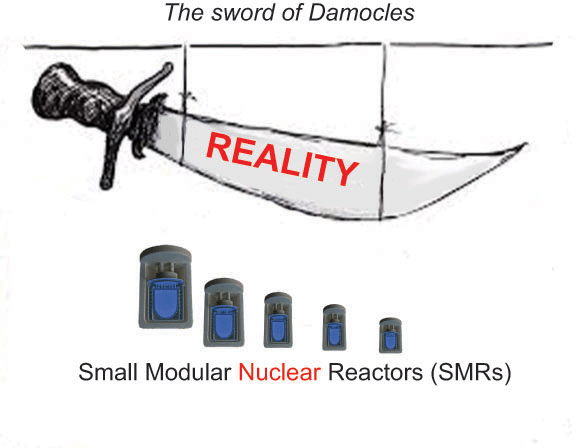
small modular reactors suffer from many of the same problems as large reactors, most notably safety issues and the unresolved problem of what to do with long-lived radioactive waste.
even in a smaller form, nuclear power is expensive — it’s one of the costliest forms of energy, requiring substantial government subsidies to build and run, not to mention insure.
When It Comes to Nuclear Power, Could Smaller Be Better? Yale Environment 360 , BY LOIS PARSHLEY 19 Feb 20, A handful of companies and governments are working to develop small-scale nuclear reactors that proponents say are safer, cheaper, and more compatible with renewables than traditional nuclear power. But critics contend the new technology doesn’t address concerns about safety and radioactive waste.
Huge computer screens line a dark, windowless control room in Corvallis, Oregon, where engineers at the company NuScale Power hope to define the next wave of nuclear energy. Glowing icons fill the screens, representing the power output of 12 miniature nuclear reactors. Together, these small modular reactors would generate about the same amount of power as one of the conventional nuclear plants that currently dot the United States — producing enough electricity to power 540,000 homes. On the glowing screens, a palm tree indicates which of the dozen units is on “island mode,” allowing a single reactor to run disconnected from the grid in case of an emergency.
This control room is just a mock-up, and the reactors depicted on the computer screens do not, in fact, exist. Yet NuScale has invested more than $900 million in the development of small modular reactor (SMR) technology, which the company says represents the next generation of nuclear power plants. NuScale is working on a full-scale prototype and says it is on track to break ground on its first nuclear power plant — a 720-megawatt project for a utility in Idaho — within two years; the U.S. Nuclear Regulatory Commission has just completed the fourth phase of review of NuScale’s design, the first SMR certification the commission has reviewed. The company expect final approval by the end of 2020. The U.S. Department of Energy has already invested $317 million in the research and development of NuScale’s SMR project.
NuScale is not alone in developing miniature reactors. In Russia, the government has launched a floating 70-megawatt reactor in the Arctic Ocean. China announced plans in 2016 to build its own state-funded floating SMR design. Three Canadian provinces — Ontario, New Brunswick, and Saskatchewan — have signed a memorandum to look into the development and deployment of small modular reactors. And the Rolls-Royce Consortium in the United Kingdom is working on the development of a 440-megawatt SMR.
Proponents say the time is ripe for this new wave of nuclear reactors for several reasons. First, they maintain that if the global community has any hope of slashing CO2 emissions by mid-century, new nuclear technologies must be in the mix. Second, traditional nuclear power is beset with problems. Many existing plants are aging, and new nuclear power construction is plagued by substantial delays and huge cost overruns; large-scale nuclear power plants can cost more than $10 billion. Finally, advocates say that as supplies of renewable energy grow, small modular reactors can better handle the variable nature of wind and solar power as SMRs are easier to turn on and leave running.
Critics of nuclear power, however, contend that small modular reactors suffer from many of the same problems as large reactors, most notably safety issues and the unresolved problem of what to do with long-lived radioactive waste. And opponents say that even in a smaller form, nuclear power is expensive — it’s one of the costliest forms of energy, requiring substantial government subsidies to build and run, not to mention insure. NuScale’s SMR is offering an artificial 6.5 cent-per-kilowatt-hour cap as an incentive to get its first project off the ground. Yet in September, the Los Angeles Department of Water and Power announced that it had accepted a bid of electricity coming from renewables, with storage capacity that can deliver round-the-clock supply, at 2 cents a kilowatt-hour.
M.V. Ramana, the Simons Chair in Disarmament, Global and Human Security at the University of British Columbia, says that as renewable prices plummet, nuclear power just can’t compete. More than a third of U.S. nuclear plants are now unprofitable or scheduled to close. Globally, nuclear energy now only supplies 11 percent of electricity, down from a record high of 17.6 percent in 1996. After the 2011 Fukushima disaster in Japan, Germany decided to close its nuclear industry altogether, and countries like Belgium, Switzerland, and Italy have declined to replace existing reactors or move forward with plans for new ones…….
SMR opponents maintain that no matter the size, nuclear power has unresolved cost and safety concerns. To realize savings through mass manufacturing, there would need to be a standardized SMR design, critics say; currently, there are dozens. And SMRs would also have to be built in large quantities. But for a company to invest in making reactors and their components, it would need a reliable market, and many private investors are still wary of the new technology. Andrew Storer, CEO of the Nuclear Advanced Manufacturing Research Center, which forecasts markets for nuclear power manufacturers, says, as far far as supply chain companies go, “We’re advising people, ‘Don’t invest yet.’”
Recent experience supports skepticism. Westinghouse worked on an SMR design for a decade before giving up in 2014. Massachusetts-based Transatomic Power, a nuclear technology firm, walked away from a molten salt SMR in 2018, and despite an $111 million dollar infusion from the U.S. government, a SMR design from Babcock &Wilcox, an advanced energy developer, folded in 2017. While the Russians have managed to get their state-funded SMR floating, its construction costs ran over estimates by four times, and its energy will cost about four times more than current U.S. nuclear costs.
Eventually, every nuclear conversation turns to radioactive waste and safety. SMRs using a pressurized water reactor will continue to generate highly radioactive spent fuel, yet no country has a permanent solution for how to safely store this kind of waste. The U.S. has been looking for a place to put a permanent nuclear waste repository since 1982; in the meantime, 70 percent of the U.S.’s spent fuel is sitting in cooling pools, many of which are aging and vulnerable, and often in quantities much larger than what is considered safe.
Because NuScale hopes to replace coal-fired power plants in the U.S. and the UK, perhaps even building on the grounds of shuttered power plant sites in more populated areas, the Nuclear Regulatory Commission is considering eliminating some standard safety measures, including a requirement for an emergency evacuation zone and the need for backup power. NuScale says that because SMRs contain smaller quantities of radioactive materials and can be sited underground, their risks are lower and they require less security staff.
This has raised sharp criticism from nuclear experts. Even the Union of Concerned Scientists, which has generally supported nuclear power, says, “It would be irresponsible for the NRC to reduce safety and security requirements for any reactor of any size.”
|
This very well-written and informative article still does not examine the question “Is nuclear power, of any type REALLY a solution to climate change?” Why on earth are all these writers mindlessly buying the nuclear lobby’s spurious claim? The nuclear reactor itself emits a tiny amount of Carbon 14. The entire nuclear chain, from mining to waste storage is a huge carbon emitter. How many thousands of these so-called “small” reactors would have to be up and running in time to make any difference? This push for smrs will be useful only to the military, and only tax-payers will foot the bill. https://e360.yale.edu/features/when-it-comes-to-nuclear-power-could-smaller-be-better |
|
|
No comments yet.
1 This Month


Tell the Ukrainian Government to Drop Prosecution of Peace Activist Yurii Sheliazhenko

Petition to revoke the licensing of the Near Surface Nuclear Disposal Facility (NSDF) at Chalk River. https://www.ourcommons.ca/petitions/en/Petition/Details?Petition=e-7247


of the week – STOP SMALL MODULAR REACTORS IN CANADA
To see nuclear-related stories in greater depth and intensity – go to https://nuclearinformation.wordpress.com
-
Archives
- March 2026 (204)
- February 2026 (268)
- January 2026 (308)
- December 2025 (358)
- November 2025 (359)
- October 2025 (376)
- September 2025 (258)
- August 2025 (319)
- July 2025 (230)
- June 2025 (348)
- May 2025 (261)
- April 2025 (305)
-
Categories
- 1
- 1 NUCLEAR ISSUES
- business and costs
- climate change
- culture and arts
- ENERGY
- environment
- health
- history
- indigenous issues
- Legal
- marketing of nuclear
- media
- opposition to nuclear
- PERSONAL STORIES
- politics
- politics international
- Religion and ethics
- safety
- secrets,lies and civil liberties
- spinbuster
- technology
- Uranium
- wastes
- weapons and war
- Women
- 2 WORLD
- ACTION
- AFRICA
- Atrocities
- AUSTRALIA
- Christina's notes
- Christina's themes
- culture and arts
- Events
- Fuk 2022
- Fuk 2023
- Fukushima 2017
- Fukushima 2018
- fukushima 2019
- Fukushima 2020
- Fukushima 2021
- general
- global warming
- Humour (God we need it)
- Nuclear
- RARE EARTHS
- Reference
- resources – print
- Resources -audiovicual
- Weekly Newsletter
- World
- World Nuclear
- YouTube
-
RSS
Entries RSS
Comments RSS
 nuclear-news
Leave a comment