nuclear-news

The News That Matters about the Nuclear Industry Fukushima Chernobyl Mayak Three Mile Island Atomic Testing Radiation Isotope

  • Home
  • 1 This Month
  • ACTION !
  • Disclaimer
  • Links
  • PAGES on NUCLEAR ISSUES

Secret research by U.S. Navy revealed effects of nuclear radiation on animals

What happened inside the Georgia Nuclear Aircraft Lab? Finding the facts in the forest with Dr. James Mahaffey  Jessica Taylor Dawson News jtaylor@dawsonnews.com Feb. 19, 2020, 

Over half a century later, rumors still swirl around Dawson Forest and the mysterious remnants of Dawson County’s past in the Cold War. 

Though the Georgia Nuclear Aircraft Facility has been out of commission for nearly 50 years, local residents can still be heard whispering about two-headed deer and oak leaves the size of elephant ears spotted around the nuclear facility’s remains.

For nuclear engineer and author, Dr. James Mahaffey, the task of unraveling the history behind Dawson County’s top-secret nuclear test site and separating facts from the fiction has led to decades of research and hard work. ………

On paper, it seemed feasible as an incredible amount of power could be housed in a very small space, however the findings from the Dawsonville laboratory proved that nuclear aircraft would take more than what was originally thought.

“Any nuclear reactor on this earth has shielding,” Mahaffey explained. “It’s got lead, concrete, steel, you know, heavy things to keep it from killing everybody, but you put it in an airplane and you can’t have concrete and steel and lead. It’s got to be naked.”

Components for nuclear-powered engines were assembled in a facility in Idaho then brought to Dawsonville for testing inside the reactor. In Mahaffey’s research, he discovered that the facility found that rubber tires either melted or turned to rock when exposed to different radiation. Hydraulic fluids turned into a tacky substance akin to chewing gum. Transistors in the radio system were immediately killed by radiation.

The other aspect of the Dawsonville facility was testing the effects of radiation on the environment and living creatures. 

“What does flying over a farm with a nuclear aircraft do to the farm? Well, it kills everything on the ground. It kills trees, grass, crops, insects, birds, anything. It might even kill the farmer if he’s out looking at it so what are you going to do about that? And also, what happens when one of these things crashes,” Mahaffey said. “If a jet plane crashes you clean it up and you pay the people for the house that it destroyed and all that, but what if it’s a nuclear aircraft? Nuclear aircraft – when it crashes – it makes a five mile radius area contaminated with long lasting radionuclides and you have to fence it off so nobody can go there. Are you really willing to have that as part of your Air Force operations?”

The effects of radiation were tested through controlled experimentation but also through observation of what Mahaffey describes as “instant taxidermy” of animals caught inside the kill zone around the outside of the operational reactor.

“Any animal like a toad frog that happened to be hopping around on the ground when the reactor was turned on, he died and interestingly it also killed all the bacteria in and around the frog,” Mahaffey said.

“When those [bacteria] die, it doesn’t deteriorate so you have this dead frog that you can put on your mantle and it’ll just stay there.”

According to Mahaffey, the scientists conducted many experiments with animals including releasing rats and studying the effects of radiation on them.

“I heard a rumor that the largest animal they ever irradiated was a mule and the mule died of course, and like a toad frog it would not deteriorate in a normal way,” Mahaffey said.

Billions of dollars were poured into the Nuclear Aircraft Project that GNAL was part of during the 1960s, but funding was cut in the John F. Kennedy administration. The GNAL was closed in pieces and shut its completely in 1971.

The GNAL buildings inside Dawson Forest were dismantled and hauled away. The hot cell building, the only remaining structure still standing, was boarded up with stainless steel to keep intruders from entering the radioactive building. To this day, the building remains radioactive with particulates of Cobalt 60.  ……

What makes Dawsonville’s secret nuclear facility stand out from other nuclear facilities for Mahaffey is the very detailed extent to which they dug into the dangers of nuclear fission products.

“An enormous amount of work was done to find out how having this reactor affects the environment. I’ll give them that,” Mahaffey said. “They wanted to find out how groundwater would transport radiation and they dug wells all over the facility, and they would have monitors monitoring what type of radiation, how much radiation and knew how fast radiation could transport in the environment.”

Great care went into studying radiation in the Etowah River including the construction of rafts to track and map the flow of radiation as well as the atmospheric effects of radiation.

“This was all unknown,” Mahaffey said. “You have to build a facility that’ll test it in real ways, not just computer simulations and it has to be somewhere where you’re not potentially going to wipe out a city.”  https://www.dawsonnews.com/local/what-happened-inside-georgia-nuclear-aircraft-lab-finding-facts-forest-dr-james-mahaffey/

February 20, 2020 Posted by Christina Macpherson | environment, radiation, Reference, secrets,lies and civil liberties, USA | Leave a comment

France shuts down Fessenheim reactor in first phase of retreat from nuclear power

France to shut down oldest nuclear plant in energy re-planning drive, https://www.france24.com/en/20200219-france-to-shut-down-oldest-nuclear-plant-fessenheim-in-energy-re-planning-drive  French Prime Minister Edouard Philippe said on Wednesday that the Fessenheim nuclear reactor, on the border with Germany, will be shut down at the end of June, with one of its reactors to be closed this weekend.
A statement on Wednesday called the decision “the first phase” of France’s energy strategy set out in 2018 by President Emmanuel Macron. The plan calls for a re-balancing of nuclear-produced energy and electricity derived from renewable sources. Coal plants are to be closed by 2022 to reduce greenhouse gases, the statement said.

Reactor No. 1 will be halted on Saturday and the entire complex will come to a halt on June 30, the statement said.

Germany has long called for the plant, France’s oldest, to be shut down. It is the first nuclear complex to be closed under Macron’s plan.
France depends more on nuclear energy than any other country, getting about three-quarters of its electricity from the plants. Macron said in 2018, outlining France’s energy strategy for the next 30 years, that 14 nuclear reactors out of the 58 now running at 19 plants would be shut down by 2035. France would cap the amount of electricity it derives from nuclear plants at 50% by then.

February 20, 2020 Posted by Christina Macpherson | France, politics | Leave a comment

Indonesian authorities investigate suspected nuclear waste dumping at housing estate

Indonesia probes suspected nuclear waste dumping at housing estate, MONGABAY, by Barita News Lumbanbatu, Basten Gokkon on 19 February 2020
Indonesian authorities have launched an investigation into radioactive contamination at a housing estate near a nuclear research reactor outside Jakarta.
Officials first discovered elevated radiation levels at the site in late January during a routine check, and suspect the caesium-137 was dumped there from the nearby reactor.
Authorities say a cleanup of soil and vegetation from the site has brought radiation levels down; they are also carrying out medical exams of residents living in the area.
Environmental activists have renewed their calls for the Indonesian government to refrain from developing nuclear power in the country, given the inability of regulators to police even a research facility.JAKARTA — Authorities in Indonesia have launched an investigation following the discovery of radioactive contamination in an empty lot in a housing complex near a nuclear research facility.

The Nuclear Energy Regulatory Agency, or Bapeten, recorded elevated levels of the radioactive isotope caesium-137 from a routine test at the estate in South Tangerang, a satellite city of Jakarta. The agency has since 2013 conducted regular checks in the estate, which is part of a complex that includes a research reactor run by the National Nuclear Energy Agency, or Batan.

Radiation levels in the empty lot showed 680 millisieverts (mSv) per hour when experts checked at the end of January. That’s about the same as the maximum level of radiation that workers responding to the Fukushima nuclear plant meltdown in Japan in 2011 were exposed to. The normal level determined by Indonesian regulators is 0.03 mSv per hour.

“We found it in the form of shards, so we need to examine it in our laboratory to identify the source of the radioactivity,” said Heru Umbara, a Batan spokesman…….

Bapeten said it suspected that radioactive material had been deliberately dumped in the lot, likely from the research reactor some 3 kilometers (1.9 miles) away. Indonesia’s nuclear program is limited to research at three reactors. ….https://news.mongabay.com/2020/02/indonesia-probes-suspected-nuclear-waste-dumping-at-housing-estate/

February 20, 2020 Posted by Christina Macpherson | Indonesia, secrets,lies and civil liberties, wastes | Leave a comment

Algeria and French Polynesia suffer from France’s 30 years of nuclear bomb testing

Questions Remain as France Marks 60 Years Since Nuclear Tests, VOA,  19 Feb 20, This month, France marks the 60th anniversary of nuclear weapons tests that made the country one of the world’s first nuclear powers. But critics claim more than 30 years of testing in Algeria and French Polynesia left many suffering from the effects of harmful radiation.On February 13, 1960, France held its first nuclear test in Algeria’s southern Sahara desert. “Hurray for France,” then-French President Charles de Gaulle wrote at the time.

But Jean-Claude Hervieux has other memories. He joined the French testing efforts in Algeria as an electrician. He remembers a nuclear test in 1962 that did not go according to plan.

Radioactive dust and rock escaped from underground. Hervieux and others observing the testing ran for shelter. Two French ministers were among them. The group washed themselves in a military housing area to decontaminate.

France held more than 200 nuclear tests until a later president, Jacques Chirac, ended testing in 1996. Most tests took place in French Polynesia. But 17 took place in Algeria between 1960 and 1966, ending four years after Algeria’s independence from France.

Brahim Oumansour is a North Africa expert at the French Institute of International Relations in Paris. He said, “It’s part of the whole issue of decolonization and Algerians in general asking for recognition of colonization crimes.” He added that official recognition and financial compensation for the Algerian tests could cost millions of dollars.

Hervieux spent 10 years working on nuclear test areas in Algeria and later French Polynesia. Now 80 and living in France’s Lyon area, he says he is physically fine. But he used to receive some questionable radioactive testing results from the French government……

France’s nuclear compensation commission, CIVEN, said more than 1,600 claims have been filed under a 2010 French law that finally recognized health problems related to the testing.

Only about one-third have met the requirements needed to receive financial benefits. The requirements include about 24 possible radiation-related cancers. Almost all the claims came from France and French Polynesia. Of the 51 claims from Algeria, only one has been compensated…. https://learningenglish.voanews.com/a/questions-remain-as-france-marks-60-years-since-nuclear-tests-/5287541.html

February 20, 2020 Posted by Christina Macpherson | France, health, legal, OCEANIA | Leave a comment

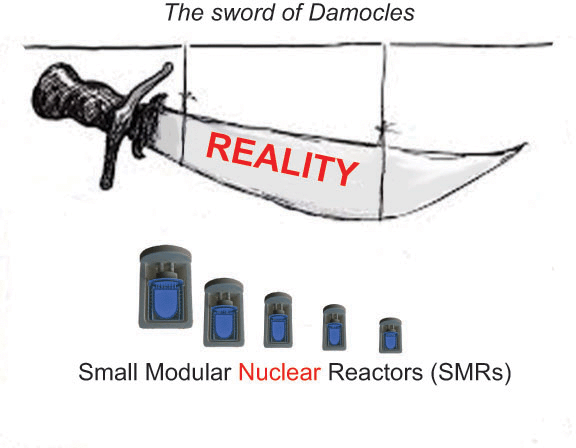
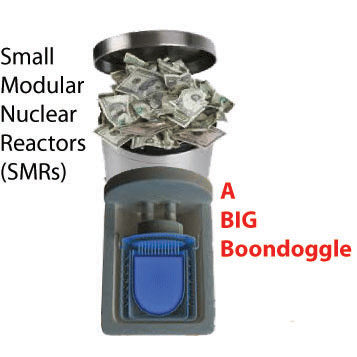
Small nuclear reactors are no better than large ones

This very well-written and informative article still does not examine the question “Is nuclear power, of any type REALLY a solution to climate change?” Why on earth are all these writers mindlessly buying the nuclear lobby’s spurious claim? The nuclear reactor itself emits a tiny amount of Carbon 14. The entire nuclear chain, from mining to waste storage is a huge carbon emitter. How many thousands of these so-called “small” reactors would have to be up and running in time to make any difference? This push for smrs will be useful only to the military, and only tax-payers will foot the bill.

small modular reactors suffer from many of the same problems as large reactors, most notably safety issues and the unresolved problem of what to do with long-lived radioactive waste.

even in a smaller form, nuclear power is expensive — it’s one of the costliest forms of energy, requiring substantial government subsidies to build and run, not to mention insure.

When It Comes to Nuclear Power, Could Smaller Be Better?  Yale Environment 360 , BY LOIS PARSHLEY 19 Feb 20, A handful of companies and governments are working to develop small-scale nuclear reactors that proponents say are safer, cheaper, and more compatible with renewables than traditional nuclear power. But critics contend the new technology doesn’t address concerns about safety and radioactive waste.

Huge computer screens line a dark, windowless control room in Corvallis, Oregon, where engineers at the company NuScale Power hope to define the next wave of nuclear energy. Glowing icons fill the screens, representing the power output of 12 miniature nuclear reactors. Together, these small modular reactors would generate about the same amount of power as one of the conventional nuclear plants that currently dot the United States — producing enough electricity to power 540,000 homes. On the glowing screens, a palm tree indicates which of the dozen units is on “island mode,” allowing a single reactor to run disconnected from the grid in case of an emergency.

This control room is just a mock-up, and the reactors depicted on the computer screens do not, in fact, exist. Yet NuScale has invested more than $900 million in the development of small modular reactor (SMR) technology, which the company says represents the next generation of nuclear power plants. NuScale is working on a full-scale prototype and says it is on track to break ground on its first nuclear power plant — a 720-megawatt project for a utility in Idaho — within two years; the U.S. Nuclear Regulatory Commission has just completed the fourth phase of review of NuScale’s design, the first SMR certification the commission has reviewed. The company expect final approval by the end of 2020. The U.S. Department of Energy has already invested $317 million in the research and development of NuScale’s SMR project.

NuScale is not alone in developing miniature reactors. In Russia, the government has launched a floating 70-megawatt reactor in the Arctic Ocean. China announced plans in 2016 to build its own state-funded floating SMR design. Three Canadian provinces — Ontario, New Brunswick, and Saskatchewan — have signed a memorandum to look into the development and deployment of small modular reactors. And the Rolls-Royce Consortium in the United Kingdom is working on the development of a 440-megawatt SMR.

Proponents say the time is ripe for this new wave of nuclear reactors for several reasons. First, they maintain that if the global community has any hope of slashing CO2 emissions by mid-century, new nuclear technologies must be in the mix. Second, traditional nuclear power is beset with problems. Many existing plants are aging, and new nuclear power construction is plagued by substantial delays and huge cost overruns; large-scale nuclear power plants can cost more than $10 billion. Finally, advocates say that as supplies of renewable energy grow, small modular reactors can better handle the variable nature of wind and solar power as SMRs are easier to turn on and leave running.

Critics of nuclear power, however, contend that small modular reactors suffer from many of the same problems as large reactors, most notably safety issues and the unresolved problem of what to do with long-lived radioactive waste. And opponents say that even in a smaller form, nuclear power is expensive — it’s one of the costliest forms of energy, requiring substantial government subsidies to build and run, not to mention insure. NuScale’s SMR is offering an artificial 6.5 cent-per-kilowatt-hour cap as an incentive to get its first project off the ground. Yet in September, the Los Angeles Department of Water and Power announced that it had accepted a bid of electricity coming from renewables, with storage capacity that can deliver round-the-clock supply, at 2 cents a kilowatt-hour.

M.V. Ramana, the Simons Chair in Disarmament, Global and Human Security at the University of British Columbia, says that as renewable prices plummet, nuclear power just can’t compete. More than a third of U.S. nuclear plants are now unprofitable or scheduled to close. Globally, nuclear energy now only supplies 11 percent of electricity, down from a record high of 17.6 percent in 1996. After the 2011 Fukushima disaster in Japan, Germany decided to close its nuclear industry altogether, and countries like Belgium, Switzerland, and Italy have declined to replace existing reactors or move forward with plans for new ones…….

SMR opponents maintain that no matter the size, nuclear power has unresolved cost and safety concerns. To realize savings through mass manufacturing, there would need to be a standardized SMR design, critics say; currently, there are dozens. And SMRs would also have to be built in large quantities. But for a company to invest in making reactors and their components, it would need a reliable market, and many private investors are still wary of the new technology. Andrew Storer, CEO of the Nuclear Advanced Manufacturing Research Center, which forecasts markets for nuclear power manufacturers, says, as far far as supply chain companies go, “We’re advising people, ‘Don’t invest yet.’”

Recent experience supports skepticism. Westinghouse worked on an SMR design for a decade before giving up in 2014. Massachusetts-based Transatomic Power, a nuclear technology firm, walked away from a molten salt SMR in 2018, and despite an $111 million dollar infusion from the U.S. government, a SMR design from Babcock &Wilcox, an advanced energy developer, folded in 2017. While the Russians have managed to get their state-funded SMR floating, its construction costs ran over estimates by four times, and its energy will cost about four times more than current U.S. nuclear costs.

Eventually, every nuclear conversation turns to radioactive waste and safety. SMRs using a pressurized water reactor will continue to generate highly radioactive spent fuel, yet no country has a permanent solution for how to safely store this kind of waste. The U.S. has been looking for a place to put a permanent nuclear waste repository since 1982; in the meantime, 70 percent of the U.S.’s spent fuel is sitting in cooling pools, many of which are aging and vulnerable, and often in quantities much larger than what is considered safe.

Because NuScale hopes to replace coal-fired power plants in the U.S. and the UK, perhaps even building on the grounds of shuttered power plant sites in more populated areas, the Nuclear Regulatory Commission is considering eliminating some standard safety measures, including a requirement for an emergency evacuation zone and the need for backup power. NuScale says that because SMRs contain smaller quantities of radioactive materials and can be sited underground, their risks are lower and they require less security staff.

This has raised sharp criticism from nuclear experts. Even the Union of Concerned Scientists, which has generally supported nuclear power, says, “It would be irresponsible for the NRC to reduce safety and security requirements for any reactor of any size.”

This very well-written and informative article still does not examine the question “Is nuclear power, of any type REALLY a solution to climate change?” Why on earth are all these writers mindlessly buying the nuclear lobby’s spurious claim? The nuclear reactor itself emits a tiny amount of Carbon 14. The entire nuclear chain, from mining to waste storage is a huge carbon emitter. How many thousands of these so-called “small” reactors would have to be up and running in time to make any difference? This push for smrs will be useful only to the military, and only tax-payers will foot the bill.  https://e360.yale.edu/features/when-it-comes-to-nuclear-power-could-smaller-be-better

February 20, 2020 Posted by Christina Macpherson | Small Modular Nuclear Reactors, USA | Leave a comment

Chinese-led nuclear company pretending that Sizewell project is a ‘fait accompli’ – no, it is far from it.

BANNG 1020, The Blackwater Against New Nuclear Group (BANNG) has learned that GNSL, the Chinese-led company seeking to build a mammoth new nuclear power station at Bradwell, is preparing to launch its pre-application public consultation for planning permission later this year.

This will be long before detailed discussions with the nuclear regulators are concluded. There are major issues and challenges still to be confronted. ‘It seems that the Chinese developers are taking a risk in trying to present the public and politicians with an apparent ‘fait accompli’ well before major design
and environmental hurdles have been crossed’ said Prof. Andy Blowers,
Chair of BANNG.

GNSL greeted the announcement that the Generic Design
Assessment (GDA) for Bradwell B had begun Step 4 as a major milestone,
clearing the path for deployment of Chinese nuclear technology in Britain.

That is far from the case. Moving to Step 4 in the GDA is like reaching a
hurdle, not passing a milestone. It is at this stage that all the tricky
issues facing the Bradwell B project must be confronted, including the
cooling system, site suitability, security, coastal defence, impacts on
marine and terrestrial environments and so on.

Step 4 is a long and intensive process between the developer and the independent regulators, the Office for Nuclear Regulation (ONR) and the Environment Agency (EA). It is not expected to be concluded for another two years. A pre-application should follow, not overlap, Step 4 of the GDA.

https://www.banng.info/news/press-release-18th-february-2020/

February 20, 2020 Posted by Christina Macpherson | politics, spinbuster, UK | Leave a comment

Large U.S. nuclear delegation to India to con Indians into buying Small Modular Nuclear Reactors

Nuclear ties in focus ahead of Trump visit, Live Mint 18 Feb 2020, Elizabeth Roche

  • The US delegation held talks for collaborating in R&D, advanced nuclear tech and offered nuclear power plants
  • The US team was the largest to visit India since the two nations eased differences over civil nuclear liability in 2015
  • New Delhi: The largest US nuclear delegation to visit India in five years held talks with senior Indian officials last week, exploring collaborations in research and development (R&D) and advanced nuclear technology, besides offering nuclear power plants in a range of sizes.

    The delegation of a dozen people representing the US industry and government, headed by Rita Baranwal, assistant secretary for the office of nuclear energy in the department of energy, was in India on 10-14 February to explore opportunities.

    The group was in India under the aegis of the US-India Strategic Partnership Forum.

    The visit came ahead of US President Donald Trump’s 24-25 February official trip to India next week.

    Besides collaborating with India in R&D and advanced nuclear technology, the US has offered nuclear power plants in three sizes—small modular, micro, and bigger plants of at least one gigawatt capacity……

    There are a lot of really talented researchers in India and I think we need to continue our discussions and leverage that talent so that as we move forward to deploy advanced nuclear technology reactors we have the technology talent that can assist with deploying and operating those types of nuclear reactors,” she said.

    “And when I talk about advanced nuclear technology I mean not only the large gigawatt-size reactors such as Westinghouse AP-1000 but also the SMR (small modular reactor) technology and the even smaller micro reactor.”…….

  • The US is looking to set up advanced nuclear technology demonstration reactors in the next five-seven years. The new technologies would be for the US market, “but we hope to see them deployed globally and it will be really great to have Indian cooperation early in the process. …. https://www.livemint.com/news/india/nuclear-ties-in-focus-ahead-of-trump-visit-11582049040350.html
  •  

February 20, 2020 Posted by Christina Macpherson | India, marketing, USA | Leave a comment

Why India is not defined as a “Nuclear Power”, though it has nuclear bombs

India Has Nuclear Bombs—But It’s Not Defined As a ‘Nuclear Power’ National Interest, Here’s why. by Ramesh Thakur-19 Feb 20  Among the big changes in the global strategic landscape since the Nuclear Non-Proliferation Treaty came into force in 1970 is the expansion of the nuclear club from five to nine. All five nuclear powers at that time were recognised as nuclear-weapon states by the NPT. Since then, four more countries have gate-crashed the Here’s why.

by Ramesh Thakur

Among the big changes in the global strategic landscape since the Nuclear Non-Proliferation Treaty came into force in 1970 is the expansion of the nuclear club from five to nine. All five nuclear powers at that time were recognised as nuclear-weapon states by the NPT. Since then, four more countries have gate-crashed the  exclusive nuclear club: Israel, India, Pakistan and North Korea.

The first three have been de facto nuclear-armed states for decades, and North Korea conducted its first nuclear test in 2006. But because of an Alice-in-Wonderland definition in the treaty—nuclear-weapon states are countries that nuclear-tested before 1 January 1967—they can’t be recognised as nuclear-weapon states. The legal straitjacket means the NPT can’t function as the normative framework for the nuclear policies of four of the world’s nine nuclear-armed states: a triumph of definitional purity over strategic reality. …….. https://nationalinterest.org/blog/buzz/india-has-nuclear-bombs%E2%80%94-its-not-defined-nuclear-power-124721

February 20, 2020 Posted by Christina Macpherson | India, politics international, weapons and war | Leave a comment

Danger of nuclear catastrophe in USA’s New “Low-Yield” Nuclear Warhead

The Senseless Danger of the Military’s New “Low-Yield” Nuclear Warhead, The weapon’s smaller destructive power does not mean a smaller risk of catastrophe. Slate, By FRED KAPLAN, FEB 18, 2020 The U.S. Navy has deployed a new type of “low-yield” nuclear warhead in some of its Trident submarines.

Sometime in the past two months, the U.S. Navy has deployed a new type of nuclear warhead in some of its Trident submarines. Called the W76-2, it is a “low-yield” warhead, which would explode with the blast power of about 8 kilotons—far less powerful than the Tridents’ other warheads, which have an explosive yield of 90 to 450 kilotons.

At first glance, this might seem like a good thing: a smaller blast means less death and damage, if a nuclear war happened. But in some ways, it’s a dangerous thing, and to explain why requires a brisk dive into the rabbit hole logic of nuclear strategy.

For many years, arms control advocates have argued that low-yield nuclear weapons are destabilizing because they lower the threshold between conventional and nuclear war. They seem to be—they are designed to be—more usable as weapons of war, and therefore some president, in a crisis, might feel more tempted to use them. (The United States has always had an explicit policy of reserving the right to use nuclear weapons first in a conflict.)

Those worries have intensified when we’ve had presidents who are viewed as erratic. In 2003, after the invasion of Iraq, some Air Force generals proposed building a new low-yield nuclear warhead that could burrow underground before exploding; they saw it as the ideal weapon for killing some future Saddam Hussein hiding in a bunker. But many members of the House and Senate Armed Services Committees did not trust President George W. Bush with such a weapon, so they tacked on an amendment to that year’s defense budget, prohibiting the “testing, acquisition, or deployment of a low-yield nuclear weapon”—and barring the Department of Energy from even researching such a weapon—without the advance approval of Congress.

Many now have the same worry about Donald Trump. In 2018, when then–Secretary of Defense Jim Mattis lobbied for the W76-2 on Capitol Hill, at least one Republican senator told him, “I don’t have a problem with this weapon. I have a problem with the president who’s authorized to use this weapon.”

But just months later, Trump’s vicelike grip on the Republican Party had tightened. The Democrat-controlled House voted to cancel the program; the GOP-led Senate voted to approve it. In the conference committee, the House managers folded. Some reasoned that it was such an inexpensive program: Only 50 warheads would be modified to the low-yield version, at a cost of $65 million, less than 0.1 percent of the entire defense budget. No big deal.

Another reason for the Democrats’ concession was that this low-yield program was presented as a response to a Russian threat. The argument was that the Russians had a new strategy called “escalate to de-escalate.” If war broke out in Europe, the Russians would launch a low-yield nuclear weapon at U.S. and NATO forces. If we didn’t have low-yield nuclear weapons to fire back, we would have to surrender. If we did have low-yield nukes, the rationale went, the Russians might not attack in the first place.

It is true that the Russian military has outlined such a strategy in some manuals and rehearsed this scenario in some training exercises. But it’s slippery logic to conclude that we need a low-yield Trident warhead to meet the threat.

First, the case for the new warhead hinges on the premise that, in order to deter the Russians, we need to match in kind every move they make: They build a low-yield missile; we have to do the same, or we wind up with a “gap in the escalation spectrum” (as some have labeled the threat). But there is nothing in history, strategy, or intelligence findings about Russian thinking on the subject to support this notion.

When the warhead goes off, it would look and feel like the largest explosion witnessed since World War II.

Second, even if the notion could be supported, it would be irrelevant because—as Hans Kristensen of the Federation of American Scientists estimates—the U.S. already has about 1,000 low-yield nuclear bombs and cruise missiles, which could be dropped or fired from F-15, F-16, B-1, and B-2 aircraft. Advocates of the low-yield Trident argue that those planes might be shot down by Russian air defenses, whereas the Trident missiles—launched from undetectable submarines—would definitely get through Russian defenses. This imbalance is overstated. Many, probably most of the U.S. planes would get through to their targets. More to the point, even if only a few got through, that would mean that we are able to launch low-yield nuclear weapons in response to Russian low-yield weapons—which means the premise of advocates’ case for low-yield Tridents is false.

Third, there is some dispute within intelligence agencies over why the Russians are deploying low-yield nuclear warheads in the first place. From the 1950s to the 1970s, the U.S. placed thousands of nuclear weapons in Western Europe to compensate for the superiority of Soviet tanks and troops in Eastern Europe. Now, many analysts believe, the Russians are putting more emphasis on nuclear weapons in order to counter U.S. and NATO superiority in conventional weapons. It’s two sides of the same coin. It doesn’t reflect a new kind of threat—or require a new kind of response.

In my new book, The Bomb: Presidents, Generals, and the Secret History of Nuclear War, I recount a highly classified war game played by the National Security Council late in the Obama administration. Reports of Russia’s “escalate to de-escalate” strategy were emerging. The idea of the game was to test whether this strategy might indeed thwart America’s ability or will to project power in Europe. The scenario went like this: The Russians invade one of the Baltic states; NATO fights back effectively; to reverse the tide, Russia fires a low-yield nuclear weapon at the NATO troops or at a base in Germany where drones, combat planes, and smart bombs were deployed. The question: What do U.S. decision-makers do next?

The game was first played in an NSC deputies’ meeting, consisting of second-tier officials from the various agencies and military branches. Initially, the generals steered the discussion toward operational details: How many nuclear weapons, and of what type, should the U.S. fire at what targets? Then, Colin Kahl, Vice President Joe Biden’s national security adviser, spoke up. The generals, he said, were missing the big picture. The minute the Russians drop a nuclear bomb, we would face a world-defining moment—the first time an atom bomb had been used in war since 1945. It would be an opportunity to rally the entire world against Russia. If we responded with diplomacy and economic pressure, and by pushing ahead with our conventional advantage, we would isolate and weaken Moscow’s leaders, policies, and military forces. However, if we responded by shooting off some nukes of our own, we would forfeit that advantage and, moreover, normalize the use of nuclear weapons.

The generals were caught off guard. They knew of the long-standing debate over whether the U.S. should be the first to use nuclear weapons in response to a conventional attack, but it seemed perverse to consider using conventional weapons in response to a nuclear attack. A few hours of discussion ensued, examining Kahl’s political challenge, NATO’s conventional military strength, the puzzle of which targets to hit with nuclear weapons (none made much sense), and whether a nuclear response would end the war any sooner or more victoriously than a conventional response (which didn’t seem likely). In the end, a consensus formed that, at least as a first step, the U.S. should respond with continued conventional military operations.

A month later, the NSC’s Principals Committee—the group of Cabinet secretaries and military chiefs—played the same game, but with very different results. Some of the same concerns were raised—the possibility of isolating the Russians by not taking the nuclear bait, the lack of any sensible targets, the uncertainty of whether nukes would dampen or further escalate the war. Still, the principals decided we had to respond with nuclear weapons, to maintain credibility among our allies and adversaries. They decided to fire a few nuclear weapons at the former Soviet republic of Belarus, even though, in the game, it had no involvement in the Russian attacks—and then they ended the game, without playing the next few steps.

Regardless of who was right, the deputies or the principals, there is another good reason for opposing the idea of launching low-yield nuclear weapons from a Trident submarine. In the first months of Trump’s presidency, Mattis assembled a group of seven longtime defense experts—the “Graybeards,” he called them—to hash out various issues. In the third and last of their meetings, held on Nov. 1, 2017, they discussed the “escalate to de-escalate” scenario and whether to respond by building low-yield Trident warheads. Most of the seven opposed the idea. Kevin Chilton, a retired Air Force general, argued that if the Russians saw a missile hurtling their way after being fired upon by a Trident submarine, they wouldn’t know whether it was high-yield or low-yield—they would see it as a “strategic” weapon, perhaps the first volley of a much larger attack against Russia, and respond accordingly.

Chilton’s opposition might have stemmed in part from the fact that the warhead was a Navy weapon. (He argued that, if we wanted to use nukes to send a signal to Moscow, a cruise missile fired from a bomber aircraft would be a better tool. Both the bomber and the cruise missile were Air Force weapons.) Still, he had a point. There’s nothing on the missile that flashes “Low Yield! Low Yield!” And when the warhead goes off, it would look and feel like the largest explosion witnessed since World War II. An 8-kiloton bomb may sound puny, but 8 kilotons means 8,000 tons, which means 16 million pounds—and that’s just the blast. There would also be fire, smoke, electromagnetic pulse, radiation, and radioactive fallout, spreading the toxicity far and wide. The bomb that leveled Hiroshima at the end of World War II exploded with the force of 12.5 kilotons—not that much larger than the W76-2.

No one in officialdom has ever played a war game in which a “limited” attack believably stays limited. Things spiral out of control pretty quickly.

Where would this weapon be aimed? I’ve asked several officials who deal with these matters. They have different answers. Some say it would be aimed at a target inside Russia. Some say, no, that would escalate the conflict; it would be aimed at a target on the battlefield. Some say the president would make the decision. (That’s the scariest answer of all.) The point is, as the Obama NSC’s war game spelled out, nobody knows how it would, or should, be used—and certainly nobody knows what might happen next.

That is the real danger of the low-yield weapon—not so much the weapon itself (especially compared with much higher-yield weapons) but the deception that the whole concept plants in a decision-maker’s mind: the idea that “low-yield” means tiny, harmless, controllable. In fact, the dynamic unleashed—the near-certainty of a retaliatory strike, followed by another round of strikes, steadily subsumed in the fog of war, as communications systems burn out, commanders wander in confusion about what’s going on, each side fears the worst from the other and seeks to preempt the next blow with a blow of his own—would mean that before too long, the conflict escalates to catastrophe.

If war happens and if nuclear weapons come into the fray, clearly it’s sensible to try to keep the damage limited. But no one in officialdom has ever played a war game in which a “limited” attack believably stays limited. Things spiral out of control pretty quickly. Which is why it’s a good idea to keep the threshold between conventional and nuclear war as high as possible—and why the low-yield Trident warhead is a bad idea. https://slate.com/news-and-politics/2020/02/low-yield-warhead-nuclear-weapons-navy-trident-submarines.html
February 20, 2020 Posted by Christina Macpherson | USA, weapons and war | Leave a comment

New Energy Deputy Secretary nominee (?unwisely) contradicts Trump on Yucca Mountain and nuclear wastes.

Energy deputy secretary nominee faces heat after contradicting Trump  https://www.axios.com/energy-deputy-secretary-nominee-contradicts-trump-yucca-mountain-1395063d-bd50-4c20-8494-4150483b0773.html

Alayna Treene, Jonathan Swan, 18 Feb 20, Trump administration officials are internally raising concerns about President Trump’s nominee for Energy deputy secretary, who appeared to openly contradict the president on nuclear waste storage at Nevada’s Yucca Mountain last week.

Driving the news: While speaking at a House Energy and Commerce subcommittee hearing last Wednesday, Mark Menezes told members of the panel that the Trump administration is still interested in storing nuclear waste at Yucca Mountain and that “what we’re trying to do is to put together a process that will give us a path to permanent storage at Yucca.”

  • His statement came just weeks after Trump tweeted that he hears and respects Nevadans’ concerns about the nuclear waste repository — part of a long-standing “not in my backyard” battle. “[M]y Administration is committed to exploring innovative approaches – I’m confident we can get it done!”
  • Menezes’ remarks also came just days after the White House unveiled its fiscal year 2021 budget, which does not include funding for Yucca Mountain. The administration’s previous budget requests included $120 million and $116 million, respectively, to maintain licensing for the site.

What we’re hearing: Menezes’ comments were flagged internally to White House officials who have been working on Yucca Mountain, an administration official told Axios.

  • “It’s a big deal that the possible No. 2 at the Department of Energy came out in defiance [of] the president’s very strong position on a huge issue,” the official said, calling it “shocking” that Menezes would “basically give a middle finger to the president.”
    • A second administration official told Axios that Menezes knew for weeks that funding for Yucca Mountain was going to be seized, adding to internal frustration over his comments last week: “When the budget comes out, and it has made a change from previous years, everyone’s notified of that. Department of Energy is clearly in the know about that because it’s a core change.”

    The other side: “I have spoken to the White House and the Administration will not be pursuing Yucca Mountain as a solution for nuclear waste, and there are no funds in the budget to do so. I am fully supportive of the President’s decision and applaud him for taking action when so many others have failed to do so,” Menezes told Axios.

    • A White House official said, “There is zero daylight between the President and Under Secretary Menezes on the issue.”
    • Why it matters: Trump’s comments about Yucca Mountain, as well as his decision to cease funding for the repository, come as his re-election campaign seeks to turn Nevada red again after narrowly losing the state to Hillary Clinton in 2016.
      • As the New York Times first reported, two of Trump’s top political advisers, Bill Stepien and Justin Clark, have opposed storing nuclear waste at Yucca Mountain for years, and they see the president’s decision to side with Nevada residents as positive for his re-election campaign.
      • Trump heads to Nevada this week, where he’ll host a rally in Las Vegas on the eve of the Nevada Democratic caucus and speak at a Hope for Prisoners graduation ceremony at police department headquarters. He’ll stay overnight at his hotel on the Strip.

      The backstory: Menezes, currently the Energy undersecretary, was officially nominated as deputy secretary on Thursday, a day after his remarks before members of Congress.

      • However, administration officials say these nominations are normally planned weeks before being announced.

February 20, 2020 Posted by Christina Macpherson | politics, USA, wastes | Leave a comment

Taiwan searches for a solution to its nuclear waste problem

Searching for a Permanent Storage Solution https://topics.amcham.com.tw/2020/02/permanent-storage-solution/

BY TIMOTHY FERRYON FEBRUARY 19, 2020  Permanent storage in deep geological repositories is the current international standard for final disposal of nuclear waste, but in practice this solution has so far proven extremely difficult to accomplish.

The U.S. government has de-funded its deep geological repository at Yucca Mountain, and most nations have yet to begin development of similar facilities. Finland is the closest to successfully completing deep geological repository. Its Onkalo site is now in the final approval stage, and should begin accepting nuclear waste early in this decade.

Executives from U.S. startup Deep Isolation visited Taiwan last fall with an innovative solution that could serve as either interim or permanent storage. Deploying technologies developed in the oil and gas industry, it would use directional drilling approximately 1 kilometer deep and then another kilometer horizontally. The spent fuel would then be lowered down the borehole inside nickel-chromium-molybdenum alloy canisters.

Developed by University of California at Berkeley physicist Richard Muller, the solution is based on proven technologies. The canisters can even be retrieved. The company has yet to utilize the technology in an actual case, though, and Taipower may be wary of being first in the world to implement it.

In the meantime, Taiwan is continuing a search for its own site for a deep geological depository. The Atomic Energy Council hopes to have a site ready by 2055.

For now, however, the focus is on developing interim solutions for the spent fuel in the cooling pools. Both New Taipei City and Taipower are optimistic that solutions can be found.

“The election is over and the noise is quieting down, so maybe now will be a better time to solve the issue,” says Edward H.C. Chang (張學植), director of Tai-power’s Department of Nuclear Backend Management.

February 20, 2020 Posted by Christina Macpherson | Taiwan, wastes | Leave a comment

Al Gore’s goal to beat climate change – get Trump out of office!

Al Gore’s New Campaign To Save The Planet Is Focused On Getting Donald Trump Out Of Office

“For those of us concerned about the future of the Earth’s climate and balance, this election is extremely important,” Gore said.

Zahra HirjiBuzzFeed News Reporter  – 19 Feb 20, Former vice president Al Gore is launching a voter registration campaign this week to increase voter turnout in November, focusing on young people concerned about the rapidly warming planet.This new effort by Gore, who starred in the 2006 climate documentary An Inconvenient Truth and won a 2007 Nobel Peace Prize for his climate activism, comes amid dire scientific warnings about the climate crisis and a new explosion in climate activism, driven mostly by young people skipping school and challenging politicians to take action. …

“Young people in particular have been both more concerned about climate than other age groups and traditionally less likely to vote in large percentages,” said Gore. “I want to do everything I possibly can to contribute to the registration and turnout and voting by those who are concerned about the climate crisis.”

The effort will initially focus on key battleground states. Gore will kick off with a voter registration rally on Wednesday at the Texas Southern University, a historically black public college in Houston, followed by visits to the University of Nevada, Las Vegas, on March 10 and the University of Pittsburgh on March 17. Voter registration drives are also being planned at eight additional college and university campuses in Florida, Michigan, Pennsylvania, and Texas over the coming months, and Gore plans to add more sites in the future.

And although he’s largely focused on influencing the presidential election, Gore will encourage voters to consider climate across the ballot…..

https://www.buzzfeednews.com/article/zahrahirji/al-gore-climate-voter-registration-2020

February 20, 2020 Posted by Christina Macpherson | climate change, politics, USA | Leave a comment

1% World Military Spending Can End Starvation on Earth — limitless life

Statistic on Billboard Explained In 2008, the United Nations said that $30 billion per year could end hunger on earth, as reported in the New York Times, Los Angeles Times, and many other outlets. The Food and Agriculture Organization of the United Nations tells us that number is still up to date. As of 2019, the annual Pentagon base […]

via 1% World Military Spending Can End Starvation on Earth — limitless life

February 20, 2020 Posted by Christina Macpherson | Uncategorized | Leave a comment


1 This Month

Website of the Week

Nuclear Free Hawaii

New book – https://www.amazon.com/dp/1923372157?utm_source=substack&utm_medium=email

Now until to February 10, 2026 Radioactive waste storage in France: the debate is finally open! How to participate?

  • Categories

    • 1
      • Arclight's Vision
    • 1 NUCLEAR ISSUES
      • business and costs
        • employment
        • marketing
      • climate change
      • culture and arts
      • ENERGY
        • renewable
          • decentralised
          • energy storage
      • environment
        • oceans
        • water
      • health
        • children
        • psychology – mental health
        • radiation
        • social effects
        • women
      • history
      • indigenous issues
      • Legal
        • deaths by radiation
        • legal
      • marketing of nuclear
      • media
        • investigative journalism
        • Wikileaks
      • opposition to nuclear
      • PERSONAL STORIES
      • politics
        • psychology and culture
          • Trump – personality
        • public opinion
        • USA election 2024
        • USA elections 2016
      • politics international
      • Religion and ethics
      • safety
        • incidents
      • secrets,lies and civil liberties
        • civil liberties
      • spinbuster
        • Education
      • technology
        • reprocessing
        • Small Modular Nuclear Reactors
        • space travel
      • Uranium
      • wastes
        • – plutonium
        • decommission reactor
      • weapons and war
        • Atrocities
        • depleted uranium
      • Women
    • 2 WORLD
      • ANTARCTICA
      • ARCTIC
      • ASIA
        • Burma
        • China
        • India
        • Indonesia
        • Japan
          • – Fukushima 2011
          • Fukushima 2012
          • Fukushima 2013
          • Fukushima 2014
          • Fukushima 2015
          • Fukushima 2016
          • Fukushima continuing
        • Malaysia
        • Mongolia
        • North Korea
        • Pakistan
        • South Korea
        • Taiwan
        • Turkey
        • Vietnam
      • EUROPE
        • Belarus
        • Bulgaria
        • Denmark
        • Finland
        • France
        • Germany
        • Greece
        • Ireland
        • Italy
        • Kazakhstan
        • Kyrgyzstan
        • Russia
        • Spain
        • Sweden
        • Switzerland
        • UK
        • Ukraine
      • MIDDLE EAST
        • Afghanistan
        • Egypt
        • Gaza
        • Iran
        • Iraq
        • Israel
        • Jordan
        • Libya
        • Saudi Arabia
        • Syria
        • Turkey
        • United Arab Emirates
      • NORTH AMERICA
        • Canada
        • USA
          • election USA 2020
      • OCEANIA
        • New Zealand
        • Philippines
      • SOUTH AMERICA
        • Brazil
    • ACTION
    • AFRICA
      • Kenya
      • Malawi
      • Mali
      • Namibia
      • Niger
      • Nigeria
      • Somalia
      • South Africa
    • Atrocities
    • AUSTRALIA
    • Christina's notes
    • Christina's themes
    • culture and arts
    • Events
    • Fuk 2022
    • Fuk 2023
    • Fukushima 2017
    • Fukushima 2018
    • fukushima 2019
    • Fukushima 2020
    • Fukushima 2021
    • general
    • global warming
    • Humour (God we need it)
    • Nuclear
    • RARE EARTHS
      • thorium
    • Reference
      • Reference archives
    • resources – print
    • Resources -audiovicual
    • Weekly Newsletter
    • World
    • World Nuclear
    • YouTube
  • Pages

    • 1 This Month
    • ACTION !
    • Disclaimer
    • Links
    • PAGES on NUCLEAR ISSUES
      • audio-visual news
      • Anti Nuclear, Clean Energy Movement
        • Anti Nuclear movement – a success story
          • – 2013 – the struggle for a nuclear-free, liveable world
          • – 2013: the battle to expose nuclear lies about ionising radiation
            • Speakers at Fukushima Symposium March 2013
            • Symposium 2013 Ian Fairlie
      • Civil Liberties
        • – Civil liberties – China and USA
      • Climate change
      • Climate Change
      • Economics
        • – Employment
        • – Marketing nuclear power
        • – Marketing Nuclear Power Internationally
        • nuclear ‘renaissance’?
        • Nuclear energy – the sick man of the corporate world
      • Energy
        • – Solar energy
      • Environment
        • – Nuclear Power and the Tragedy of the Commons
        • – Water
      • Health
        • Birth Defects in the Chernobyl Radiation Affected Region.
      • History
        • Nuclear History – the forgotten disasters
      • Indigenous issues
      • Ionising radiation
        • – Ionising radiation – medical
        • Fukushima FACT SHEET
      • Media
        • Nuclear Power and Media 2012
      • Nuclear Power and the Consumer Society – theme for December 2012
      • Peace and nuclear disarmament
        • Peace on a Nuclear Free Earth
      • Politics
        • – Politics USA
      • Public opinion
      • Religion and ethics
        • -Ethics of nuclear power
      • Resources – print
      • Safety
      • Secrets and lies
        • – NUCLEAR LIES – theme for January 2012
        • – Nuclear Secrets and Lies
      • Spinbuster
        • 2013 nuclear spin – all about FEAR -theme for June
        • Spinbuster 1
      • Technology
        • TECHNOLOGY Challenges
      • Wastes
        • NUCLEAR WASTES – theme for October 2012
        • – Plutonium
      • Weapons and war
      • Women
  • Archives

    • January 2026 (118)
    • December 2025 (358)
    • November 2025 (359)
    • October 2025 (377)
    • September 2025 (258)
    • August 2025 (319)
    • July 2025 (230)
    • June 2025 (348)
    • May 2025 (261)
    • April 2025 (305)
    • March 2025 (319)
    • February 2025 (234)
  • Categories

    • 1
      • Arclight's Vision
    • 1 NUCLEAR ISSUES
      • business and costs
        • employment
        • marketing
      • climate change
      • culture and arts
      • ENERGY
        • renewable
          • decentralised
          • energy storage
      • environment
        • oceans
        • water
      • health
        • children
        • psychology – mental health
        • radiation
        • social effects
        • women
      • history
      • indigenous issues
      • Legal
        • deaths by radiation
        • legal
      • marketing of nuclear
      • media
        • investigative journalism
        • Wikileaks
      • opposition to nuclear
      • PERSONAL STORIES
      • politics
        • psychology and culture
          • Trump – personality
        • public opinion
        • USA election 2024
        • USA elections 2016
      • politics international
      • Religion and ethics
      • safety
        • incidents
      • secrets,lies and civil liberties
        • civil liberties
      • spinbuster
        • Education
      • technology
        • reprocessing
        • Small Modular Nuclear Reactors
        • space travel
      • Uranium
      • wastes
        • – plutonium
        • decommission reactor
      • weapons and war
        • Atrocities
        • depleted uranium
      • Women
    • 2 WORLD
      • ANTARCTICA
      • ARCTIC
      • ASIA
        • Burma
        • China
        • India
        • Indonesia
        • Japan
          • – Fukushima 2011
          • Fukushima 2012
          • Fukushima 2013
          • Fukushima 2014
          • Fukushima 2015
          • Fukushima 2016
          • Fukushima continuing
        • Malaysia
        • Mongolia
        • North Korea
        • Pakistan
        • South Korea
        • Taiwan
        • Turkey
        • Vietnam
      • EUROPE
        • Belarus
        • Bulgaria
        • Denmark
        • Finland
        • France
        • Germany
        • Greece
        • Ireland
        • Italy
        • Kazakhstan
        • Kyrgyzstan
        • Russia
        • Spain
        • Sweden
        • Switzerland
        • UK
        • Ukraine
      • MIDDLE EAST
        • Afghanistan
        • Egypt
        • Gaza
        • Iran
        • Iraq
        • Israel
        • Jordan
        • Libya
        • Saudi Arabia
        • Syria
        • Turkey
        • United Arab Emirates
      • NORTH AMERICA
        • Canada
        • USA
          • election USA 2020
      • OCEANIA
        • New Zealand
        • Philippines
      • SOUTH AMERICA
        • Brazil
    • ACTION
    • AFRICA
      • Kenya
      • Malawi
      • Mali
      • Namibia
      • Niger
      • Nigeria
      • Somalia
      • South Africa
    • Atrocities
    • AUSTRALIA
    • Christina's notes
    • Christina's themes
    • culture and arts
    • Events
    • Fuk 2022
    • Fuk 2023
    • Fukushima 2017
    • Fukushima 2018
    • fukushima 2019
    • Fukushima 2020
    • Fukushima 2021
    • general
    • global warming
    • Humour (God we need it)
    • Nuclear
    • RARE EARTHS
      • thorium
    • Reference
      • Reference archives
    • resources – print
    • Resources -audiovicual
    • Weekly Newsletter
    • World
    • World Nuclear
    • YouTube
  • RSS

    Entries RSS
    Comments RSS

Site info

nuclear-news
Blog at WordPress.com.
Privacy & Cookies: This site uses cookies. By continuing to use this website, you agree to their use.
To find out more, including how to control cookies, see here: Cookie Policy
  • Subscribe Subscribed
    • nuclear-news
    • Join 2,080 other subscribers
    • Already have a WordPress.com account? Log in now.
    • nuclear-news
    • Subscribe Subscribed
    • Sign up
    • Log in
    • Report this content
    • View site in Reader
    • Manage subscriptions
    • Collapse this bar
 

Loading Comments...