UK govt is treating Julian Assange inhumanely – amounting to torture
 Julian Assange and the Inhumanity of the British State: ‘Unofficial’ Solitary Confinement as Torture 21st Century Wire, JANUARY 26, 2020 BY NINA CROSS
 Up until this week, Assange has been held in solitary confinement in Belmarsh prison. Incredibly, it was the other prisoners along with Assange’s legal team, who have pressured the government officials to respect the law and allow Assange to be removed from solitary confinement, resulting in his transfer to a general wing. This piece looks at how Assange was unofficially segregated in the prison’s healthcare unit, with no recourse to systems designed for prisoners in official solitary confinement regimes as applied under Prison Rule 45, leaving him out of reach of rules and law.
The sustained violation of the human rights of Wikileaks founder, Julian Assange, has been carried out in full view of the world throughout his arbitrary detention in HMP Belmarsh. Until now, condemnation of his treatment and pleas to end his suffering have been met with denial and silence by the British authorities.
But the announcement this week that Assange has been moved out of Belmarsh healthcare unit where he has been detained in solitary confinement since May, is a sign that the campaign to stop his persecution is gaining traction. Continue reading
A new serious problem with stainless steel canisters for nuclear wastes
|
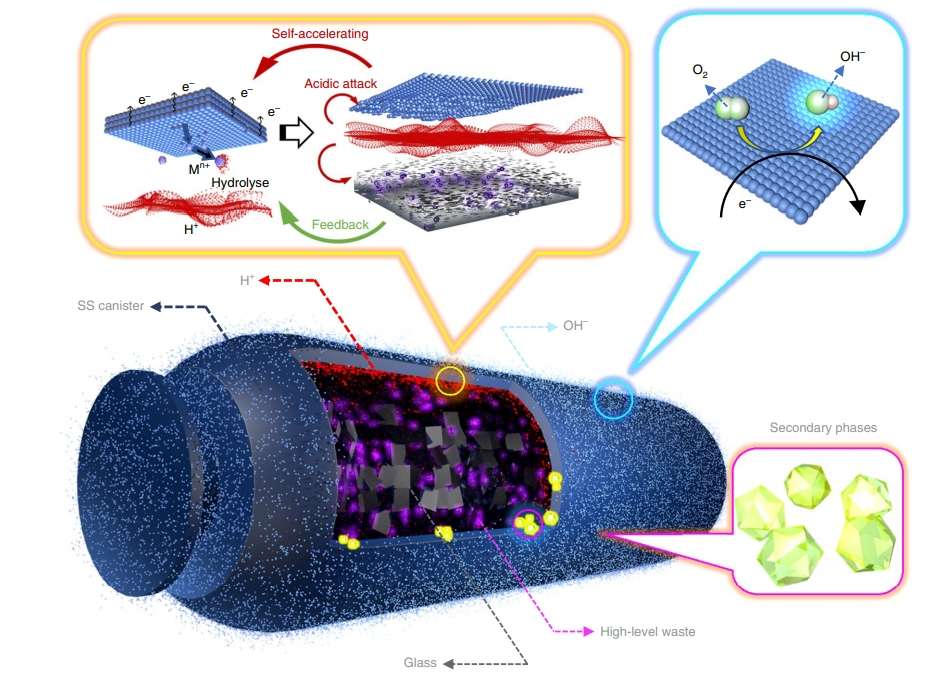
By David Szondy January 28, 2020 A new study by researchers at Ohio State University suggests that stainless steel may not be the best choice for containing high-level nuclear waste. By simulating long-term storage conditions, the team found that the storage materials interact with each other more than previously thought, causing them to degrade faster.
The storage of nuclear waste is more than a perennial political football, it is an existential problem. Whatever one’s opinions about nuclear power or weapons, there are thousands of tons of nuclear waste temporarily stored around the world, meaning that a way must be found to store it all
safely in the long term.
The most important type of nuclear waste is the high-level waste left over from reprocessing nuclear fuel or from nuclear weapon production. Such waste is made up of a complex mixture of radioactive isotopes with half-lives ranging from years to millennia. Though reactors have been operating all over the world for over 75 years, only Finland has started to build a permanent storage facility for such very dangerous waste.
That may show a remarkable lack of political will or even courage, but perhaps this reluctance will turn out to be serendipitous. That’s because the favored way of storing high-level waste is to vitrify it. That is, to mix the isotopes with molten glass or ceramics to form a chemically inert mass that can be sealed in stainless steel canisters before being sealed in an underground storage facility.
That plan may now have to change if the Ohio study is correct. Led by Xiaolei Guo, the team took glasses and ceramics and put them in close contact with stainless steel in various wet solutions for 30 days in conditions similar to those that would be found in the proposed US Yucca Mountain nuclear waste repository.
In the real-life scenario, the glass or ceramic waste forms would be in close contact with stainless steel canisters,” says Xiaolei. “Under specific conditions, the corrosion of stainless steel will go crazy. It creates a super-aggressive environment that can corrode surrounding materials.”
They found that the steel interacted with the glass or ceramic to produce severe and localized corrosion that both damaged the steel and corroded and cracked the glass and ceramics. According to the team, this is because the iron in stainless steel has a chemical affinity with the silicon in glass, accelerating corrosion. This indicates that the current models may not be sufficient to keep this waste safely stored,” says Xiaolei. “And it shows that we need to develop a new model for storing nuclear waste.” The research was published in Nature Materials. Source: Ohio State University |
|

Surplus nuclear power has become an embarrassment. Inflexible baseload power no longer needed.
Out of earshot of the politicians, the question of what to do with all the surplus power when demand is low is being tackled by increasing storage capacity but also by making green hydrogen. Some nuclear buffs are even suggesting hydrogen production might be the only viable hope for using up their spare power.
The Bomb: Presidents, Generals, and the Secret History of Nuclear War
 Nuclear Nightmares–– By Justin Vogt, NYT, Jan. 28, 2020, THE BOMB By Fred Kaplan, It’s an old joke, but a good one. “Doctor, my son thinks he’s a chicken,” a father tells a psychiatrist, who suggests treatment for the boy. “We’d like to do that,” the father says, “but we need the eggs.”
For decades, American presidents have found themselves in a similar predicament, as revealed with bracing clarity by “The Bomb,” Fred Kaplan’s rich and surprisingly entertaining history of how nuclear weapons have shaped the United States military and the country’s foreign policy. It is the story of how high-level officials, generals and presidents have contended with what Kaplan calls “the rabbit hole” of nuclear strategy, whose logic transforms efforts to avoid a nuclear war into plans to fight one, even though doing so would kill millions of people without producing a meaningful victory for anyone. As President Barack Obama once put it before weighing in during a meeting on nuclear weapons: “Let’s stipulate that this is all insane.”
Owing to the spread of those weapons and to the inevitability of competition between powerful countries, generations of policymakers have leapt into the abyss again and again. Nuclear strategy is an exercise in absurdity that pushes against every moral boundary but that has likely contributed to the relative safety and stability of the contemporary era, during which nuclear weapons have proliferated but major war has all but vanished. Apparently, we need the eggs.

The danger in deploying new US nuclear warhead on a submarine
|
Deployment of new US nuclear warhead on submarine a dangerous step, critics say
First submarine to go on patrol armed with the W76-2 warhead makes a nuclear launch more likely, arm control advocates warn, Guardian Julian Borger in WashingtonThu 30 Jan 2020 The US has deployed its first low-yield Trident nuclear warhead on a submarine that is currently patrolling the Atlantic Ocean, it has been reported, in what arms control advocates warn is a dangerous step towards making a nuclear launch more likely. According to the Federation of American Scientists, the USS Tennessee – which left port in Georgia at the end of last year – is the first submarine to go on patrol armed with the W76-2 warhead, commissioned by Donald Trump two years ago. It has an explosive yield of five kilotons, a third of the power of the “Little Boy” bomb dropped on Hiroshima and considerably lower than the 90- and 455-kiloton warheads on other US submarine-launched ballistic missiles. Advocates of W76-2 argued that the US had no effective deterrent against Russian tactical weapons because Moscow assumed Washington would not risk using the overwhelming power of its intercontinental ballistic missiles in response, for fear of escalating from a regional conflict to a civilian-destroying war. Critics of the warhead say it accelerates a drift towards thinking of nuclear weapons as a means to fight and win wars, rather than as purely a deterrent of last resort. And the fielding of a tactical nuclear weapon, they warn, gives US political and military leaders a dangerous new option in confronting adversaries other than Russia…… https://www.theguardian.com/world/2020/jan/29/us-submarine-trident-nuclear-warhead-patrols-atlantic-ocean The Trump administration’s nuclear posture review (NPR) in February 2018, portrays this warhead as a counter to a perceived Russian threat to use its own “tactical” nuclear weapons to win a quick victory on the battlefield. |
|
Does the USA arsenal REALLY need costly new plutonium weapons cores?
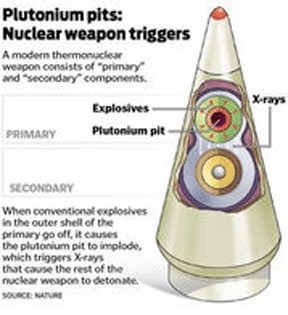 An Unanswered Question at the Heart of the U.S.’s Nuclear Arsenal. Nobody knows how long the plutonium “pits” in the cores of bombs last, and the answer could cost—or save—billions https://blogs.scientificamerican.com/observations/an-unanswered-question-at-the-heart-of-americas-nuclear-arsenal/, By Stephen Young on January 28, 2020 An Unanswered Question at the Heart of the U.S.’s Nuclear Arsenal. Nobody knows how long the plutonium “pits” in the cores of bombs last, and the answer could cost—or save—billions https://blogs.scientificamerican.com/observations/an-unanswered-question-at-the-heart-of-americas-nuclear-arsenal/, By Stephen Young on January 28, 2020
The United States has an arsenal of some 3,800 nuclear weapons, about half of which are deployed, with the rest in storage. The Department of Energy’s National Nuclear Security Agency (NNSA) and the nuclear weapons laboratories it oversees are concerned that the performance of the weapons will degrade over time. Most of the components can be—and are being—replaced with new versions, so the main concern is the behavior of aging plutonium “pits” at the core of all U.S. weapons. Plutonium essentially doesn’t exist in nature but is produced in nuclear reactors. It was first produced during World War II, and the U.S. government didn’t care about pit aging because it constantly replaced pits with newly built ones as it upgraded its arsenal during the Cold War. So, no one in the weapons labs knew what the lifetime of a pit was. Instead, the NNSA simply assumed it was 45–60 years. And during the Cold War, the U.S. produced a lot of pits, tens of thousands. It stopped in 1989 when the production plant was shut down by the FBI and the EPA due to pervasive environmental damage. Los Alamos National Laboratory in New Mexico manufactured 31 pits between 2007 and 2013, but none since. That means virtually all the pits in today’s arsenal were made 30–40 years ago, which would have meant serious problems for the stockpile starting in 2025 if the NNSA’s assumption were correct. So, what is the lifetime of a pit? In 2005, Congress tasked JASON, the independent science advisory group, with answering this question. Their groundbreaking 2007 report examined the data the weapons labs had produced and concluded that most weapons system types in the stockpile “have credible minimum [emphasis added] lifetimes in excess of 100 years as regards aging of plutonium.” Moreover, this minimum age would also apply to the remaining types once straightforward adjustments were made. This finding significantly reduced pressure to resume large-scale production of pits for some time. Last year, Congress—led by Sen. Dianne Feinstein (D–Calif.)—sensibly asked JASON to update its earlier work. Unfortunately, JASON’s new, very brief “letter report” contains zero new information on pit lifetimes. What went wrong? Did JASON fail to do its job? Or was the group unable to do it? When asked this question, an NNSA official confirmed that it was a lack of data, not a failure by JASON, that prevented an update on the 2007 estimates. JASON’s report states: “A focused program of experiments, theory, and simulations is required to determine the timescales over which Pu [plutonium] aging may lead to unacceptable degradation in primary performance.” JASON lays the blame for this failure squarely on the NNSA, declaring that “in general, studies on Pu aging and its impacts on the performance of nuclear-weapon primaries have not been sufficiently prioritized over the past decade.” It seems entirely possible that this was not an oversight on the part of NNSA but reflects that the agency does not want to know the answer. The NNSA wants to produce new types of warheads, not just refurbish existing ones. That requires the ability to produce new pits in bulk. If minimum pit lifetimes were 200 years, then there would be no need for new pit production to maintain existing weapons. The cost of pit production would then be entirely attributed to new weapons and the price tag for those would increase substantially, making it less likely that Congress will give NNSA the go-ahead. Instead of studying pit lifetimes, the NNSA has focused on major upgrades for three existing nuclear weapons, a new uranium processing facility and, notably, one all-new nuclear weapon—the first since the end of the Cold War—that will require production of new plutonium pits. And, not coincidentally, the Trump administration and many in Congress are pushing a plan to produce at least 80 pits per year by 2030. The rationale they offer is disarmingly simple: if the U.S. has roughly 4,000 nuclear weapons and pits last 100 years, then the NNSA needs to produce 80 pits per year starting in 2030 to be able to replace the entire stockpile by 2080. But what if plutonium pits last longer than 100 years? Deferring production of new pits would significantly reduce the stress on the NNSA’s infrastructure, already struggling under a workload many times heavier than at any time since the end of the Cold War. It would also save tens of billions of dollars. However, the all-new warhead, known as the W87-1, would need new plutonium pits. The NNSA estimates the W87-1 will cost $11–16 billion, not including the money needed to produce the new pits, which adds another $14–28 billion. Moreover, another recent independent study mandated by Congress found that the current timeline and cost estimate for pit production are not realistic. The May 2019 study by the Institute for Defense Analyses concluded that the 80 pits per year goal was “potentially achievable given sufficient time, resources, and management focus, although not on the schedules or budgets currently forecasted…. Put more sharply, eventual success of the strategy to reconstitute plutonium pit production is far from certain.” (Emphasis added.) In other words, producing 80 pits per year may be possible, but it will not happen by 2030 and it will cost more than current projections. This makes an updated estimate on pit lifetime even more important. Congress should put the NNSA’S feet to the fire. Sen. Feinstein, sponsor of the JASON study, is the ranking member of the Senate committee that oversees the NNSA. She should push the committee to direct the NNSA to undertake the “focused program” that JASON recommends, now. The answer will determine whether the U.S. needs to spend tens of billions of dollars in a rush to produce pits, or whether it can sensibly and safely postpone that decision. |
|
|
North Korea’s nuclear tests have made Hamgyong Province area unstable

“It was a natural earthquake, presumably caused by the sixth nuclear test,” the administration said in a statement on its website. “The area is about 3km southeast of the sixth nuclear test site.”
Punggye-ri is the only known site in North Korea used to test nuclear weapons. At least six tests were conducted there between October 2006 and September 2017.
In early 2018, North Korea said it would close the site, saying its nuclear force was complete.
The entrances to tunnels at the site were blown up in front of a small group of foreign media invited to view the demolition, but North Korea rejected calls for international experts to inspect the closure.
Frustrated at what it sees as a lack of reciprocal concessions by the United States in denuclearisation talks, North Korea now says it is no longer bound by its self-imposed moratorium on test firing nuclear weapons and long-range ballistic missiles, though it has not conducted new tests.
The 2017 nuclear test, which North Korea said was a thermonuclear weapon, appeared to be several times larger than previous blasts, according to monitoring organisations at the time.
In the weeks after the sixth explosion, experts pointed to a series of tremors and landslides near the nuclear test base as a sign the large blast had destabilised the region.
Wednesday’s quake is the latest confirmation that the nuclear explosion had permanently changed the geology of the area, said Woo Nam-chul, an earthquake analyst at KMA.
“The terrain of the area was solid enough to have no natural earthquakes before the sixth nuclear test in September 2017.”
Long Island Power Authority ratepayers will have to Subsidize Upstate Nuclear Power Plants
LIPA Customers To Subsidize Upstate Nuclear Power Plants.wshu, By JAY SHAH 29 Jan 2020 Long Island Power Authority ratepayers could spend more than $800 million over the next decade to help fund upstate nuclear power plants.
LIPA will have to buy zero-emission credits through a state agency, which subsidizes energy generators that don’t emit greenhouse gases, like [?] nuclear power plants. …….https://www.wshu.org/post/lipa-customers-subsidize-upstate-nuclear-power-plants#stream/0
Russian Space Agency confirms plans to launch nuclear-powered space tug by 2030
|
Russian Space Agency confirms plans to launch nuclear-powered space tug by 2030 Space Daily, by Staff Writers
Moscow (Sputnik) Jan 29, 2020 The secrecy-laden project, in development since 2010, is intended to facilitate the transportation of large cargoes in deep space, including for the purpose of creating permanent bases on other planets in our solar system.Roscosmos plans to deliver a nuclear-powered space tug into orbit by the year 2030, agency first deputy director Yuri Urlichich has confirmed. In a presentation at the ongoing Korolev Academic Space Conference in Moscow, Urlichich explained that the tug will be launched in 2030 for flight testing, with series production and commercial use to begin after that…….. http://www.spacedaily.com/reports/Russian_Space_Agency_confirms_plans_to_launch_nuclear_powered_space_tug_by_2030_999.html |
|
1 This Month
Chernobyl: The Lost Tapes – A good documentary on Chernobyl on SBS available On Demand for the next 3 weeks– https://www.sbs.com.au/ondemand/tv-program/chernobyl-the-lost-tapes/2352741955560

of the week–London Campaign for Nuclear Disarmament

Tell the Ukrainian Government to Drop Prosecution of Peace Activist Yurii Sheliazhenko
To see nuclear-related stories in greater depth and intensity – go to https://nuclearinformation.wordpress.com
-
Archives
- April 2026 (152)
- March 2026 (251)
- February 2026 (268)
- January 2026 (308)
- December 2025 (358)
- November 2025 (359)
- October 2025 (376)
- September 2025 (257)
- August 2025 (319)
- July 2025 (230)
- June 2025 (348)
- May 2025 (261)
-
Categories
- 1
- 1 NUCLEAR ISSUES
- business and costs
- climate change
- culture and arts
- ENERGY
- environment
- health
- history
- indigenous issues
- Legal
- marketing of nuclear
- media
- opposition to nuclear
- PERSONAL STORIES
- politics
- politics international
- Religion and ethics
- safety
- secrets,lies and civil liberties
- spinbuster
- technology
- Uranium
- wastes
- weapons and war
- Women
- 2 WORLD
- ACTION
- AFRICA
- Atrocities
- AUSTRALIA
- Christina's notes
- Christina's themes
- culture and arts
- Events
- Fuk 2022
- Fuk 2023
- Fukushima 2017
- Fukushima 2018
- fukushima 2019
- Fukushima 2020
- Fukushima 2021
- general
- global warming
- Humour (God we need it)
- Nuclear
- RARE EARTHS
- Reference
- resources – print
- Resources -audiovicual
- Weekly Newsletter
- World
- World Nuclear
- YouTube
-
RSS
Entries RSS
Comments RSS
 nuclear-news