Nuclear industry in terminal decline – over to solar and wind
 Nuclear Futures, Oil Price 18th Jan 2020
unequivocally entering the era of wind and solar power. https://oilprice.com/Alternative-Energy/Nuclear-Power/Is-This-The-Death-Knell-For-Nuclear.html
UK’s nuclear region, Cumbria, has unusually high rates of certain cancers
 NW Evening Mail 16th Jan 2020, A WORRYING new report has found that Cumbria has the highest incidence rates of certain kinds of cancer in the North West. According to data collated by charity North West Cancer Research, the county ranks 11 per cent higher on key cancers than the national average. As part of the study, analysts assessed the impact of 25 key cancers across the North West and 37 cancers across Wales.
Radioactive micro-particles still a hazard to the Olympics in Japan
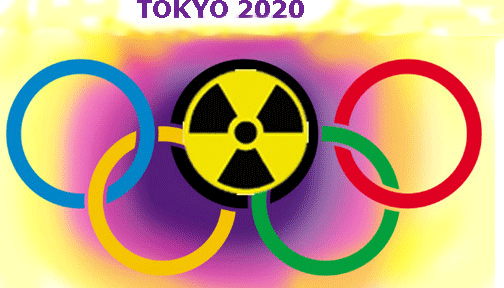 Nukewatch 10th Jan 2020. Hundreds of thousands of people—athletes, officials, media, and spectators—will flood into Japan for the 2020 Olympics.
Soon after the start of the meltdowns in 2011, experts began warning of exposure to radioactive micro-particles or “hot particles”—a type of particle that poses a danger unaccounted for by regulatory agencies. In order to understand the special danger posed by these particles at the Olympics and beyond, we mustfirst understand the current state of radiation exposure standards.
U.S. cities near nuclear weapons stations realise they are targets
 Cities in the crosshairs are pushing back against nuclear weapons
“We forget that all power is local. And by forgetting to act locally, we are giving away all the power.” Salon.com JON LETMAN, JANUARY 19, 2020 This article originally appeared on Truthout. Two years after a mistakenly sent text alert warning of an inbound ballistic missile threat caused widespread panic and confusion across Hawaii, cities remain potential targets and nuclear jitters continue to grow around the world.
Panicked responses to the erroneous text alert — which read “BALLISTIC MISSILE THREAT INBOUND TO HAWAII. SEEK IMMEDIATE SHELTER. THIS IS NOT A DRILL” and was accidentally issued on January 13, 2018, to Hawaii residents via the Emergency Alert System and Commercial Mobile Alert System — revealed how believably close nuclear fears hover to our everyday life
And now two years later, at the beginning of 2020, those fears have grown even stronger following a year in which talks aimed at denuclearizing the Korean peninsula faltered, fears of a nuclear clash between India and Pakistan spiked, and Russia announced it had deployed its first hypersonic nuclear-capable missiles.
Meanwhile, the U.S. abandoned the Intermediate Nuclear Forces treaty and continued to undermine the Joint Comprehensive Plan of Action (Iran nuclear deal) after it unilaterally withdrew in 2018. Now, many fear the U.S. will likely withdraw from the Open Skies and New START treaties.
As the U.S. modernizes its nuclear arsenal at a cost that could exceed $1.5 trillion and the other eight nuclear armed states upgrade their own nuclear weapons, ordinary citizens and the leaders of cities, towns, and municipalities around the world are resisting nuclear weapons through efforts like the Back from the Brink campaign and the International Campaign to Abolish Nuclear Weapons’ #ICANSave Cities appeal.
Across the U.S., cities like Seattle, Albuquerque, Colorado Springs and others are located near key military installations, which some see as a good reason to oppose nuclear policies. Today, more than 40 U.S. cities including, Philadelphia, Salt Lake City, Los Angeles and Honolulu have adopted a Back from the Brink resolution, which puts forward five policy goals aimed at reducing the threat of nuclear war: no first use of nuclear weapons, end sole authority to launch a nuclear attack, take U.S. nuclear weapons off hair-trigger alert, cancel modernization/replacement of the U.S. nuclear arsenal, and ultimately seek the elimination of nuclear weapons.
Back from the Brink aims to prompt cities, counties, and local governments to pressure Congress and the Trump administration to adopt the above five points.
Dozens of smaller cities from Portsmouth, New Hampshire, to Arcata, California, have adopted the resolution, as have local and state governments across the U.S. More than a dozen more cities (Little Rock, Chicago, Madison) and states (New York, Vermont, Washington) have proposed resolutions.
In a joint article, three council members representing Washington, D.C., Baltimore, and Montgomery County, Maryland, wrote, “As leaders of the Greater Washington area, home to the seat of our federal government and headquarters of its military — we are particularly at risk. We are living in the crosshairs of America’s enemies, both hostile governments and terrorists.” That risk, and the financial costs associated with nuclear weapons, led all three communities to adopt Back from the Brink resolutions…………
Based in Geneva, Switzerland, the International Campaign to Abolish Nuclear Weapons (ICAN) launched its #ICANSAVE cities appeal in 2018, calling on cities large and small around the world to formally support the 2017 U.N. Treaty on the Prohibition of Nuclear Weapons. The ban treaty, currently ratified by 34 nations, will enter into legal force once 50 nations have done so.
ICAN Executive Director Beatrice Fihn says that while, for many people, nuclear weapons can feel abstract and theoretical, it’s important to remain focused on their fundamental purpose.
“What these weapons really are made for is to wipe out whole cities. These are not precision guidance that will take out a specific military facility,” Fihn told Truthout. “We are so obsessed by staring at these world leaders, we forget that all power is local. And by forgetting to act locally, we are giving away all the power.”……….. https://www.salon.com/2020/01/19/cities-in-the-crosshairs-are-pushing-back-against-nuclear-weapons_partner/
Low dose radiation causes cell mutations – new research

Low doses of radiation used in medical imaging lead to mutations in cell cultures, https://www.sciencedaily.com/releases/2020/01/200116141731.htm–
Discovery that radiation creates breaks that allow in foreign DNA must be confirmed in animal studies January 16, 2020 Source: PLOS
- Summary:
- Common medical imaging procedures use low doses of radiation that are believed to be safe. A new study, however, finds that in human cell cultures, these doses create breaks that allow extra bits of DNA to integrate into the chromosome.
-
Common medical imaging procedures use low doses of radiation that are believed to be safe. A new study, however, finds that in human cell cultures, these doses create breaks that allow extra bits of DNA to integrate into the chromosome. Roland Kanaar and Alex Zelensky of Erasmus University Medical Center and Oncode Institute and colleagues report these new findings in a study published 16th January in PLOS Genetics.
Scientists have long known that exposing cells to high doses of ionizing radiation generates mutations by creating double-strand breaks that let in external segments of DNA. These extraneous fragments of DNA can occur in the nucleus, left over from natural processes, such as genomic DNA repair and viral infections. In the new study, researchers investigated whether low doses of ionizing radiation have damaging side effects by irradiating human and mouse cells grown in the lab. When they counted the cells that had taken up foreign DNA, they found that low doses of radiation, in the upper range of common diagnostic procedures, create mutations through inserted DNA even more efficiently than the much larger doses studied previously.
- While the new results in cell cultures are potentially concerning, the study’s authors stress that translating radiation’s effects on lab-grown cell cultures to effects in the body is premature. Future experiments using animal models will be necessary to determine the full effects of low-dose radiation, and whether its use in medical imaging has an impact on patient health. If the same phenomenon does occur inside the body, then doctors may need to take into account levels of extraneous DNA, such those resulting from a long-term viral infection, when assessing a patient’s risk from a procedure that requires radiation.
“Most molecular radiobiological research is focused on high doses of ionizing radiation relevant to cancer treatment, while effects of physiologically relevant doses of radiation on the cell are notoriously difficult to study at the molecular level,” said author Roland Kanaar. “Our discovery that mutagenic insertion of foreign DNA into cell’s genome is remarkably responsive to doses encountered during diagnostic, rather than therapeutic, procedures provides a new simple and sensitive tool to study their consequences and revealed surprising molecular genetic details of how cells cope with natural amounts of DNA damage.”
Japan’s Olympics – recovery for Fukushima? rescue for the nuclear industry?

Can Japan’s ‘Recovery Olympics’ heal Fukushima’s nuclear scars?fFukushima’s power plant. Three nuclear reactors melted down, spewing radioactive particles into the air. Jan. 14, 2020, By Keir Simmons, Yuka Tachibana and Henry Austin, FUTABA, Japan — Nine years after “Fukushima” became synonymous with nuclear disaster, the area will help kick off the 2020 Summer Olympics in Tokyo by hosting the opening ceremony’s torch relay near its devastated power plant.
But this symbol of rebirth — part of a planned renaissance for a region ravaged by the strongest earthquake in Japan’s history and deadly tsunami that engulfed entire communities — raises questions of whether nearly a decade is enough time to recover and make the area safe.
Officials in Japan told NBC News they were hopeful that the games, which open on July 24 and have been dubbed the country’s “Recovery Olympics,” would convince skeptics that the answer is yes.
“It’s an opportunity for Japan to change people’s perception, people’s view of Fukushima,” said Naoto Hisajima, the director general of disarmament, nonproliferation and science for Japan’s Foreign Ministry. “The Olympic torch will pass through Fukushima, and there’re going to be Olympic events in Fukushima.”
……… Three nuclear reactors melted down, spewing radioactive particles into the air.
Authorities acted quickly, scrubbing buildings and removing about 4 inches of soil and vegetation from the surrounding area. That lowered radioactivity to levels that are safe for people to be in contact with, according to Dr. Claire Corkhill of the U.K.’s University of Sheffield.
Corkhill’s team is helping plant operators come up with a plan to dispose of the highly radioactive melted cores — the parts of the power plant’s nuclear reactors that contained fuel components, like uranium and plutonium, that generated the heat to produce the power.
They are so toxic that only remotely controlled robots can get to them, but the robots are unable to remove them because “the intense radiation tends to fry their circuits,” she said.
Corkhill said that it will take decades to completely shut down the plant and that the operators still don’t know how to reach the cores.
Space to store the 1 million tons of water — equal to 400 Olympic-size swimming pools — that must be pumped through the reactor to keep the fuel cool is also running out, she warned.
While the water has been treated to remove most of the most dangerous radioactive components, traces of tritium remain.
Japanese authorities have suggested releasing the water slowly into the sea over a number of years, which Corkhill said was standard practice for power stations around the world.
It’s “the most feasible option at the moment,” she said.
Many residents are doubtful, however — particularly fishermen and women who test every catch for radiation…..
Sean Bonner and Azby Brown are part of environmental organization Safecast, which gives Geiger counters to Fukushima residents, as well as other people across Japan, to take radiation readings. It then collates the data and publishes them live on their website, which is an open source for radiation information.
Brown described trust as a “nonrenewable resource.”
“Once you’ve lost it, you don’t get it back,” Bonner said. “So we see our system as a side effect of people desperate to find something they can trust, because they’re not trusting information from the news. They’re not trusting information from authorities or institutions.”
While the cleanup continues, some areas remain off limits. Two miles from the plant, the town of Futaba remains uninhabited. Radiation levels are so high that former residents have to seek special permission to enter the town.
Katushide Okada, 75, said he had run a rose garden in the town since he was 23.
“We left with only what we were wearing,” he said. “We haven’t been able to go home since.”
Okada, who now lives in Tsukuba, about 130 miles to the south, in Ibaragi Prefecture, added, “This is a manmade disaster.”
Radiation hotspots have been found in J-Village, the starting point of the Olympic torch relay, according to Greenpeace.
After conducting its own tests, Greenpeace said radioactive contamination still remained in the parking lot and the nearby forests at the Olympic sports complex in Fukushima Prefecture. …….. Keir Simmons and Yuka Tachibana reported from Futaba, Japan, and Henry Austin from London. https://www.nbcnews.com/news/world/can-japan-s-recovery-olympics-heal-fukushima-s-nuclear-scars-n1114361
Nuclear’s swansong?
 Is This The Death Knell For Nuclear? https://finance.yahoo.com/news/death-knell-nuclear-200000585.html By Haley Zaremba – Jan 18, 2020 It’s nearly impossible to discuss climate change and the future of the energy industry without discussing nuclear energy. Nuclear energy produces zero carbon emissions, [ ed. not so!] it’s ultra-efficient, it’s already in widespread use, and could be scaled up to meet much more of our global energy needs with relative ease, but it is, and will likely always be, an extremely divisive solution.nuclear energy certainly has its fair share of drawbacks. It may not emit greenhouse gases, but what it does produce is deadly nuclear waste that remains radioactive for up to millions of years and we still don’t really know what to do with it other than hold onto it in ever-growing storage spaces. And then there are the horror stories that keep civilians and politicians alike wary if not outright antagonistic toward the technology. Chernobyl, Fukushima, and Three Mile Island loom large in our collective doomsday consciousness, and not without good reason.
We’re still dealing with the aftermath of these nuclear disasters. Japan is in many ways still reeling from 2011’s Fukushima nuclear disaster and recently even threatened to throw radioactive water into the Pacific Ocean or letting it evaporate into the air because they are running out of storage space for the wastewater they have been using to keep the damaged Fukushima reactors from overheating again. So yeah, nuclear isn’t perfect.
As paraphrased by environmental news site EcoWatch, the energy experts at Chatham House “agreed that despite continued enthusiasm from the industry, and from some politicians, the number of nuclear power stations under construction worldwide would not be enough to replace those closing down.” The consensus was that this is nuclear’s swan song, and we are now unequivocally entering the era of wind and solar power.
These conclusions were arrived at during a summit convened to discuss the findings of the World Nuclear Industry Status Report 2019, which concluded that “money spent on building and running nuclear power stations was diverting cash away from much better ways of tackling climate change.”
This echoes the sentiment of many other climate and energy experts, who have long been sounding the alarm bells that renewable energy is not being built up or invested in with nearly enough urgency. Last year the International Energy Agency announced that renewables growth has slumped, and that our current renewable growth rate of 18o GW of added renewable capacity per year is “only around 60 percent of the net additions needed each year to meet long-term climate goals”.
The International Renewable Energy Agency (Irena) did the math, calculating exactly how much renewable energy will need to be installed by 2030 if the world has any hope of meeting the goals set by the Paris climate agreement, and they found that “7.7TW of operational renewable capacity will be needed by 2030 if the world is to limit global warming to ‘well below’ 2C above pre-industrial levels, in line with the Paris Climate Agreement,” according to reporting by Wind Power Monthly. “However, at present, countries’ nationally determined contributions (NDCs) amount to 3.2TW of renewable installations by 2030, up from 2.3TW currently deployed.”
The World Nuclear Industry Status Report succinctly sums up the situation while sounding the death knell for nuclear: “Stabilising the climate is urgent, nuclear power is slow. It meets no technical or operational need that these low-carbon competitors cannot meet better, cheaper, and faster.”
Tehran warns it may cease cooperation with IAEA
Iran Says It Might Reconsider Cooperation With Nuclear Watchdog, https://www.haaretz.com/middle-east-news/iran/iran-says-it-might-reconsider-cooperation-with-nuclear-watchdog-1.8412402 19 Jan 2020
Tehran’s warning comes in response to EU powers triggering a dispute mechanism under the 2015 nuclear deal, Iran will review its cooperation with the United Nations’ nuclear watchdog should it face “unjust” measures, Iranian parliament speaker Ali Larijani said, after EU powers last week triggered a dispute mechanism under Tehran’s 2015 nuclear deal.
“We state openly that if the European powers, for any reason, adopt an unfair approach in using the dispute mechanism, we will seriously reconsider our cooperation with the International Atomic Energy Agency,” state TV quoted Larijani as saying.
France, Britain and Germany triggered the mechanism in the deal after Tehran continued to distance itself from the pact by decreasing its nuclear commitments in reaction to sanctions reimposed by Washington since the U.S. quit the agreement in 2018.
Tehran announced last week that it would abandon limitations under the deal on enriching uranium, though it said that Iran would continue cooperating with the UN nuclear watchdog (IAEA), which is policing the nuclear pact.
Under the deal between Iran and six major powers, Tehran agreed to curb its nuclear programme in exchange for lifting international sanctions against the Islamic Republic.
The three European nations said they still wanted the 2015 nuclear deal to succeed and were not joining a “maximum pressure” campaign by the United States.
Triggering the mechanism amounts to formally accusing Iran of violating the terms of the deal and could lead eventually to reimposing UN sanctions that were lifted under the pact.
The mechanism involves a Joint Commission, whose members are Iran, Russia, China, Germany, France, Britain and the European Union, seeking to resolve the dispute.
Belgium lawmakers narrowly agree to keep U.S. nuclear weapons, Belgian public overwhelmingly opposes this
Belgium debates phase-out of US nuclear weapons on its soil, By Alexandra Brzozowski | EURACTIV.com Jan 17, 2020 It’s one of Belgium’s worst kept secrets. Lawmakers on Thursday (16 January) narrowly rejected a resolution asking for the removal of US nuclear weapons stationed in the country and joining the UN Treaty on the Prohibition of Nuclear Weapons (TPNW).
66 MPs voted in favour of the resolution while 74 rejected it.
Those in favour included the Socialists, Greens, centrists (cdH), the workers party (PVDA) and the francophone party DéFI. The 74 that voted against included the nationalist Flemish party N-VA, the Flemish Christian Democrats (CD&V), the far-right Vlaams Belang and both Flemish and francophone Liberals.
Just before the Christmas recess, the parliament’s Foreign Affairs Committee approved a motion calling for the withdrawal of nuclear weapons from Belgian territory and the accession of Belgium to the International Treaty on the Prohibition of Nuclear Weapons. The resolution was led by Flemish socialist John Crombez (sp.a).
With this resolution, the chamber requested the Belgian government “to draw up, as soon as possible, a roadmap aiming at the withdrawal of nuclear weapons on Belgian territory”.
The December resolution was voted in the absence of two liberal MPs, even though the text was already watered down.
According to Flemish daily De Morgen, the American ambassador to Belgium was “particularly worried” about the resolution before Thursday’s vote and a number of MPs were approached by the US embassy for a discussion.
The controversy was sparked by a debate to replace the US-made F-16 fighter aircraft in the Belgian army with American F-35s, a more advanced plane capable of carrying nuclear weapons…….
Although the Belgian government had so far adopted a policy of “to neither confirm, nor deny” their presence on Belgian soil, military officials have called it one of Belgium’s “most poorly kept secrets”.
According to De Morgen, which obtained a leaked copy of the document before its final paragraph was replaced, the report stated:
“In the context of NATO, the United States is deploying around 150 nuclear weapons in Europe, in particular B61 free-bombs, which can be deployed by both US and Allied planes. These bombs are stored in six American and European bases: Kleine Brogel in Belgium, Büchel in Germany, Aviano and Ghedi-Torre in Italy, Volkel in the Netherlands and Inçirlik in Turkey……..
Belgium, as a NATO country, so far has not supported the 2017 UN Treaty on the Prohibition of Nuclear Weapons (TPNW), the first legally binding international agreement to comprehensively prohibit nuclear weapons, with the goal of leading towards their total elimination.
However, the resolution voted on Thursday was meant to change that. A public opinion poll conducted by YouGov in April 2019 found that 64% of Belgians believe that their government should sign the treaty, with only 17% opposed to signing. https://www.euractiv.com/section/defence-and-security/news/belgium-debates-phase-out-of-us-nuclear-weapons-on-its-soil/
Anxiety in Belarus and Lithuania, over new Chernobyl-style nuclear power station
|
They may not tell you the whole truth’: Fears of another Chernobyl as Russian-built atomic power station set to open in Belarus, Independent, 20 Jan 2020 Three decades after world’s worst nuclear disaster, the country most affected by the fall out is set to open its first nuclear plant. But as Oliver Carroll finds out, not everyone is pleased It was when the tree fellers arrived in early 2009 with their bulldozers that Nikolai Ulasevich, a local activist, knew the game was up. There might not have been a published order to build an atomic power station in the fields overlooking his homestead in the village of Vornyany – but a decision had clearly been made. In authoritarian Belarus those decisions rarely have a reverse gear. In the years that followed, Ulasevich watched as the gigantic cooling towers and system blocks of Belarus’s first nuclear power station took shape. Construction, which was led by the Russian state nuclear agency Rosatom, would be far from straightforward. A string of incidents delayed its opening, but the first reactor is finally due to go online early 2020. To say the construction of the Belarusian nuclear plant has been controversial would be to trivialise the history of these lands. Chernobyl lies only seven miles from Belarus’s southern border, and the nuclear accident, still the world’s worst, has left the deepest of scars locally. The direction of the wind in spring 1986 – and the Soviet authorities’ decision to avoid major harm in Moscow – meant Belarus suffered more than any other region in the union. At the moment that the radioactive clouds moved towards the capital, air force pilots were ordered to chase down the toxic clouds and seed them with jets of silver iodide. Much of the southernmost region of Homel remains seriously contaminated, with elevated oncology levels as a result. Any local over 50 can recall what they were doing on those dry, spring-summer days. They talk about the tiredness; the strange, dryness of the mouth; the rumours that it might be a good idea to take iodine, but the lack of reliable information. They will also tell you about a cloud of secrecy almost as harmful as the black cumulus masses that had their radioactive bowels emptied over southern Belarus. …….. “The thought of what happened back in 1986 can’t fail to make you anxious about what may happen. You know they may not tell you the whole truth.” Lithuania, the European nation that borders Belarus just 10 miles west of Astravets, is bitterly opposed to the nuclear plant. It says it has not been properly consulted and claims the plant breaches post-Fukushima distance guidelines – in particular, a recommendation that nuclear power stations should not be built closer than 100km of major conurbations. The new nuclear plant lies just 30 miles east of the Lithuanian capital, Vilnius. The Lithuanians say they are preparing for any eventuality: from stockpiling iodine tablets to opening up nuclear bunkers and issuing survival notes to their citizens. In October, authorities ran a major preparedness operation, imitating a disaster response to a nuclear meltdown. The drills were knowingly hyperbolic. But several reported incidents do give pause for thought. From what we know, the reactor vessel in Belarus has already been involved in at least two accidents. The first was in July 2016, when it was apparently dropped from a crane during installation. Belarusian authorities took weeks to admit a “minor” incident. Five months later, a replacement reactor vessel collided with a railway pylon while being transported. At least five workers have died in construction accidents. There was at least one fire incident in the control room. The outside world would likely have stayed little the wiser were it not for the opposition activist Ulasevich monitoring from his modest home, which he shares with his wife, a few chickens and sheep, three miles away from the new power station. He said he found out about the dropped reactor vessel in conversation with a local construction worker. “He swore that he saw it break free of ropes at a height of two or three metres,” he says. ……. Yury Voronezhtsev, the man who led the official Soviet official response to Chernobyl, says he could not believe any statement that the plant was “safe”. “I don’t believe that our Belarusian construction workers are any better than the Soviet ones,” he tells The Independent. “We have the same people, and the same systems………. https://www.independent.co.uk/news/world/europe/chernobyl-belarus-nuclear-power-station-atomic-vornyany-rosatom-ostrovets-astravets-a9271811.html
|
|
Australian bushfire smoke across the Pacific shows how French nuclear tests spread radiation
fallout from nuclear tests affected islands such as Tahiti. Smoke from Australia this month drifted over the south of French Polynesia after crossing New Zealand.
Mr Temaru said this was more than proof that fallout from France’s atmospheric nuclear weapons tests at Moruroa spread while France maintained they didn’t affect Tahiti.
He again called on France to tell the full truth about this dark chapter of history.
Until 1974 France detonated 46 atomic bombs over Moruroa and Fangataufa before continuing the tests with underground blasts.
France maintained until a decade ago that its nuclear tests were clean and posed no risk to human health.
A law brought in in 2010 offered compensation but its criteria were widely seen as too narrow because most applications by those suffering poor health were thrown out.
Its revision was changed again, leaving veterans organisations still dismayed. Mr Temaru made the comments as his Tavini Huiraatira party campaigned for the March municipal election.
However, Mr Temaru is yet to say whether he will seek re-election to the mayoralty of Faaa which he has held since 1983.
Among the candidates known so far are two assembly members of the ruling Tapura Huiraatira party.
Need to improve Hanford radiation exposure records
|
Some Hanford radiation exposure records could harm workers and taxpayers, report says, https://www.bellinghamherald.com/news/state/washington/article239240843.htm
BY ANNETTE CARY, JANUARY 13, 2020 RICHLAND, WA Recordkeeping at Hanford could be improved to track worker radiation exposure, including to ensure fair compensation for workers who develop cancer, according to an inspection report of the Department of Energy Office of Inspector General. Issues in recordkeeping can be a problem for both individual workers and the federal government under a compensation program for ill workers, said the report released Monday. If a group of workers’ radiation exposure cannot be determined because of lack of records, the compensation program conservatively assumes that working at Hanford caused any of a wide range of cancers and the federal government must offer compensation. Recordkeeping issues also could prevent a worker from having complete records to make an individual case that cancer was caused by radiation exposure. The Energy Employee Occupational Illness Compensation Program Act (EEOICPA) pays each worker $150,000 in compensation for cancer plus medical coverage. An additional payment of up to $250,000 compensation may be made related to wage loss and impairment The program has paid out $1.7 billion to Hanford workers, former workers and their survivors in compensation and reimbursement of medical costs.
Brian Vance, the Department of Energy Hanford manager, disputed that inconsistencies in recordkeeping posed a liability to DOE under the compensation program, but did not explain why in his response to the Office of Inspector General. PAST RADIATION RECORDKEEPING INCOMPLETEThe review of the radiation exposure, or dosimetry program, at Hanford generally found that DOE Hanford contractor Mission Support Alliance was doing a good job of managing radiation exposure records for all Hanford workers. But it raised concerns that about 111 tank farm workers hired in 2014 and 2015 were not given radiation history forms to fill out by their employer, Washington River Protection Solutions. Some may have had previous exposures at the Hanford nuclear reservation or other DOE sites. Although the problem has since been resolved, some workers went without a historical exposure record in the Radiation Exposure Database for up to 3.5 years, according to the IG report. Radiation exposure records “provide key and sensitive information to management and workers, who make decisions based on this information, the IG report said. Although Mission Support Alliance has forms that other Hanford contractors can use to complete records in the site’s Radiation Exposure Database, contractors may instead use their own forms. Those forms do not require all the information that needs to be input into the database, which increases the risks that the database will not be complete and accurate, according to the IG report. DOE responded that it would consider working with Hanford contractors on standardized radiation exposure forms where appropriate. Mission Support Alliance provides sitewide services at Hanford, while contractors Washington River Protection Solutions and CH2M Hill Central Plateau Remediation Co. hires workers for cleanup of environmental contamination at Hanford, including radioactive waste and contamination. The Hanford nuclear reservation is contaminated from the past production of plutonium for the nation’s nuclear weapons program from World War II through the Cold War. REVIEW OF DOSIMETRY REPORTING POLICIESDOE also agreed to review contracts and procedure manuals for consistency in radiation exposure reporting requirements, after the IG report said there were inconsistencies. The report concluded that some of the issues with radiation-exposure records might be because of unclear oversight responsibilities at Hanford. Mission Support Alliance reports to the DOE Hanford Richland Operations Office, while one of the cleanup contractors, the tank farm contractor, reports to the DOE Hanford Office of River Protection. Vance, who oversees both DOE offices, said that was not a problem, but that the two offices will reinforce expectations that existing processes are used to resolve any conflict between contractors on dosimetry service issues. Hanford workers or the survivors of ill workers can learn more about compensation programs and how to apply for them at the Hanford Workforce Engagement Center at 309 Bradley Blvd., Suite 120, in Richland. The center can be reached at 509-376-4932. |
|
As building large nuclear stations stall in UK, sites are picked for ‘small] nuclear reactors


REVEALED: Sites for revolutionary mini nuclear power stations led by Rolls-Royce are set to be built in the North of England
- Whitehall is planning new small nuclear power plants in Cumbria and Wales
- Britain’s eight large-scale nuclear power plants are reaching their end of life
- Plans to build a new generation of large-scale nuclear power stations are stalled
- Officials hope these smaller power stations will be able to plug the potential gap
Daily Mail, By NEIL CRAVEN FOR THE MAIL ON SUNDAY 19 January 2020 | The first of a new generation of revolutionary mini nuclear power stations is to be built in the North of England and North Wales by a consortium led by Rolls-Royce, The Mail on Sunday can reveal.
A number of existing licensed nuclear sites have already been informally discussed within Whitehall.
The sites under consideration include Moorside in Cumbria and Wylfa in North Wales, where plans for future large-scale reactor projects have recently been shelved/
Britain’s eight large-scale nuclear power plants are nearing the end of their collective lifespan, with most due to close by the end of the decade.
It will be followed by up to 16 more mini reactors at other sites, with plans for all to be producing electricity.
It is understood that other locations being considered include Trawsfynydd in Snowdonia, North Wales…….
The pre-fabricated modules would then be transported to sites for construction. Officials have cautioned, though, that there could be public opposition in some areas to a nuclear facility being built nearby. ……..
Work at Wylfa by nuclear developer Horizon, owned by Japanese firm Hitachi, was suspended a year ago amid rising costs. Only months before, plans for a new nuclear power station at Moorside were scrapped after the Japanese giant Toshiba announced it was winding up the project.
A joint investment of £500 million between the Government and the Rolls-Royce consortium was proposed last summer. An initial award from the Government of £18 million was signed off in November, which the consortium will match.
One nuclear industry source said: ‘There is broad support for this programme from Government.’ https://www.dailymail.co.uk/news/article-7903495/New-Rolls-Royce-mini-nuclear-power-stations-built-North.html
V4 group and Austria disagree on nuclear power
“We want to live in a diverse Europe,” that is yet unified when it comes to the main goals, said Kurz after meeting Commission President Ursula von der Leyen in Brussels on Tuesday (12 January).
Kurz emphasised that the V4 as a group are the second most important partner for Austria after Germany, but admitted that his country, a net contributor to the bloc’s budget, has a different point of view from the Visegrád partners when it comes to the distribution of European funds.
In the context of talks on the future EU budget for 2021-2027, Poland, Hungary, the Czech Republic and Slovakia are members of the so-called ‘Friends of cohesion’ group, while Austria and other rich countries are members of the so-called group of “frugal” countries.
“It is very important for Austria not to support nuclear energy but the funds should be allocated on development of renewable energy sources,” said Kurz.
discuss migration, border security, competitiveness, enlargement and climate. The newly appointed Austrian chancellor Sebastian Kurz, also in attendance, said he wanted to “fight” the “gaps” between Western and Eastern Europe.
“We want to live in a diverse Europe,” that is yet unified when it comes to the main goals, said Kurz after meeting Commission President Ursula von der Leyen in Brussels on Tuesday (12 January).
Kurz emphasised that the V4 as a group are the second most important partner for Austria after Germany, but admitted that his country, a net contributor to the bloc’s budget, has a different point of view from the Visegrád partners when it comes to the distribution of European funds.
In the context of talks on the future EU budget for 2021-2027, Poland, Hungary, the Czech Republic and Slovakia are members of the so-called ‘Friends of cohesion’ group, while Austria and other rich countries are members of the so-called group of “frugal” countries.
“It is very important for Austria not to support nuclear energy but the funds should be allocated on development of renewable energy sources,” said Kurz.
Hungarians and Slovaks are currently building new reactors to enlarge their existing power plants, a sore spot for the Austrian government that has previously pledged to fight the construction of new nuclear facilities in neighbouring countries “with all available political and legal means.” …… https://www.euractiv.com/section/politics/news/austria-and-v4-agree-on-everything-but-nuclear/
The B-52 Stratofortress will no longer carry the B61-7 and B83-1 nuclear gravity bombs
|
The B-52 Will No Longer Carry Certain Nuclear Weapons. Here’s Why, 18 Jan 2020, Military.com | By Oriana Pawlyk
The B-52 Stratofortress will no longer carry the B61-7 and B83-1 nuclear gravity bombs as it prepares to carry the new long-range standoff weapon, known as LRSO. Following reports that the bomb variants had been removed from the Cold War-era aircraft’s inventory, officials at Air Force Global Strike Command confirmed the move is in line with the bomber’s transition into an era of modern warfare………. …….. Hans Kristensen, director of the nuclear information project at the Federation of American Scientists, first pointed out the change, which went into effect in September, according to Air Force Instruction 91-111, “Safety Rules for U.S. Strategic Bomber Aircraft.”
“It’s official: B-52 bombers are no longer authorized to carry nuclear gravity bombs,” Kristensen said in a tweet earlier this week. “New Air Force instruction describes ‘removal of B61-7 and B83-1 from B-52H approved weapons configuration.'” Command officials pointed out that the move actually preceded the AFI. “The removal of nuclear gravity weapons like the B-61 and B-83 from the B-52 platform has been in effect for several years,” said Justin Oakes, public affairs director for the Eighth Air Force and Joint-Global Strike Operations Center. “The B-52 remains the premier stand-off weapons platform utilizing the air-launched cruise missile as the main nuclear deterrent. While B61s and B83s are no longer equipped on the B-52, the weapons remain in the [B-2 Spirit] inventory,” he added. Eventually, the LRSO — a nuclear cruise missile that provides an air-launched capability as part of the nuclear triad — will replace the AGM-86B ALCM, developed in the early 1980s. The command said the LRSO, expected by the early 2030s, is one of many investments to keep the B-52, known as the Big Ugly Fat Fellow, flying into the foreseeable future……..https://www.military.com/daily-news/2020/01/18/b-52-will-no-longer-carry-certain-nuclear-weapons-heres-why.html |
|
1 This Month


Tell the Ukrainian Government to Drop Prosecution of Peace Activist Yurii Sheliazhenko

Petition to revoke the licensing of the Near Surface Nuclear Disposal Facility (NSDF) at Chalk River. https://www.ourcommons.ca/petitions/en/Petition/Details?Petition=e-7247


of the week – STOP SMALL MODULAR REACTORS IN CANADA
To see nuclear-related stories in greater depth and intensity – go to https://nuclearinformation.wordpress.com
-
Archives
- March 2026 (204)
- February 2026 (268)
- January 2026 (308)
- December 2025 (358)
- November 2025 (359)
- October 2025 (376)
- September 2025 (258)
- August 2025 (319)
- July 2025 (230)
- June 2025 (348)
- May 2025 (261)
- April 2025 (305)
-
Categories
- 1
- 1 NUCLEAR ISSUES
- business and costs
- climate change
- culture and arts
- ENERGY
- environment
- health
- history
- indigenous issues
- Legal
- marketing of nuclear
- media
- opposition to nuclear
- PERSONAL STORIES
- politics
- politics international
- Religion and ethics
- safety
- secrets,lies and civil liberties
- spinbuster
- technology
- Uranium
- wastes
- weapons and war
- Women
- 2 WORLD
- ACTION
- AFRICA
- Atrocities
- AUSTRALIA
- Christina's notes
- Christina's themes
- culture and arts
- Events
- Fuk 2022
- Fuk 2023
- Fukushima 2017
- Fukushima 2018
- fukushima 2019
- Fukushima 2020
- Fukushima 2021
- general
- global warming
- Humour (God we need it)
- Nuclear
- RARE EARTHS
- Reference
- resources – print
- Resources -audiovicual
- Weekly Newsletter
- World
- World Nuclear
- YouTube
-
RSS
Entries RSS
Comments RSS
 nuclear-news