Depleted uranium causing cancer epidemic in Serbia
The number of cancer patients will dramatically increase 20 years after NATO aggression, because that is when uranium has strongest effect, said oncologist Vladimir Cikaric. Now we have 35000 people that suffer from cancer, and in three years that number could climb to 70.000
According to him, there are 35.000 people suffering from cancer, and after 2019 that number could double to 70.000 because the effect of the depleted uranium from Kosovo and from Pcinjski area is spreading over the entire country.
– Serbia is number one in the mortality rate from tumors in Europe, and we have almost three times higher mortality than carcinoma in comparison to the world. The reason is that the dust from the depleted uranium in Pcinski area and Kosovo spread across the entire country. We all breathed it. Because of that we now have drastic increase of leukemia and lymphoma, but also all other types of carcinoma. However, the worst is yet to come. Depleted uranium has the strongest effect after 20 years and it turns healthy cells into cancer cells. That means that from 2019 the number of people who will get sick with cancer will increase, according to some assessments, there will be 70.000 people, which is twice the number we have now. Real health disaster is in front of us, which we can not prevent – warns Cikaric.
Fukushima Reactor Cleanup Delayed by Five Years as Japanese Public Demands End to Nuclear Energy
The removal of the spent fuel was planned to begin in 2023, but the process was bumped back to 2024 at the earliest for the plant’s No. 1 reactor and 2027 or later for the No. 2 reactor.
According to the Japan Times, the government claims this aspect of the clean-up is being delayed due to safety concerns and that it plans to construct barriers around the reactors to prevent the spread of radioactive dust.
Reporting on the delay comes days after the Ministry of Economy, Trade, and Industry proposed releasing contaminated water from the plant into the ocean or allowing it to evaporate, and weeks after the ministry said the water contained higher levels of radioactive material than previously thought.
The most recent news about the cleanup process—which is under a 30-40 year plan following the 2011 earthquake and tsunami which forced more than 100,000 residents to evacuate the rural Fukushima region to avoid nuclear contamination from the plant—raised alarm among critics of nuclear power.
The Japanese public has reportedly grown increasingly anti-nuclear power since the Fukushima disaster, according to an Al Jazeera report earlier this month.
“Japanese people’s sentiment changed after Fukushima Daiichi and it is continuing until now,” Hajime Matsukubo, secretary-general of the Citizens’ Nuclear Information Center, told Al Jazeera. “They say no.”
In a 2015 poll by the Japan Atomic Energy Relations Organization, only 10 percent of Japanese respondents said the country should maintain its use of nuclear energy.
The European Pressurised Water Reactor (EPR) is dragging nuclear company EDF into $billions of debt

Climate News Network 31st Dec 2019, The edifice already heading for the status of the largest and most expensive construction project in the world, the Hinkley C nuclear power station (above) in the UK, is dragging its builder, the French giant EDF, into ever-deeper debt: the company’s flagship reactor is facing still more delay.
Although EDF is a vast company, owning 58 reactors in France alone,
and is 85% owned by the French state, it owes around €60 billion ($67bn),
a debt expected to increase by €3 billion ($3.35bn) a year.
This has led some city analysts, notably S&P Global, to downgrade the company’s prospects to “negative” − which is essentially a recommendation to
shareholders to sell.
Apart from the problem that EDF’s fleet of reactors in France is operating well beyond their original design life and are in constant need of safety and maintenance upgrades, the company’s main problem is its flagship, the European Pressurised Water Reactor (EPR), which is getting into ever-greater difficulties.

In Europe there are four EPRs under construction: the two barely begun at Hinkley Point in Somerset in the west of England; one in northern France at Flamanville (below) in Normandy; and the original prototype in Finland, known as Olkiluoto 3 (OL3) (above) . The extraordinary fact is that, although OL3 was due to start up in 2009, it is still incomplete, and its start date has just been put back again – until 2021.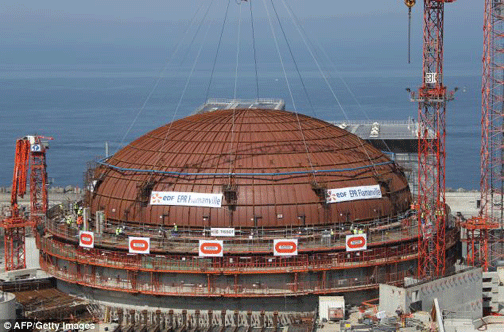
https://climatenewsnetwork.net/flagship-reactor-launch-postponed-again/
Russia, in fear of a USA first strike may now revive its “dead hand” nuclear weapon
 ‘s Nuclear “Dead Hand”
Russia won’t succumb to pressure near its territory. National Interest, by Michael Peck 30 Dec 19,
Key point: Russia is acting out of fear that a U.S. first-strike that would decapitate the Russian leadership before it could give the order to retaliate.
But the system, known as “Perimeter” or “Dead Hand,” may be back and deadlier than ever.
This comes after the Trump administration announced that the United States is withdrawing from the 1987 Intermediate-Range Nuclear Forces Treaty, which eliminated the once-massive American and Russian stockpiles of short- and medium-range missiles.
Donald Trump alleges that Russia has violated the treaty by developing and deploying new, prohibited cruise missiles.This has left Moscow furious and fearful that America will once again, as it did during the Cold War, deploy nuclear missiles in Europe. Because of geographic fate, Russia needs ICBMs launched from Russian soil, or launched from submarines, to strike the continental United States. But shorter-range U.S. missiles based in, say, Germany or Poland could reach the Russian heartland.
Viktor Yesin, who commanded Russia’s Strategic Rocket Forces in the 1990s, spoke of Perimeter/Dead Hand during an interview last month in the Russian newspaper Zvezda [Google English translation here]. Yesin said that if the United States starts deploying intermediate-range missiles in Europe, Russia will consider adopting a doctrine of a preemptive nuclear strike. But he also added this:
Yesin: “The Perimeter system is functioning, it has even been improved. But when it works, we will have little left – we can only launch those missiles that will survive after the first attack of the aggressor.” …….
What is unmistakable is that Perimeter is a fear-based solution. Fear of a U.S. first-strike that would decapitate the Russian leadership before it could give the order to retaliate. Fear that a Russian leader might lose his nerve and not give the order.
And if Russia is now discussing Perimeter publicly, that’s reason for the rest of us to worry.https://nationalinterest.org/blog/buzz/america-driving-return-russias-nuclear-dead-hand-109206
January 1 Energy News — geoharvey

Opinion: ¶ “Australia’s Angry Summer: This Is What Climate Change Looks Like” • Summer used to be something we yearned for: long, lazy days spent by the beach or pool, backyard barbecues, and games of cricket with family and friends. But summer has become a time of fear, with heatwaves, fires, and evacuations. Australia has […]
Australia’s bushfires and their danger to nuclear waste transport
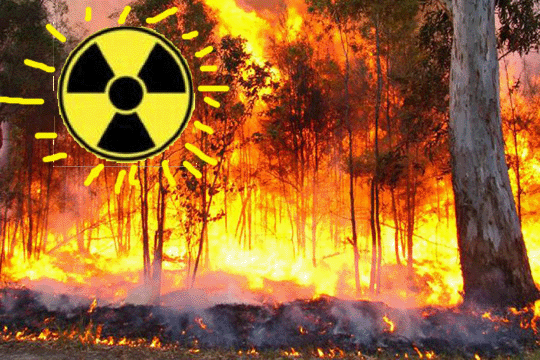
In all the propaganda for a nuclear waste dump in Kimba, South Australia,  there was no mention of bushfire risks. An extraordinary omission, don’t you think?
 The whole bizarre plan to trek the Lucas Heights nuclear reactor wastes some 1700km by land, or even longer by sea, would entail trucking highly radioactive (they call it intermediate) wastes through forest areas, towns, ports, to what used to be an agricultural area.
The nuclear industry touts itself as the cure for climate change. In reality,it is the other way around. For Australia especially, climate change, bushfires, water shortages – make every aspect of the nuclear industry ever more dangerous.
The Lucas Heights nuclear reactor itself is uncomfortably close to the bushfires. But nobody’s talking about that. That reactor shoud be shutdown, and no more wastes produced.
War planners ignore the fire effects of nuclear bombing

City on fire, Nuclear Darkness, by Lynne Eden, 30 Dec 19, By ignoring the fire damage that would result from a nuclear attack and taking into account blast damage alone, U.S. war planners were able to demand a far larger nuclear arsenal than necessary.
For more than 50 years, the U.S. Government has seriously underestimated damage from nuclear attacks. The earliest schemes to predict damage from atomic bombs, devised in 1947 and 1948, focused only on blast damage and ignored damage from fire, which can be far more devastating than blast effects.
The failure to include damage from fire in nuclear war plans continues today. Because fire damage has been ignored for the past half-century, high-level U.S. decision makers have been poorly informed, if informed at all, about the extent of damage that nuclear weapons would actually cause. As a result, any U.S. decision to use nuclear weapons almost certainly would be predicated on insufficient and misleading information. If nuclear weapons were used, the physical, social, and political effects could be far more destructive than anticipated.
How can this systematic failure to assess fire damage have persisted for more than half a century? The most common response is that fire damage from nuclear weapons is inherently less predictable than blast damage. This is untrue. Nuclear fire damage is just as predictable as blast damage.
One bomb, one city
To visualize the destructiveness of a nuclear bomb, imagine a powerful strategic nuclear weapon detonated above the Pentagon, a short distance from the center of Washington, D.C.1 Imagine it is a “near-surface” burst-about 1,500 feet above the ground-which is how a military planner might choose to wreak blast damage on a massive structure like the Pentagon. Let us say that it is an ordinary, clear day with visibility at 10 miles, and that the weapon’s explosive power is 300 kilotons-the approximate yield of most modern strategic nuclear weapons. This would be far more destructive than the 15-kilotonbomb detonated at Hiroshima or the 21-kiloton bomb detonated at Nagasaki.2
Washington, D.C., has long been a favorite hypothetical target.3 But a single bomb detonated over a capital city is probably not a realistic planning assumption.
When a former commander in chief of the U.S. Strategic Command read my scenario, he wanted to know why I put only one bomb on Washington. “We must have targeted Moscow with 400 weapons,” he said. He explained the military logic of planning a nuclear attack on Washington: “You’d put one on the White House, one on the Capitol, several on the Pentagon, several on National Airport, one on the CIA, I can think of 50 to a hundred targets right off. . . . I would be comfortable saying that there would be several dozens of weapons aimed at D.C.” Moreover, he said that even today, with fewer weapons, what makes sense would be a decapitating strike against those who command military forces. Today, he said, Washington is in no less danger than during the Cold War.
The discussion that follows greatly understates the damage that would occur in a concerted nuclear attack, and not only because I describe the effects of a single weapon. I describe what would happen to humans in the area, but I do not concentrate on injury, the tragedy of lives lost, or the unspeakable loss to the nation of its capital city. These are important. But I am concerned with how organizations estimate and underestimate nuclear weapons damage; thus, I focus largely, as do they, on the physical environment and on physical damage to structures.
With this in mind, let us look at some of the consequences of a nuclear weapon detonation, from the first fraction of a second to the utter destruction from blast and fire that would happen within several hours. This will allow us to understand the magnitude of the damage from both effects, but particularly from fire, which is neither widely understood nor accounted for in damage prediction in U.S. nuclear war plans.
Unimaginable lethality
The detonation of a 300-kiloton nuclear bomb would release an extraordinary amount of energy in an instant-about 300 trillion calories within about a millionth of a second. More than 95 percent of the energy initially released would be in the form of intense light. This light would be absorbed by the air around the weapon, superheating the air to very high temperatures and creating a ball of intense heat-a fireball.
Because this fireball would be so hot, it would expand rapidly. Almost all of the air that originally occupied the volume within and around the fireball would be compressed into a thin shell of superheated, glowing, high-pressure gas. This shell of gas would compress the surrounding air, forming a steeply fronted, luminous shockwave of enormous extent and power-the blast wave.
By the time the fireball approached its maximum size, it would be more than a mile in diameter. It would very briefly produce temperatures at its center of more than 200 million degrees Fahrenheit (about 100 million degrees Celsius)-about four to five times the temperature at the center of the sun.
This enormous release of light and heat would create an environment of almost unimaginable lethality. Vast amounts of thermal energy would ignite extensive fires over urban and suburban areas. In addition, the blast wave and high-speed winds would crush many structures and tear them apart. The blast wave would also boost the incidence and rate of fire-spread by exposing ignitable surfaces, releasing flammable materials, and dispersing burning materials.
Within minutes of a detonation, fire would be everywhere. Numerous fires and firebrands-burning materials that set more fires-would coalesce into a mass fire. (Scientists prefer this term to “firestorm,” but I will use them interchangeably here.) This fire would engulf tens of square miles and begin to heat enormous volumes of air that would rise, while cool air from the fire’s periphery would be pulled in. Within tens of minutes after the detonation, the pumping action from rising hot air would generate superheated ground winds of hurricane force, further intensifying the fire.4
Virtually no one in an area of about 40-65 square miles would survive.
A little farther away…….
Within minutes of a detonation, fire would be everywhere. Numerous fires and firebrands-burning materials that set more fires-would coalesce into a mass fire. (Scientists prefer this term to “firestorm,” but I will use them interchangeably here.) This fire would engulf tens of square miles and begin to heat enormous volumes of air that would rise, while cool air from the fire’s periphery would be pulled in. Within tens of minutes after the detonation, the pumping action from rising hot air would generate superheated ground winds of hurricane force, further intensifying the fire.4
Virtually no one in an area of about 40-65 square miles would survive.
A little farther away……
Three miles from ground zero……..
A hurricane of fire…..
|
….The first indicator of a mass fire would be strangely shifting ground winds of growing intensity near ground zero. (Such winds are entirely different from and unrelated to the earlier blast-wave winds that exert “drag pressure” on structures.) These fire-winds are a physical consequence of the rise of heated air over large areas of ground surface, much like a gigantic bonfire.
The inrushing winds would drive the flames from combusting buildings horizontally toward the ground, filling city streets with hot flames and firebrands, breaking in doors and windows, and causing the fire to jump hundreds of feet to swallow anything that was not yet violently combusting. These extraordinary winds would transform the targeted area into a huge hurricane of fire. Within tens of minutes, everything within approximately 3.5 to 4.6 miles of the Pentagon would be engulfed in a mass fire. The fire would extinguish all life and destroy almost everything else. Firestorm physicsThis description of the physics of mass fire is based on the work of a few scientists who have examined in detail the damaging effects of nuclear weapons, including nuclear engineer Theodore A. Postol and physicist Harold Brode. Postol is one of the country’s leading non-government funded technical experts on nuclear weapons, missiles, and arms control. Brode’s five-decade career has been devoted to the study of nuclear weapons effects. That mass fires have occurred, and that something like the firestorm described here could occur, is not in dispute. What is not widely accepted is that nuclear weapons detonated in urban or suburban areas would be virtually certain to set mass fires, and that the resulting damage is as predictable as blast damage. The much more widely held view is that the probability and range of mass fire depends on many unpredictable environmental variables, including rain, snow, humidity, temperature, time of year, visibility, and wind conditions. But the work of Postol, Brode, and Brode’s collaborators shows that mass fire creates its own environment. Except in extreme cases, environmental factors do not affect the likelihood of mass fire. Weather can affect the fire’s range, but this can be reasonably well predicted. For nuclear weapons of approximately 100 kilotons or more, the range of destruction from mass fire will generally be substantially greater than from blast. The extraordinarily high air temperatures and wind speeds characteristic of a mass fire are the inevitable physical consequence of many simultaneous ignitions occurring over a vast area. The vacuum created by buoyantly rising air follows from the basic physics of combustion and fluid flow (hydro- or fluid dynamics). As the area of the fire increases, so does the volume of rising air over the fire zone, causing even more air to be sucked in from the periphery of the fire at increasingly higher speeds. Only a few mass fires have occurred in human history: those created by British and U.S. conventional incendiary weapons and by U.S. atomic bombs in World War II. These include fires that destroyed Hamburg, Dresden, Kassel, Darmstadt, and Stuttgart in Germany, and Tokyo, Hiroshima, and Nagasaki in Japan. History’s first mass fire began on the night of July 27, 1943, in Hamburg-created by allied incendiary raids. Within 20 minutes, two thirds of the buildings within an area of 4.5 square miles were on fire. It took fewer than six hours for the fire to completely burn an area of more than five square miles. Damage analysts called it the “Dead City.” Wind speeds were of hurricane force; air temperatures were 400-500 degrees Fahrenheit. Between 60,000 and 100,000 people were killed in the attack.6 A mass fire from a modern nuclear bomb could be expected to destroy a considerably larger urban or suburban area, in a similarly short time. The unique features of the mass fire fundamentally distinguish it from the more slowly propagating line fire. …….. Fire environments created by mass fires are fundamentally more violent and destructive than smaller-scale fires, and they are far less affected by external weather conditions. They are not substantially altered by seasonal and daily weather conditions. ….. Average air temperatures in the burning areas after the attack would be well above the boiling point of water; winds generated by the fire would be hurricane force; and the fire would burn everywhere at this intensity for three to six hours. Even after the fire burned out, street pavement would be so hot that even tracked vehicles could not pass over it for days, and buried, unburned material from collapsed buildings could burst into flames if exposed to air even weeks after the fire. Those who sought shelter in basements of strongly constructed buildings could be poisoned by carbon monoxide seeping in, or killed by the ovenlike conditions. Those who tried to escape through the streets would be incinerated by the hurricane-force winds laden with firebrands and flames. Even those able to find shelter in the lower-level sub-basements of massive buildings would likely die of eventual heat prostration, poisoning from fire-generated gases, or lack of water. The firestorm would eliminate all life in the fire zone. All publication data from “Whole World on Fire” by Lynn Eden at Google Books http://www.nucleardarkness.org/web/cityonfire/ |
|
Dangerous climate is now upon Australia- Michael Mann
 Australia, your country is burning – dangerous climate change is here with you now , Guardian, Michael Mann 1 Jan 2020, I am a climate scientist on holiday in the Blue Mountains, watching climate change in action,
After years studying the climate, my work has brought me to Sydney where I’m studying the linkages between climate change and extreme weather events.
Prior to beginning my sabbatical stay in Sydney, I took the opportunity this holiday season to vacation in Australia with my family. We went to see the Great Barrier Reef – one of the great wonders of this planet – while we still can. Subject to the twin assaults of warming-caused bleaching and ocean acidification, it will be gone in a matter of decades in the absence of a dramatic reduction in global carbon emissions.
We also travelled to the Blue Mountains, another of Australia’s natural wonders, known for its lush temperate rainforests, majestic cliffs and rock formations and panoramic vistas that challenge any the world has to offer. It too is now threatened by climate change.
I witnessed this firsthand.
I did not see vast expanses of rainforest framed by distant blue-tinged mountain ranges. Instead I looked out into smoke-filled valleys, with only the faintest ghosts of distant ridges and peaks in the background. The iconic blue tint (which derives from a haze formed from “terpenes” emitted by the Eucalyptus trees that are so plentiful here) was replaced by a brown haze. The blue sky, too, had been replaced by that brown haze. ……
The brown skies I observed in the Blue Mountains this week are a product of human-caused climate change. Take record heat, combine it with unprecedented drought in already dry regions and you get unprecedented bushfires like the ones engulfing the Blue Mountains and spreading across the continent. It’s not complicated.
The warming of our planet – and the changes in climate associated with it – are due to the fossil fuels we’re burning: oil, whether at midnight or any other hour of the day, natural gas, and the biggest culprit of all, coal. That’s not complicated either.
When we mine for coal, like the controversial planned Adani coalmine, which would more than double Australia’s coal-based carbon emissions, we are literally mining away at our blue skies. The Adani coalmine could rightly be renamed the Blue Sky mine.
In Australia, beds are burning. So are entire towns, irreplaceable forests and endangered and precious animal species such as the koala (arguably the world’s only living plush toy) are perishing in massive numbers due to the unprecedented bushfires.
The continent of Australia is figuratively – and in some sense literally – on fire.
Yet the prime minister, Scott Morrison, appears remarkably indifferent to the climate emergency Australia is suffering through, having chosen to vacation in Hawaii as Australians are left to contend with unprecedented heat and bushfires.
Morrison has shown himself to be beholden to coal interests and his administration is considered to have conspired with a small number of petrostates to sabotage the recent UN climate conference in Madrid (“COP25”), seen as a last ditch effort to keep planetary warming below a level (1.5C) considered by many to constitute “dangerous” planetary warming.
But Australians need only wake up in the morning, turn on the television, read the newspaper or look out the window to see what is increasingly obvious to many – for Australia, dangerous climate change is already here. It’s simply a matter of how much worse we’re willing to allow it to get.
Australia is experiencing a climate emergency. It is literally burning. It needs leadership that is able to recognise that and act. And it needs voters to hold politicians accountable at the ballot box.
Australians must vote out fossil-fuelled politicians who have chosen to be part of the problem and vote in climate champions who are willing to solve it.
- Michael E Mann is distinguished professor of atmospheric science at Pennsylvania State University. His most recent book, with Tom Toles, is The Madhouse Effect: How Climate Change Denial Is Threatening Our Planet, Destroying Our Politics, and Driving Us Crazy (Columbia University Press, 2016).https://www.theguardian.com/commentisfree/2020/jan/02/australia-your-country-is-burning-dangerous-climate-change-is-here-with-you-now
UK: legal action against environmental destruction by Sizewell nuclear project
Crowd Justice (accessed) 30th Dec 2019, Together Against Sizewell C (TASC) is an unincorporated citizens’ group
formed to oppose the building of Sizewell C’s twin nuclear reactors and
associated works in Suffolk Coast & Heaths Area of Outstanding Natural
Beauty (AONB) in a legal open, peaceful and fully accountable manner.
TASC has mounted a legal challenge against East Suffolk Council’s decision to
approve the planning application submitted by EDF, the nuclear developer,
to: – chop down 100-year-old Coronation Wood, turn a large area of priority
habitat acidic grassland, known as Pillbox Field, into a 576 space car
park, relocate over 320,000 sq. feet of 7 largely non-essential and
non-operational Sizewell B buildings and an additional 128 car parking
spaces, that will encroach further into the AONB. Most of these
buildings/facilities could be located outside the AONB. The works are
needed to free up land for the construction of Sizewell C as the existing
site is too small and are clearly integral to the wider Sizewell C
development.
https://www.crowdjustice.com/case/save-coronation-wood/
BBC 30th Dec 2019, Campaigners opposing a new nuclear power station are seeking a judicial review over a “premature” decision to allow woodland to be felled. EDF Energy wants to build two reactors next to Sizewell B in Suffolk and in September was told it could chop down Coronation Wood on the site. TogetherAgainst Sizewell C (Tasc) said the area was vital for wildlife. East
Suffolk Council said it would respond to the campaigners’ challenge in due
course.
Germany To Close All Nuclear Plants By 2022
In the wake of the Fukushima disaster in Japan in 2011, Germany ordered the immediate shutdown of eight of its 17 reactors, and plans to phase out nuclear power plants entirely by 2022.
The Philippsburg 2 reactor near the city of Karlsruhe in southwestern Germany has provided energy for 35 years. The Philippsburg 1 reactor—opened in 1979—was taken offline in 2011.
Over the past few years, nuclear power generation in Germany has been declining with the shutdown of its nuclear plants, while electricity production from renewable sources has been rising.
A government-appointed special commission at Europe’s largest economy announced the conclusions of its months-long review and proposed that Germany shut all its 84 coal-fired power plants by 2038.
Germany, where coal, hard coal, and lignite combined currently provide around 35 percent of power generation, has a longer timetable for phasing out coal than the UK and Italy, for example—who plan their coal exit by 2025—not only because of its vast coal industry, but also because Germany will shut down all its nuclear power plants within the next three years.
The closure of all nuclear reactors in Germany by 2022 means that Germany might need to retain half of its coal-fired power generation until 2030 to offset the nuclear phase-out, German Economy and Energy Minister Peter Altmaier said earlier this year.
Ohio’s nuclear legal battles: Supreme Court will hear case filed by Ohioans Against Corporate Bailouts (OACB).

 Kallanish Energy 30th Dec 2019, Legal battles over the Ohio energy law that starts providing subsidies to the state’s two nuclear power plants in 2021, may continue, Kallanish Energy learns.
The Ohio Supreme Court voted 4-0 to hear the case filed by Ohioans Against Corporate Bailouts (OACB). Three justices recused
themselves from the case, citing political campaign conflicts, Energy
Central News reported. OACB maintains it was denied a full 90 days to
gather signatures for a referendum. They want to overturn the law that
subsidizes Ohio’s two nuclear power plants owned by FirstEnergy Solutions
and two coal-fired plants owned by Ohio Valley Electric Corp. The law also
shrinks and eventually eliminates requirements that utilities get a
percentage of their power from renewable energy sources and scraps
utilities’ state-mandated energy efficiency programs.
https://www.kallanishenergy.com/2019/12/30/ohio-supreme-court-will-hear-nuclear-bailout-case/
Russia extends license for remote nuclear power plant
One of the reactors at Bilibino NPP has got permission for another five years despite the nearby new floating nuclear power plant now is in operation. By Thomas Nilsen– December 29, 2019
Just one week after “Akademik Lomonosov” started to produce electricity to the grid in Pevek, one of the three remaining reactors at Bilibino nuclear power plant (NPP) got a renewed five-years permission until December 31st, 2025.
Bilibino NPP is located in the far remote Bilibinsky District in the Chukotka Autonomous Okrug, Russia’s northeastern corner. The power plant provides electricity to the same Pevek-Chaun-Bilibino grid currently under construction as the new floating nuclear power plant.
One of the four reactors at Bilibino is already shut-down, while the other three were to follow as soon as the grid and the “Akademik Lomonosov” came in place. That would likely not happen before earliest by the end of 2021.
The license was issued by Rosteknadzor, Russia’s Federal Agency for Ecological, Technological and Nuclear Supervision and is valid for reactor No. 2.
It is operator of the plant, state nuclear corporation Rosatom, that informs about the renewed license.
Bilibino nuclear power plant started operation in 1974 with reactors supposed to run for a 30-years period. In 2004, the plant’s operational lifetime was prolonged with 15 years, and now, another five years is added to one of the reactors.
Bilibino NPP, which is located some 240 kilometers from Pevek, would need a prolonged license even if shut down by 2022, since the spent nuclear fuel most likely will stay in the reactors for a much longer period before decommissioning work can start.
Russian nuclear news-site Seogan reports that work is underway aimed at prolonging the lifetime of reactor No. 3 and No. 4 as well.
The reactors are of the EGP-6 type, a scaled down version of the Chernobyl-type RBMK light-water cooled graphite reactors. The plant is both the world’s smallest and most remote located onshore nuclear power plant.
In August this year, Rostechnadzor made a scheduled audit at the plant and discovered 19 violations of norms and rules for operating a nuclear power plant. 3 of the violations were fixed on spot, while the 16 others resulted in administrative protocols and sanctions, the agency reports on its own portal.
Kim Jong Un May Be Leaving The Door Open To Nuclear Talks
Why North Korea’s Kim Jong Un May Be Leaving The Door Open To Nuclear Talks, January 1, 2020, ANTHONY KUHN
Some analysts believe a key reason behind his calculations may be President Trump’s prospects for surviving an impeachment process and possibly winning a second term in the White House.
“Donald Trump happens to be the first sitting U.S. president to view North Korea as a source of political victory, for domestic purposes,” says Go Myong-hyun, a research fellow and expert on North Korea at the Asan Institute for Policy Studies, a Seoul-based think tank.
Pyongyang has said it has no intention of handing President Trump any victories on denuclearization, but officials see Trump’s eagerness to tout achievements to his domestic audience as a source of leverage.
In remarks carried by state media, Kim on Tuesday had plenty of tough words for the U.S. as he addressed a plenum of the ruling Workers Party Central Committee. He acknowledged the countries’ current stalemate on nuclear talks, but insisted he would not passively wait for things to improve……
Prolonged stalemate likely
For now, analysts see a prolonged stalemate over North Korea’s nukes as all but inevitable……North Korea’s only remaining tool is nuclear brinksmanship — essentially bluffing opponents into thinking Pyongyang might actually use atomic weapons, even though it is plainly evident that the cost of doing so is prohibitive for both sides.
Fuhrmann’s theory has implications for policy: a nuclear-armed North Korea is not the apocalyptic event some fear, “even if we might prefer a situation where they were not to have nuclear weapons.”
He advises that a complete and verifiable nuclear disarmament is “somewhat unrealistic.” Better, he says, for the U.S. to “look for a deal that allows us to place meaningful limits on North Korean capabilities.” https://www.npr.org/2020/01/01/792843551/north-korea-drops-testing-moratorium-but-leaves-door-open-to-u-s-nuclear-talks

Germany’s nuclear phase-out enters final stretch
The 2011 Fukushima nuclear disaster in Japan led to widespread anti-atomic-power protests across Germany. Two months after the accident, Chancellor Angela Merkel announced that all plants would be closed over the next decade, making Germany the second country after Italy to shut down all of its atomic energy stations.
The German Federation for the Environment and Nature Conservation (BUND) welcomed the news. A BUND spokesman said the group hoped to see the end of nuclear power being “conjured up again and again as a supposed healing charm and climate savior.”
However, Wolfram König, who heads the German government’s office for the nuclear phase-out, warned that the country still faced the great “challenge” of trying to phase out both coal and atomic energy at the same time.https://www.dw.com/en/germany-shuts-down-atomic-plant-as-nuclear-phase-out-enters-final-stretch/a-51845616
Britain’s nuclear weapons convoys a disaster waiting to happen

DOZENS of safety failures during nuclear weapons convoys are a “disaster waiting to happen,” campaigners charged as they demanded the Ministry of Defence (MoD) answer for the risks it is exposing the public to.
The Campaign for Nuclear Disarmament (CND) and political campaigners have hit out at the MoD after concerning reports show 40 lapses in safety while nuclear and radioactive materials were being transported across the country over the past five years.
A Freedom of Information request has revealed the 40 operational and engineering issues on convoys carrying bombs and hazardous materials.
These incidents included issues identified with brakes on convoy vehicles, included burning smells during transportation.
On other occasions convoy vehicles were forced to stop, and road lanes closed, after suffering flat tyres.
Among other engineering faults listed were warnings of overheating in convoy vehicles.
Multiple “operational” issues also disrupted transportation of dangerous materials.
Reported in these were rolling road blocks needed to manoeuvre the convoy through busy, congested routes across the UK, causing delays in the journey.
CND general secretary Kate Hudson said: “Nuclear bombs carried on our roads are a disaster waiting to happen.
“This report shows that ‘poor maintenance’ is a factor in these safety lapses.
“The MoD must be brought to book for this disgraceful failure — and our new government must end this cargo of death through our communities.”
Britain’s nuclear weapons are still based in Scotland and those north of the border have said it is time to rid ourselves of the apocalyptic threats.
Scottish Green MSP Mark Ruskell led a debate on the topic last year.
He said: “Like many I’d like to see an end to the housing of nuclear weapons in Scotland, but while they are still here it’s not unreasonable to expect the highest standards of safety to apply to their movement.
“People will be shocked at the thought of nuclear convoys travelling on public roads.
“In Stirling the convoys even park up overnight behind a chain-link fence across the road from a Nando’s and a Vue Cinema. This is an absurd situation that must come to an end.”…… https://morningstaronline.co.uk/article/b/britain-nuclear-weapons-convoys-are-a-disaster-waiting-to-happen-peace-campaigners-warn
1 This Month

of the week – Shut Down Drone Warfare!


Tell the Ukrainian Government to Drop Prosecution of Peace Activist Yurii Sheliazhenko

Petition to revoke the licensing of the Near Surface Nuclear Disposal Facility (NSDF) at Chalk River. https://www.ourcommons.ca/petitions/en/Petition/Details?Petition=e-7247
To see nuclear-related stories in greater depth and intensity – go to https://nuclearinformation.wordpress.com
-
Archives
- April 2026 (114)
- March 2026 (251)
- February 2026 (268)
- January 2026 (308)
- December 2025 (358)
- November 2025 (359)
- October 2025 (376)
- September 2025 (257)
- August 2025 (319)
- July 2025 (230)
- June 2025 (348)
- May 2025 (261)
-
Categories
- 1
- 1 NUCLEAR ISSUES
- business and costs
- climate change
- culture and arts
- ENERGY
- environment
- health
- history
- indigenous issues
- Legal
- marketing of nuclear
- media
- opposition to nuclear
- PERSONAL STORIES
- politics
- politics international
- Religion and ethics
- safety
- secrets,lies and civil liberties
- spinbuster
- technology
- Uranium
- wastes
- weapons and war
- Women
- 2 WORLD
- ACTION
- AFRICA
- Atrocities
- AUSTRALIA
- Christina's notes
- Christina's themes
- culture and arts
- Events
- Fuk 2022
- Fuk 2023
- Fukushima 2017
- Fukushima 2018
- fukushima 2019
- Fukushima 2020
- Fukushima 2021
- general
- global warming
- Humour (God we need it)
- Nuclear
- RARE EARTHS
- Reference
- resources – print
- Resources -audiovicual
- Weekly Newsletter
- World
- World Nuclear
- YouTube
-
RSS
Entries RSS
Comments RSS
 nuclear-news