Australian Parliamentary Report uses dodgy and incorrect nuclear information
House Of Reps Report Supports Nuclear – But Only If Everyone Is Into It https://www.solarquotes.com.au/blog/nuclear-energy-australia/ December 19, 2019 by Ronald Brakels Last Friday the House Of Representatives released a report on nuclear energy in Australia. They said it’s a good idea — provided everyone is cool with it.Australia. They said it’s a good idea — provided everyone is cool with it.
The report is called:
“Not without your approval: a way forward for nuclear technology in Australia”
It gives the country three recommendations :
- Consider using nuclear power.
- Gather information to support the future use of nuclear power.
- End or partially lift the moratorium that prohibits building nuclear reactors.
- \While nuclear is a low-emissions source of energy, .I don’t agree with these recommendations because:
- There is no point considering nuclear power here until one of the countries that have been using it for decades gets it right and starts building reactors that supply energy at a lower cost than renewables.
- There is no point paying people to study nuclear energy until other countries with existing nuclear industries show it can make economic sense. If it never manages to pay for itself, the research will be a waste. If it does pay for itself then the cost effective reactors may be very different from existing ones and the effort will, again, have been wasted.
- We live in a country where the government is always going to require you to get permission before you can build a nuclear reactor, so saying the magic words, “The moratorium is lifted!” makes no practical difference. But I figure we may as well say the magic words just to make it clear the reason we don’t have nuclear power isn’t because they haven’t been uttered.
The problem with this report is not that the House of Representatives committee and I have a difference of opinion. The problem is, only someone who has been whacked on the head with a graphite rod could look at the problems new nuclear power is experiencing around the world today and recommend Australia go ahead with it.
The problems have nothing to do with safety, nuclear waste, or security. These issues are irrelevant because nuclear power can not pay for itself. If it can’t do that, there is no point in worrying about the other issues and it is painfully clear new nuclear power makes no economic sense when renewables are now cheaper than coal power and continuing to fall in cost.
In the United Kingdom — the nuclear power possessing nation that is, embarrassingly, most similar to our own — they will pay 22 cents per kilowatt-hour for electrical energy from the under-construction Hinkley C reactors. That’s three times its average cost in the Australian National Electricity Market this year and fives times its average price in 2015.
While Australia’s wholesale electricity prices are unusually high at the moment, they are not going to get three miles high on this island. Thanks to the decreasing cost of renewable energy they are expected to trend downwards from their current high of one-third the cost of new nuclear energy in the UK.
Britain’s not the only place where new nuclear power is extremely expensive. A similar price is required for it to be constructed in the US. There have also been huge cost overruns building reactors in other countries, which include France and Finn’s land. Because Australia doesn’t have an existing nuclear power industry it could be even more expensive here and, last time I checked, we didn’t have any magic pixie dust we could sprinkle on nuclear energy projects to make them cheaper or on our politicians to make them smarter.
To me, it seems this report is an expensive face-saving measure by Parliamentary supporters of nuclear power. It makes no sense for this country given the current and decreasing cost of renewable energy, but they’re not willing to admit that. They instead want to pretend nuclear power is a great idea for us but the reason it’s not going ahead is because it’s unpopular. Hence the title, “Not without your approval”. In other words, they are saying the Australian people aren’t smart enough to know a good thing when they see it and that’s the only reason why we’re not building nuclear reactors.
Well, I say screw you House of Representatives Standing Committee on Energy and the Environment and the plutonium powered pony you rode in on. I felt that looking into nuclear power once again was a waste of time, but if you had investigated it and said
“Nuclear power is far too expensive to make sense for Australia. If this changes and new reactors overseas produce electricity at a lower cost than renewables we can look into it again, but until that happens, forget about it.”
Then at least we’d know the system works. We would be able to see that Parliamentary committees are able to look at the bleeding obvious and interpret it correctly. But instead, they only looked at information they liked while avoiding asking the obvious question of — are modern reactors making enough money to cover the cost of their construction and operation? Rather than do this, they took bits and pieces they picked from around the obvious question, turned them this way and that, and squinted until they were able to announce that it looked good — but the punters wouldn’t appreciate it and they’re the reason why we can’t have nice things.
They did this rather than admit what has been obvious for years now, that new nuclear will not pay for itself in Australia and, given the decreasing cost of renewable energy, it looks impossible for current nuclear designs to ever pay for themselves here.
By choosing to protect their egos rather than admit they were wrong, the nuclear energy supporters have sullied Parliament’s good… well, they’ve sullied Parliament’s name. I don’t expect anything run by humans to be perfect, but I really think we need a turn around in the ratio of sullying to pride inducing Parliamentary moments.
It’s A Long Report
The report is 214 pages. It could have been a lot shorter. I could have gotten it down to something like:
“Given that:
- The UK will be pay around 22 cents per kilowatt-hour in today’s money for electricity from the Hinkley C nuclear power plant, and…
- In the United States new nuclear capacity requires a similar price to proceed and nuclear plants have been abandoned while under construction because it became clear they would never pay for themselves.
- Australia has no advantages in building nuclear power stations while having the disadvantage of no existing nuclear power industry.
It is therefore not reasonable to believe we can build nuclear generating capacity for less than what it costs in the UK or USA. Until reactors are built overseas that produce electricity at a cost that is competitive in Australia, the subject does not merit further consideration.
Additionally, given that:
- New reactors under construction in France and Finland have had long delays and are far over budget, indicating the high cost of new nuclear capacity is not confined to English speaking countries, and…
- No organization is offering to or wants to build a nuclear power station in Australia at a price we would find anywhere close to acceptable.The idea of nuclear power in Australia should be abandoned and only reviewed if there are major improvements in its economic viability.”That’s under 214 words while having the advantage of being correct. The House of Representatives committee used 214 pages to come to the wrong conclusion. But arriving at the right conclusion can’t be easy if you have no ability to smell bullshit in your own research.
-
One Solar Panel Does Not Cause 0.8 Tonnes Of CO2 Emissions
Take a look at this table included in the report, taken from a publication that advocates nuclear power:


Casually looking at that you might think CO2 emissions for both nuclear energy and solar PV are pretty low. But if we stop for one minute and use basic mathematical ability that’s available to anyone who doesn’t have to take their socks off to count to 20, then we can see that a Parliamentary committee saw fit to include a table in an official report that gives ridiculous results.
Looking at their minimum figure for Solar PV (Utility scale), I see they are claiming a large solar farm will result in at least 18 grams of CO2 emissions per kilowatt-hour generated. While generating electricity from PV doesn’t result in any emissions, they are involved in the manufacture of solar panels, so they aren’t completely emissions-free. However, they are a lot bloody closer to emission free than this table suggests.
These days a typical standard sized solar panel is around 300 watts. In a solar farm in Australia on a fixed mount it will generate around 12,300 kilowatt-hours over 25 years. This means they are saying the solar panel will result in a minimum of 222 kilograms of CO2 emissions. If we use their maximum figure it will result in 2.22 tonnes of CO2, all for a panel that weighs about 18 kilograms. So they are saying manufacturing and installing one solar panel results in emissions equal to burning 80-800 or more kilograms of coal.
Jinko Solar, the world’s largest solar panel manufacturer, has a figure from 2017 of just 2.19 grams of CO2 per kilowatt-hour generated by a solar farm. As this has been decreasing year by year it will be even lower now. However, this is just for the solar panel and doesn’t include emissions from the construction of its ground mount or inverter, so I’ll double it to 4.4 grams. This means the actual emissions per kilowatt-hour are probably less than the best figure on the table and more than 40 times less than the worst figure. Even if we triple the Jinko figure it still comes to less than their median emissions for nuclear energy and less than 4% of their maximum figure for PV.
It’s clear the committee had no ability to detect figures that were bullshit — or they simply didn’t care.
Renewable Energy Increases The Cost Of Nuclear
Here is section 1.50 of the report:
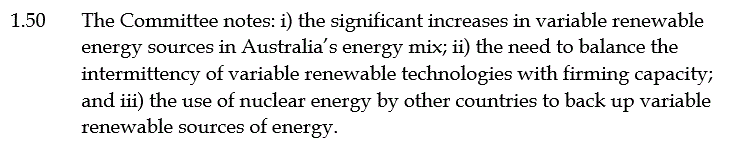
I note the committee has failed to understand the economics of nuclear power if they think it works well with solar and wind energy. This is because if a nuclear power station produces half the energy its capable of, it almost doubles the cost of that energy. This is due to nuclear fuel being very cheap1 per kilowatt-hour, so very little money is saved by ramping down, while nearly all other costs remain the same.
This means nuclear power, which is already too expensive when operated in the most economical way — almost continuously at full normal power — becomes even more expensive when used in a grid with a significant amount of solar energy and/or wind power capacity. Australia already has more than enough to adversely affect the economics of nuclear energy and, even if we approve and build a nuclear power station in one quarter the average time it has taken overseas this century, things will be much worse for its economics by the time it’s complete.
They Don’t Even Know Who Buys Our Coal
The report suggests South Korea could build nuclear power plants for us at low cost. It’s a very strange conclusion because South Korea is the third largest importer of Australian coal. You’d think if they could build nuclear reactors cheaply they wouldn’t get nearly three times as much energy from flammable rocks:
If you try breathing the air in South Korea you’ll soon wish they could build nuclear reactors at a lower cost than coal power, but unfortunately they can’t, and — as I’ve probably mentioned in other articles — Australia can build renewable generating capacity that supplies electricity at a lower cost than new coal power. This includes the cost of firming the renewable energy so supply is always available.
It is amazing we have a Parliament dominated by a party obsessed with coal, but this committee can’t even get their head around the fact that the country that imports more of our coal per capita than any other nation isn’t likely to be in possession of the secret of cheaper than coal nuclear power.
Smaller Is Not Cheaper
Small Modular Reactors (SMRs) are suggested in the report as a way of making nuclear power economically viable. The problem with this is they cost more per kilowatt than large ones. This fact should not be a surprise to anyone. The engineers who designed the large nuclear reactors in the world today are not idiots who are currently slapping their foreheads, saying, “I’m so stupid! If only I had thought of making them smaller instead of bigger!” Modern reactors are very large to keep their cost per kilowatt down. Going small has the opposite effect.
That small reactors are not cheap is made obvious by the fact Britain, which has the longest history of nuclear power generation of any country, decided to power their new aircraft carriers with kerosene and diesel rather than small nuclear reactors because of they are so expensive. This is despite the alternative being expensive oil products rather than much cheaper solar and wind energy.
An advantage given for SMRs is they will supposedly suffer from fewer cost overruns. But that sales pitch is not enough to make nuclear energy economically attractive — pay for a more expensive product so you’ll have less of a chance of unpleasant surprise expenses down the line.2
They Want Money Wasted On More Reports
The report suggests we get people to write another report on how much nuclear power will cost here:

But I have a different suggestion. A much cheaper one. We just wait for another country to build and operate a nuclear power plant at a low enough cost that would be competitive in Australia. Then we can look into it.
Better yet, to make sure they aren’t exaggerating how cheap their nuclear power is, we say:
“Hey, budget nuclear energy guys, how would you like to build a nuclear power station in Australia? We give you nothing, but you get the market price for whatever electricity you sell.”
If they say, “nyet” or “bu shi” or “piss off” then we can suspect it’s not as cheap as they’re making it out to be.
If they say, “yes” then we can talk about how they’ll be required to insure it for a reasonable amount based on the costs of nuclear accidents that have occurred in the past. While nuclear power is very safe, there must have been at least one or two minor little upsets.
Everyone Has To Love Nuclear Energy
The report says that social acceptance of nuclear power is necessary for it to go ahead. So it’s not going to go ahead because that’s not going to happen. Nuclear energy has turned out to be an economic disaster overseas, we have much cheaper alternatives, and now that I think about it there have been one or two major nuclear accidents overseas that have left a bad impression.
There was a problem with a nuclear power station in Fukushima, Japan. The Japanese Government estimated the cost at around $270 billion dollars. As our government is currently willing to spend around $4.5 million to save an Australian life through public health and safety measures, if we lost that amount of money it would represent around 60,000 Australian lives that potentially could have been saved with it.
Since nuclear power — at the costs we see overseas — is only going to increase electricity bills, and we have far cheaper ways to reduce emissions that are quicker to deploy, and because Australians aren’t in love with a very very small chance of a nuclear accident that has a very high cost, there will never be acceptance for nuclear power in this country. Not in its current form. But be sure to let me know when a DeLorean compatible Mr Fusion becomes available.
I’m guessing the entire section on social acceptance is only in the report so when nuclear power doesn’t get built, its supporters can say, “It’s the fault of normal Australians for not believing in the nuclear economic viability fairy hard enough”, rather than admit they themselves were wrong.
The Moratorium Means Nothing
Currently there is a moratorium on nuclear power in Australia. This means you’re not allowed to build it without special permission from the government. Well, guess what? In this country you are never going to be allowed to build a nuclear reactor without permission from the government. That’s just the way it is. I know it’s a terrible infringement of our right to build nuclear reactors in our backyards and squash courts. But on the other hand, it does support our right not to live next door to someone who’s building a nuclear reactor in their backyard, so I could go either way on this one.
The report suggests scrapping the moratorium or partially lifting it. I’m not sure what partially lifting it means. Maybe you have to ask for permission but you don’t have to say pretty please or maybe it just means they won’t be too worried if you have an eye patch, a cool scar, and introduce yourself as “The Jackal”.
Because the moratorium doesn’t really mean anything, there may not be any harm in lifting it and shutting up a few idiots who think the only reason nuclear power isn’t currently under construction in this country is because the government hasn’t muttered the magic words, “The moratorium is lifted!” So they may as well say moratorium leviosa and be done with it.
It’s not as if nuclear power is going to be built in this country one way or the other. Supporters will soon discover no one’s lining up to build reactors even with our current high wholesale electricity prices. The only way they will get built is with very substantial subsidies and the government is too busy trying to keep coal power afloat while Australia burns to waste its energy subsidising nuclear.
No comments yet.
1 This Month

of the week – Shut Down Drone Warfare!


Tell the Ukrainian Government to Drop Prosecution of Peace Activist Yurii Sheliazhenko

Petition to revoke the licensing of the Near Surface Nuclear Disposal Facility (NSDF) at Chalk River. https://www.ourcommons.ca/petitions/en/Petition/Details?Petition=e-7247
To see nuclear-related stories in greater depth and intensity – go to https://nuclearinformation.wordpress.com
-
Archives
- March 2026 (237)
- February 2026 (268)
- January 2026 (308)
- December 2025 (358)
- November 2025 (359)
- October 2025 (376)
- September 2025 (257)
- August 2025 (319)
- July 2025 (230)
- June 2025 (348)
- May 2025 (261)
- April 2025 (305)
-
Categories
- 1
- 1 NUCLEAR ISSUES
- business and costs
- climate change
- culture and arts
- ENERGY
- environment
- health
- history
- indigenous issues
- Legal
- marketing of nuclear
- media
- opposition to nuclear
- PERSONAL STORIES
- politics
- politics international
- Religion and ethics
- safety
- secrets,lies and civil liberties
- spinbuster
- technology
- Uranium
- wastes
- weapons and war
- Women
- 2 WORLD
- ACTION
- AFRICA
- Atrocities
- AUSTRALIA
- Christina's notes
- Christina's themes
- culture and arts
- Events
- Fuk 2022
- Fuk 2023
- Fukushima 2017
- Fukushima 2018
- fukushima 2019
- Fukushima 2020
- Fukushima 2021
- general
- global warming
- Humour (God we need it)
- Nuclear
- RARE EARTHS
- Reference
- resources – print
- Resources -audiovicual
- Weekly Newsletter
- World
- World Nuclear
- YouTube
-
RSS
Entries RSS
Comments RSS
 nuclear-news
Leave a comment