 Ethics of Nuclear Energy Abu-Dayyeh (P.hD)
  Amman – H.K. of Jordan Ayoub101@hotmail.com E_case Society (President) www.energyjo.com [Extract] November 30, 2019
“…..5- Nuclear energy in the South!
“If all the latter costs were reallocated to consumers, an increase in the price for electricity between €0.139 and €2.36 for each kilowatt-hour will have to be administered for a period of commitment of 100 years”(45). These estimates explicate the true cost of electricity produced from nuclear sources, similar to some predictions discussed earlier in the Japanese case, and thus urge few more reflections on the issue, such as:
Can developing countries in the South afford the actual prices of each KWh?
Is it ethical to overburden these developing nations with loans and radioactive waste management for millions of years?
To what extent can developing countries afford the risk of experiencing a major nuclear accident?
If small developing nations disintegrate due to a nuclear catastrophe, does this outcome open the way to asylum seekers flocking towards the North?
If a nuclear catastrophe strikes in the South, is the North ready to accommodate environmental refugees from the South?
If the answer is still yes, we suggest reminding the North that corruption risks are much higher in the South compared to the North, which thus dooms the investment in nuclear energy a failure! Furthermore, extra load management, upgrading the electricity grid, providing cooling water, constructing desalination plants for the cooling towers and facilitating the proper infra-structure are all factors to consider. Not to mention that a higher risk of a catastrophe would be predicted in the South due to shortages in skilled labor and because of the loose ends of cultural safety values typical of under developed countries.
As for non-proliferation, each nuclear power plant of around 1000 MW produces around 200 kg of plutonium every year, which is enough to arm 20 nuclear warheads. Wouldn’t that be an incentive for some countries to plunder the resources of others by force?
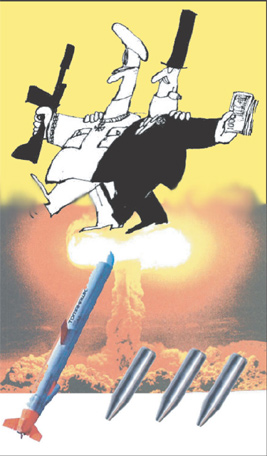
Enriching uranium U235 to 3.5%, for use in nuclear reactors, produces huge amounts of U238 (depleted Uranium), enough to encase tonnes of missiles annually. Who can guarantee these lethal weapons not to be used in the future for the destruction of humanity, as it has already been used in Yugoslavia, Iraq and Afghanistan?
Environmental degradation already accounts for 3-5% of GDP for some countries in the Middle East and North Africa, such as Jordan and Egypt. Uranium mining in these countries will worsen the environmental conditions which are already out of control, such as phosphate tailings in Rusaifa and Hasa in Jordan, which have bewailed the natural environment beyond recovery!
Creation of jobs is essential too when considering any investment in the South as unemployment is very high there. In a country like Namibia, were uranium mines had been utilized for a long time, the percentage of unemployment reached 51.2% in 2008(46). What about construction and operating nuclear facilities, are they labor intensive?
Energy source-jobs per tera watt hours are underlined in the following table:
| Natural Gas |
250 jobs / TWh |
| Coal |
370 jobs / TWh |
| Nuclear |
75 jobs / TWh |
| Wood |
733 jobs / TWh |
| Hydro |
250 jobs / TWh |
| Wind |
918 – 2400 jobs / TWh |
| Photo-voltaic |
29580 – 107000 jobs / TWh |
Table 1: Jobs per tera watt hours of electricity production (47)
It looks quite obvious that the nuclear industry is the poorest concerning jobs per energy production. Hence, developing countries need to be motivated to resort to intensive labor energy sources, away from logging and deforestation, by promoting wind and solar energy which provide far more jobs than the nuclear industry. Renewable and clean energy jobs are both decentralized, require no high skilled labor and are safe and secure energy sources; decentralization and jobs are badly needed in the South as migration from rural areas to cities is intensifying and many skilled labor had already migrated to the North.
As for safety and security, we wonder! With the present reputation of safety and security in the South, can developing countries minimize the risks of a nuclear disaster?
Expert nuclear engineer David Lochbaum responds to our question:
“It is not if we are going to have nuclear accidents but when” (48)!
If developing countries can afford nuclear accidents and can recover from such catastrophes, like what happened in Japan at Fukushima, developing countries of the South cannot for the reasons discussed earlier……”
December 14, 2019
Posted by Christina Macpherson |
2 WORLD, Religion and ethics |
1 Comment
 UN talks struggle to stave off climate chaos, https://www.sbs.com.au/news/un-talks-struggle-to-stave-off-climate-chaos 13 Dec 19, Observers and delegates at the UN’s COP25 climate summit said negotiators had largely failed to live up to the conference’s motto: Time for Action.
United Nations climate negotiations in Madrid were set to wrap up with even the best-case outcome likely to fall well short of what science says is needed to avert a future ravaged by global warming.
The COP25 summit comes on the heels of climate-related disasters across the planet, including unprecedented cyclones, deadly droughts and record-setting heatwaves.
Scientists have amassed a mountain of evidence pointing to even more dire impacts on the near horizon, while millions of youth activists are holding weekly strikes demanding government action.
As pressure inside and outside the talks mounts, old splits dividing rich polluters and developing nations – over who should slash greenhouse gas emissions by how much, and how to pay the trillions needed to live in a climate-addled world — have reemerged.
Newer fissures, meanwhile, between poor, climate vulnerable nations and emerging giants such as China and India – the world’s No.1 and No.4 emitters – may further stymie progress.
To not lose time, the 12-day meet was moved at the last minute from original host Chile due to social unrest.
But observers and delegates said negotiators had largely failed to live up to the conference’s motto: Time for Action.
Not even appearances from wunderkind campaigner Greta Thunberg – named Time Person of the Year Wednesday, much to the chagrin of Donald Trump — could spur countries to boost carbon-cutting pledges that are, taken together, woefully inadequate.
“We are appalled at the state of negotiations,” said Carlos Fuller, lead negotiator for the Association of Small Island States (AOSIS), many of whose members face an existential threat due to rising sea levels.
“At this stage we are being cornered. We fear having to concede on too many issues that would damage the very integrity of the Paris Agreement.”
Shifting alliances
The narrow aim of the Madrid negotiations is to finalise the rulebook for the 2015 climate accord, which enjoins nations to limit global temperature rises to “well below” two degrees Celsius.
Earth has already warmed 1C, and is on track to heat up another two or three degrees by 2100.
But “raising ambition” on emissions remains the overarching goal in Madrid.
Host nation Spain said Thursday that rich and developing nations alike were stalling.
There are two very clear visions,” Spain’s minister for energy and climate change Teresa Ribera told reporters.
“There are those that want to move quicker and those that want to hide behind things which aren’t working, so as not to advance.”
The deadline under the Paris treaty for revisiting carbon cutting commitments – known as NDCs, or nationally determined contributions – is 2020, ahead of the next climate summit in Glasgow.
But Madrid was seen as a crucial launch pad where countries could show their good intentions. Nearly 80 countries have said they intend to do more, but they only represent 10 percent of global emissions.
Conspicuously absent are China, India and Brazil, all of whom have indicated they will not follow suit, insisting that first-world emitters step up.
Fantasy land’
But some countries historically aligned with the emerging giants over the course of the 25-year talks broke rank Thursday.
“The failure of major emitters — including Australia, the United States, Canada, Russia, India, China, Brazil – ‘to commit to submitting revised NDCs suitable for achieving a 1.5C world shows a lack of ambition that also undermines ours,” AOSIS said in a statement.
The talks received a meagre shot in the arm Friday after the EU pledged to make the bloc carbon-neutral by 2050.
The much-heralded decision was immediately undermined however by the refusal of Poland – a major emitter – to sign on.
The UN said this month that in order for the world to limit warming to 1.5C, emissions would need to drop over seven percent annually to 2030, requiring nothing less than a restructuring of the global economy.
In fact, they are currently rising year-on-year, and have grown four percent since the Paris deal was signed.
“It’s basically like what’s happening in the real world and in the streets, the protesters, doesn’t exist,” Alden Meyer from the Union of Concerned Scientists, told AFP.
“We are in a fantasy land here.”
Without strong commitments from big emitters to up their own contributions to the climate fight, Meyer said the talks would have failed to fulfil their purpose.
“Countries need to be on a track to be 1.5C compatible, that’s the bottom line.”
December 14, 2019
Posted by Christina Macpherson |
2 WORLD, climate change |
1 Comment
 Sound the alarm on deadly US-Russia nuclear threat, by Jill Dougherty December 12, 2019 CNN, As I looked around the large square conference table, I watched the faces settle into worried frowns. Russians and Americans, several of whom once had responsibility for their nations’ nuclear weapons, all members of the Dartmouth Conference, the oldest continual bi-lateral dialogue between Americans and Russians, founded almost 60 years ago during one of the darkest periods of the Cold War.
For a long minute, no one spoke. Then, one of them broke the silence: “Someone needs to sound the alarm.”
Now, profoundly concerned that the United States and Russia are on the verge of a new arms race, they are
speaking out, issuing an urgent appeal to keep arms control alive:
“… for the first time in our history we are compelled by the urgency of the situation to issue this public appeal to our governments, founded on our view that the clear threat of an uncontrolled nuclear arms race has re-emerged with the collapse in recent years of key elements of the post-Cold War arms control architecture.”
Members of the Dartmouth Conference meet twice a year to discuss ways of improving — and, at this point, salvaging — the US/Russia relationship. Several are former top-level military and diplomatic officials. Some are religious leaders or physicians. All are concerned citizens.
They’ve watched as the arms control agreements, which helped prevent nuclear war between our countries, were dismantled — the Anti-Ballistic Missile Treaty signed by former President Richard Nixon and Soviet General Secretary Leonid Brezhnev, and the Intermediate Nuclear Forces agreement signed by former Presidents Ronald Reagan and Mikhail Gorbachev.
Now, the New START agreement — the last remaining arms control agreement between the US and Russia — hangs in the balance. …….
It could get worse, both I and other Dartmouth Conference members believe. Neither country wants to start a nuclear war, which would imperil the entire planet, but it could start by mistake, by misunderstanding, by escalation of tensions, as it almost did during the Cold War……..
In their appeal, Dartmouth members say the dialogue on strategic stability should be broadened to include other nuclear powers. But that doesn’t mean that, in the interim, New START can’t be extended for another five years, as the treaty provides. Extending it beyond 2021 would provide some breathing space to work on future global security agreements. We can do both.
New START not only led to steep reductions of nuclear arsenals on both sides but it strengthened confidence and trust between our countries and our militaries by providing for inspections and data exchanges that verify compliance. Transparency is key; Not knowing what weapons the other side might have can ignite suspicion.
At this very moment both countries are developing new, highly advanced conventional arms and delivery systems.
A cyberattack could knock out early warning systems. Both countries keep most of their nuclear weapons on hair-trigger alert, ready to be fired within minutes. Our presidents have only a few minutes to decide whether to respond. A missile launched in Russia can hit an American city in less than
30 minutes — and vice versa. A single warhead can kill millions of people.
December 14, 2019
Posted by Christina Macpherson |
politics international, Russia, USA, weapons and war |
Leave a comment













 nuclear-news