Pope Francis i Nagasaki – calls for a ‘world without nuclear weapons’
Pope Francis calls for a ‘world without nuclear weapons’ during Nagasaki visit, https://www.theguardian.com/world/2019/nov/24/pope-francis-calls-for-a-world-without-nuclear-weapons-during-nagasaki-visit
Pontiff urges disarmament as he tours Japan’s atomic bomb sites and meets survivors of the 1945 attacks, Justin McCurry in Tokyo and agencies
Mon 25 Nov 2019 Pope Francis has condemned the “unspeakable horror” of nuclear weapons during a visit to Nagasaki, one of two Japanese cities destroyed by American atomic bombs towards the end of the second world war.
Speaking on the second day of the first papal visit to Japan for 38 years, Francis urged world leaders to end the stockpiling of nuclear weapons, saying it offered their nations a false sense of security.
“This place makes us deeply aware of the pain and horror that we human  beings are capable of inflicting upon one another,” Francis said, standing next to a large photograph of a young boy carrying his dead baby brother on his back at a crematorium in the aftermath of the attack on Nagasaki.
“In a world where millions of children and families live in inhumane conditions, the money that is squandered and the fortunes made through the manufacture, upgrading, maintenance and sale of ever more destructive weapons, are an affront crying out to heaven,” Francis said.
A survivor of the Nagasaki bombing said he hoped the pope’s words would make nuclear powers think seriously about disarmament. Describing his experience 74 years ago as “a living hell,” Minoru Moriuchi, an 82-year-old Catholic, said: “My father’s sister ran away to our house with her two children and I never forgot the sight – their bodies were reddish-black and completely burnt.
“Four other relatives were brought in … but they didn’t look like humans,” he told Agence France-Presse.
Doctors’ prescription for the Tokyo Olympics — Beyond Nuclear International

The risks to athletes and spectators
via Doctors’ prescription for the Tokyo Olympics — Beyond Nuclear International
Sellafield Wants Free Rein to Discharge Under the Guise of Reducing Emissions to the Environment —

There is a short consultation by the Environment Agency going on now which has been described by the BBC as a proposed “New permit for Sellafield as discharge levels drop”. This is pure Sellafield PR spin. Sellafield says its levels of discharge are dropping because they are no longer reprocessing (dipping spent fuel rods in […]
via Sellafield Wants Free Rein to Discharge Under the Guise of Reducing Emissions to the Environment —
The radioactive Olympics? — Beyond Nuclear International

Japan is using the Games to “normalize” Fukushima aftermath
via The radioactive Olympics? — Beyond Nuclear International
November 24 Energy News — geoharvey

Science and Technology: ¶ “Climate Change Affecting Diversity In Some Of Australia’s Most Remote Areas, Despite Work Of Indigenous Rangers” • Three-quarters of all of Australia’s species that are currently known to be threatened occur in Indigenous tenures. And in Indigenous Protected Areas the land is protected by Indigenous Rangers. [ABC News] (Lots of photos) […]
Scottish National Party will press Jeremy Corbyn to scrap UK’s nuclear deterrent

 Nicola Sturgeon to press Corbyn to scrap UK’s nuclear deterrent
Abandoning Trident would be key issue in SNP support for a minority Labour government, Guardian Severin Carrell Scotland editor
@severincarrell, Mon 25 Nov 2019
|
Nicola Sturgeon will press Jeremy Corbyn to scrap the UK’s nuclear deterrent in any talks on Scottish National party support for a minority Labour government. The SNP leader said abandoning Trident would a key issue in any post-election talks with Labour, alongside supporting a second independence referendum, abolishing the universal credit benefits system and devolving immigration policy to Holyrood. In an article for the Guardian Sturgeon attacked Corbyn for abandoning his longstanding opposition to nuclear weapons in favour of supporting Trident and its replacement by a new system, based at Faslane submarine base on the Clyde. “Like many other Scots, I’ve always been appalled that Britain’s nuclear arsenal has been kept in my back yard,” Sturgeon wrote. “Corbyn, a longtime supporter of the Campaign for Nuclear Disarmament, is now fully signed up to renewing Trident. While I have my differences with Jeremy, on this issue – in his heart of hearts – I believe he still feels the same as I do. Yet, in attempting to become prime minister, he feels the need to sell out his principled opposition to Trident and promise to keep them on the Clyde.”….. Corbyn and Jo Swinson, the Liberal Democrat leader, have both been asked during the election campaign whether they would use nuclear weapons. Corbyn refused to say; Swinson quickly said yes. Corbyn has also repeatedly insisted Labour will not negotiate with other parties to ensure it can govern. …… https://www.theguardian.com/politics/2019/nov/24/nicola-sturgeon-to-press-corbyn-to-scrap-uks-nuclear-deterrent |
|
USA’s “Senate Climate Caucus” full of climate deniers, funded by dirty industries
 New Senate Climate Caucus Is Filled With Climate Deniers and Climate “Delayers”, BY Sharon Zhang, Truthout, 14 Nov 19, What’s climate change to a senatorial non-believer? The new Senate Climate Solutions Caucus might soon answer that question.
Formed late last month, the caucus’s aim is to hold hearings with climate experts, educate fellow senators and introduce unanimously agreed-upon legislation. The caucus’s founders — Delaware Democrat Christopher Coons and Indiana Republican Mike Braun — boast of the mandated bipartisanship of the caucus. For every Democrat, there must be a Republican, and vice versa.
Floridian Sen. Marco Rubio, a former hardline climate denier, is the group’s latest addition. He joins fellow Republicans Lisa Murkowski, Mitt Romney (a former climate waffler) and Lindsey Graham, who once said that greenhouse gas emissions are bad but probably don’t warm the planet all that much.
“In its current state, our national conversation on this issue is too polarized, toxic, and unproductive,” Braun and Coons said in an op-ed about the caucus for The Hill. “Our caucus seeks to take the politics out of this important issue.”
Setting aside that the climate conversation isn’t as polarized among voters as Coons and Braun might think — in fact, an overwhelming majority of voters agree that global warming is happening — it’s strange that they think that bipartisanship on climate can be apolitical. For the last couple of decades, the Republican Party has been nearly united on the climate change denial front, and, in the name of compromise, Democrats have largely been hesitant to move to the left on climate — or make any moves at all.
RL Miller, political director of Climate Hawks Vote, a grassroots climate super PAC, calls bipartisanship in the caucus “a joke.”………
the biggest threat to any progress for the caucus isn’t necessarily the Republicans on it. The biggest threat may be the amount of fossil fuel money accepted by members on both sides of the aisle. Only one member so far has signed the No Fossil Fuel Money Pledge: Colorado’s Michael Bennet, a Democratic presidential candidate, non-supporter of the Green New Deal, and recipient of over $320,000 worth of oil and gas money in his time in Congress, according to the Center for Responsive Politics. The other three Democrats in the caucus – Jeanne Shaheen, Angus King and Coons — have received over $200,000 combined. Meanwhile, the Republican members of the caucus have received over $9.5 million combined, $7 million of which went to Romney alone.
the biggest threat to any progress for the caucus isn’t necessarily the Republicans on it. The biggest threat may be the amount of fossil fuel money accepted by members on both sides of the aisle. Only one member so far has signed the No Fossil Fuel Money Pledge: Colorado’s Michael Bennet, a Democratic presidential candidate, non-supporter of the Green New Deal, and recipient of over $320,000 worth of oil and gas money in his time in Congress, according to the Center for Responsive Politics. The other three Democrats in the caucus – Jeanne Shaheen, Angus King and Coons — have received over $200,000 combined. Meanwhile, the Republican members of the caucus have received over $9.5 million combined, $7 million of which went to Romney alone.
A starting point for bipartisan legislation would be some sort of carbon fee — an idea legislators on both sides of the aisle have been bouncing around for a while –which environmental experts consider to be a bare minimum requirement for the path to net-zero emissions. Considering all of the members of the caucus have to agree on any policy they write, however, even a carbon fee will likely be an uphill battle. Rubio derides the idea of a carbon tax and conflates it with the Green New Deal in a recent op-ed for USA Today; Murkowski has refused to endorse a carbon tax; and Graham has supported one in the past, but reneged on that view earlier this year. Even Braun says that he doesn’t want a carbon fee to be a focus of the caucus.
To say that the country needs to act on climate and then reject the most basic policy to address climate change appears to be a new form of climate denial among centrists and the right — they may not outright deny the existence of climate change, but refuse to acknowledge the all-encompassing scale of the problem. In March, when a video clip of Sen. Dianne Feinstein shows her dismissing Sunrise Movement activists circulated, Rep. Alexandria Ocasio-Cortez tweeted that Feinstein was a “climate delayer.”……..
Even if the caucus does produce legislation, “the very existence of something like this, with so many senators that have taken money from the fossil fuel industry — it risks locking us into inadequate policies,” Billings says. For instance, not only would a carbon tax alone be insufficient climate policy, but it may also contain covert fossil fuel riders. There’s a reason that ExxonMobil, BP and Shell have been pushing for the passage of a carbon tax; Exxon’s carbon tax proposal last year contained a liability waiver, granting the company immunity for any climate change lawsuits brought against it.
Most of the Republicans in the caucus and at least one of the Democrats have shown to be susceptible to fossil fuel industry messaging that’s disguised as “climate-friendly.” Climate plans with an emphasis on carbon capture are a dead giveaway on this. In the current political sphere, carbon capture primarily refers to a technology that, yes, captures carbon as it’s emitted, but also sequesters that carbon in depleted oil wells, helping the fossil fuel companies to extract more oil. Funding carbon capture research is bipartisan, too, but as its used currently, it’s as useful for the climate as using kerosene to put out a fire.
Some may hail the bipartisanship of this climate caucus as a step forward. But as long as the majority of the committee is taking fossil fuel money, any supposed progress is dubious at best, and stifling at worst. After all, there’s no way of telling what’s happening behind closed doors. https://truthout.org/articles/new-senate-climate-caucus-is-filled-with-climate-deniers-and-climate-delayers/?eType=EmailBlastContent&eId=5dfc1357-c5ab-4a92-a995-92190dbe348e
France’s Flamanville nuclear financial catastrophe gets worse
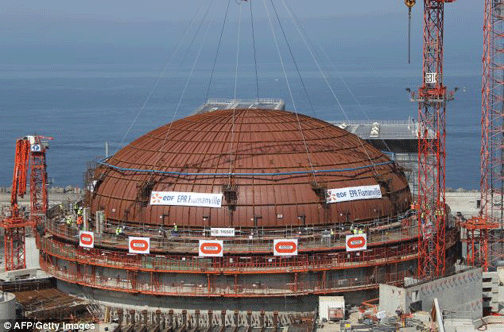 Le Monde 22nd Nov 2019, Jean-Martin Folz’s report on the construction of the Flamanville EPR, handed out on October 28 , is without appeal for the French nuclear power industry. The financial catastrophe continues to worsen. The project is currently 10 years late and 9 billion euros over budget. He helped engulf Areva, flagship of the French nuclear industry, declared bankrupt in 2016, which owed its salvation to a bailout on public funds of 4.5 billion euros.
It now weighs on the accounts of EDF, a new prime contractor since the
wreck of Areva, which no longer hopes to connect the reactor to the network
before 2022.
For the 8th time this year, a Hanford worker exposed to nuclear radiation
The 324 Building sits over a leak of radioactive cesium and strontium into the soil beneath it at the site about one mile north of Richland and about 300 yards west of the Columbia River.
“Although individually the contamination levels (on workers) have been low and no dose has been assigned to workers, collectively the number of personnel contamination events indicate a negative trend in contamination control that corrective actions taken to date have been inadequate to address,” the Department of Energy wrote in a Nov. 14 letter to its contractor on the project, CH2M Hill Plateau Remediation Co.
Earlier the same day that DOE sent the letter, CH2M had stopped work at the Hanford nuclear reservation’s 324 Building — one of several temporary halts to at least some of the work there this year.
Joe Franco, the DOE deputy manager at the DOE Richland Operations Office, told CH2M in the letter that he would not allow work to resume in the highly contaminated areas of the 324 Building until the company had developed a plan of correction and DOE had agreed on the path forward……. https://www.tri-cityherald.com/news/local/hanford/article237601614.html?fbclid=IwAR2PEXSoItPKGXYQxV0lOc3NJ2-KFlstPIvbdexqiIgP_i23UgMl9bBqGg4
Why is the UK government now hiding its nuclear history files?
 Nuclear X-files? Academics baffled as UK govt. pulls docs from national archives https://stockdailydish.com/nuclear-x-files-academics-baffled-as-uk-govt-pulls-docs-from-national-archives/ SDD Contributor on November 22, 2019 Nuclear X-files? Academics baffled as UK govt. pulls docs from national archives Thousands of national archive files on Britain’s atomic and nuclear weapons energy programs have been withdrawn from public view by order of the UK government without any explanation, alarming academics. Nuclear X-files? Academics baffled as UK govt. pulls docs from national archives https://stockdailydish.com/nuclear-x-files-academics-baffled-as-uk-govt-pulls-docs-from-national-archives/ SDD Contributor on November 22, 2019 Nuclear X-files? Academics baffled as UK govt. pulls docs from national archives Thousands of national archive files on Britain’s atomic and nuclear weapons energy programs have been withdrawn from public view by order of the UK government without any explanation, alarming academics.
Researchers reported that the documents, dating from 1939 to the 1980s, were unexpectedly withdrawn by the National Archives last week. The files relate to, among other subjects, the creation of Britain’s first nuclear bombs and the private papers of the Nobel Prize-winning physicist who split the atomic nucleus, Sir John Cockcroft. A spokesperson for the NDA stated that they are “absolutely committed to openness and transparency,” though no reason has been forthcoming, leading to speculation among academics that the files contained previously overlooked sensitive information, which should be withheld from public view. The papers in question are divided into two sections; records of the Atomic Weapons Establishment (AWE) and the records of the United Kingdom Atomic Energy Authority. The AWE documents concern the development of the UK atomic weapons. Bomb tests, feasibility reports and notes on the theoretical physics of nuclear weapons are all included. Jon Agar, a professor of history of science and technology at University College London, spoke of his ‘alarm’ at the situation to the Guardian. “We would like to know what is going on. We would be alarmed as historians that it has been taken out of public view. “These are important records for understanding the nuclear project in the UK. A couple of days ago a PhD student noticed that everything in the catalogue is coming up as temporarily retained. We are scratching our heads. It is all a bit mysterious.” |
|
Safety problems with Holtec’s dry canisters for nuclear wastes
Georgia’s Nuclear Plant Vogtle behind schedule, with costs escalating

State staff: Georgia Power nuclear timeline ‘significantly challenged’ AJC CONTINUING COVERAGE Nov 23, 2019, By Matt Kempner
Georgia Power’s nuclear expansion of Plant Vogtle is falling further behind schedule, according to a filing Friday by Georgia Public Service Commission staff and consultants.
Unless performance improves considerably, the latest deadlines for commercial operation of two new reactors by November 2021 and November 2022 are “significantly challenged,” according to the filing. It also flagged safety risks for workers.
The project is already years behind its original schedule and billions of dollars over budget. More delays could add costs. And if the price tag rises, electric consumers in much of Georgia could be at risk of increases in their monthly bills. Ultimately, elected members of the PSC will decide how much of the costs get passed along to Georgia Power customers. Many electric membership corporations and city utilities in Georgia are also connected to the project and will have to make decisions about how to recoup costs.…….
Georgia Power already has spent 10 years and incurred billions of dollars in costs to get as far as it has. That includes $2 billion in financing costs already recovered from customers through a special fee in monthly bills, years before the new reactors produce power. https://www.ajc.com/news/state-staff-georgia-power-nuclear-timeline-significantly-challenged/i1Ff7BnBp6grU5ht1WBHeO/
New Mexico not keen to take South Carolina’s plutonium wastes
|
LETHAL LEGACY, The US wants to bury SC’s plutonium stockpile forever. Its new home isn’t sure it wants it. Post and Courier, By Thad Moore tmoore@postandcourier.com Nov 23, 2019 In the time it will take for South Carolina’s stockpile of weapons-grade plutonium to decay, you could repeat most of human history, starting back in the Stone Age.
By the time its byproducts lose the explosive potential to be used in nuclear weapons, some 7 billion years will have passed. The Earth itself will have doubled in age, and then some. The U.S. government will officially decide in the next few years where the plutonium — the metal used to trigger nuclear weapons — will spend that eternity. And when it does, it will ask another part of the country to bear a profound burden: to house thousands of barrels filled with scraps of the Cold War and America’s nuclear arms race, a legacy that may well outlast our civilization.
That question will soon be posed to New Mexico, where the U.S. Department of Energy has excavated cavernous vaults deep below the ruddy soil in the state’s southeastern corner. The government hopes it will eventually hold tons of plutonium it has decided it no longer needs — enough to build a few thousand bombs the size of the one dropped over Nagasaki, Japan.
If it says yes, trucks will carry the plutonium load by load down Interstate 20 for the next three decades, and workers will lower it almost half a mile underground, where it will await its final fate: the mine’s slow collapse, and salt entombing it forever.
If New Mexico says yes, the Energy Department will bury some 20,000 steel drums deep underground there, in a ribbon of salt as thick as Charleston’s Ashley River is wide. And if New Mexico says yes, South Carolina will secure a new home for a nuclear stockpile it was wary of taking in the first place. The problem is, New Mexico isn’t sure if it will say yes. A new path The U.S.’s policy for disposing of plutonium has been in limbo for years. Congress had long planned to burn the material in commercial power plants, altering its atomic structure and making it harder to use in bombs. But the Energy Department’s project to convert plutonium into reactor fuel was deeply flawed: It started building a factory to do that work before it had a complete design, and it later discovered that finishing the plant would cost billions more than expected and stretch into the middle of the century. So the department proposed an alternative. It would convert its plutonium into a fine powder, and it would hire dozens of people in South Carolina to dilute it by hand, working in shifts around the clock. They would blend it with a secret combination of chemicals called “stardust,” designed to make it difficult to get the plutonium back out. When mixed with plutonium, stardust is said to foam up, create a gel and harden like concrete. Department officials have said the final product looks like sand on the beach. They’ve said it would save billions of dollars………. A long decay The Department of Energy grappled in the early 1990s with just how long WIPP’s legacy would survive. It hadn’t decided yet that plutonium should spend an eternity in the New Mexico desert, but it knew that America’s other nuclear waste would persist as long as anyone could comprehend. And it worried that some far-off civilization would find WIPP without understanding the invisible danger of radiation inside………When the calendar reaches the year 12000 — around the end of the team’s 10,000-year mandate — the plutonium underground will be less than halfway through its first half-life. The stockpile that currently sits in South Carolina will still be more than 200,000 years from completing its transformation into a potent type of uranium that is capable of powering cities or destroying them…… https://www.postandcourier.com/news/the-us-wants-to-bury-sc-s-plutonium-stockpile-forever/article_cbe6029e-07eb-11ea-9622-639a44471d1a.html |
|
Global heating is shrinking and accelerating the jet stream
Times 24th Nov 2019, The jet stream – the powerful transatlantic wind that dominates British weather – is being shrunk by climate change, scientists say. It means that Britain is at growing risk of more violent storms in winter and searing heatwaves in summer.
Tim Woollings, associate professor of atmospheric physics at Oxford University, who has published a new book, Jet Stream,
said: “The planet is warming rapidly due to humanity’s greenhouse gases. It
means the whole of the Earth’s tropical belt is likely to expand, pushing
the jet stream north so it shrinks in size and accelerates.”
https://www.thetimes.co.uk/article/e154bfe6-0e24-11ea-93be-ccf3f2ed7d1d
India’s government ignores opposition as it plans to build spent nuclear fuel storage facility
|
Govt to build KNPP nuke fuel storage despite opposition Anirban Bhaumik, Deccan Herald, DHNS, New Delhi, NOV 20 2019, The Government is set to go ahead with its plan to set up a facility for storing spent fuel of the first and second units of the Kudankulam Nuclear Power Plant (KNPP) in Tamil Nadu – brushing aside opposition by political parties in the state.
Jitendra Singh, Union Minister of State (MoS) in charge of Department of Atomic Energy, on Wednesday informed the Lok Sabha that the designing of the “Away From Reactor” (or AFR) Spent Fuel Storage facility for the first and second units of the KNPP …….
The DMK MPs from Tamil Nadu were not convinced though. “I feel that it is unfair to decide about the necessity of repository considering the quantity of radioactive waste. Any day, an atomic reactor is like a Damocles Sword hanging over you,” Thamizhachi Thangapandian, the MP from Chennai South, said…….. https://www.deccanherald.com/national/govt-to-build-knpp-nuke-fuel-storage-despite-opposition-778172.html
|
|
|
1 This Month

of the week – Shut Down Drone Warfare!


Tell the Ukrainian Government to Drop Prosecution of Peace Activist Yurii Sheliazhenko

Petition to revoke the licensing of the Near Surface Nuclear Disposal Facility (NSDF) at Chalk River. https://www.ourcommons.ca/petitions/en/Petition/Details?Petition=e-7247
To see nuclear-related stories in greater depth and intensity – go to https://nuclearinformation.wordpress.com
-
Archives
- March 2026 (244)
- February 2026 (268)
- January 2026 (308)
- December 2025 (358)
- November 2025 (359)
- October 2025 (376)
- September 2025 (257)
- August 2025 (319)
- July 2025 (230)
- June 2025 (348)
- May 2025 (261)
- April 2025 (305)
-
Categories
- 1
- 1 NUCLEAR ISSUES
- business and costs
- climate change
- culture and arts
- ENERGY
- environment
- health
- history
- indigenous issues
- Legal
- marketing of nuclear
- media
- opposition to nuclear
- PERSONAL STORIES
- politics
- politics international
- Religion and ethics
- safety
- secrets,lies and civil liberties
- spinbuster
- technology
- Uranium
- wastes
- weapons and war
- Women
- 2 WORLD
- ACTION
- AFRICA
- Atrocities
- AUSTRALIA
- Christina's notes
- Christina's themes
- culture and arts
- Events
- Fuk 2022
- Fuk 2023
- Fukushima 2017
- Fukushima 2018
- fukushima 2019
- Fukushima 2020
- Fukushima 2021
- general
- global warming
- Humour (God we need it)
- Nuclear
- RARE EARTHS
- Reference
- resources – print
- Resources -audiovicual
- Weekly Newsletter
- World
- World Nuclear
- YouTube
-
RSS
Entries RSS
Comments RSS
 nuclear-news