Gizmodo thoroughly debunks the false story of a nuclear explosion in the South China Sea
 No, China Did Not Secretly Detonate A Nuke In The South China Sea To Signal The Start Of WWIII, Gizmodo Tom McKay, Nov 22, 2019, The Chinese government has almost certainly not secretly detonated a tactical nuclear weapon in the South China Sea to send a warning signal to the United States, experts told Gizmodo, regardless of widespread claims to the contrary on social media.
The source of this particular rumour appears to be Hal Turner, a far-right New Jersey radio host and former FBI informant considered a white supremacist by the Anti-Defamation League and the Southern Poverty Law Centre (and who once was sentenced to over nearly three years in prison for calling for the murder of three federal judges). A post on Turner’s website claimed that unidentified “military sources” had said that around 6:22 p.m. ET on Wednesday, a nuclear explosion of some kind 50 meters below the surface of the South China sea had “caused an underwater shock wave of such sudden presence, and of such strength, that the explosion itself ‘had to be between 10 and 20 Kilotons.’” Later, the article on Turner’s website was updated to claim that the uRADMonitor Global Environmental Monitoring Network had detected “significant” radiation readings on the southern coast of China near Zhangjiang and Hong Kong, as well as Taiwan.
Turner speculated that the Chinese government had detonated a nuclear weapon to quietly send a signal to the U.S. government that it was fed up with intervention against Chinese oppression of pro-democracy protests in Hong Kong, the ongoing U.S.-China trade war, or perhaps simply to suggest that World War III was around the corner:
Did China detonate a small, tactical, nuclear device to send a warning to the United States over the US Senate and US House approving the Hong Kong Democracy Act, which China views as an “assault” upon China’s internal affairs?
Has China had enough of US “freedom of navigation” exercises in the South China Sea?
Is China feeling the sting of economic downturn from its Trade War with the USA, and are they “upping-the-ante” signalling actual war?
This is normally the kind of thing that reasonable people would simply ignore. But thanks in part to a series of tweets from an account using the official-sounding handle “IndoPacific_SCS_Info” and others, Turner’s claims gathered the attention of thousands on Twitter. [Numerous Twitter examples given]
It should come as no surprise that this is hot bullshit. For one, the uRADMonitor site itself pegs the supposedly gigantic radiation spike at 0.24 microsieverts per hour. That’s about the same as in South India, parts of the southwestern U.S., and Mexico—and it is an absolutely negligible amount of radiation. For comparison, the World Nuclear Association estimates the global average of naturally occurring background radiation at 0.17-0.39 microsieverts per hour, according to Reuters. If one were exposed to 0.24 microsieverts per hour, that would equate to around 2,100 microsieverts a year, or just over two millisieverts. The U.S. defines the upper boundary of safe occupational exposure at 50 millisieverts per year.
One university radiation safety specialist, who spoke anonymously with Gizmodo because they were not authorised to talk to the media, confirmed that the supposedly ominous uRADMonitor readings appeared to reflect normal background radiation levels and called the claims “unsupported wild-arse speculation.” (That specialist also warned that uRADMonitor was not a reliable source.) Readings of airborne radioactive particles posted on the Environmental Protection Agency’s RadNet Honolulu page, as well as the Institute for Information Design Japan’s Japan Radiation Map, also seemed to show nothing out of the ordinary (other than elevated levels in the area of the 2011 Fukushima Daiichi nuclear disaster).
That’s generously assuming that those readings even matter in the context of a covert underwater Chinese nuclear explosion, which Gizmodo has it on good authority they don’t
Gizmodo spoke with Robert Rosner, a former Department of Energy scientist and current University of Chicago theoretical physicist who chairs the Bulletin of the Atomic Scientists’ Science and Security Board. Rosner laughed at the idea that anyone would be able to identify an underwater nuclear test from ground-based detectors, or that anyone would be stupid enough to conduct such a test in the South China Sea.
“I would be amazed if there had been an event that somebody would then identify as an event based on a radioactive signature,” Rosner told Gizmodo via phone. “That’s unbelievably unlikely.”
Rosner added that the primary way of detecting such an event would be seismic; the first underwater nuclear tests in the world, the 23-kiloton Baker nuke at Bikini Atoll in 1945, set off seismographs the world over. There’s been no such indication that any kind of similar event happened on Wednesday……..
In addition to security concerns, Rosner said, the region is also monitored for seismic events because of “really deadly tsunamis” like the 2004 Indian Ocean earthquake and tsunami. Rosner said that a 10-20 kiloton blast would “definitely be notable” on that scale, noting that the nuclear bombs dropped on Hiroshima and Nagasaki were of similar magnitude.
In other words: You should not believe a racist radio host who says completely unremarkable background radiation readings are evidence that China is about to start World War III……..https://www.gizmodo.com.au/2019/11/no-china-did-not-secretly-detonate-a-nuke-in-the-south-china-sea-to-signal-the-start-of-wwiii/
Ohio: the nuclear industry’s violent assault on democracy

Ohio’s GOP secretary of state has now asked the Ohio Supreme Court NOT to provide a federal judge with answers about key procedural questions surrounding the state’s referendum process.
The short-term issue is about a billion-dollar bailout for two nuke reactors and two coal burners.
Long-term it asks whether targeted violence perpetrated by paid thugs will now define our election process. And whether the public referendum will remain a workable part of our democracy.
The battle starts with House Bill 6, the now-infamous billion-dollar nuke bailout approved by the corrupt, gerrymandered Ohio legislature in late July.
HB6 forces all Ohio ratepayers to subsidize two crumbling nukes on Lake Erie, along with two decrepit coal burners, one of them in Indiana. It helps underwrite ten small solar farms, but undercuts much larger subsidies for other wind and solar facilities.
The Perry reactor east of Cleveland, and Davis-Besse near Toledo, are among the world’s most dangerous, decrepit reactors. Both were set to shut because they cannot compete with wind and solar, as well as fracked gas.
But Akron-based FirstEnergy spent millions to “persuade” the legislature to hand them a billion dollars to keep their uncompetitive, uninsured and essentially unregulated reactors on line.
When the bailout passed, a statewide group called Ohioans Against Corporate Bailouts turned in a petition for a repeal referendum on the 2020 ballot. The law allows 90 days for referendum sponsors to gather signatures to get on the ballot. In this case 265,711 would be required.
Ohio’s Attorney General David Yost sat on the request for 19 days, then rejected it. OACB filed a second application, which the AG sat on for another 19 days before approving it.
That left the petitioners just 52 days to gather signatures.
But signature gatherers were immediately attacked with violent threats and bribery offers. In the field, they (and potential signatories) were physically assaulted by “blockers” hired by the nuclear industry. Sworn testimony about these attacks was filmed at a public gathering in Columbus and can be seen here:
https://freepress.org/article/free-press-second-saturday-petition-blockers-threaten-our-democracy
Bailout opponents then went to federal court to ask that the 38 days consumed by the AG be restored to the petition campaign, which came up short at the 90-day deadline. A federal judge asked for guidance from the Ohio Supreme Court and submitted five questions for the Justices to answer.
And here things have leapt to another level. Frank LaRose, the Ohio Secretary of State, has now asked the Ohio Supreme Court NOT to respond to the federal judge’s queries.
In other words: the Republican attorney general killed nearly half the allotted signature gathering time for the repeal of this bailout. A federal judge has asked to hear from the state Supreme Court. And now Ohio’s Republican secretary of state has asked that Court NOT to comply, in a direct attempt to prevent Ohioans from voting on whether they’re to be forced to pay a billion dollar subsidy for two lethal, money losing atomic reactors.
This shocking combination of overt threats, bribery and outright physical violence, combined with judicial stall tactics by elected Ohio officials, breaks new ground in the assault on democracy itself in the American heartland.
The issue cuts to the core of the 2020 election. Donald Trump has met personally with at least one principal lobbyist for FirstEnergy, the prime beneficiary of the bailout. At least one of his associates lobbied at least five legislators in its behalf.
But a statewide referendum for repeal could be catastrophic for the GOP. Polls show more than 60% of Ohioans opposed. That includes much of the normally corporate statewide media. Many big industrial organizations have joined the fossil fuel industry here in fighting it.
If the referendum does get on the 2020 ballot, it will clearly energize a strong progressive voter turnout. Outraged ratepayers could very easily make the difference in a closely divided swing state. So for Trump and his minions, killing a vote on this billion-dollar rip-off is vital.
Their assault must be seen as part of a larger attack on democracy itself. The right to referendum has been established in numerous states for a century or more. That physical violence, choreographed bribery and official legal manipulation would now be used to kill it bodes badly for our future.
From the rise in violent white supremacist bigotry, to unaccountable police murders, to Charlottesville, to the recent attack on Code Pink’s Medea Benjamin to the concerted Republican assault on paper ballots and fair, inclusive voting practices, it’s clear the GOP intends to gut democracy in 2020 and beyond.
This all-out utility and official attack on the referendum process in Ohio has put a billion-dollar price tag on two nukes capable of doing trillions in damage to human health and the eco-systems of the Great Lakes region.
But it also signals a broader war against both democracy and truth, one we must all take very, very seriously.
—————-
Attorney Bob Fitrakis, Ph.D., is publisher of the Columbus Free Press. He’s co-author
France’s government is giving mixed messages on future of nuclear energy
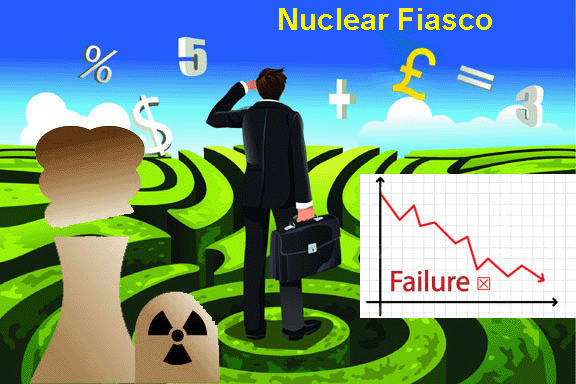 EDF gives Macron little reason to come clean on
  nuclear https://www.ft.com/content/adbe9da6-0ab8-11ea-bb52-34c8d9dc6d84 Problems at a flagship nuclear reactor means French government can take time over future of EDF, BEN HALL , Europe editor NOVEMBER 20 2019
The earthquake that shook the Rhone valley in south-east France last week could have been another financial disaster for energy giant EDF in what has been a bruising year. Its share price has taken a battering over concerns that it will struggle to pay for the upkeep of its ageing fleet of reactors, find money to build new ones and service its €37bn of net debt. The worries have been amplified by further delays and cost overruns at the mammoth nuclear plant it is building on the Normandy coast. The Rhone valley is home to four of the country’s 19 atomic power stations and a nuclear fuel processing facility, all operated by EDF. The tremor was the worst to hit France in 16 years. Three reactors at Cruas had to be shut down until mid-December for mandatory safety checks.
The French government, which owns 83.7 per cent of the company, is giving mixed messages about the way forward. It will not decide whether to build more EPRs until Flamanville is up and running — conveniently after the 2022 presidential election, allowing Emmanuel Macron to avoid the wrath of France’s increasingly powerful environmental movement. But according to Le Monde newspaper, the government has also secretly ordered EDF to draw up a feasibility study for six new EPRs built in pairs.
A call for John Hopkins University to stop helping nuclear weapons industry

Hopkins must take a stand against its nuclear weapons production, https://www.jhunewsletter.com/article/2019/11/hopkins-must-take-a-stand-against-its-nuclear-weapons-production
By THE EDITORIAL BOARD | November 21, 2019 After years of protests from students, the University continues to invest in fossil fuel companies. It has an exclusivity contract with PepsiCo, a company that uses suppliers who violate child labor laws, going against ethical and sustainable business practices. Most recently, the University was slow to end contracts with Immigration and Customs Enforcement, the government agency that is responsible for separating families at the U.S.-Mexico border.
The University’s involvement in these contracts has been well publicized and heavily criticized by students and professors alike. Adding to this list of questionable practices is a partnership that is less well-known, but just as problematic: a contract with the U.S. government to take part in nuclear weapons research.
On Nov. 13, the International Campaign to Abolish Nuclear Weapons (ICAN) published a report stating that 49 U.S. universities are complicit in the production of nuclear weapons. The group calls on students and faculty to “demand their universities stop helping to build weapons of mass destruction.”
The report is scathing. It repeatedly mentions Hopkins, highlighting its involvement in creating nuclear weapons for the U.S. ICAN notes that Hopkins receives twice as much funding as any other university from the Department of Defense (DOD) largely because of the work of its renowned Applied Physics Laboratory (APL). Created in 1942 for weapons development in World War II, the APL has since served as a technical resource for the U.S. government, developing numerous technologies for air and missile defense, naval warfare, computer security and space science.
In 2017, the APL received a seven year contract with the DOD for $93 million to continue the Air Force Nuclear Weapons Center’s strategic partnership. This contributes to the multi-year contract with the agency that is now worth more than $7 billion.
The research involved in this deal is largely classified. On the surface, this seems to contradict the University’s policy against classified research. However, the APL is exempt from this policy, as it is the only part of the University listed as a “non-academic division.”
The University continues to brand itself as an ethical research institution. However, its direct involvement with the development of weapons of mass destruction is contradictory to these actions.
We believe that Hopkins should remove itself from all contracts associated with nuclear weapons. Instead, the APL should focus on research that does not have the same devastating and inhumane implications that nuclear weapons do.
Those who support the University’s work with nuclear weapons may argue that Hopkins receives a high monetary benefit from their partnership with the Department of Defense. They may also claim that Hopkins, which is just one of nearly 50 universities conducting research, can’t make any difference on its own. Even if Hopkins ends the contracts, why would other schools do the same?
These arguments are valid, and we understand the concerns that are associated with terminating the contracts. It is true that Hopkins receives a hefty sum for its involvement with the DOD. According to ICAN, “the funding ceiling for its ongoing contract was extended beyond $7 billion” in 2019.
There is also a turning tide against nuclear weapons development across the world. The Treaty on the Prohibition of Nuclear Weapons, introduced to the United Nations in 2017, bans the development and use of nuclear weapons by signatories. So far, 122 countries have signed on, though the U.S. and most western countries have not. If Hopkins and other reputable institutions take a stand against nuclear weapons development, it will send a sign to the world at large that we want to move on from using these weapons of mass destruction.
Large scale change starts small, and it starts with us. We encourage students to take a stand for what they believe in. As with any other issue, there are multiple ways to tell Hopkins that it’s time for a change. On their website, ICAN outlines three ways that students can speak out. They recommend publicizing the issue, demanding transparency from universities and calling on them to end their work with nuclear weapons.
We know that there’s no guarantee that Hopkins will end its contracts and stop working on nuclear weapons development. But by speaking out, we can initiate the change. Activists who are part of sustainability and pro-peace groups can protest against nuclear weapons production. Students who are majoring in STEM fields can take a stand against working at the associated departments at the APL, and should be aware of the larger implications of any research they are involved in. All students can tell Hopkins that we demand an explanation and that we take issue with the greater mission behind the research.
The University’s mission statement, in part, mentions that its goal is “To educate its students and cultivate their capacity for lifelong learning, to foster independent and original research, and to bring the benefits of discovery to the world.” We hope that the University will refocus its attention on these goals. If Hopkins turns away from nuclear weapons research, other institutions may follow in our path. Making the world a safer place is the best way to bring the benefits of our discovery to everyone.
A Labour government in UK would revive Wylfa nuclear power project

|
|
 Labour commits to lagoon and nuclear plant in manifesto, BBC, 21 November 2019Major Welsh projects including a Swansea Bay tidal lagoon would be built if Labour wins the general election, the party’s manifesto says. Labour commits to lagoon and nuclear plant in manifesto, BBC, 21 November 2019Major Welsh projects including a Swansea Bay tidal lagoon would be built if Labour wins the general election, the party’s manifesto says.
Plans for a lagoon were dropped by UK ministers last year, but there have been efforts to revive such a scheme. Stalled plans for a new nuclear power station on Anglesey would also be revived under Labour, the party says……. Earlier this year, the Japanese firm Hitachi said it was suspending work on the £13bn Wylfa Newydd nuclear power project on Anglesey because of rising costs, after six months of talks with UK ministers about funding for the scheme. Labour’s manifesto states the party will “work with people on the island to maximise its potential for new nuclear energy, alongside investment in renewables”…….. What about Brexit? In his speech in Birmingham, Mr Corbyn said he would negotiate a “sensible” Brexit deal with the EU, that protects manufacturing and Northern Ireland’s Good Friday Agreement. Voters would be able to choose between that deal or staying in the EU in a referendum to be held within six months, he said. Mr Corbyn has refused to say which option he will back, although Welsh Labour leader Mark Drakeford says the party in Wales will campaign to keep the UK in the European Union. Recognising this difference between the two leaders on a key issue, the manifesto states “in Wales the Welsh Labour government will campaign to remain”. https://www.bbc.com/news/election-2019-50490159 |
|
China’s $2.5bn renewables investment in Inner Mongolia
|
China’s nuclear power company plans $2.5bn renewables investment in Inner Mongolia http://www.globalconstructionreview.com/news/chinas-nuclear-power-company-plans-25bn-renewables/, 22 November 2019 | By GCR Staff
China General Nuclear Power Group (CGN) is preparing to invest $2.5bn in renewables generation capacity in its northern province of Inner Mongolia, including a 1GW solar facility and a 2GW wind farm, according to a report in PV Magazine. The investment aims to capitalise on the climate of the region, which combines strong and steady winds with up to 3,400 hours of sunshine a year. CGN was founded in 1994 to operate nuclear power plants, but has since built up a domestic portfolio of renewable assets, including 9.1GW of wind capacity and 1.7GW of solar. The wind turbines are to be installed near the city of Ulanchabu, which will also make the turbines. Administrative work will be carried out in the first half of next year with construction scheduled to begin in August and complete in 2021. The Inner Mongolia Solar Energy Industry Association says the transmission lines required to bring the electricity from the sparsely populated north have already been built. At the beginning of this year, the State Power Investment Corporation (Spic), one of China’s top five energy generators, announced plans to build a 6GW windfarm close to China’s border with Mongolia. Spic announced that is has received planning approval for its project from the Ulanqab Municipal Development of Inner Mongolia. If it goes ahead, it would install turbines across an area of 3,800 square kilometres, roughly the same size as the UK county of Suffolk, at a construction cost of about $6.8bn. |
|
|
To Make the Olympics Look Good Japanese Government Wants Evacuees To Return To Fukushima

While Japan might want to make the Olympics look good, – internationally the IAEA , nuclear nations and global nuclear industries want the Olympics to make the nuclear industry look good!
|
Japanese Government Wants Evacuees To Return To Fukushima In Time To Make Olympics Look Good, Dead Spin Dvora Meyers, 3/08/19 One of the few things that the Olympics do well, aside from putting cities in significant debt that can take decades to pay off, is symbolism. It was on display last year in Pyeongchang when the North and South Korean delegations marched into the opening ceremonies for the Winter Olympics, and if the Japanese government has its way, 2020 will bring its own moment of symbolic healing. The Tokyo 2020 organizing committee has embraced symbolism—as well as the traditional cost overruns—and have dubbed their Games the “Reconstruction Olympics.” The “reconstruction” they’re referring to is the effort to rebuild the part of the country that was devastated by the 2011 earthquake, tsunami, and subsequent Fukushima nuclear reactor meltdown. More than 16,000 people were killed in the disaster and approximately 160,000 people evacuated the region, with the Japanese government providing subsidies and assistance to those who fled. To prove that the region is well on its way to recovery, the Tokyo Olympic organizing committee announced that the baseball and softball competitions would be held in Fukushima, a move that the IOC approved. To add another does of symbolism to this, the Olympic torch relay will begin in Fukushima, too. In 2017, when the venues for baseball and softball were announced, Aileen Mioko-Smith, an activist with Green Action Japan, noted, “It’s fine for athletes and spectators to go to Fukushima for a couple of days to compete, but the Japanese government is using this to claim that everything is back to normal and that the evacuees should go back to their homes.” ……. The Japanese government has already ended subsidies for those “voluntarily” evacuated, meaning that they weren’t in the immediate evacuation zone but left because they lived in Fukushima prefecture and were worried about the radiation levels and the environmental fallout. One of those evacuees, Kazuko Nihei, told Agence France Presse that she refuses to return to Fukushima City with her daughters even though she’s enduring financial hardship since the government ended her housing subsidy. The reason she refuses to return is because she’s concerned about long term health impacts. The government is only offering screenings for thyroid cancer, but Nihei wants a “comprehensive annual health check” for the returnees. The Japanese government insists that it is safe to return, but as the article notes, they’ve moved the goalposts a bit when it comes to acceptable radiation levels:
The Japanese government plans to end all financial assistance to evacuees in 2021, which will mark a decade since the earthquake, tsunami, and nuclear meltdown. Noriko Matsumoto, another evacuee, is critical of the government for eliminating subsidies while at the same time spending a lot of money to prepare the area for the Games. “I think there are other things that should be done before hosting the Olympics,” she said. While her comment is perhaps a specific reaction to bringing Olympic events to a region still reeling from a natural and nuclear disaster, in it you can detect a more universal criticism of the Olympics that has been repeated by activists all over the world—Why are we spending money on the Olympics when we have much more important ways to spend our limited resources?…..https://deadspin.com/japanese-government-wants-evacuees-to-return-to-fukushi-1833156282?utm_medium=sharefromsite&utm_source=deadspin_twitter&utm_campaign=top |
|
Taiwan govt to give $2.55 billion to Orchid Island in nuclear waste compensation

 Orchid Island to get NT$2.55 billion in nuclear waste compensation, Focus Taiwan, (By Flor Wang, Elaine Hou, Lu Tai-cheng Taipei, Nov. 22 (CNA) The government will pay NT$2.55 billion (US$83.6 million) to Orchid Island residents to compensate them for infringing on their rights by maintaining a nuclear waste storage facility there over the past five decades, President Tsai Ing-wen (蔡英文) announced Friday.
Tsai announced the compensation at a news conference in Taitung and hailed the move as reflecting the goal of the current government to pursue transitional justice for indigenous tribes based on fact-finding efforts.
“Evidence we collected showed that the then-government decided to build a nuke waste storage in reserved lands for the Yami people on Orchid Island without their previous knowledge or agreement,” Tsai said.
She described the payment as a step toward compensating Orchid Island and its people, but said there was still a lot to do to “correct our past errors.”
The decision to position the facility to handle low- and medium-level nuclear waste from Taiwan’s nuclear power plants on Orchid Island was made in 1974 and it began receiving shipments in 1982.
The process has long been recognized as deceptive, with a report titled “Orchid Island: Taiwan’s Nuclear Dumpsite” in the newsletter Nuclear Monitor in 1993 detailing how residents were led to believe a cannery was being built.
The Executive Yuan brought up historical documents showing that former President Chiang Ching-kuo (蔣經國) and Premier Sun Yun-suan (孫運璿) went ahead with the decision to build the facility without informing the local Yami people in advance.
Since residents realized in the late 1980s what was actually on the site, they have feared it would contaminate the food chain and force them off the island and also led protests against nuclear power……http://m.focustaiwan.tw/news/aipl/201911220023.aspx
What possible excuse is there for such monstrous, nation-destroying weaponry?
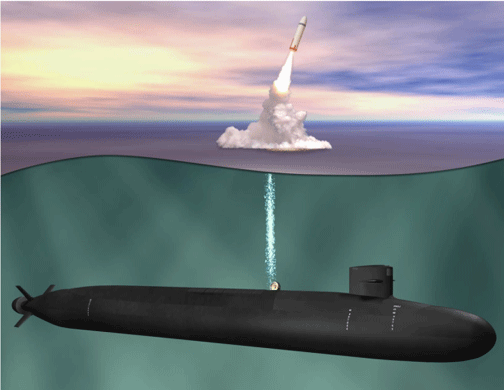 The U.S. Submarine That Could Bring Nuclear Doomsday With It, One sub to end a country. National Interest by Sebastien Roblin– 22 Nov 19 The U.S. Submarine That Could Bring Nuclear Doomsday With It, One sub to end a country. National Interest by Sebastien Roblin– 22 Nov 19
Key Point: The Ohio-class could pull it off. “…… The most deadly of the real-life kaiju prowling the oceans today are the fourteen Ohio-class ballistic-missile submarines, which carry upwards of half of the United States’ nuclear arsenal onboard. If you do the math, the Ohio-class boats may be the most destructive weapon system created by humankind. Each of the 170-meter-long vessels can carry twenty-four Trident II submarine-launched ballistic missiles (SLBMs) which can be fired from underwater to strike at targets more than seven thousand miles away depending on the load. As a Trident II reenters the atmosphere at speeds of up to Mach 24, it splits into up to eight independent reentry vehicles, each with a 100- or 475-kiloton nuclear warhead. In short, a full salvo from an Ohio-class submarine—which can be launched in less than one minute—could unleash up to 192 nuclear warheads to wipe twenty-four cities off the map. This is a nightmarish weapon of the apocalypse. The closest competitor to the Ohio-class submarine is the Russia’s sole remaining Typhoon-class submarine, a larger vessel with twenty ballistic-missile launch tubes. However, China, Russia, India, England and France all operate multiple ballistic-missile submarines with varying missile armaments—and even a few such submarines would suffice to annihilate the major cities in a developed nation………..
the New START treaty which came into effect in 2011 imposes additional limits on the number of deployed nuclear weapons. The current plan is to keep twelve Ohio-class subs active at time with twenty Trident IIs each, while two more boomers remain in overhaul, keeping a total of 240 missiles active at a time with 1,090 warheads between them. Don’t worry, restless hawks: that’s still enough to destroy the world several times over! ………. https://nationalinterest.org/blog/buzz/us-submarine-could-bring-nuclear-doomsday-it-98332
What possible excuse is there for such monstrous, nation-destroying weaponry?
|
|
UK Labour touts ‘green industrial revolution’, BUT INCLUDES NUCLEAR POWER AS “GREEN”!
 Labour pledges ‘green industrial revolution’ with nuclear power and a digging over of allotment laws Labour pledges ‘green industrial revolution’ with nuclear power and a digging over of allotment lawsThe environment gets top billing in Labour’s manifesto. The first chapter of their 150 pages of policy pledges is devoted to what Labour are calling a “Green Industrial Revolution”. While they’ve conspicuously dropped a conference pledge of a net zero carbon target by 2030, which most serious analysts warned was impossible to achieve anyway, like the Liberal Democrats and Green Parties they’re planning to borrow big to invest in a low carbon economy. There’s a £250bn “Green Transformation Fund” to massively increase low carbon energy generation, warmer, lower carbon homes and promises to decarbonise heating in buildings — much needed if the UK is going to meet its existing climate change pledges. In a notable departure from Liberal Democrat and Green manifestos, they promise to support nuclear power as a way of ensuring stable electricity supply on a future national grid….. https://www.itv.com/news/2019-11-21/labour-pledges-green-industrial-revolution-with-nuclear-power-and-a-digging-over-of-allotment-laws/ |
|
|
France’s company EDF selling out of USA nuclear plants, Exelon to buy.
EDF Will Bail on Three Nuclear Plants, Exelon Holds the Bag, Power Mag 11/21/2019 | Aaron Larson Exelon Generation said EDF Group—a French integrated electricity company—is exercising a put option to sell its 49.99% interest in the R.E. Ginna, Nine Mile Point, and Calvert Cliffs nuclear energy facilities. The two companies will now begin negotiations for Exelon to acquire full ownership of the plants.
EDF’s involvement in the facilities was through the Constellation Energy Nuclear Group (CENG), a joint venture between it and Constellation Energy, which was negotiated in 2009. Exelon acquired its majority stake in the plants as part of a merger with Constellation Energy, a deal that closed in March 2012.
EDF said the disposal of CENG shares is part of a previously announced non-core-asset disposal plan. The put option could have been exercised by EDF anytime between Jan. 1, 2016, and June 30, 2022. A transaction price will follow from the determination of the fair market value of CENG shares pursuant to the contractual provisions of the put option agreement, EDF said.
…….. The facilities consist of the single-unit 576-MW R.E. Ginna Nuclear Power Plant (Figure 1) and the dual-unit 1,907-MW Nine Mile Point Nuclear Station, which are both in upstate New York, and the dual-unit 1,756-MW Calvert Cliffs Nuclear Power Plant in Maryland. The upstate New York plants were under economic pressure and faced possible closure a few years ago, but subsidies approved by the state have kept the units financially viable.
For UK elections, top issue is climate change
 Climate crisis topping UK election agenda is ‘unprecedented’ change
 Environmentalists say such political focus on green issues ‘unthinkable’ just five years ago, Guardian, Fiona Harvey Environment correspondent, Fri 22 Nov 2019 The climate emergency has risen to the top of the UK’s election agenda in a way that would have been “unthinkable” even five years ago, leading environmentalists have said, predicting that it augurs a permanent change in British politics.On Wednesday, Labour took the unprecedented move of putting green issues as the top section of its manifesto, the first time one of the UK’s two major parties has done so. Jeremy Corbyn led the appeal to voters with policies including an £11bn windfall tax on oil and gas companies, a million new jobs in a “green industrial revolution” and commitments on moving to a net-zero carbon economy.“Such focus on climate and the environment would have been almost unthinkable five years ago,” said Shaun Spiers, executive director of the Green Alliance. “Tackling climate change runs through this manifesto in a way that is unprecedented from either of the main parties ahead of a UK general election.”
“It would not have been possible five years ago,” said Tom Burke, chairman of environmental thinktank E3G and former adviser to several governments, who said the move marked a permanent change in British politics, as younger voters in particular were “energised” over the environment. Public anxiety had been fuelled by people seeing extreme weather around the world, and the rise of climate activism in movements such as Extinction Rebellion and the school climate strikes reflected that. “The politicians are following the public on this, not the other way round.”
…….. The Liberal Democrats, while focusing on Brexit, have also made the climate emergency a key priority, promising to generate 80% of the UK’s electricity from renewable sources by 2030, to bring forward to 2045 the deadline for net-zero carbon, and to expand electric vehicles and ban fracking. The Green party wants to spend £100bn a year for the next decade on the climate crisis, replacing high-carbon infrastructure and creating jobs…. https://www.theguardian.com/environment/2019/nov/21/climate-crisis-topping-uk-election-agenda-is-unprecedented-change
EDF’s misleading and deficient safety report on Hunterston nuclear station
|
1km emergency zone around cracked reactors will do, says nuclear firm, The Ferret, 22 Nov 19, The power company, EDF Energy, has come under fire for advising that the emergency zone to protect people around its cracked nuclear reactors at Hunterston could be shrunk to a kilometre.The current zone – within which evacuation, sheltering and anti-radiation pills are planned in the event of an accident – is a radius of 2.4 kilometres from the nuclear power station on the Ayrshire coast.
……. Campaigners have criticised EDF’s move, warning that an accident could send a plume of radioactive contamination over Glasgow and Edinburgh. They have called for the emergency zone to be expanded, not contracted. EDF stressed that its advice was that one kilometre was the “minimum” recommended distance. North Ayrshire Council is consulting with local residents before it decides what distance to implement. The Ferret revealed in October that the graphite cores of two ageing nuclear reactors at Hunterston B have begun to crumble as cracks spread and widen. According to the UK government’s Office for Nuclear Regulation (ONR), at least 58 fragments and pieces of debris have broken off the graphite bricks that make up the reactor cores. The older reactor, three, has an estimated 377 core cracks and has been shut down since 9 March 2018. ONR is assessing the safety case to decide whether it can be allowed to restart in 2020. Reactor four, which has an estimated 209 cracks, was shut down for over ten months before ONR allowed it to restart in August – but only for four months. EDF is currently planning to shut it down again on 10 December……… EDF accepts, however, that food restrictions may be required over a much wider area. “It is recommended that advice be issued within 24 hours to restrict consumption of leafy green vegetables, milk and water from open sources/rain water in all sectors of the detailed emergency planning zone and downwind of the site to a distance of 43km,” it says. …….Campaigners have previously warned that a serious accident at Hunterston could spread a cloud of radioactive contamination over Glasgow, Edinburgh and the central belt, if the wind was blowing in that direction. It could be like the Chernobyl accident in Ukraine in 1986, they claimed. Radiation consultant, Dr Ian Fairlie, described EDF’s report as “deficient” and “misleading”. The suggested emergency zone was “much too small”, he argued, and there was a “lack of openness and clarity” that would leave local people uncertain what to do in the event of a major accident. He added: “The issue of the pre-distribution of prophylactic potassium iodate tablets is not mentioned. This already occurs in most European countries, and should occur here as well in order to avoid the health consequences of breathing in radioactive iodine which is a gas.” Rita Holmes, who chairs Hunterston’s local stakeholder group, pointed out that at the moment only 13 households close to the plant were given iodine tablets in advance. “It would seem a simple precaution and unwise not to pre-distribute within a wider area,” she told The Ferret. “Despite EDF’s assessment, I hope that our local authority, Ayrshire civil contingencies team and ONR will decide to extend the detailed emergency planning zone and pre-distribute stable iodine to people within a wider area. I certainly don’t expect, given the ageing reactor cores, that the zone would be shrunk.” The 50-strong group of nuclear-free local authorities argued it would be “incongruous” if the emergency zone was reduced, given the deterioration of the Hunterston reactors. “Clear question marks remain over their future operation,” said the group’s policy advisor, Peter Roche. In our view the precautionary principle would suggest a much larger emergency planning zone is drawn to provide greater reassurance to the local population.” Friends of the Earth Scotland pointed out that seven years after the explosions at the Fukushima nuclear reactors in Japan in 2011, some areas more than 20 kilometres away were still prohibited zones. “The current Hunterston zone is already very modest in comparison to the very large area which would be affected in the event of a serious accident at the plant,” said the environmental group’s director, Dr Richard Dixon. “With increasing worries about the safety of the reactors at Hunterston now is definitely not the time to reduce the level of protection on offer to the local community,” he argued. “EDF are the last people who should propose what size the exclusion zone should be around their own nuclear sites because it is in their financial and PR interests to make the zone as small as possible.”……..https://theferret.scot/emergency-zone-hunterston-nuclear-reactrors/ |
|
In Germany , renewables replace nuclear and lower emissions simultaneously
 Renewables replace nuclear and lower emissions simultaneously Energy Transmission, by Craig Morris, 20 Nov 2019
A myth is haunting the English-speaking world: Germany allegedly shows that emissions rise because renewables can’t replace nuclear – and that France is right to stick with nuclear. What do the data show? Craig Morris reports
It’s not just trolls: Cambridge professors are saying it, and top US journalists are saying it, and a US presidential candidate told it to the New York Times:
“Germany initially set out to close all of its nuclear reactors by 2022, but as a result, they are now likely to miss their emissions reduction targets. And France is now considering options to extend the life of many of its older nuclear power plants.”
— US presidential candidate Marianne Williamson in the New York Times
What’s worse, US policymakers are saying it. Five US states now subsidize nuclear to keep reactors from closing, and it’s possible that all of them have done so based on this incorrect assumption. It happened years ago in New York State with explicit reference to German emissions allegedly rising because of the phase-out, it then happened in Illinois, and as one press report from Ohio put it this year when the new nuclear subsidy was announced:
The experience of Germany was repeatedly used as an example of what might happen in Ohio. Germany decommissioned its nuclear plants in favor of an all-renewable strategy. Electricity prices spiked and carbon pollution spiked, in part because of the ramping up of fossil-fuel plants to compensate for when wind and solar faltered.
“If the studies are correct, the Germans must not know how to do this,” Mr. Randazzo [chairman of the Public Utilities Commission of Ohio] said.
“If the studies are correct” indeed: So do Germany and France show that climate change requires nuclear, as Williamson says? Let’s start with France………..
France’s concern is theoretical: they didn’t actually close any reactors and try to replace the power with renewables. Rather, the French left nuclear on, and renewables hardly grew; solar (1.9%) and wind (5.1%) made up a mere 7.5% of French power supply in 2018. (In Germany, solar alone covered 7.7% of demand in 2018, with wind adding another 18.7% for a total of 26.4%). But in Germany, replacing nuclear with renewables isn’t just a postponed political ambition; it’s happening. So what do we know?
Germany emissions during the nuclear phaseout
In 2011, eight of Germany’s 17 reactors were closed. From 2010-2017, emissions in the power sector fell by more than 15%. For 2018, the power sector numbers are not yet in, but emissions from the energy sector fell by nearly two percentage points. And to date in 2019, renewables have nearly reached 50% of power supply. Germany now has some 210 TWh of non-hydro renewable power, far more than the record level of 171 TWh in 2001 for nuclear. Since 2010, renewable power has grown nearly twice as fast as nuclear shrank. Some nine tenths of it is wind and solar alone. Clearly, Germany shows that renewables can reduce emissions during a nuclear phaseout.
At this point, I hear objections. The first: “but Germany is going to miss its 2020 climate target!” Yes, it is expected to reach a 32% emissions reduction, not 40% relative to 1990 (French emissions fell by 15% from 1990-2017 in comparison, albeit from a much lower level thanks to nuclear). But the Germans don’t see the power sector as the main problem. As Deutsche Bank recently put it, “So far, Germany’s efforts… have focused on the electricity sector. However, attention is increasingly shifting towards the transport sector and its steadily rising carbon emissions.” Former Environmental Minister and Christian Democrat Klaus Töpfer recently worded the German consensus well: “We have the highest taxes on electricity although we have reduced emissions there the most.” That’s right: Germany has performed best in the sector where it has removed nuclear and worse in sectors where nuclear plays little or no role: mobility, agriculture, and heat.
The second objection is generally: “Germany would have lowered emissions even more if it had phased out coal, not nuclear.” That’s a fine thing to discuss, but it only moves us from a falsehood (“German phaseout raised emissions”) to revisionist history – not to facts. The revisionist historians act as though renewables would have been built anyway if nuclear remained online. As I wrote in my 50-page paper entitled Can reactors react (2018), the Germans argued a decade ago that renewables were unlikely to be built if nuclear stayed online.
What do the French and German cases show about how much renewable energy gets added when nuclear stays online? The French are also failing to add new nuclear as quickly as its own power company closes old reactors it wishes to keep on. From 2010-2018, wind and solar grew by 27.4 TWh in France, while nuclear shrank by 14.7 TWh (and demand stayed flat). During the same timeframe in Germany, nuclear shrank by 64.6 TWh – but solar and wind alone grew by 91.8 TWh.
The current French situation suggests that, if you remain committed to nuclear, nuclear power nonetheless shrinks; to make matters worse, the growth of renewables struggles to close the gap. Germany suggests that, if you stick with renewables and phase out nuclear, renewables growth outstrips the drop in nuclear nearly twofold, and you reduce emissions by 2 percentage points annually in the power sector. https://energytransition.org/2019/11/renewables-replace-nuclear-and-lower-emissions-simultaneously/
Russian Watchdog Detects ‘Radiation Incident’ in South China Sea
|
Russian Watchdog Detects ‘Radiation Incident’ in South China Sea https://www.themoscowtimes.com/2019/11/22/russian-watchdog-detects-radiation-incident-in-south-china-sea-a68287
A Rospotrebnadzor statement said radiation levels are not high enough to threaten the Russian population. The Russian government’s consumer protection watchdog Rospotrebnadzor said Friday it has detected a “radiation incident” in the South China Sea.“Based on data received from the Global Environmental Monitoring System, there’s an increase in background radiation in the South China Sea in connection with a radiation incident,” Rospotrebnadzor said in an online statement. It added that the radiation levels did not “currently threaten the Russian population” and that it “has increased its radiation monitoring in the adjacent border areas.” A website run by far-right U.S. talk show radio host Hal Turner claimed Wednesday that unidentified military sources had allegedly detected an underwater nuclear explosion in the area that caused powerful shockwaves. The U.S. tech news website Gizmodo cited two scientists who dismissed the report as fake. Gizmodo reported that uRADMonitor Global Environmental Monitoring Network data used in the initial report registered “negligible” radiation and noted that two other agencies in the region showed normal radiation readings. Military analysts reported Saturday that an 11,000-ton Chinese nuclear missile submarine had surfaced among Vietnamese fishing boats in the South China Sea in September. |
|
|
1 This Month


Tell the Ukrainian Government to Drop Prosecution of Peace Activist Yurii Sheliazhenko

Petition to revoke the licensing of the Near Surface Nuclear Disposal Facility (NSDF) at Chalk River. https://www.ourcommons.ca/petitions/en/Petition/Details?Petition=e-7247


of the week – STOP SMALL MODULAR REACTORS IN CANADA
To see nuclear-related stories in greater depth and intensity – go to https://nuclearinformation.wordpress.com
-
Archives
- March 2026 (204)
- February 2026 (268)
- January 2026 (308)
- December 2025 (358)
- November 2025 (359)
- October 2025 (376)
- September 2025 (258)
- August 2025 (319)
- July 2025 (230)
- June 2025 (348)
- May 2025 (261)
- April 2025 (305)
-
Categories
- 1
- 1 NUCLEAR ISSUES
- business and costs
- climate change
- culture and arts
- ENERGY
- environment
- health
- history
- indigenous issues
- Legal
- marketing of nuclear
- media
- opposition to nuclear
- PERSONAL STORIES
- politics
- politics international
- Religion and ethics
- safety
- secrets,lies and civil liberties
- spinbuster
- technology
- Uranium
- wastes
- weapons and war
- Women
- 2 WORLD
- ACTION
- AFRICA
- Atrocities
- AUSTRALIA
- Christina's notes
- Christina's themes
- culture and arts
- Events
- Fuk 2022
- Fuk 2023
- Fukushima 2017
- Fukushima 2018
- fukushima 2019
- Fukushima 2020
- Fukushima 2021
- general
- global warming
- Humour (God we need it)
- Nuclear
- RARE EARTHS
- Reference
- resources – print
- Resources -audiovicual
- Weekly Newsletter
- World
- World Nuclear
- YouTube
-
RSS
Entries RSS
Comments RSS
 nuclear-news