Nuclear power allows climate change to speed up, while renewables are faster, cheaper, and more efficient
In sum, the nuclear industry seeks its own sales arrangements protected from competition, its own prices determined by political processes rather than markets, and diminished opportunities for its carbon-free competitors to express their value, reach their customers, and discover their own prices. This could be good for compliant legislators’ campaign contributions, but hardly in the national interest or helpful for climate protection.
If you haven’t heard this view before, it’s not because it wasn’t published in reputable venues over several decades, but rather because the nuclear industry, which holds the microphone, is eager that you not hear it. Many otherwise sensible analysts and journalists have not properly reported this issue. Few political leaders understand it either. But by the end of this article, I hope you will.
to protect the climate, we must save the most carbon at the least cost and in the least time, counting all three variables—carbon and cost and time. Costly options save less carbon per dollar than cheaper options. Slow options save less carbon per year than faster options. Thus even a low- or no-carbon option that is too costly or too slow will reduce and retard achievable climate protection.
anti-market monkeybusiness cannot indefinitely forestall the victory of cheaper competitors, but it can delay and diminish climate protection while transferring tens of billions of unearned dollars from taxpayers and customers to nuclear owners.
Does Nuclear Power Slow Or Speed Climate Change? Forbes Amory B. Lovins-18 Nov 19, Most U.S. nuclear power plants cost more to run than they earn. Globally, the World Nuclear Industry Status Report 2019 documents the nuclear enterprise’s slow-motion commercial collapse—dying of an incurable attack of market forces. Yet in America, strong views are held across the political spectrum on whether nuclear power is essential or merely helpful in 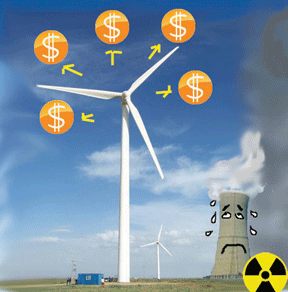 protecting the Earth’s climate—and both those views
  are wrong.
Those who state as fact that rejecting (more precisely, declining to bail out) nuclear energy would make carbon reduction much harder are in good company, but are mistaken.
Nuclear power’s potential role in the global climate challenge
If the nuclear one-tenth of global electricity generation displaced an average mix of fossil-fueled generation and nothing else, it would offset 4% of fossil-fuel CO2 emissions. So in an era of urgent climate concern, should nuclear power continue, shrink, or expand? Should its successive previous rationales—replacing insecure oil, then replacing dirty coal, then fighting global poverty—now add a fourth one, protecting climate?
Six months ago, a report by the International Energy Agency claimed that not sustaining and even expanding nuclear power would make climate solutions “drastically harder and more costly.” To check that claim, we must compare nuclear power with other potential climate solutions. What criteria should we use? Here I’ll use only two—cost and speed—because if nuclear power has no business case or takes too long, we need not address its other merits or drawbacks.
How should we compare different ways to provide electrical services in a carbon-constrained world? Our society built coal-fired power plants by counting cost but not carbon. Nuclear advocates defend their preference by counting carbon but not cost. But to protect the climate, we must save the most carbon at the least cost and in the least time, counting all three variables—carbon and cost and time. Costly options save less carbon per dollar than cheaper options. Slow options save less carbon per year than faster options. Thus even a low- or no-carbon option that is too costly or too slow will reduce and retard achievable climate protection. Being carbon-free does not establish climate-effectiveness.
Most analysts ignore common-sense comparisons of both cost and speed. The result is akin to arguing that since people are hungry, hunger is urgent, and caviar and rice are both food, therefore both are vital to reducing hunger. Since in reality money and time are both limited, our priorities in feeding people or in providing energy services must be informed by relative cost and speed. Lower cost saves more carbon per dollar. Faster deployment saves more carbon per year. We need both.
The bedrock economic principle of “opportunity cost” means you can’t spend the same money on two different things at the same time. Each purchase foregoes others. Buying nuclear power displaces buying some mixture of fossil-fueled generation, renewable generation, and efficient use. Nuclear owners strive to beat coal and gas while their allies often disparage or suppress renewables. Yet most US nuclear plants are uneconomic just to run, so many are closing. To keep milking those old assets instead, their powerful owners seek and often get multi-billion-dollar bailouts from malleable state legislatures for about a tenth of the nuclear fleet so far, postponing the economic reckoning by shooting the market messenger……..
Costs of new nuclear power vs. competing options
On 7 November 2019, the eminent 170-year-old financial house Lazard published its 13th annual snapshot of relative 2019-$ prices for different ways to generate a megawatt-hour of electricity………. Lazard’s comparison between new electricity resources is stark:
Nuclear power: $118–192/MWh (of which $29 is typical operating cost)
Coal power: $66–132/MWh (of which $33 is typical operating cost)
Combined-cycle gas power: $44–68/MWh
Utility-scale solar power: $32–42/MWh
Onshore windpower: $28–54/MWh………
The other preeminent data sources—Bloomberg New Energy Finance, Lawrence Berkeley National Lab, National Renewable Energy Lab—show market prices for renewables broadly similar to Lazard’s,though BNEF says new nuclear power ranges from Lazard’s high value to nearly twice that big. Either way, new reactors are many-fold out of the money, with no material relief in prospect from any new technology, size, or fuel cycle. Nuclear costs are also rising while renewable costs keep falling. New nuclear plants will save many-fold less carbon per dollar than competing carbon-free resources, in proportion to their relative costs. And new reactors’ expected performance must be tempered by historical experience: of the 259 power reactors ordered in the US, by mid-2017 only 28 units or 11% had been built, were still competitive in their regional markets, and hadn’t suffered at least one outage lasting at least a year. That high dry-hole risk reinforces capital markets’ skepticism.
Should existing nuclear plants keep operating?
Today’s hot question, though, is not about new US reactors, which investors shun, but about the 96 existing reactors, already averaging about a decade beyond their nominal original design life. Most now cost more to run—including major repairs that trend upward with age—than their output can earn. They also cost more just to run than providing the same services by building and operating new renewables, or by using electricity more efficiently… [detailed description and graph here compares prices for the past 15 years]……..
Now compare US nuclear plants’ average operating cost excluding all original construction cost. Average nuclear operations, the small magenta triangles, now cost more than new modern renewables, with or without their temporary subsidies.
During two recent three-year periods, the magenta horizontal bars reported by the Nuclear Energy Institute [graph on original] show that those average nuclear operating costs by quartile fell as the worst reactors were closed—but renewable prices fell even faster. Nuclear operating costs will be hard to cut much further in reactors averaging four decades old, but renewable prices promise strong further declines for decades to come. International nuclear operating costs tend to be even higher.
These operating-cost data reveal an important climate opportunity. Operating cost (opex) exceeds $40/MWh for the costlier-to-run half of the 96 US power reactors, or $50 for the costliest quartile. Owners demand big new subsidies to keep running these money-losing plants. Yet customer efficiency costs utilities only $20–30/MWh on average—less if they shop carefully. Therefore closing a top-quartile-cost nuclear plant and buying efficiency instead, as utilities could volunteer or regulators require, would save considerably more carbon than continuing to run the nuclear plant. Some modern renewables too can now rival efficiency’s cost and could compete for that opportunity.
Thus, while we close coal plants to save carbon directly, we should also close distressed nuclear plants and reinvest their large saved operating cost in cheaper options to save carbon indirectly. These two climate-protecting steps are not alternatives; they are complements.
Replacing a closed nuclear plant with efficiency or renewables empirically takes only 1–3 years ……..
Nuclear plants take many years to build, typically around a decade, while renewable projects can take a year or less—even months or weeks. Further, national nuclear power programs need three times as much lead time for institutional preparations as modern renewables need. For both reasons, renewables can start saving carbon many years sooner. Both project-level and program-level nuclear slowness incur a big carbon penalty. Being both slower and costlier than its modern competitors makes nuclear power doubly unhelpful for protecting the climate. ……….
Sustaining uneconomic reactors would not only divert public funding from more climate-effective competitors but also constrain their sales and degrade the competitive markets where they thrive. Slowing and blocking the fastest and cheapest climate solutions harms climate protection. …..
How high can US nuclear subsidies go?
Meanwhile, back in the United States, the climate-effectiveness of continued nuclear operations is not discussed; the conversation focuses solely on carbon, not on cost or time. Indeed, the industry’s immense lobbying power has now hatched a brazen new way to make taxpayers or customers pay for existing nuclear plants for a seventh time, and disadvantage their most potent supply-side competitor (modern renewable power), and reduce and retard climate protection while claiming to increase it. Rarely have so many been so deceived so thoroughly, for so long, at such cost…………
|
While some nuclear advocates favor carbon pricing (which would comparably advantage nuclear power, renewables, and efficiency over gas-fired power), many do not, presumably because the same utilities often run both nuclear and fossil-fueled plants. Nuclear advocates must awkwardly straddle the need to oppose fossil-fueled generation when seeking supposedly “green” state subsidies while cozying up to fossil-fueled generation at the federal level, where the Secretary of Energy wants to bail out both nuclear and coal plants. In sum, the nuclear industry seeks its own sales arrangements protected from competition, its own prices determined by political processes rather than markets, and diminished opportunities for its carbon-free competitors to express their value, reach their customers, and discover their own prices. This could be good for compliant legislators’ campaign contributions, but hardly in the national interest or helpful for climate protection. Such anti-market monkeybusiness cannot indefinitely forestall the victory of cheaper competitors, but it can delay and diminish climate protection while transferring tens of billions of unearned dollars from taxpayers and customers to nuclear owners. That would save less carbon, more slowly, than letting the best buys win, yet some politicians fervently favoring climate protection mistakenly endorse it, and most journalists reinforce their misconception. Citizens who care about climate or markets or both should therefore pay attention not only to carbon but not also to cost and time—and should vigorously defend markets’ ability to choose climate solutions that can save the most carbon per dollar and per year. Doing otherwise makes climate change worse than it could and should have been, stifles economic competitiveness and innovation, and suppresses market competition. That these errors are often bipartisan does not excuse them. Our best climate strategy would be to start taking economics seriously https://www.forbes.com/sites/amorylovins/2019/11/18/does-nuclear-power-slow-or-speed-climate-change/#5b47c988506b |
|
No comments yet.
1 This Month

of the week – Shut Down Drone Warfare!


Tell the Ukrainian Government to Drop Prosecution of Peace Activist Yurii Sheliazhenko

Petition to revoke the licensing of the Near Surface Nuclear Disposal Facility (NSDF) at Chalk River. https://www.ourcommons.ca/petitions/en/Petition/Details?Petition=e-7247
To see nuclear-related stories in greater depth and intensity – go to https://nuclearinformation.wordpress.com
-
Archives
- April 2026 (114)
- March 2026 (251)
- February 2026 (268)
- January 2026 (308)
- December 2025 (358)
- November 2025 (359)
- October 2025 (376)
- September 2025 (257)
- August 2025 (319)
- July 2025 (230)
- June 2025 (348)
- May 2025 (261)
-
Categories
- 1
- 1 NUCLEAR ISSUES
- business and costs
- climate change
- culture and arts
- ENERGY
- environment
- health
- history
- indigenous issues
- Legal
- marketing of nuclear
- media
- opposition to nuclear
- PERSONAL STORIES
- politics
- politics international
- Religion and ethics
- safety
- secrets,lies and civil liberties
- spinbuster
- technology
- Uranium
- wastes
- weapons and war
- Women
- 2 WORLD
- ACTION
- AFRICA
- Atrocities
- AUSTRALIA
- Christina's notes
- Christina's themes
- culture and arts
- Events
- Fuk 2022
- Fuk 2023
- Fukushima 2017
- Fukushima 2018
- fukushima 2019
- Fukushima 2020
- Fukushima 2021
- general
- global warming
- Humour (God we need it)
- Nuclear
- RARE EARTHS
- Reference
- resources – print
- Resources -audiovicual
- Weekly Newsletter
- World
- World Nuclear
- YouTube
-
RSS
Entries RSS
Comments RSS
 nuclear-news
Leave a comment